



Skip to content
  • Facebook
  • X
  • Linkedin
  • WhatsApp
  • YouTube
  • Associate Journalism
  • About Us
  • Privacy Policy
  • 033-46046046
  • editor@artifex.news
Artifex.News

Artifex.News

Stay Connected. Stay Informed.

  • Breaking News
  • World
  • Nation
  • Sports
  • Business
  • Science
  • Entertainment
  • Lifestyle
  • Toggle search form
  • In Jhansi, Grieving Parents Struggle To Cope With Loss After Hospital Fire
    In Jhansi, Grieving Parents Struggle To Cope With Loss After Hospital Fire Nation
  • Access Denied Sports
  • Access Denied
    Access Denied Nation
  • US Woman Handcuffed Son, Allowed Him To Be Mauled By Pitbull As Punishment: Police
    US Woman Handcuffed Son, Allowed Him To Be Mauled By Pitbull As Punishment: Police World
  • Rabada to lead strong South Africa pace attack at T20 World Cup
    Rabada to lead strong South Africa pace attack at T20 World Cup Sports
  • Kerala Assembly Elections 2026: Wildlife incursion, a vote-catcher issue in many constituencies
    Kerala Assembly Elections 2026: Wildlife incursion, a vote-catcher issue in many constituencies Nation
  • Space Wrap: A blockbuster month for India’s private sector
    Space Wrap: A blockbuster month for India’s private sector Science
  • Donald Trump agrees to new ethics rules to advance crypto bill, but hurdles remain
    Donald Trump agrees to new ethics rules to advance crypto bill, but hurdles remain World
India’s rice fields now rank among world’s top methane hotspots

India’s rice fields now rank among world’s top methane hotspots

Posted on July 19, 2026 By admin


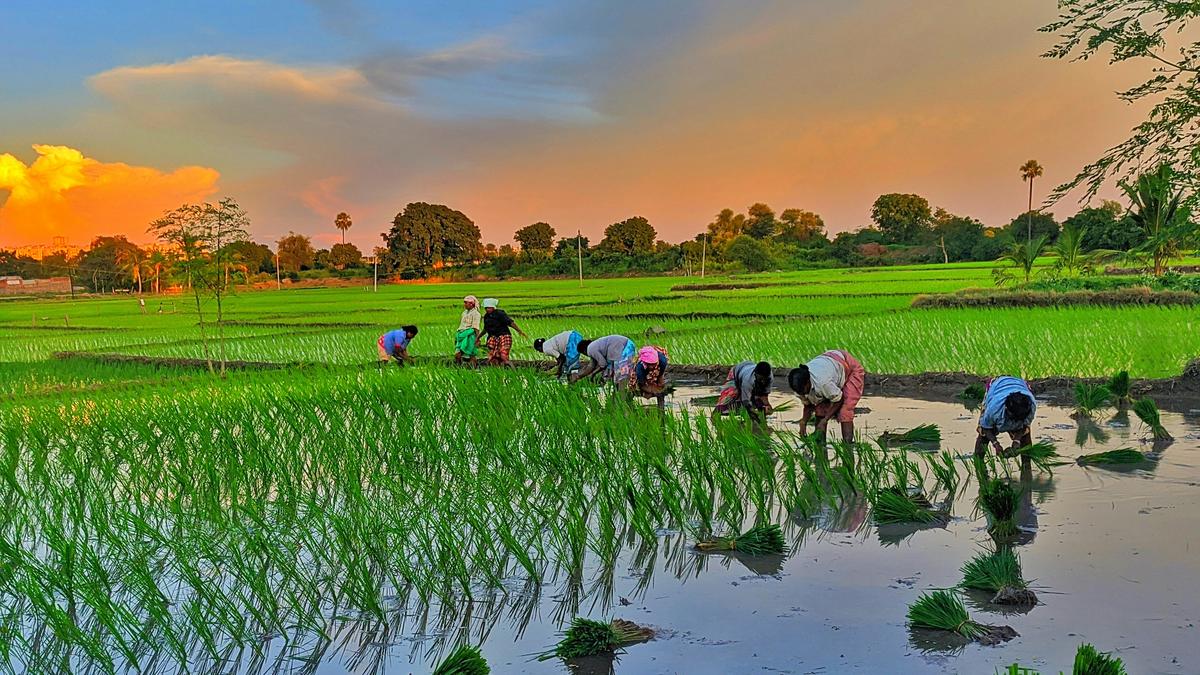
Greenhouse gas (GHG) emissions from paddy fields worldwide have doubled since the 1960s, a new study in NatureFood has found. In the most recent decade, 2011-2020, paddy fields around the world produced around 1.1 billion tonnes of carbon dioxide-equivalent (CO2-e) emissions every year — a 90.4% increase from the annual emissions between 1961 and 1980, the study reported.

Upon examining the sources contributing to the rise in emissions, the study found that about half the increase was driven by the loss of soil organic carbon. Between 1961 and 1980, paddy fields were soil organic carbon sinks, removing some 289 million tonnes of CO2-e emissions annually. However, the sink weakened over time. In the 2010s, over a third of paddy fields worldwide in fact began losing carbon from the soil.

Apart from soil organic carbon, methane from paddy fields was also a significant driver of emissions. Flooded fields develop low-oxygen conditions where methane-producing microbes thrive. And paddy fields in eastern India were among the global methane hotspots.

‘Comprehensive assessment’

“Most previous studies have focused on a single greenhouse gas, a specific management practice or a particular region,” Hanqin Tian, co-author of the study and director and institute professor, Department of Earth and Environmental Sciences, Boston College, the U.S., said.

“Our study provides a much more comprehensive assessment by integrating a global meta-analysis of more than 1,200 field experiments, process-based ecosystem modelling, and artificial intelligence approaches to quantify GHG emissions from rice cultivation worldwide.”

India tops the list of countries on rice production, delivering 154 million tonnes in 2025-26. The area under paddy cultivation has also increased by around 25% since the 1970s, and currently covers 55% of India’s rainfed harvested area. This expansion, together with continuous irrigation of fields, incorporating residues such as leftover stalks, leaves, and stubble, and increasing use of nitrogen fertilisers, also increased emissions.

Paddy fields v. Germany

Considering rice’s crucial role in India’s food security, the study underscored the need for urgent measures to reduce emissions while ensuring sustainable production.

“Our analysis indicates that a combination of improved irrigation, optimised fertiliser use, residue management, and reduced tillage could reduce global rice-related greenhouse gas emissions by about 10% by mid-century, even under a warming climate,” Dr. Tian said.

The study also projected that between 2031 and 2050, annual emissions will increase by around 26%, fuelled by global warming, erratic rainfall, and the continued intense use of agricultural inputs.

Irrigated paddy fields in India release around 3.9 million tonnes of methane every year. This is a little more than the entire annual methane emissions of Germany.

Potential and incentives

While India has not set up goals to reduce emissions from agriculture, several techniques and incentives are currently available to farmers.

The National Innovations in Climate Resilient Agriculture (NICRA) project, for example, suggests the ‘System for Rice Intensification’ technique to reduce emissions. Here, young seedlings are transplanted in a precise manner and fields are not continuously flooded during irrigation. Direct-seeded rice, where rice seeds are directly sown in fields as opposed to the traditional method of cultivation involving the transplantation of seedlings into a flooded field, is also encouraged. Drip Irrigation and the alternate wetting and drying technique — where the fields are only intermittently flooded — are also promoted.

However, they don’t address the fact that the emission reduction potentials vary widely between India’s States. Apart from large-scale demonstrations of these techniques across districts under NICRA, several country and state-level policies, like the National Mission for Sustainable Agriculture and financial incentives provided by states like Punjab and Haryana, aim to encourage the adoption of DSR and SRI. However, the reluctance to change from traditional practices, along with issues such as labour shortages, lack of technical knowledge, and changes in rainfall patterns, constrain farmers’ decisions.

Prakashan Chellattan Veettil, senior agricultural and behavioural economist at the International Rice Research Institute (IRRI), New Delhi, said a regional approach that considers the topography, soil, and irrigation conditions plus the farmers’ requirements is crucial.

Dr. Veettil is the IRRI lead in the KERA-AWD project, which is working to establish processes to cultivate low-emission rice systems in Kerala’s low-land (Thrissur kole lands) and mid-land (Palakkad Malampuzha canal) regions.

“Using a multi-pronged approach, which includes increasing soil organic carbon, understanding the hydrology and aligned irrigation systems, agricultural inputs, residue management protocols, soil microbes and farmer preferences, we are working on identifying low-emission packages, where a combination of these factors can help reduce emissions for various paddy varieties,” Dr. Veettil said.

He shared the example of lime that farmers use to neutralise the acidic soil that prevails in the State.

“We have observed that replacing a portion of the lime with [a material called] phosphogypsum has a positive impact on emissions in the subsoil surface,” he added. “We are also experimenting with different formulations and application methods for nitrogen fertilisers.”

Expansion of paddy

Ashwini Chhatre, associate professor of public policy and executive director at the Bharti Institute of Public Policy, Hyderabad, said that depending on a region’s suitability for paddy, farmers should have support to opt for low-emission techniques or grow alternative local crop varieties. In his research, Dr. Chhatre found that despite facing climate-related losses and price variations, farmers still dedicate large areas of their farmlands to paddy.

“As a general strategy, there is no way forward without crop diversification,” he said. “Despite the agro-climatic diversity in the country, paddy has the largest area under cultivation at the cost of regional indigenous crops.”

Dr. Chhatre said several traditional millet varieties in Odisha have been replaced with high-yielding paddy. Reports indicate the State’s paddy fields have contributed the most to its greenhouse gas emissions.

Through initiatives like the Odisha Agriculture Drought Mitigation Programme with IRRI, and the Shree Anna Abhiyan-Odisha Millet Mission, the State government is taking steps to reduce paddy’s environmental footprint and encourage crop diversity.

“An integrated intervention for alternative grains is crucial,” Dr. Chhatre said, adding that it “must include” extension and training services, involve self-help groups, and provide procurement support. “While encouraging sustainable paddy cultivation, policies must also prevent further expansion of paddy fields to curb emissions.”

Sharmila Vaidyanathan is an independent journalist from Bengaluru.


Source link

Science

Post navigation

Previous Post: Doctors assault case: Bombay High Court cancels bail of Shiv Sena corporator
Next Post: Nigerian children pay the price for Iran war as malnutrition, poverty surge

Related Posts

  • Study reveals how new species evolve without geographic barriers 
    Study reveals how new species evolve without geographic barriers  Science
  • LPG crisis: India needs to electrify heat and win thermal independence
    LPG crisis: India needs to electrify heat and win thermal independence Science
  • Watch: Explained: All about India’s new nuclear energy bill
    Watch: Explained: All about India’s new nuclear energy bill Science
  • How an Indian start-up sparked a global girls’ space mission
    How an Indian start-up sparked a global girls’ space mission Science
  • India selects two astronaut-designates for upcoming Axiom-4 mission to International Space Station
    India selects two astronaut-designates for upcoming Axiom-4 mission to International Space Station Science
  • Crown shyness: let our realms stay apart
    Crown shyness: let our realms stay apart Science

More Related Articles

Aditya-L1 mission to mark 25th flight of PSLV-XL variant Aditya-L1 mission to mark 25th flight of PSLV-XL variant Science
How dual-use satellites are blurring the lines of modern space war How dual-use satellites are blurring the lines of modern space war Science
SpaceX’s xAI to compete in Pentagon contest for autonomous drone technology SpaceX’s xAI to compete in Pentagon contest for autonomous drone technology Science
Krishna Ella, of Bharat Biotech, conferred INSA Fellowship Krishna Ella, of Bharat Biotech, conferred INSA Fellowship Science
‘Virtual magnet’ claims reveal why EVs need their rare-earth magnets ‘Virtual magnet’ claims reveal why EVs need their rare-earth magnets Science
How are astronauts trained? – The Hindu How are astronauts trained? – The Hindu Science
SiteLock

Archives

  • September 2026
  • August 2026
  • July 2026
  • June 2026
  • May 2026
  • April 2026
  • March 2026
  • February 2026
  • January 2026
  • December 2025
  • November 2025
  • October 2025
  • September 2025
  • August 2025
  • July 2025
  • June 2025
  • May 2025
  • April 2025
  • March 2025
  • February 2025
  • January 2025
  • December 2024
  • November 2024
  • October 2024
  • September 2024
  • August 2024
  • July 2024
  • June 2024
  • May 2024
  • April 2024
  • March 2024
  • February 2024
  • January 2024
  • December 2023
  • November 2023
  • October 2023
  • September 2023
  • August 2023
  • July 2023
  • June 2023
  • May 2023
  • April 2023
  • March 2023
  • February 2023
  • January 2023
  • December 2022
  • November 2022
  • October 2022
  • September 2022
  • August 2022
  • July 2022
  • June 2022
  • May 2022

Categories

  • Business
  • Nation
  • Science
  • Sports
  • World

Recent Posts

  • Free mega medical camp promotes Health and Legal awareness in Gajuwaka
  • After October 1, only smaller 5 or 10 kg LPG refills await non-eKYC households
  • Pakistan forces kill five terrorists, rescue 23 abductees in Balochistan
  • Asian Games 2026: Smriti Mandhana surpasses Suzie Bates to become women’s T20I cricket’s leading run-scorer
  • Hope flows anew with revival of Andhra’s Veligonda project

Recent Comments

  1. Glennalbub on UP Teacher Who Asked Students To Slap Muslim Classmate
  2. PhilipLog on UP Teacher Who Asked Students To Slap Muslim Classmate
  3. DennisDum on UP Teacher Who Asked Students To Slap Muslim Classmate
  4. DonaldFrosy on UP Teacher Who Asked Students To Slap Muslim Classmate
  5. DonaldFrosy on UP Teacher Who Asked Students To Slap Muslim Classmate
  • U.P. CM Yogi all praise for Budget; Opposition says it ‘fails the needy’
    U.P. CM Yogi all praise for Budget; Opposition says it ‘fails the needy’ Business
  • Access Denied
    Access Denied Nation
  • Canada says no place for aggression, hate, intimidation in country amid online threats to Hindus
    Canada says no place for aggression, hate, intimidation in country amid online threats to Hindus World
  • German-Israeli woman abducted by Hamas at music festival is dead, Israel says
    German-Israeli woman abducted by Hamas at music festival is dead, Israel says World
  • The Montreal Protocol turned a scientific hypothesis into a landmark environmental treaty. See how well you know its story
    The Montreal Protocol turned a scientific hypothesis into a landmark environmental treaty. See how well you know its story World
  • Myanmar military recaptures 2 strategic border towns from ethnic militias
    Myanmar military recaptures 2 strategic border towns from ethnic militias World
  • Access Denied Sports
  • ‘Shouldn’t even be in the Gs anymore’: Trump says he won’t attend G20 Summit in South Africa
    ‘Shouldn’t even be in the Gs anymore’: Trump says he won’t attend G20 Summit in South Africa World

Editor-in-Chief:
Mohammad Ariff,
MSW, MAJMC, BSW, DTL, CTS, CNM, CCR, CAL, RSL, ASOC.
editor@artifex.news

Associate Editors:
1. Zenellis R. Tuba,
zenelis@artifex.news
2. Haris Daniyel
daniyel@artifex.news

Photograher:
Rohan Das
rohan@artifex.news

Artifex.News offers Online Paid Internships to college students from India and Abroad. Interns will get a PRESS CARD and other online offers.
Send your CV (Subjectline: Paid Internship) to internship@artifex.news

Links:
Associate Journalism
About Us
Privacy Policy

News Links:
Breaking News
World
Nation
Sports
Business
Entertainment
Lifestyle

Registered Office:
72/A, Elliot Road, Kolkata - 700016
Tel: 033-22277777, 033-22172217
Email: office@artifex.news

Editorial Office / News Desk:
No. 13, Mezzanine Floor, Esplanade Metro Rail Station,
12 J. L. Nehru Road, Kolkata - 700069.
(Entry from Gate No. 5)
Tel: 033-46011099, 033-46046046
Email: editor@artifex.news

Copyright © 2023 Artifex.News Newsportal designed by Artifex Infotech.