



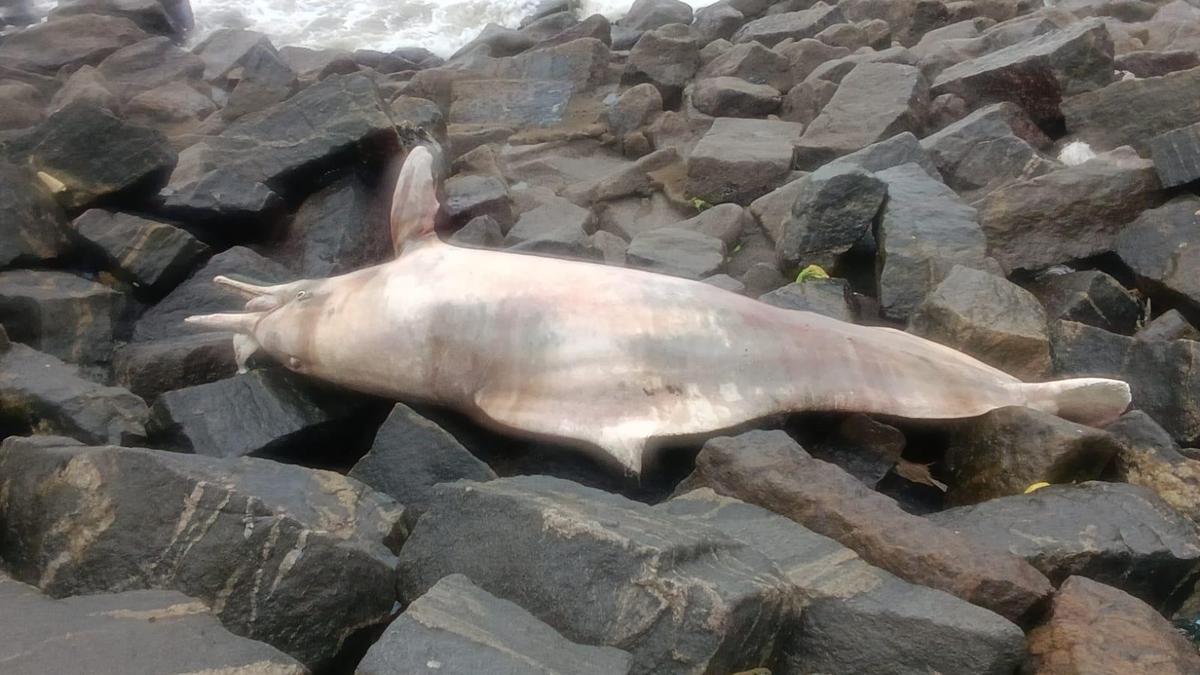
Around noon on July 4, 2026, local residents found an Indian Ocean humpback dolphin (Sousa plumbea) and an Indo-Pacific finless porpoise (Neophocaena phocaenoides) dead at separate locations on the Kozhikode beach in Kerala. Alerted by the public, officials recovered the carcasses for a post-mortem examination. The necropsy of the roughly 200-kg dolphin, an endangered species on the IUCN Red List, revealed something alarming. Its stomach was empty, while most of its organs were functioning normally, but a nearly 2 kg plastic fishing net was found tightly lodged in its oesophagus, disrupting normal feeding and leading to its death.
“It might have accidentally ingested the net while feeding on marine prey, but was unable to regurgitate it. We believe the net was originally in the stomach. As fermentation produced gas, the plastic twisted into a ball under pressure and was forced into the oesophagus,” says K.M. Manojlal, chief veterinary officer, District Veterinary Centre, Kozhikode, who conducted the necropsy.
Workers and officials prepare to conduct the necropsy of the Indian Ocean humpback dolphin that washed ashore in Kozhikode on July 4, 2026.
| Photo Credit:
K. RAGESH
The post-mortem of the approximately 80-kg Indo-Pacific finless porpoise suggested it most likely died of suffocation, probably following an accident such as an entanglement in a fishing net.
Human-induced stress on marine ecosystem
According to experts, the recent marine mammal deaths underscore the growing impact of human-induced pressures on the marine ecosystem along India’s coastline, with plastic pollution, ‘ghost nets’, and entanglement in fishing gear emerging as major threats.
Marine mammal strandings have remained relatively high along the Indian coastline in recent years. According to data from the Central Marine Fisheries Research Institute (CMFRI), Kochi, 171 strandings were recorded in 2024 and 161 involving 14 species in 2025. Among the States, Goa recorded the highest number of strandings in both years, 87 in 2024 and 113 in 2025, followed by Kerala (29 and 15, respectively). Tamil Nadu recorded 14 strandings in 2024, while Maharashtra reported 11 in 2025.
A portion of the plastic net retrieved from the dolphin’s oesophagus
| Video Credit:
special arrangement
Scientists say the threat is especially high for coastal species such as the Indian Ocean humpback dolphin, which inhabits shallow waters less than 20 metres deep, usually within a few kilometres of the shore, bringing it into direct contact with human activities. Although strandings have multiple causes, “anthropogenic activities” are considered the primary driver.
Indian Ocean humpback dolphins accounted for 129 strandings during the two-year period. Their numbers rose from 47 in 2024 to 82 in 2025. Goa accounted for the majority of these strandings, with 33 in 2024 and 68 in 2025, followed by Kerala (5 and 8, respectively) and Maharashtra (3 and 4).
The Indo-Pacific finless porpoise was the second most commonly stranded species, with 54 strandings in 2024 and 44 in 2025.

Percentage of Indian Ocean humpback dolphins in total marine mammal strandings along Indias coastline in 2024 and 2025. Data shared by Central Marine Fisheries Research Institute (CMFRI), Kochi
For the past two years, CMFRI has recorded and assessed marine mammal strandings along the Indian coastline through its extensive network. However, officials acknowledge that the actual figures could be higher as many go unnoticed.
Ratheesh Kumar Raveendran, senior scientist, Marine Biodiversity and Environment Management Division, CMFRI, says plastic pollution is among the biggest threats to marine biodiversity. “Millions of tonnes of plastic enter the oceans each year, where they persist for decades, breaking into smaller fragments. Marine mammals often mistake plastic for food or ingest it accidentally while feeding, including when taking prey entangled in fishing gear. Plastic ingestion can cause digestive blockages, internal injuries, starvation and chemical toxicity,” he says.
Mr. Raveendran adds: “’Ghost nets’ (abandoned, lost or discarded fishing gear) are another growing concern. Made of durable synthetic materials, they persist in the ocean for years, indiscriminately trapping dolphins, whales, sea turtles, dugongs, sharks, rays and fish. Entanglement can cause severe injuries, restrict movement and breathing, lead to drowning, or result in prolonged starvation and death,” he notes.
Divya Panicker, a guest investigator at Woods Hole Oceanographic Institution (WHOI), suggests the need for science-based, location-specific conservation measures to protect coastal dolphins.

“Authorities should conduct post-mortems and release the findings to help agencies and civil society direct conservation efforts. Such an approach will help conserve the species while supporting local livelihoods. The public can contribute by avoiding single-use plastics, especially soft plastics, and participating in beach clean-ups, benefiting dolphins and other marine life,” says Ms. Panicker.
Fishers, meanwhile, say dolphins often tear fishing nets while attempting to access fish caught in them.
Kerala Forest department officials have said no comprehensive data on marine mammal strandings along the State’s coastline is available.
Published – July 10, 2026 10:37 am IST