





In a paper published in the Journal of Statistical Physics in 1980, the American physicist Paul Benioff described what is now called the quantum Turing machine: a model of a computer that operated according to the laws of quantum mechanics.
Quantum mechanics is the branch of physics that studies the behaviour of matter and light at atomic and subatomic scales. At these scales, the certainty associated with classical mechanics disappears. Instead of pinpointing a particle’s properties, scientists can only make educated guesses.
This uncertainty may sound daunting. But Benioff — and other scientists like the British physicist David Deutsch, American physicist Richard Feynman, and American computer scientist Peter Shor — suggested ways to harness it for computation. Their work eventually became the foundation for one of the contemporary world’s most ambitious technological pursuits, one for which the Government of India sanctioned over Rs 6,000 crore in April 2023.
By 2031, the National Quantum Mission (NQM) — whose objectives include building “intermediate-scale quantum computers” — is expected to “make India one of the leading nations in the development of Quantum Technologies & Applications,” according to the Department of Science & Technology website.
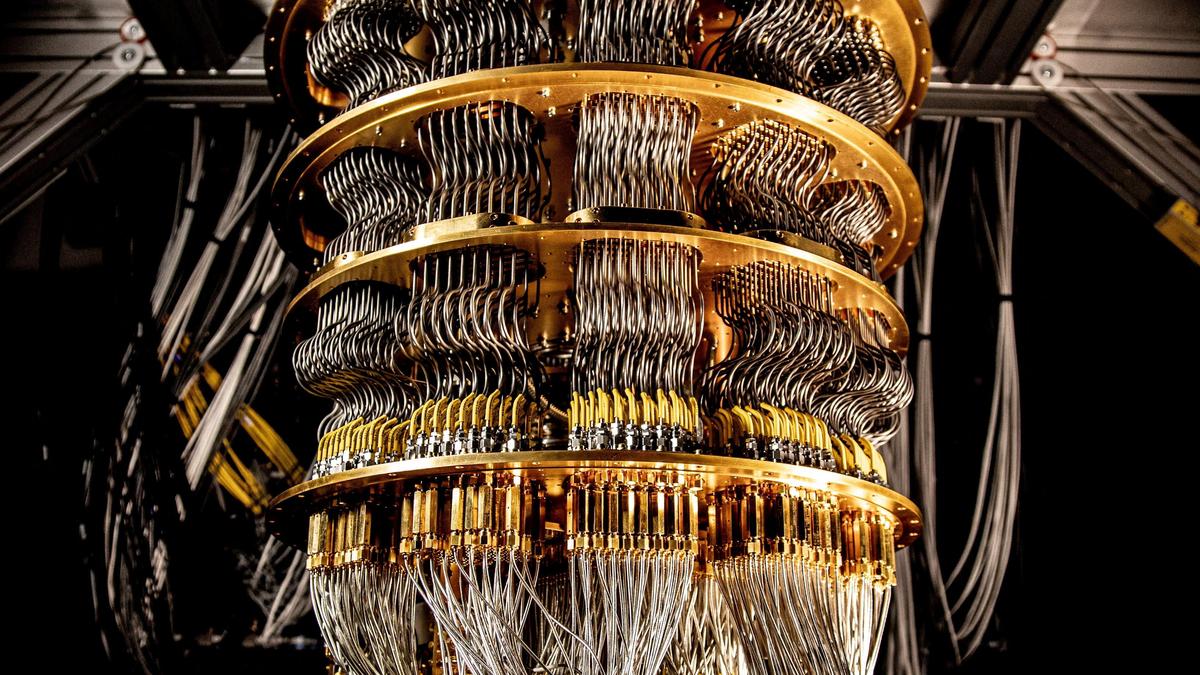
Google Quantum AI’s Hartmut Neven (left) and Anthony Megrant examine a cryostat refrigerator for cooling quantum computing chips, November 25, 2024.
| Photo Credit:
Reuters
Beyond hype
Beyond nationalistic pride, the possibilities of a quantum computer are tantalising. Among other things, quantum computers are expected to herald a new era in how we simulate molecules and their interactions, secure our digital lives, optimise complex logistical networks, and model natural phenomena that overwhelm even our most powerful supercomputers.
However, those in the thick of it warn against hype. “It is worth treating claims you hear in the field with scepticism,” Jason Freidenfelds, spokesperson for Google Quantum AI, the tech giant’s quantum computing research division, said. “To date no one has experimentally demonstrated a commercially relevant problem that can be solved by today’s quantum computers that could not be solved by a classical supercomputer.”
Indian Institute of Science physicist Arindam Ghosh, who chairs the Karnataka Government’s Quantum Task Force, agreed. “At least at this point of time, there is no reason to believe that the classical computing that we know as of today is going to go away in any form,” he said. Dr. Ghosh also led the vision document for the NQM’s Quantum Materials and Devices vertical.
At the heart of this gap between promise and performance is hardware.

Building a quantum computer
The processors of classical computers are made of billions of tiny devices called transistors. Made of silicon, these can amplify or block electrical signals. If a transistor allows current to pass through it, it is said to be in the ON state (represented by the number 1); conversely, if it blocks electrical signals from passing, it is said to be in the OFF state (represented by 0).
These states of a transistor form the fundamental unit of data in classical computers: a bit.
Quantum computers replace the bit with a qubit (‘quantum bit’). Unlike a bit, which can be either in the 0 or 1 states at any point of time, a qubit can exist in multiple states simultaneously: 0, 1, and any of the infinite states between them. This is like a coin tossed in the air; it is both heads and tails until it falls on the ground. This property is called superposition. It allows qubits to represent much larger amounts of information as compared with classical bits.
Further, thanks to the laws of quantum mechanics, qubits can also be entangled. That is, their states can become inexorably linked regardless of the physical distance between them. Any action or measurement made on one of the qubits will then affect the state of all other entangled qubits.
This makes quantum computers “massively parallel versions of a classical machine,” explained IIT-M quantum computing researcher Prabhu Rajagopal, the current Director-In-Charge of IIT-M’s Zanzibar campus.
Superposition and entanglement massively increase the speed of processing — especially for tasks that require a machine to work with large amounts of data and compare many different solutions of a problem. Examples of such tasks include “sorting algorithms and search algorithms,” Dr. Ghosh suggested.
Sorting algorithms provide instructions on how to rearrange a group of items into a specific order; for example, an online store that organises products by price in real-time. Search algorithms dictate how to find specific data points from a large set of data (for example, finding which two metals will form an alloy with required properties from all possible combinations of metals).
Depending on their origin, qubits can be of different types. Superconducting qubits are made from a device called the Josephson junction. It involves two superconductors – materials that allow current to flow through them with almost negligible resistance – separated by a thin barrier. Google’s quantum processor Willow, launched in December 2024, is an example.

Other ways of fabricating qubits include using tiny particles of semiconductors like silicon, gallium arsenide, or germanium (called quantum dot qubits); trapping and manipulating individual ions (trapped ion qubits); manipulating particles of light (photonic qubits); and using the angular momentum of nuclei within molecules (nuclear magnetic resonance, or NMR, qubits).
Perfect machine, imperfect parts
In 1998, two groups of researchers – one from Oxford University, and another consisting of scientists from IBM, University of California Berkeley, Stanford University, and the Massachusetts Institute of Technology – unveiled for the first time a quantum computer consisting of two NMR qubits. On that computer, they solved the Deutsch-Jozsa problem, demonstrating for the first time that quantum computers can solve certain problems dramatically faster than classical computers.
The Deutsch-Jozsa problem asks a computer to determine whether a mathematical function is constant or balanced. Functions are rules that take an input and process it to produce a corresponding output. A constant function would return the same value for all possible inputs. A balanced function, on the other hand, would return different outputs for different inputs. Although the problem was of little practical use, the milestone was important. A quantum computer had been realised.
Since then, tech companies have raced to create increasingly larger processors, with California-based Atom Computing having reported in 2023 a quantum computer with over 1,000 qubits. Today’s quantum computers have outperformed classical computers on a benchmark, successfully ran algorithms that would take classical computers impractically long amounts of time, and have computed the structures of some small molecules.

Yet they are still years away from being practically useful, all researchers this reporter spoke to agreed. Part of the challenge is to make processors with more qubits. The other, more important part is to deal with “noise and errors,” Dr. Rajagopal, the IIT-M quantum computing researcher, pointed out. This is why California Institute of Technology quantum computing researcher John Preskill called contemporary quantum processors “Noisy Intermediate-Scale Quantum Computing”.
Qubits are incredibly sensitive and short-lived. Any interaction with the environment – including with particles of light – lead to qubits losing their quantum states, a phenomenon called decoherence. To prevent this, qubits are isolated from the environment and cooled to temperatures near absolute zero (-273 °C).
Further, the mechanisms by which qubits are controlled and manipulated, like lasers or microwave pulses, are themselves rarely perfect. Together, these lead to quantum processors being prone to noise, and, eventually, errors.
Contemporary quantum processors have error rates of 1% to 0.1%. That is, one out of every 100 to 1000 quantum operations results in an error. In contrast, classical computers make errors at the rate of one out of every quintillion (10 followed by 17 zeroes) operations. In fact, some researchers, like University of Copenhagen’s Michael Kastoryano, have suggested that error rates of quantum processors are unlikely to decrease beyond one out of 1,00,00,000 operations.
Then the challenge facing quantum computing is, in the words of Quanta Magazine, “how do you construct a perfect machine out of imperfect parts?”
Fixing errors
The answer: error correction. This is a set of techniques that force several qubits to work together as a single “logical qubit”. A computer can then use several such logical qubits to perform calculations.
There is, however, one problem. Merely adding more qubits doesn’t help. If each qubit is prone to errors, adding more qubits could worsen the performance of logical qubits. But if scientists can push the error rate for individual qubits below a certain threshold, we get a system whose error rate drops exponentially with each additional qubit.
That is exactly what Google Quantum AI researchers showed for the first time in a 2024 Naturepaper with their processor Willow. “Each time we increase our encoded qubits from a 3×3 to a 5×5 to a 7×7 lattice of physical qubits, the encoded error rate is suppressed by a factor of two,” team members Michael Newman and Kevin Satzinger wrote in a 2024 blog post explaining the study. “This culminates in a logical qubit whose lifetime is more than twice of its best constituent physical qubit,” they added.
With that, Google is working on its next target: “a long-lived logical, or error-corrected, qubit,” spokesperson Freidenfelds said. “We expect the first useful quantum computing applications within the next five years.”
Ultimately, Google plans to tile thousands of these logical qubits together to create a “fully fault-tolerant quantum computer,” he added. IBM expects to debut theirs by 2029.

‘Everything will change’
If these projections are correct, a practically useful quantum computer is practically knocking at our doors. The anticipation among scientists is palpable. “Everything would change” is their common refrain.
“The day we get an industrial-grade quantum computer, everything in this field of climate modelling [will] change,” Manmeet Singh, climate modeller and assistant professor at the Western Kentucky University, said. Dr. Ghosh and Dr. Rajagopal echoed his excitement, albeit about the role of quantum computers in materials modelling and cryptography.
While it may take some time for quantum computers to make their way to laptops, if at all, “it could cause a technological revolution well before that,” Dr. Ghosh said.
Sayantan Datta is an independent science journalist and a faculty member at Alliance University, Bengaluru.