




Skip to content
  • Facebook
  • X
  • Linkedin
  • WhatsApp
  • YouTube
  • Associate Journalism
  • About Us
  • Privacy Policy
  • 033-46046046
  • editor@artifex.news
Artifex.News

Artifex.News

Stay Connected. Stay Informed.

  • Breaking News
  • World
  • Nation
  • Sports
  • Business
  • Science
  • Entertainment
  • Lifestyle
  • Toggle search form
  • Access Denied World
  • Sri Lanka Tamil Parties Plan To Field Presidential Candidate From Community
    Sri Lanka Tamil Parties Plan To Field Presidential Candidate From Community World
  • Access Denied World
  • The Science Quiz: On firestorms
    The Science Quiz: On firestorms Science
  • Budget 2024, Industry Reactions LIVE: Business
  • Rupee slumps 43 paise to close at 88.26 against U.S. dollar
    Rupee slumps 43 paise to close at 88.26 against U.S. dollar Business
  • Access Denied
    Access Denied Nation
  • Ajit Jogi’s Party Releases 2nd List Of 11 Candidates For Chhattisgarh Polls
    Ajit Jogi’s Party Releases 2nd List Of 11 Candidates For Chhattisgarh Polls Nation
Hotter Kalahari desert may stop hornbills breeding by 2027

Hotter Kalahari desert may stop hornbills breeding by 2027

Posted on August 1, 2024 By admin


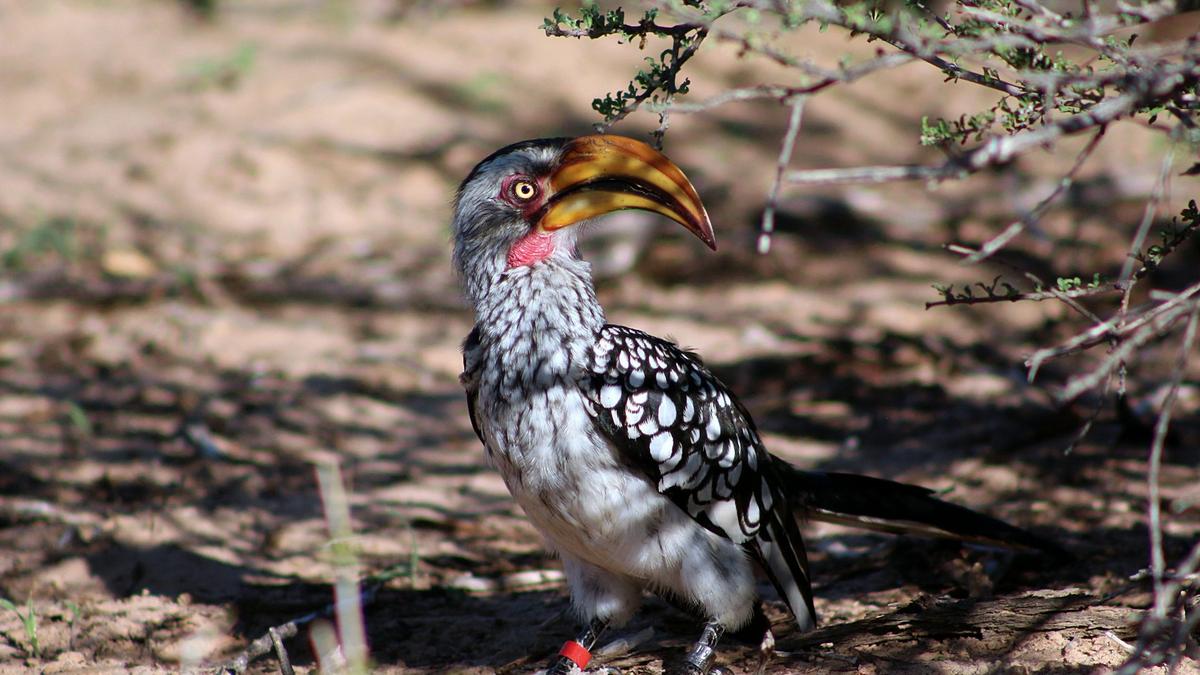
Southern yellow-billed hornbills struggle to breed at high temperatures.
| Photo Credit: Nicholas B. Pattinson, Special arrangement

Rapid climate change has the potential to strongly influence the physiology, behaviour and breeding success of animals. Research is showing that increasing temperatures, for instance, are having negative effects on animals. These range from mass die-off events during heat waves to less obvious problems like difficulty finding food.

For birds in arid zones, rising temperatures pose a significant problem. Birds in these dry zones usually breed in response to rainfall, which often occurs during the hottest time of the year. And birds are mostly active during the day, when they are exposed to the sun’s heat. This is when their vital processes for reproduction take place – such as territorial defence, courtship, finding food for their young and attending the nest.

Research suggests that high temperatures over a few days or weeks can have negative effects on foraging and body mass. At the scale of one or two breeding seasons, these effects have a negative impact on breeding performance. This can be through reducing the condition of offspring or the probability that young birds will survive to adulthood and breed.

The longer-term effects of responses to high temperatures – over decades – are less well-known.

Our recent research aimed to help bridge this gap in knowledge. We assessed the effects of air temperature and drought on the breeding output of southern yellow-billed hornbills (Tockus leucomelas) in southern Africa’s Kalahari Desert over a decade period, from 2008 to 2019.

We found that the breeding output of our study population collapsed during the monitoring period and was strongly correlated with temperature and rainfall. In the Kalahari, air temperatures have already risen more than 2°C in a few decades. At this rate, by 2027, these birds will not breed at all at this site.

Desert temperatures and breeding birds

First we examined air temperature and rainfall data from the South African Weather Service for the Kalahari region between 1960 and 2020. The frequency and severity of drought have not changed but spring and summer average daily maximum air temperatures have been increasing. They have risen from about 34°C to well over 36°C from the mid 1990s to the present day. This equates to a warming rate of about 1°C per decade, a rate five times faster than the worldwide average of about 0.2°C per decade.

We then assessed the effects of air temperature and drought on the breeding output of a population of southern yellow-billed hornbills in the Kalahari over the decade 2008 to 2019. These birds are still common across much of central and eastern southern Africa.

The study population comprised about 25 pairs each breeding season. These hornbills nest in cavities and at our study site pairs usually made one breeding attempt per season. Their breeding strategy is unusual: the female seals herself inside the nest cavity and moults all her flight feathers. This leaves the male parent as the sole provisioner to the nest for the female parent and the chicks. A successful breeding attempt usually takes about two months, with a pair raising between one and four chicks.

Although the number of pairs at the site remained constant over the study decade, more pairs skipped breeding each year. And those which did breed did so less and less successfully, producing fewer offspring or none at all.

Comparing the first three seasons (2008-2011) of monitoring to the last three (2016-2019), the mean percentage of nest boxes occupied declined from 52% to 12%. Nest success – a breeding attempt successfully raising at least one chick – fell from 58% to 17%. Fledglings produced per breeding attempt declined from 1.1 to 0.4.

Without successful breeding, the population will not be able to persist, and will quickly become locally extinct.

We found that breeding output was negatively correlated with increasing air temperatures and the occurrence of drought within the breeding season. Breeding attempts all failed when average daily maximum air temperatures exceeded 35.7°C. And the effects of high air temperatures were present even in non-drought years.

Considering the strong negative correlation between high air temperature and breeding output, we argue that global warming has likely been the primary driver of the recent, rapid collapse in breeding success in our study population. The consequences of high air temperatures (regardless of high rainfall) and drought on the parents affect the probability of successfully fledging offspring or even attempting to breed at all.

Based on current warming trends, the 35.7°C threshold for successful breeding attempts will be exceeded for the entire hornbill breeding season by approximately 2027 at our study site.

Overall, while our study is specific to southern yellow-billed hornbills, we suggest that our findings are likely applicable to a range of species. Even for species that are unlikely to die in large numbers because of heat, climate change can drive rapid declines and potentially local extinctions.

What we can do about it

Luckily, a few mitigation strategies are still available to help prevent local and global extinctions.

In the short term, there are options such as providing water and insulated nest boxes.

Long-term, it would be necessary to preserve habitats which warm less rapidly or which can buffer the effects of climate change on biodiversity.

Even preservation of habitat won’t be enough, however, if the current rate of climate change is sustained. Recent models based on current rates of warming and what’s known about how birds handle heat are suggesting that rare and endangered species will be lost over the next century. But so will species which are currently common, such as the southern yellow-billed hornbill.

Nicholas B. Pattinson is a doctoral student at the FitzPatrick Institute of African Ornithology, University of Cape Town. This article is republished from The Conversation.


The Conversation


Source link

Science

Post navigation

Previous Post: Mexican Drug Lord El Chapo’s Son Didn’t Kidnap Fellow Gangster, Says Lawyer
Next Post: Paris Olympic Games 2024, Day 6 Live Updates: Medal Hopes In Race Walk, Shooting; Badminton Knockouts Start

Related Posts

  • Cabinet nod to ‘BioE3’ policy for innovation-driven support to research and development
    Cabinet nod to ‘BioE3’ policy for innovation-driven support to research and development Science
  • Centre amends surrogacy rules, allows couples with medical conditions to use donor gametes
    Centre amends surrogacy rules, allows couples with medical conditions to use donor gametes Science
  • The cosmological constant problem is one of the biggest crises in physics
    The cosmological constant problem is one of the biggest crises in physics Science
  • Watch | Indians are buying land on the moon… but can one ‘own’ lunar land?
    Watch | Indians are buying land on the moon… but can one ‘own’ lunar land? Science
  • What is the ‘dinosaur highway’?
    What is the ‘dinosaur highway’? Science
  • Scientists decode ancient earthquakes using quartz clocks in the earth — Sand Dikes
    Scientists decode ancient earthquakes using quartz clocks in the earth — Sand Dikes Science

More Related Articles

New scheme to triple those with access to top journals New scheme to triple those with access to top journals Science
As the lights stay on, birds are staying up past their bedtime As the lights stay on, birds are staying up past their bedtime Science
ISRO successfully carries out vacuum ignition trial of cryogenic engine ISRO successfully carries out vacuum ignition trial of cryogenic engine Science
Scientists and astronomers meet at Raman Research Institute to explore moon as vantage point for studying the Universe  Scientists and astronomers meet at Raman Research Institute to explore moon as vantage point for studying the Universe  Science
Tamil Nadu uses inexpensive method to treat rodenticide poisoning Tamil Nadu uses inexpensive method to treat rodenticide poisoning Science
What are carbon credits? – The Hindu What are carbon credits? – The Hindu Science
SiteLock

Archives

  • May 2026
  • April 2026
  • March 2026
  • February 2026
  • January 2026
  • December 2025
  • November 2025
  • October 2025
  • September 2025
  • August 2025
  • July 2025
  • June 2025
  • May 2025
  • April 2025
  • March 2025
  • February 2025
  • January 2025
  • December 2024
  • November 2024
  • October 2024
  • September 2024
  • August 2024
  • July 2024
  • June 2024
  • May 2024
  • April 2024
  • March 2024
  • February 2024
  • January 2024
  • December 2023
  • November 2023
  • October 2023
  • September 2023
  • August 2023
  • July 2023
  • June 2023
  • May 2023
  • April 2023
  • March 2023
  • February 2023
  • January 2023
  • December 2022
  • November 2022
  • October 2022
  • September 2022
  • August 2022
  • July 2022
  • June 2022
  • May 2022

Categories

  • Business
  • Nation
  • Science
  • Sports
  • World

Recent Posts

  • Nicobarese oppose proposal for three wildlife sanctuaries
  • Visakhapatnam Collector calls for inter-departmental synergy to boost investments
  • Kohli’s masterful knock powers Royal Challengers to the top
  • Senior IPS officer Asra Garg posted IGP Intelligence
  • Vijay Narayan earns rare distinction of being Advocate General under two different governments

Recent Comments

  1. StevenLek on UP Teacher Who Asked Students To Slap Muslim Classmate
  2. Leonardren on UP Teacher Who Asked Students To Slap Muslim Classmate
  3. NathanQuins on UP Teacher Who Asked Students To Slap Muslim Classmate
  4. Davidgof on UP Teacher Who Asked Students To Slap Muslim Classmate
  5. NathanJobre on UP Teacher Who Asked Students To Slap Muslim Classmate
  • Women’s Hockey World Cup Qualifiers: England makes India pay for missed opportunities
    Women’s Hockey World Cup Qualifiers: England makes India pay for missed opportunities Sports
  • Grassroots workers of Awami League blame top Ministers, former General Secretary for downfall of party
    Grassroots workers of Awami League blame top Ministers, former General Secretary for downfall of party World
  • India, China Discuss “Complete Disengagement” Along LAC In Fresh Border Talks
    India, China Discuss “Complete Disengagement” Along LAC In Fresh Border Talks Nation
  • Hemant Soren Denied Interim Bail In Land Scam Case
    Hemant Soren Denied Interim Bail In Land Scam Case Nation
  • Access Denied World
  • People hail GST relief on essentials, traders warn of implementation issues
    People hail GST relief on essentials, traders warn of implementation issues Business
  • “He Actually Knows My Name”: WPL Winner Shreyanka Patil Star-Struck After Meeting Virat Kohli
    “He Actually Knows My Name”: WPL Winner Shreyanka Patil Star-Struck After Meeting Virat Kohli Sports
  • Man Jumps Into Canal, Rescued By Alert UP Cop
    Man Jumps Into Canal, Rescued By Alert UP Cop Nation

Editor-in-Chief:
Mohammad Ariff,
MSW, MAJMC, BSW, DTL, CTS, CNM, CCR, CAL, RSL, ASOC.
editor@artifex.news

Associate Editors:
1. Zenellis R. Tuba,
zenelis@artifex.news
2. Haris Daniyel
daniyel@artifex.news

Photograher:
Rohan Das
rohan@artifex.news

Artifex.News offers Online Paid Internships to college students from India and Abroad. Interns will get a PRESS CARD and other online offers.
Send your CV (Subjectline: Paid Internship) to internship@artifex.news

Links:
Associate Journalism
About Us
Privacy Policy

News Links:
Breaking News
World
Nation
Sports
Business
Entertainment
Lifestyle

Registered Office:
72/A, Elliot Road, Kolkata - 700016
Tel: 033-22277777, 033-22172217
Email: office@artifex.news

Editorial Office / News Desk:
No. 13, Mezzanine Floor, Esplanade Metro Rail Station,
12 J. L. Nehru Road, Kolkata - 700069.
(Entry from Gate No. 5)
Tel: 033-46011099, 033-46046046
Email: editor@artifex.news

Copyright © 2023 Artifex.News Newsportal designed by Artifex Infotech.