



India’s agriculture faces a serious paradox: a large amount of biomass that could improve soil health is instead being burned. This threatens soil health and food security. Punjab and Haryana burn more than 20 million tonnes of paddy straw in their open fields every year. This is due to the short post-harvest periods and a lack of practical alternatives.
Burning these residues releases large quantities of greenhouse gases and fine particles into the air and soil, causing serious air pollution in the region as well as a major loss of organic matter that could otherwise be returned to the increasingly depleted soils.
At the same time, large tracts of agricultural land, from the black soils of Maharashtra to the red soils of Kerala, suffer from very low soil organic carbon, poor water-holding capacity, and rapid loss of nutrients, reducing crop productivity even with better seeds and irrigation.
Both these problems are symptoms of the same larger failure to recycle natural resources efficiently.
Value to agriculture

Biochar pellets.
| Photo Credit:
Oregon Department of Forestry (CC BY)
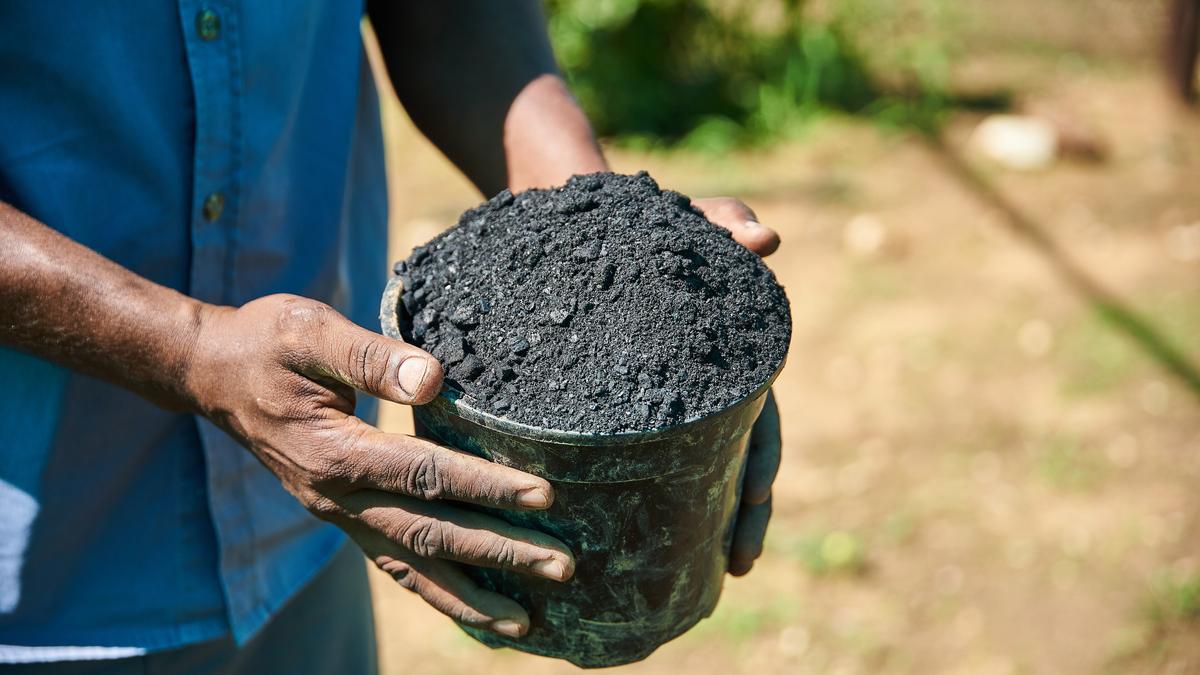
This is where biochar emerges as a carbon negative solution. Biochar is made by heating agricultural waste in low-oxygen conditions. What remains is a carbon-rich material that breaks down very slowly in the soil, helping to keep carbon locked away for long periods of time. The benefits extend well beyond carbon capture. Biochar is highly porous and contributes to aggregating soil particles, holding water and creating a suitable environment for microorganisms.
Given these properties, the value of biochar to agriculture should be obvious. When added to poor, degraded soils, it can increase their ability to store water and stimulate the growth of beneficial microbes. Studies have indicated that it can improve crop productivity by 10% to 30% and water-holding capacity by 10% to 25%, particularly in soils low in nutrients.
Biochar derived from maize stalks and applied to black soils in Akola district of Maharashtra has improved soil organic carbon content and overall soil fertility in field trials. Research from Kerala has shown that biochar made from coconut leaf stalks increased soil quality in different cropping systems, emphasising the need to use local resources effectively. Perhaps most significantly, long-term studies have shown that biochar has the benefit of enhancing soil health and maintaining higher crop output over time.
Wider vision
This approach also supports India’s wider vision of sustainable agriculture and climate resilience. As droughts, heat waves, and erratic rainfall become more frequent and more intense, improving soil health will be crucial to sustaining agricultural productivity.
By increasing the water-holding capacity and the ability to use nutrients efficiently, thus, biochar can help crops withstand moisture stress while reducing dependency on external inputs. This is particularly important for small and marginal farmers who are often the most exposed to the climate’s vagaries.

Integrating biochar into the existing initiatives on natural farming, soil health management, and carbon farming can deliver environmental and economic benefits at scale. Yet in India, biochar remains largely confined to research trials and pilot projects, and is very much alien to many farmers.
In fact, agricultural residues are generally seen only as a problem of disposal. But they are an important resource that can generate additional income, create jobs, can deliver environmental benefits, and could even support payments for ecosystem services.
Carbon credits

An electron microscope’s image of biochar shows its pores, which helps aggregate soil particles and hold water, creating a suitable environment for microorganisms.
| Photo Credit:
G. Lens Microscopist, Jaime Cardenas (CC BY)
As one way forward, the government could package the activities of turning agricultural waste into biochar and putting it on soil into carbon credit markets, creating a strong economic incentive for mass adoption. Biochar carbon already passes rigorous stability criteria for long-term sequestration, and it can be classified as a persistent carbon dioxide removal technology under internationally accepted accounting standards.
For instance, VM0042 agricultural land management methodology quantifies both avoided emissions from residue burning and long-term carbon sequestration in soils. In this protocol, each tonne of certified biochar can generate 2-2.8 t carbon dioxide-equivalent in carbon credits. Depending on carbon market prices, certified biochar can thus provide an additional source of income for project developers, farmers, and cooperatives.
This approach is already being tested in projects such as those using the KISAN kiln from IIT-Kharagpur, which allows smallholders to monetise farm waste.
Several international examples also illustrate the scalability of biochar systems. In Kenya, turning rice husks into biochar has produced thousands of certified carbon credits and improved soil pH and phosphorus content. Thailand has pushed biochar use through national initiatives on soil rehabilitation and carbon management, and tied certification to access to the national carbon registry system, providing a policy-to-market pipeline. High carbon retention and large yield gains have also been reported from Brazil’s Embrapa Institute after using on-farm biochar generated from sugarcane bagasse.

Urban organic waste

An aerial view shows a landfill next to a lake swathed in water hyacinth in Bengaluru on April 15, 2026. India generates around 62 million tonnes of municipal solid garbage per year and more than 50% of that is biodegradable.
| Photo Credit:
AFP
These examples also show that success depends on integrated strategies that combine decentralised, appropriately scaled pyrolysis technology with strong measurement, reporting, and verification systems.
The feedstock for biochar is also not limited to agricultural waste and can encompass urban organic waste as well. India generates around 62 million tonnes of municipal solid garbage per year and more than 50% of that is biodegradable. Sewage sludge and crop residues can also be converted into biochar.
This is in keeping with the precepts of the circular economy, as organic waste is diverted from landfills that produce methane and is converted to a useful product for agriculture. By systematically implementing these measures, India can turn its large waste streams into ‘black gold’, thus ensuring a more resilient agricultural future while making a meaningful contribution to global climate mitigation efforts.
Overall, the value of biomass can only be realised through an integrated ecosystem that catalyses innovation, entrepreneurship, market linkages, investment, and cost-effective access to biochar for farmers.
Vinaya Kumar H.M. is assistant professor, Keladi Shivappa Nayaka University of Agricultural and Horticultural Sciences, Shivamogga, Karnataka. Vikram Patil is scientist, agricultural economics, International Rice Research Institute (IRRI), India.
Published – June 22, 2026 07:30 am IST