

Skip to content
  • Facebook
  • X
  • Linkedin
  • WhatsApp
  • YouTube
  • Associate Journalism
  • About Us
  • Privacy Policy
  • 033-46046046
  • editor@artifex.news
Artifex.News

Artifex.News

Stay Connected. Stay Informed.

  • Breaking News
  • World
  • Nation
  • Sports
  • Business
  • Science
  • Entertainment
  • Lifestyle
  • Toggle search form
  • Jordan security forces kill man who opened fire near Israeli Embassy
    Jordan security forces kill man who opened fire near Israeli Embassy World
  • Rajasthan Man Kills Bed-Ridden Father, Sits Next To Body For Hours: Cops
    Rajasthan Man Kills Bed-Ridden Father, Sits Next To Body For Hours: Cops Nation
  • Access Denied Sports
  • Access Denied Sports
  • “Darna Mana Hai”: Ishan Kishan Gets Spooked By ‘Ghost’ On Return To MI Camp Ahead Of Ipl 2024. Watch
    “Darna Mana Hai”: Ishan Kishan Gets Spooked By ‘Ghost’ On Return To MI Camp Ahead Of Ipl 2024. Watch Sports
  • Access Denied
    Access Denied Nation
  • Access Denied Sports
  • BJP sweeps Haryana civic polls; a student stuns party in Uklana
    BJP sweeps Haryana civic polls; a student stuns party in Uklana Nation
Quantum gates: Devices that translate quantum effects to computing awesomeness

Quantum gates: Devices that translate quantum effects to computing awesomeness

Posted on August 19, 2023 By admin


Information technology (IT) has become essential to communication, banking, business, health, education, entertainment, and many other walks of our lives. Its prevalence makes us wonder if society can survive without it. IT relies on gadgets that store and process vast amounts of information at humanly impossible speeds.

Gate in computing

A bit is the smallest piece of information storage (it is a portmanteau of binary digit). Often, a large number of bits is required to convey meaningful information. With the advent of modern semiconductor technology, we routinely speak of household computers having a few terabytes (8 trillion bits) of information storage. One terabyte can store 500 hours of high-definition video content.

In a computer, a bit is a physical system with two easily discernible configurations, or states – e.g. high and low voltage. These physical bits are useful to represent and process expressions that involve 0s and 1s: for instance, low voltage can represent 0 and high voltage can represent 1.

A gate is a circuit that changes the states of bits in a predictable way. The speed at which these gates work determines how fast a computer functions.

The quantum gate

Modern computers use semiconductor transistors to build circuits that function as bits. A semiconductor chip hosts more than 100 million transistors on 1 sq. mm. Imagine how small an individual transistor is and how close it is to adjacent transistors. As transistors become smaller, they become more susceptible to quantum effects. This is not desirable as the existing technology will then become unreliable for computational tasks. So there is a limit to how many transistors a computer can have.

Moore’s law, announced in 1965, states that computing power increases tenfold every five years. This law no longer holds as we have already slowed to a two-fold increase every five years. But this doesn’t have to mean we are nearing the end of computing development: the quantum revolution is coming.

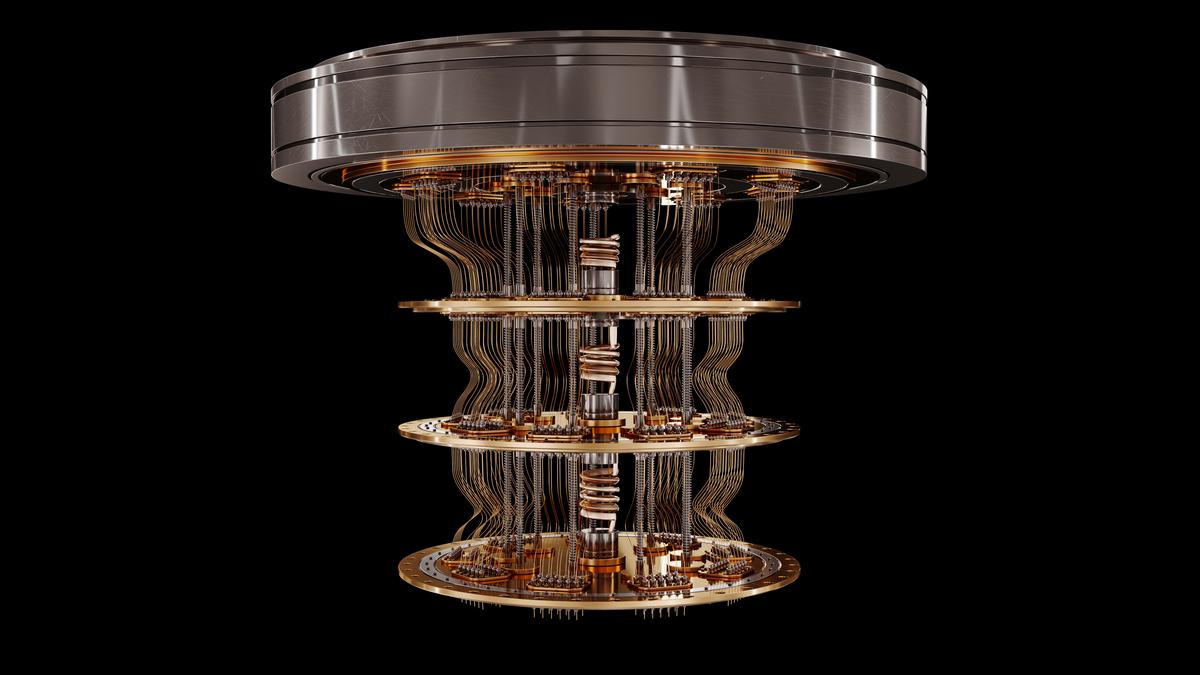
The most basic unit of a quantum computer is a quantum bit, or qubit. Like in a conventional computer, it is a physical object that has two states. For example, the spin of a particle can point along two different directions, so the particle can function as a qubit. Or it can be a superconducting circuit that mimics an atom, and its two states can be a ground state, where it has lower energy, and a higher ‘excited’ state.

A quantum gate is a physical process or circuit that changes the state of a qubit or a collection of qubits.

In the quantum-computing context, if particles or superconducting qubits are the physical qubits, the gate is often an electromagnetic pulse.

Interlude: Superposition

A fundamental limitation of conventional computing architecture is that each bit can exist in only one of the two states, 0 or 1. But according to quantum physics, a qubit can also be in a superposition of its two states at the same time.

Imagine you’re walking in the northeast direction. It is equivalent to moving partly along the north and the rest along the east. Your northeast movement is a superposition of walking along the north and along the east. So by combining different distances along the two directions, you can realise some movement in any direction between the two.

The basis states of the qubit are similar to the north and east directions. A qubit in a superposition has some contributions from each basis state. Different superpositions correspond to different amounts of contributions.

If a qubit is in a superposition, then measuring the qubit will cause it to collapse to one of the two states (i.e. either north or east). However, we can only predict the probability that it will collapse to one state. Quantum computers use this to their advantage.

For example, to perform one calculation that requires 16 different inputs, a classical computer requires a total of four bits and sixteen computations. But with four qubits in superposition, a quantum computer could generate answers corresponding to all 16 inputs in a single computation.

Superposition is one of the main factors responsible for speeding up a quantum computer.

But while superposition provides enormous advantages, it is a fragile effect. It deteriorates when qubits interact with their environment. Identifying ways to sidestep or overcome this fragility is an active area of research today.

What gates do

In quantum computers, quantum gates act on qubits to process information. For example, a quantum NOT gate changes the state of a qubit from 0 to 1 and vice versa. The effect of the NOT gate on a superposition is again a superposition, resulting from the action of the NOT gate on each basis state in the initial superposition.

Notably, this feature is common to all quantum gates: the effect of a quantum gate on a superposition is the superposition of the effects of the quantum gate on the basis states contributing to the initial superposition.

So as the quantum NOT gate inter-converts the states 0 and 1, its action is to swap the contributions of the basis states in the superposition.

The Hadamard gate is a type of gate that acts on a single qubit: it generates a superposition of the basis states.

The controlled-NOT, or CNOT, gate acts on two qubits: a control qubit and a target qubit. The control qubit is unaffected by the CNOT gate. The target qubit flips from 0 to 1 or 1 to 0 if the control qubit state is 1.

CNOT plus a few other gates (that act on single qubits) can perform all possible logical operations on binary information encoded on qubits. That is, they can be combined to form quantum circuits capable of processing information.

Research on reliable quantum computers and suitable quantum algorithms is happening in many institutes, universities, and research labs worldwide. Large-scale, reliable quantum computers will benefit industries ranging from drug design to safe communications.

S. Srinivasan is a professor of physics at Krea University.


Source link

Science Tags:CNOT gate, Hadamard gate, quantum computing, quantum dots, quantum gates, quantum NOT gate, quantum superposition, superconducting qubits, topological qubits

Post navigation

Previous Post: India’s Growth To Outpace All Other G20 Economies For Next 2 Years: Moody’s
Next Post: Adani Group Market Cap Jumps To 3-Month High, Adds Rs 45,200 Crore On Friday

Related Posts

  • India selects two astronaut-designates for upcoming Axiom-4 mission to International Space Station
    India selects two astronaut-designates for upcoming Axiom-4 mission to International Space Station Science
  • Sensing China threat, India joins race to mine new sea patch
    Sensing China threat, India joins race to mine new sea patch Science
  • Where is ISRO heading – The Hindu
    Where is ISRO heading – The Hindu Science
  • New research finds abundant microplastics in personal care products available in India
    New research finds abundant microplastics in personal care products available in India Science
  • Avalanches can grow 100-times larger undersea than on land
    Avalanches can grow 100-times larger undersea than on land Science
  • BlueBird Block-2 mission: ISRO successfully launches LVM3-M6 rocket
    BlueBird Block-2 mission: ISRO successfully launches LVM3-M6 rocket Science

More Related Articles

What is jet lag? – The Hindu What is jet lag? – The Hindu Science
Who owns our knowledge? Rethinking scientific publishing in the AI age Who owns our knowledge? Rethinking scientific publishing in the AI age Science
What scientists find when they find nothing What scientists find when they find nothing Science
Unusual genetic code in Antarctic microbes yields rare amino acid Unusual genetic code in Antarctic microbes yields rare amino acid Science
3 craters discovered on Mars by scientists of Physical Research Laboratory 3 craters discovered on Mars by scientists of Physical Research Laboratory Science
Does seeking social proximity improve flight routes among pigeons? Does seeking social proximity improve flight routes among pigeons? Science
SiteLock

Archives

  • May 2026
  • April 2026
  • March 2026
  • February 2026
  • January 2026
  • December 2025
  • November 2025
  • October 2025
  • September 2025
  • August 2025
  • July 2025
  • June 2025
  • May 2025
  • April 2025
  • March 2025
  • February 2025
  • January 2025
  • December 2024
  • November 2024
  • October 2024
  • September 2024
  • August 2024
  • July 2024
  • June 2024
  • May 2024
  • April 2024
  • March 2024
  • February 2024
  • January 2024
  • December 2023
  • November 2023
  • October 2023
  • September 2023
  • August 2023
  • July 2023
  • June 2023
  • May 2023
  • April 2023
  • March 2023
  • February 2023
  • January 2023
  • December 2022
  • November 2022
  • October 2022
  • September 2022
  • August 2022
  • July 2022
  • June 2022
  • May 2022

Categories

  • Business
  • Nation
  • Science
  • Sports
  • World

Recent Posts

  • Congress MLA-elects make a beeline for Indira Bhavan as AICC inches closer to announcing its Chief Minister pick for Kerala
  • Woman gang-raped in sleeper bus in New Delhi
  • Lebanon, Israel to hold new talks in U.S. as ceasefire nears end
  • Lionel Messi has two goals and an assist as Inter Miami rallies for 5-3 victory over Cincinnati
  • Cuba has run out of diesel and fuel oil amid U.S. oil blockade

Recent Comments

  1. OrvalMaync on UP Teacher Who Asked Students To Slap Muslim Classmate
  2. Jeffreyroure on UP Teacher Who Asked Students To Slap Muslim Classmate
  3. Stevemonge on UP Teacher Who Asked Students To Slap Muslim Classmate
  4. RichardClage on UP Teacher Who Asked Students To Slap Muslim Classmate
  5. StevenLek on UP Teacher Who Asked Students To Slap Muslim Classmate
  • Zelensky meets top military leaders in Germany as the U.S. announces additional aid to Ukraine
    Zelensky meets top military leaders in Germany as the U.S. announces additional aid to Ukraine World
  • “Lacked Fitness”: India Women’s Hockey Captain Salima Tete’s Brutal Confession Amid Downward Spiral
    “Lacked Fitness”: India Women’s Hockey Captain Salima Tete’s Brutal Confession Amid Downward Spiral Sports
  • Fitness App Leads To Massive Security Breach On French Nuclear Submarines
    Fitness App Leads To Massive Security Breach On French Nuclear Submarines World
  • China’s military says it tracked Philippine patrol in South China Sea
    China’s military says it tracked Philippine patrol in South China Sea World
  • Access Denied Sports
  • “Only Reason I Retired…”: Rohit Sharma Reveals Truth Behind Decision To Quit T20Is Sports
  • 20 Mountaineers Climb Tallest Peaks In All 28 States To Hoist Tricolour
    20 Mountaineers Climb Tallest Peaks In All 28 States To Hoist Tricolour Nation
  • Access Denied
    Access Denied Nation

Editor-in-Chief:
Mohammad Ariff,
MSW, MAJMC, BSW, DTL, CTS, CNM, CCR, CAL, RSL, ASOC.
editor@artifex.news

Associate Editors:
1. Zenellis R. Tuba,
zenelis@artifex.news
2. Haris Daniyel
daniyel@artifex.news

Photograher:
Rohan Das
rohan@artifex.news

Artifex.News offers Online Paid Internships to college students from India and Abroad. Interns will get a PRESS CARD and other online offers.
Send your CV (Subjectline: Paid Internship) to internship@artifex.news

Links:
Associate Journalism
About Us
Privacy Policy

News Links:
Breaking News
World
Nation
Sports
Business
Entertainment
Lifestyle

Registered Office:
72/A, Elliot Road, Kolkata - 700016
Tel: 033-22277777, 033-22172217
Email: office@artifex.news

Editorial Office / News Desk:
No. 13, Mezzanine Floor, Esplanade Metro Rail Station,
12 J. L. Nehru Road, Kolkata - 700069.
(Entry from Gate No. 5)
Tel: 033-46011099, 033-46046046
Email: editor@artifex.news

Copyright © 2023 Artifex.News Newsportal designed by Artifex Infotech.