





Skip to content
  • Facebook
  • X
  • Linkedin
  • WhatsApp
  • YouTube
  • Associate Journalism
  • About Us
  • Privacy Policy
  • 033-46046046
  • editor@artifex.news
Artifex.News

Artifex.News

Stay Connected. Stay Informed.

  • Breaking News
  • World
  • Nation
  • Sports
  • Business
  • Science
  • Entertainment
  • Lifestyle
  • Toggle search form
  • Access Denied Sports
  • After Rafael Nadal’s Retirement, India Pacer Jasprit Bumrah Writes Heart-Stirring Tribute For Tennis Legend
    After Rafael Nadal’s Retirement, India Pacer Jasprit Bumrah Writes Heart-Stirring Tribute For Tennis Legend Sports
  • Govt. to take over Krishna Iyer’s residence to set up legal research centre: Minister
    Govt. to take over Krishna Iyer’s residence to set up legal research centre: Minister Nation
  • Why do we have wisdom teeth?
    Why do we have wisdom teeth? Science
  • Access Denied World
  • France on alert for disinformation ahead of European polls
    France on alert for disinformation ahead of European polls World
  • Global Voices On PM Modi And India’s “Rising Influence”
    Global Voices On PM Modi And India’s “Rising Influence” Nation
  • Govt. to take over Krishna Iyer’s residence to set up legal research centre: Minister
    Police officer suspended pending inquiry into alleged sexual harassment of head constable Nation
Dog brains shrank significantly by 5,000 years ago, thanks to humans

Dog brains shrank significantly by 5,000 years ago, thanks to humans

Posted on May 23, 2026 By admin


Domestic dogs have significantly smaller brains than their wolf ancestors. Researchers have long known that dogs’ brains shrank in the past, but when has been a mystery. Some theories also argue that strict aesthetic standards and intensive, selective modern breeding over the last 200 years could have been the cause.

In a new study, researchers from Europe have suggested that canines’ brains had already shrunk by at least 5,000 years ago — and possibly due to human interference.

During the Upper Pleistocene period, around 35,000 years ago, and long before humans started settled agriculture, dogs and wolves had similar brain sizes. This was around when humans and dogs began to interact more often. But by the Late Neolithic period, around 5,000 years ago, by when agricultural societies had become widespread, dogs living in Western European settlements had brains nearly 46% smaller than those of wolves at the same time, the researchers reported on April 29 in Royal Society Open Science.

They noticed this shrinkage in the remains of dogs in a Middle/Late Neolithic site in Chalain in France.

This study provides “new evidence” for the evolutionary reduction in the brain size of dogs that correlates with their domestication, Ian Kuijt, a zooarcheologist at the University of Notre Dame in Indiana, who was not involved in the research, said.

“It is fascinating to see the overall trajectory, even if this is a very small sample,” he added.

Virtual endocasts

To trace how dog brains evolved, Thomas Cucchi, a bioarchaeologist at the French National Centre for Scientific Research (CNRS), Paris, and his colleagues and peers analysed the skulls of 185 modern and 22 prehistoric wolf and dog specimens. The specimens included two dog-like animals from about 35,000 and 15,000 years ago, and Late Neolithic wolves and dogs from about 5,000 to 4,500 years ago.

The researchers used this data to create virtual endocasts — models of the space inside the skull where the brain once sat. Even though, the brain decomposes rapidly after death, the skull’s inner cavity preserves an imprint of the brain’s size and general shape, so the endocast served as a proxy for the brain, Eniko Kubinyi, a biologist at Eotvos Lorand University in Hungary and another author of the study, said.

Using the volume of these endocasts and the skull size, the team could track how brain size, relative to body size, changed at different points of time.

The endocranial volume of the so-called ‘protodogs’ from the Pleistocene didn’t indicate the smaller brain seen in later dogs. This, the researchers said, could mean they were still more wolflike than doglike.

One specimen from a cave site called Goyet in Belgium had a slightly larger brain volume than that of contemporary wolves. Dr. Cucchi said this might be due to increased human interaction at the beginning of the domestication process that posed new cognitive challenges.

Disproportionate drop

As humans transitioned from hunter-gatherers to a settled lifestyle around 5,000 years ago, dogs in Western European farming settlements adapted as well, becoming widely domesticated as a result.

Dogs face pressure to evolve from predators, foraging, and mating but domestication relaxes all of them. The high energy cost of neural tissues combined with the lower cognitive demands of a captive environment results in smaller brains in domesticated animals.

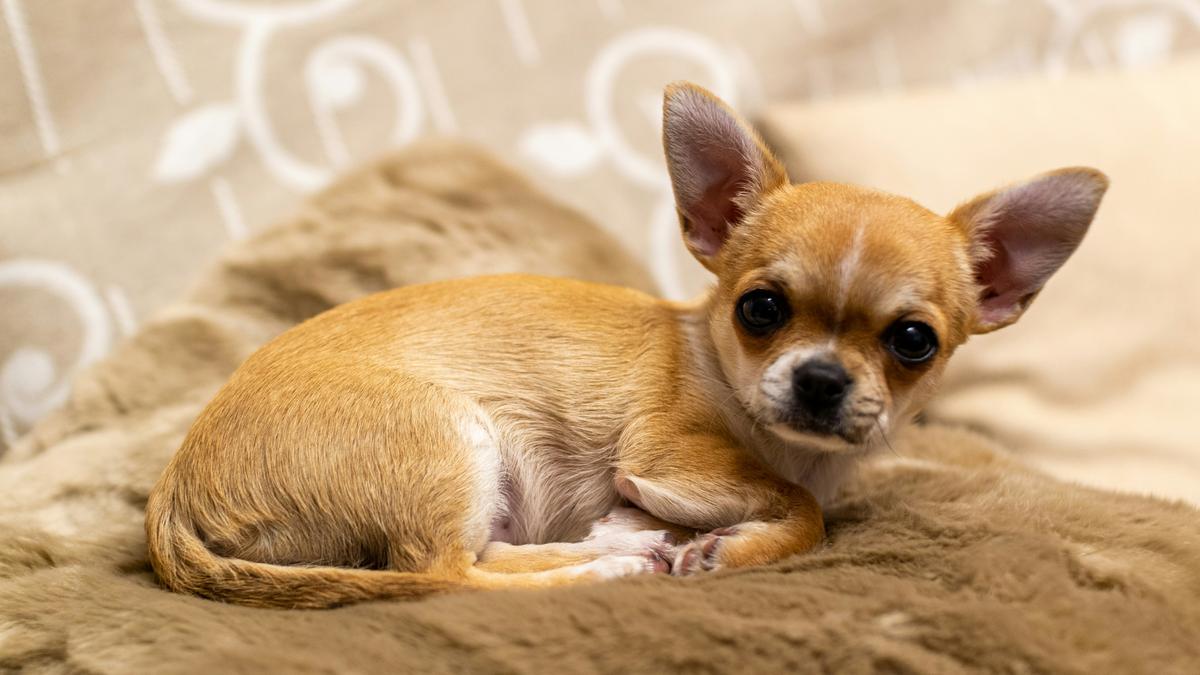
That said, the researchers found that dogs’ brains shrunk disproportionate to the drop in their body sizes — so much so that their brains were as big as those of Chihuahuas and pugs today. The researchers did note that the samples from Chalain alone were based on eight to ten dogs, meaning the findings from here alone can’t be generalised.

Previous studies have suggested that when brain size drops drastically, brain regions are reorganised. Often, this means a smaller cortical brain — which is responsible for learning, self-control, and cognitive ability — and a larger subcortical brain, which is involved in controlling emotions, Dr. Cucchi said.

Extrapolating from neuroanatomical research and studies of modern breeds, the researchers also suggested that the reorganisation resulted in dogs that were likely less trainable but more anxious, fearful, and prone to barking. Since small-brained dogs are more temperamental and wary of everything, they could have served the purpose of alerting humans to unusual activities nearby, Dr. Cucci said by way of one example of a role they could have played.

Dr. Kuijt noted that dog skulls and mandibles had also been found in refuse pits, meaning they were likely used as food as well.

A dingo story

“The link with changing temperaments serving as an alarm system is an intriguing speculation, but of course inferring behaviours from the archaeological and palaeontological records is challenging,” Michael Buckley, a bioarchaeologist at the University of Manchester and who was not involved in the study, said.

The study also examined dingoes, the East Asian dogs introduced to Australia and which returned to the wild at least 3,300 years ago. They have since been living largely independent of humans. Despite this long separation, dingoes’ brain volumes are between the smallest and largest-brained modern dogs, and larger than village dogs of comparable skull size.

According to experts, this suggests living as a free-ranging apex predator and facing the cognitive demands of hunting and survival without human support may have exerted some positive selection pressure favouring larger brains.

However, dingoes haven’t regained the brain size seen in wolves.

Even though dingoes could grow a larger brain, Dr. Kubinyi said, “brain tissue is metabolically very costly [to maintain], so brain size is unlikely to increase without strong selection pressure.”

Since dingoes do not rely on cooperative hunting against large and dangerous prey the way wolves do, “it seems that dingoes do not need a larger brain for their survival,” she added.

Jay Kakade is a freelance science writer.

Published – May 27, 2026 07:30 am IST



Source link

Science

Post navigation

Previous Post: GVMC launches ‘Operation Clean Sweep’ to tackle city waste issues
Next Post: Whole body scans: why investors love them but doctors hate them

Related Posts

  • Could gut fungi be linked to severe COVID? What to make of new research findings
    Could gut fungi be linked to severe COVID? What to make of new research findings Science
  • Ehrlich builds the basis for chemotherapy
    Ehrlich builds the basis for chemotherapy Science
  • Does prenatal Zika infection have long-term immune consequences in children?
    Does prenatal Zika infection have long-term immune consequences in children? Science
  • Sci-Five | The Hindu Science Quiz: On weird animals 
    Sci-Five | The Hindu Science Quiz: On weird animals  Science
  • Rising temperatures are leading to torrential rains in the Himalayas
    Rising temperatures are leading to torrential rains in the Himalayas Science
  • A cancelled mission that succeeded
    A cancelled mission that succeeded Science

More Related Articles

Research rewrites where, when humans first domesticated horses Research rewrites where, when humans first domesticated horses Science
Earth Day 2026: India’s plastic crisis and blame game Earth Day 2026: India’s plastic crisis and blame game Science
IIT Bombay scientists develop solar heat battery for freezing Himalayan homes  IIT Bombay scientists develop solar heat battery for freezing Himalayan homes  Science
ISRO carries out assessment of space situation around L1 to ensure safety of Aditya-L1 spacecraft ISRO carries out assessment of space situation around L1 to ensure safety of Aditya-L1 spacecraft Science
Traditional diets shape unique gut microbes of Indian tribes Traditional diets shape unique gut microbes of Indian tribes Science
Rhinos can’t sweat, making them vulnerable to overheating Rhinos can’t sweat, making them vulnerable to overheating Science
SiteLock

Archives

  • September 2026
  • August 2026
  • July 2026
  • June 2026
  • May 2026
  • April 2026
  • March 2026
  • February 2026
  • January 2026
  • December 2025
  • November 2025
  • October 2025
  • September 2025
  • August 2025
  • July 2025
  • June 2025
  • May 2025
  • April 2025
  • March 2025
  • February 2025
  • January 2025
  • December 2024
  • November 2024
  • October 2024
  • September 2024
  • August 2024
  • July 2024
  • June 2024
  • May 2024
  • April 2024
  • March 2024
  • February 2024
  • January 2024
  • December 2023
  • November 2023
  • October 2023
  • September 2023
  • August 2023
  • July 2023
  • June 2023
  • May 2023
  • April 2023
  • March 2023
  • February 2023
  • January 2023
  • December 2022
  • November 2022
  • October 2022
  • September 2022
  • August 2022
  • July 2022
  • June 2022
  • May 2022

Categories

  • Business
  • Nation
  • Science
  • Sports
  • World

Recent Posts

  • Asian Games 2026: Shafali’s fiery ton fires India to women’s cricket final, ensures medal
  • Hyena gave birth to two cubs at the Thiruvananthapuram Zoo
  • FPIs turn cautious; withdraw ₹20,974 crore from equities in September amid global uncertainty
  • World leaders return to UN amid wars in West Asia and Ukraine
  • Overnight rain bring temperatures down in Bengaluru, KIA records 94.2 mm

Recent Comments

  1. Glennalbub on UP Teacher Who Asked Students To Slap Muslim Classmate
  2. PhilipLog on UP Teacher Who Asked Students To Slap Muslim Classmate
  3. DennisDum on UP Teacher Who Asked Students To Slap Muslim Classmate
  4. DonaldFrosy on UP Teacher Who Asked Students To Slap Muslim Classmate
  5. DonaldFrosy on UP Teacher Who Asked Students To Slap Muslim Classmate
  • OBC activist criticises Jarange Patil, BJP MLA Dhas over Beed sarpanch murder case 
    OBC activist criticises Jarange Patil, BJP MLA Dhas over Beed sarpanch murder case  Nation
  • ‘Anxious’ Woman Opens Emergency Exit, Climbs Onto Wing Of Alaska Airlines Plane
    ‘Anxious’ Woman Opens Emergency Exit, Climbs Onto Wing Of Alaska Airlines Plane World
  • Access Denied
    Access Denied Nation
  • How did memory chipmaker CXMT become China’s most valuable stock? | Explained
    How did memory chipmaker CXMT become China’s most valuable stock? | Explained World
  • Access Denied Sports
  • Access Denied
    Access Denied Nation
  • Access Denied
    Access Denied Nation
  • Diljit Dosanjh Dedicates His Guwahati Concert To Manmohan Singh
    Diljit Dosanjh Dedicates His Guwahati Concert To Manmohan Singh Nation

Editor-in-Chief:
Mohammad Ariff,
MSW, MAJMC, BSW, DTL, CTS, CNM, CCR, CAL, RSL, ASOC.
editor@artifex.news

Associate Editors:
1. Zenellis R. Tuba,
zenelis@artifex.news
2. Haris Daniyel
daniyel@artifex.news

Photograher:
Rohan Das
rohan@artifex.news

Artifex.News offers Online Paid Internships to college students from India and Abroad. Interns will get a PRESS CARD and other online offers.
Send your CV (Subjectline: Paid Internship) to internship@artifex.news

Links:
Associate Journalism
About Us
Privacy Policy

News Links:
Breaking News
World
Nation
Sports
Business
Entertainment
Lifestyle

Registered Office:
72/A, Elliot Road, Kolkata - 700016
Tel: 033-22277777, 033-22172217
Email: office@artifex.news

Editorial Office / News Desk:
No. 13, Mezzanine Floor, Esplanade Metro Rail Station,
12 J. L. Nehru Road, Kolkata - 700069.
(Entry from Gate No. 5)
Tel: 033-46011099, 033-46046046
Email: editor@artifex.news

Copyright © 2023 Artifex.News Newsportal designed by Artifex Infotech.