



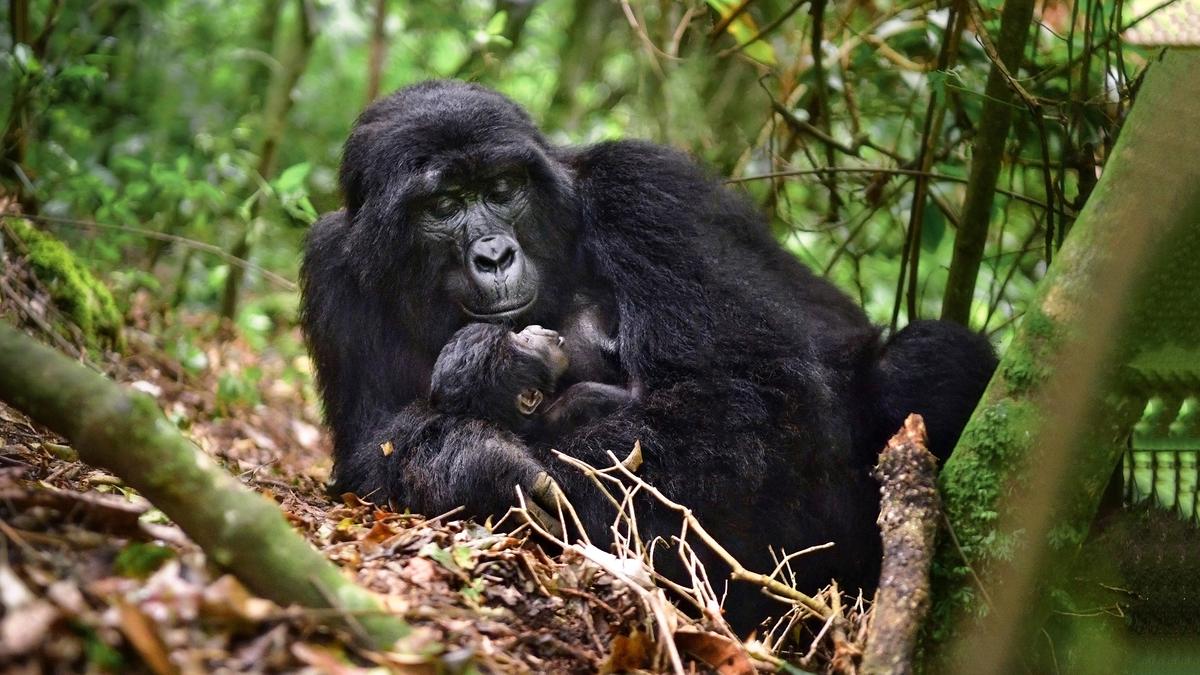
Uganda’s history with mountain gorillas is inseparable from its political turmoil. Mountain gorillas (Gorilla beringei beringei) are restricted to Central Africa and number around a thousand individuals. They inhabit dense volcanic, bamboo, and montane forests at elevations of 2,200-4,300 m.
Yet from Uganda’s independence in 1962 through Milton Obote’s centralisation, Idi Amin’s brutal dictatorship, and Yoweri Museveni’s lengthy rule, poaching and habitat loss have pushed gorillas confined to the Bwindi and the Virunga parks to the brink. And in Uganda’s collective efforts to restore both the species and a sense of national identity, Gladys Kalema-Zikusoka stands out as a defining figure.
Dr. Kalema-Zikusoka, Uganda’s first wildlife veterinarian and one of Africa’s most respected conservationists, has spent more than three decades working during one of the most difficult periods of Ugandan history. She is a globally recognised conservationist and the founder of Conservation Through Public Health (CTPH), where her One Health model has significantly contributed to mountain gorilla conservation. For this work, she received the Whitley and Rolex Awards and the UN Environment Programme’s Champion of the Earth Award.
Like India, Uganda is a postcolonial democracy where wildlife conservation has unfolded alongside political instability and debates about who should bear the cost of protecting nature. The fate of Uganda’s mountain gorillas, much like India’s tigers or elephants, has been shaped by governance, public health, and community relations as well as ecology. And Dr. Kalema-Zikusoka’s work must be understood within this intersection.
First wildlife veterinarian
Being born and raised in Amin’s time on Ugandan soil and in a politically influential family wasn’t easy.
“When I was just two years old in the 1970s, my father was abducted and murdered by Idi Amin’s men,” Dr. Kalema-Zikusoka said. Much like the rest of Uganda, her life was severely affected by the regime, which destroyed institutions, communities, and wildlife.
“I wanted to continue my father’s dream of a prosperous Uganda, and conservation felt like a way of putting things right.”
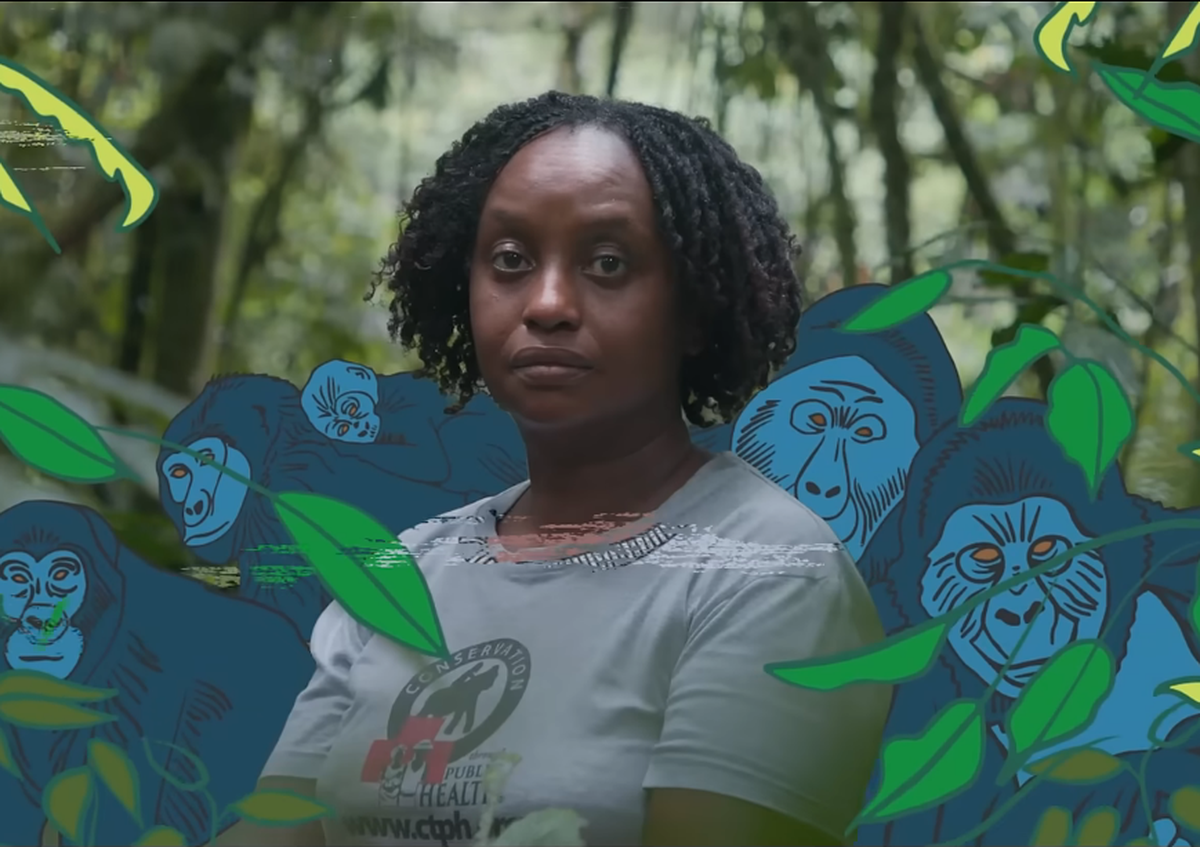
Through the Women for the Environment Africa Leadership Council, Gladys Kalema-Zikusoka works to address the stark gender gap in conservation leadership across the continent.
| Photo Credit:
U.N. Environment Programme
Her career began at a time when conservation in the country had been fractured by years of political violence. The wildlife suffered catastrophic losses in the 1970s and 1980s. Elephants were slaughtered for ivory and protected areas were encroached. Conservation infrastructure nearly collapsed. Evidence from April 1980 suggests Uganda’s elephant population may have collapsed to as few as 1,200 animals. Fuelled by rising ivory prices, from $6 per kg in 1963 to about $50 in 1977, poaching operated openly across large areas. Soldiers sometimes hunted elephants with automatic weapons.
The mountain gorillas were already restricted to a handful of forest fragments. Hunting alone caused the Virunga gorilla population to drop from 400-500 individuals in 1960 to 260-290 during Amin’s regime.
When Dr. Kalema-Zikusoka returned to Uganda after studying in the UK and the US, gorilla conservation was neither glamorous nor well-funded. “I had to teach myself a lot,” she recalled.
She was the country’s first wildlife veterinarian, and faced scepticism as a woman in a male-dominated field and as someone insisting that veterinary care mattered to conservation outcomes.
One of her earliest cases involved an ageing silverback gorilla named Mugurusi, meaning “old man” in a Bantu language spoken in southwestern Uganda. The gorilla was lagging behind his group, moving slowly, visibly unwell. Dr. Kalema-Zikusoka examined him but he died shortly afterwards. A postmortem revealed chronic heart and kidney failure. When the findings were published in Ugandan newspapers, the public reaction was unexpected
“People were amazed that gorillas die of the same things as humans,” she said. “It created excitement and empathy.”
That moment was a turning point in Uganda’s broader conservation narrative.

Gorillas and nation-building
As the political situation in Uganda started to stabilise, gorillas played a central role in its economic recovery. Gorilla tourism helped rebuild conservation institutions and provided livelihoods for communities living around protected areas.
“Gorillas helped bring tourism back to Uganda,” Dr. Kalema-Zikusoka said, “just like tigers did in India.”
Yet tourism alone couldn’t protect the great apes. Increasing human-gorilla contact in Bwindi raised the risk of respiratory infections. Dr. Kalema-Zikusoka responded by co-founding CTPH.
Many villagers near gorilla habitats once depended on small-scale farming, bushmeat, firewood, poaching, and cattle grazing that brought them into frequent contact with wildlife while increasing their disease risk. The intervention aimed to provide them with better healthcare, sanitation, and alternative livelihoods. The results were tangible: since 2007, it reduced disease transmission and human-wildlife conflict and strengthened local support for conservation.
Women, leadership, resistance
“Exciting, but very challenging,” Dr. Kalema-Zikusoka said of becoming Uganda’s first wildlife veterinarian. She encountered scepticism at every turn, including disbelief that a woman could handle large mammals such as elephants.
One defining moment came during Uganda’s first elephant translocation in the late 1990s. Farmers had complained about crop raids, and the then First Lady of Uganda, Janet Museveni, intervened. While then Uganda Wildlife Authority executive director Eric Edroma supported Dr. Kalema-Zikusoka, others questioned her insistence on humane handling.
Dr. Kalema-Zikusoka assessed the situation on site, coordinated with local rangers, darted and collared the elephants, and oversaw their safe translocation, all while managing community interactions and logistical challenges.
“Later, I realised you cannot just be a vet,” Dr. Kalema-Zikusoka said. “You need diplomacy, logistics, and patience.”
Her experience shaped her commitment to mentoring women in conservation. Through the Women for the Environment Africa Leadership Council, she still works to address the stark gender gap in conservation leadership across the continent.
She noted that women in conservation in India enjoy more leadership opportunities and visibility whereas women in Uganda struggle for recognition.
“People like to put you in boxes, either veterinary or community or public health,” Dr. Kalema-Zikusoka added. “But you don’t have to be in only one. Each one builds on the other.”
Above all, she insisted, conservation must begin with people. In her view, conservation is less about imposing solutions and more about creating conditions where humans and wildlife can thrive together.

Cultural crossings
Dr. Kalema-Zikusoka’s worldview was also shaped by cultural experiences beyond conservation. She grew up in Uganda in the 1970s, when Idi Amin was expelling Indians, many of whom later returned. She recalled maintaining close family ties with Indian friends and business partners.
“My dad had Indian friends. My mom had a very close Indian friend; she even wrote about her in her book. I was too young to notice cultural differences,” she said. “What I noticed was friendship.”
She studied in the UK and later in the US. In her 2023 book Walking with Gorillas: The Journey of an African Wildlife Vet, she recalled a classmate using a racial slur, a rude awakening after her sheltered upbringing in Uganda. When she returned to the country after time in Britain, she was struck by how warm and open people were, only later realising this wasn’t exceptional behaviour so much as the Ugandan way.
Food, however, offered clearer distinctions and comforts. She grew up in central Uganda and she savoured simple, traditional dishes, from mashed matoke — the country’s national dish of steamed, mashed green bananas — to luwombo, a rich stew of meat, chicken or groundnuts steamed in banana leaves. Her personal favourite, she said, was plantain, a humble staple that connected her to home and heritage.
Lessons from Jane
One of the most formative influences on Dr. Kalema-Zikusoka’s career was Jane Goodall, who wrote the foreword to her book. Meeting Goodall for the first time left a lasting impression, not because of celebrity but because of humility: “She gave everyone equal attention, from a forest tracker to a head of state,” Dr. Kalema-Zikusoka recalled.
She added that Goodall’s greatest lesson was collaboration: in a field often marked by competition, Goodall demonstrated the power of quiet influence from persuading institutions, shaping policy, and advancing conservation without also stealing the spotlight. “She was powerful without being loud,” Dr. Kalema-Zikusoka put it.
She had considered other figures to write the foreword. David Attenborough was approached but he declined endorsements to avoid a flood of requests. Her agent also suggested someone like Michelle Obama, whose public profile could bring conservation to a wider audience. Coincidentally, Dr. Kalema-Zikusoka’s sister had been at Princeton at the same time as Michelle Obama and Jeff Bezos, though she was unable to contact them.

Gorillas and humans
When asked what humans can learn from gorillas, Dr. Kalema-Zikusoka turned philosopher: “They say chimps are what we are, but gorillas are what we want to be.”
A striking example of gorillas’ gentleness is birth spacing. Gorilla mothers give birth roughly every four and a half years, ensuring their older offspring are emotionally independent before a new baby arrives.
“Animals think about consequences,” Dr. Kalema-Zikusoka said. “Many humans don’t.”
(Aside: asked who would win in a hypothetical fight between 100 men and one gorilla, she laughed. “A gorilla would beat 100 men. After one or two are taken down, the rest will run away.”)
Faith and AI
Dr. Kalema-Zikusoka is a believer and said she turns to prayer in moments of disappointment. She swims for a hobby, which she said offers solace and reminds her of her fisherman grandfather from the Ssese Islands, as does time with her children.
As for the future: the rise of artificial intelligence (AI) and robotics may one day aid conservation, particularly by reducing human-wildlife interactions and limiting disease transmission, but Dr. Kalema-Zikusoka insisted that such tools must respect the intelligence of the animals themselves.
“Gorillas are very intelligent creatures, so any technology applied should be thoughtfully designed,” she said.
As Uganda continues to rebuild its ecological heritage, Dr. Kalema-Zikusoka’s career is a reminder that conservation is as much about saving species as about rebuilding trust and reimagining what coexistence can look like.
Dr. Nobinraja M. is a postdoctoral researcher at the Conservation Genetics Lab in ATREE, Bengaluru. He won the 2025 Hasmukh Shah Memorial Award for Ecological Studies (research).