




Skip to content
  • Facebook
  • X
  • Linkedin
  • WhatsApp
  • YouTube
  • Associate Journalism
  • About Us
  • Privacy Policy
  • 033-46046046
  • editor@artifex.news
Artifex.News

Artifex.News

Stay Connected. Stay Informed.

  • Breaking News
  • World
  • Nation
  • Sports
  • Business
  • Science
  • Entertainment
  • Lifestyle
  • Toggle search form
  • Access Denied
    Access Denied Nation
  • Access Denied
    Access Denied Nation
  • Shakib Al Hasan Banned From Bowling By England Cricket Board Over “Illegal Action”: Report
    Shakib Al Hasan Banned From Bowling By England Cricket Board Over “Illegal Action”: Report Sports
  • A Memory Of Lives Lost To COVID-19 In London
    A Memory Of Lives Lost To COVID-19 In London World
  • IPL-17 | Yuzvendra Chahal first bowler to take 200 wickets
    IPL-17 | Yuzvendra Chahal first bowler to take 200 wickets Sports
  • “We Have To Make Decision”: Tim Southee On Recalling Retired Neil Wagner For 2nd Test vs Australia
    “We Have To Make Decision”: Tim Southee On Recalling Retired Neil Wagner For 2nd Test vs Australia Sports
  • Indian national indicted for smuggling individuals from across Canadian border into U.S.
    Indian national indicted for smuggling individuals from across Canadian border into U.S. World
  • Manchester United Beat Real Madrid To The Signing Of Leny Yoro from Lille
    Manchester United Beat Real Madrid To The Signing Of Leny Yoro from Lille Sports
To make sense of cosmic rays, CERN team tracks a fragile nucleus

To make sense of cosmic rays, CERN team tracks a fragile nucleus

Posted on January 28, 2026 By admin


The hydrogen atom is the lightest in the universe and it consists of the simplest nucleus: a single proton. But while helium is the second-lightest element, its nucleus isn’t the second simplest. That distinction belongs to the deuteron, the nucleus of the deuterium atom, which contains one proton and one neutron. (Deuterium is an isotope of hydrogen.)

However, the two particles are bound with a very low binding energy, making deuterons seem fragile relative to the energetic, messy environment created when particles collide at nearly the speed of light at the Large Hadron Collider (LHC). Yet experiments have repeatedly observed deuterons (and anti-deuterons) emerging from these collisions. How do they survive this environment?

Coalescence scenario

Physicists have come up with two broad explanations. One, called direct emission, assumes the deuterons are produced directly from a hot source, meaning their formation doesn’t involve a different particle (or particles) condensing from a soup of energy, then decaying to form deuterons. The other idea, called coalescence, holds that the proton and neutron are produced first, then they stick together later if they get close enough.

The problem is a proton and a neutron can’t fuse if they have too much energy, so there has to be a third particle to carry away the excess energy. That third participant can be a type of particle called pion that acts like a catalyst, i.e. it will enable the reaction without becoming part of the final deuteron.

Finding out whether this is possible matters beyond collider physics. If scientists have to predict how light nuclei and antinuclei form in high-energy collisions in space — such as when cosmic rays strike interstellar gas — they need to know which formation mechanisms are possible and which ones nature doesn’t ‘allow’.

Delta resonance

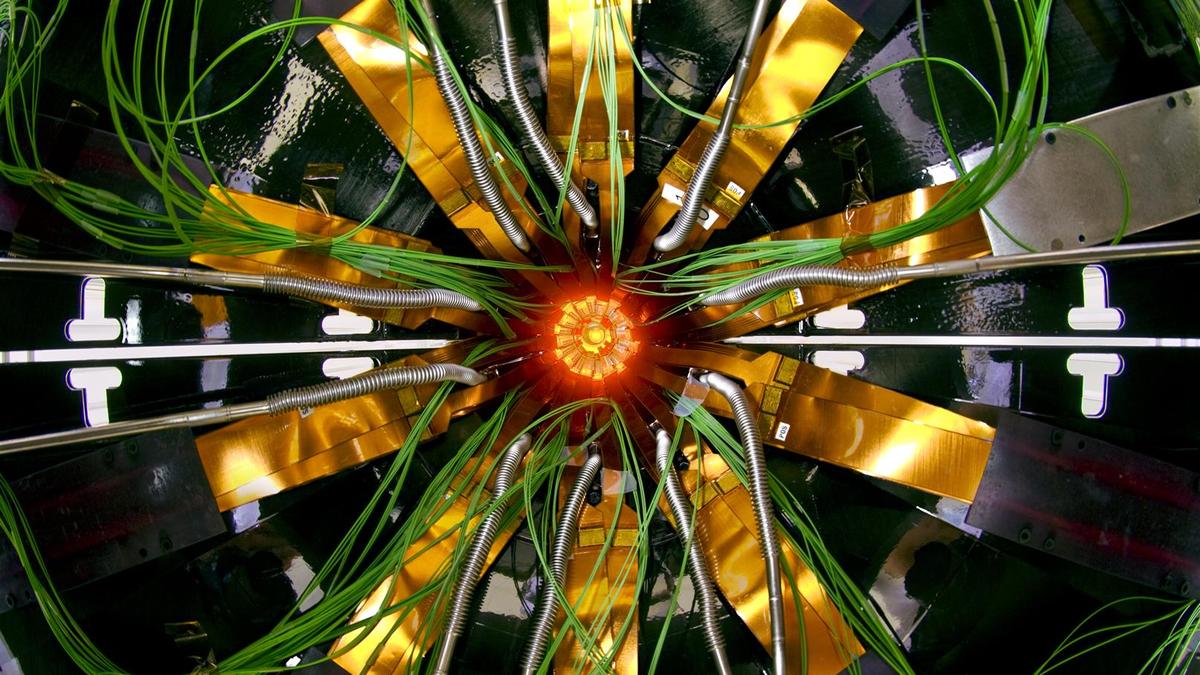
A new study out of the ALICE collaboration at the LHC has provided the answer. The collaboration works with the ALICE detector, one of nine detectors on the LHC. At four points on its ring, the LHC smashes together opposing beams of protons at high energy. The collisions produce a morass of particles and reactions between them. The detectors have computers and sensors that are triggered when they identify reactions of interest and which they record and analyse.

For the new study, the ALICE collaboration used a technique called femtoscopy to infer how and when particles were produced by checking whether two particles come out with very similar velocities more often than chance would predict. Its basic object was a ratio called the correlation function. The numerator was how often a given pair (a pion and a deuteron) is seen with a small relative momentum. The denominator was how often such pairs would form assuming they had no affinity for each other.

The team was looking specifically for a particle called Δ(1232) resonance. (‘Δ’ is pronounced ‘delta’.) The resonance is a very short-lived excited version of a proton or a neutron that quickly decays. Δ(1232) in particular decays into a pion and a proton or neutron. If a deuteron is later formed using that same proton (or neutron), then the pion and the deuteron would appear to be ‘linked’ in the data by having a correlated momentum.

ALICE reported just this signal in the pion-deuteron data, meaning many of the deuterons are formed after the Δ decays, rather than directly at the start.

Where a nucleus is born

If the pions were only bumping into deuterons that already existed, some of those collisions should have broken the deuteron apart (which is fragile, remember). In that case, the data should’ve shown a dip around the Δ region. ALICE, however, found a positive signal, meaning deuterons were forming after Δ particles decayed and the pions from the same decay were correlated with the new deuterons.

Norwegian University of Science and Technology physics professor Michael Kachelriess called the finding a “great achievement” to Physics World.

From the size of the Δ signal, the team estimated that around 62% of deuterons were produced following Δ decays. They figured if they included other short-lived resonances as well, about 80% of deuterons would be formed by coalescence.

This seems to be the answer to why deuterons can survive the LHC’s high-energy collisions. Resonances usually travel a short distance before they decay, so the coalescence that forms deuterons happens slightly later and slightly away from the most violent part of the collision. Thus the deuterons are also ‘born’ into a less extreme environment.

Cosmic rays, dark matter

In sum, most deuterons aren’t born as readymade nuclei at the instant of collision but are instead assembled shortly afterwards from existing protons and neutrons, with help from pions nearby. This should change how theorists model the way nuclei (and anti-nuclei) are produced in high-energy particulate reactions.

In fact the ALICE team’s paper, published on December 10, noted that scientists can use this insight to build more realistic models of reactions induced by cosmic rays.

Cosmic rays are very energetic protons and atomic nuclei hurtling through space and which often collide with other nuclei in outer space. When scientists are studying telescope data of these collisions or are modelling them in the lab, e.g. for astronomy research or because they’re sending a probe to that part of space, they’ll need to know which signals are coming from which sources.

“These findings not only explain a long-standing puzzle in nuclear physics but could have far-reaching implications for astrophysics and cosmology,” the ALICE team said in a statement.

“Light nuclei and antinuclei are also produced in interactions between cosmic rays and the interstellar medium, and theymay be created in processes involving the dark matter that pervades the universe. By building reliable models for the production of light nuclei and anti-nuclei, physicists can better interpret cosmic-ray data and look for possible dark-matter signals.”

mukunth.v@thehindu.co.in

Published – January 28, 2026 05:30 am IST



Source link

Science

Post navigation

Previous Post: Trump says will ‘de-escalate’ in Minneapolis after shooting backlash
Next Post: Access Denied

Related Posts

  • Microbe might spark first stages of ulcerative colitis: new study
    Microbe might spark first stages of ulcerative colitis: new study Science
  • GM crops can help fight hunger — depending on how they are farmed
    GM crops can help fight hunger — depending on how they are farmed Science
  • Science quiz: On vexillography – The Hindu
    Science quiz: On vexillography – The Hindu Science
  • Science quiz: Applications of lasers
    Science quiz: Applications of lasers Science
  • Chandrayaan-2 makes first ever observation of Sun’s impact on Moon, says ISRO
    Chandrayaan-2 makes first ever observation of Sun’s impact on Moon, says ISRO Science
  • Why did metal-organic frameworks win the 2025 chemistry Nobel?
    Why did metal-organic frameworks win the 2025 chemistry Nobel? Science

More Related Articles

Why participatory science is crucial to tackling coconut root wilt disease Why participatory science is crucial to tackling coconut root wilt disease Science
Prototype fast breeder reactor | Nuclear paradox Prototype fast breeder reactor | Nuclear paradox Science
ICMR to develop evidence-based guidelines for antibiotic use in respiratory infections, pneumonia ICMR to develop evidence-based guidelines for antibiotic use in respiratory infections, pneumonia Science
Hidden craters suggest earth once had a Saturn-like ring Hidden craters suggest earth once had a Saturn-like ring Science
Bengaluru scientists develop affordable fruit fly trap; seek global patents Bengaluru scientists develop affordable fruit fly trap; seek global patents Science
Daily quiz: on nuclear fusion reaction Daily quiz: on nuclear fusion reaction Science
SiteLock

Archives

  • September 2026
  • August 2026
  • July 2026
  • June 2026
  • May 2026
  • April 2026
  • March 2026
  • February 2026
  • January 2026
  • December 2025
  • November 2025
  • October 2025
  • September 2025
  • August 2025
  • July 2025
  • June 2025
  • May 2025
  • April 2025
  • March 2025
  • February 2025
  • January 2025
  • December 2024
  • November 2024
  • October 2024
  • September 2024
  • August 2024
  • July 2024
  • June 2024
  • May 2024
  • April 2024
  • March 2024
  • February 2024
  • January 2024
  • December 2023
  • November 2023
  • October 2023
  • September 2023
  • August 2023
  • July 2023
  • June 2023
  • May 2023
  • April 2023
  • March 2023
  • February 2023
  • January 2023
  • December 2022
  • November 2022
  • October 2022
  • September 2022
  • August 2022
  • July 2022
  • June 2022
  • May 2022

Categories

  • Business
  • Nation
  • Science
  • Sports
  • World

Recent Posts

  • Despite zoonotic diseases threat, Keralam’s proposed veterinary public health wing yet to take shape
  • Fact, fiction and flying objects: This new docufiction journeys across prehistory, colonial records and UFO encounters in Pavagada
  • Government can bear cost of maintaining UPI network: BJD MP Santrupt Misra
  • Sri Lankan lawmaker seeks Modi’s intervention in Saudi case involving Tamil youth
  • India’s FTAs opening new career opportunities for youth: PM Modi

Recent Comments

  1. AlvinNet on UP Teacher Who Asked Students To Slap Muslim Classmate
  2. AlvinNet on UP Teacher Who Asked Students To Slap Muslim Classmate
  3. Jamesslits on UP Teacher Who Asked Students To Slap Muslim Classmate
  4. MichaelClear on UP Teacher Who Asked Students To Slap Muslim Classmate
  5. Jamesslits on UP Teacher Who Asked Students To Slap Muslim Classmate
  • 17 Children Die After Fire Rips Through Primary School Hostel In Kenya
    17 Children Die After Fire Rips Through Primary School Hostel In Kenya World
  • Once Shunned, Areas Near Bhopal Gas Tragedy Site Now Seeing Real Estate Boom
    Once Shunned, Areas Near Bhopal Gas Tragedy Site Now Seeing Real Estate Boom Nation
  • OpenAI Says US Allies Should Partner On AI To Take On China
    OpenAI Says US Allies Should Partner On AI To Take On China World
  • Webb telescope confirms the universe is expanding at an unexpected rate
    Webb telescope confirms the universe is expanding at an unexpected rate Science
  • China looks to spur births, aid families in fight on shrinking population
    China looks to spur births, aid families in fight on shrinking population World
  • South Africa Sweep Bangladesh Series With Crushing Innings Victory
    South Africa Sweep Bangladesh Series With Crushing Innings Victory Sports
  • Economic Survey 2025-26 paints rosy picture of job scenario, raises concerns on inequality among gig workers
    Economic Survey 2025-26 paints rosy picture of job scenario, raises concerns on inequality among gig workers Business
  • Vietnam nominates its public security minister as new president
    Vietnam nominates its public security minister as new president World

Editor-in-Chief:
Mohammad Ariff,
MSW, MAJMC, BSW, DTL, CTS, CNM, CCR, CAL, RSL, ASOC.
editor@artifex.news

Associate Editors:
1. Zenellis R. Tuba,
zenelis@artifex.news
2. Haris Daniyel
daniyel@artifex.news

Photograher:
Rohan Das
rohan@artifex.news

Artifex.News offers Online Paid Internships to college students from India and Abroad. Interns will get a PRESS CARD and other online offers.
Send your CV (Subjectline: Paid Internship) to internship@artifex.news

Links:
Associate Journalism
About Us
Privacy Policy

News Links:
Breaking News
World
Nation
Sports
Business
Entertainment
Lifestyle

Registered Office:
72/A, Elliot Road, Kolkata - 700016
Tel: 033-22277777, 033-22172217
Email: office@artifex.news

Editorial Office / News Desk:
No. 13, Mezzanine Floor, Esplanade Metro Rail Station,
12 J. L. Nehru Road, Kolkata - 700069.
(Entry from Gate No. 5)
Tel: 033-46011099, 033-46046046
Email: editor@artifex.news

Copyright © 2023 Artifex.News Newsportal designed by Artifex Infotech.