



Skip to content
  • Facebook
  • X
  • Linkedin
  • WhatsApp
  • Associate Journalism
  • About Us
  • Privacy Policy
  • 033-46046046
  • editor@artifex.news
Artifex.News

Artifex.News

Stay Connected. Stay Informed.

  • Breaking News
  • World
  • Nation
  • Sports
  • Business
  • Science
  • Entertainment
  • Lifestyle
  • Toggle search form
  • Bansuri Swaraj’s Dig Over US Remarks
    Bansuri Swaraj’s Dig Over US Remarks Nation
  • Barbora Krejcikova Defeats Fourth Seed Elena Rybakina To Reach Wimbledon 2024 Women’s Singles Final
    Barbora Krejcikova Defeats Fourth Seed Elena Rybakina To Reach Wimbledon 2024 Women’s Singles Final Sports
  • Access Denied
    Access Denied Nation
  • Jason Cummings’ Late Strike Seals Dramatic Win For Mohun Bagan vs NEUFC In Five-goal Thriller
    Jason Cummings’ Late Strike Seals Dramatic Win For Mohun Bagan vs NEUFC In Five-goal Thriller Sports
  • Access Denied
    Access Denied Nation
  • Celebrating a sage king, a celebration of India-Bhutan ties
    Celebrating a sage king, a celebration of India-Bhutan ties World
  • Access Denied
    Access Denied Nation
  • Rajnath Singh On Death Of 5 Armymen In Jammu’s Kathua
    Rajnath Singh On Death Of 5 Armymen In Jammu’s Kathua Nation
To make sense of cosmic rays, CERN team tracks a fragile nucleus

To make sense of cosmic rays, CERN team tracks a fragile nucleus

Posted on January 28, 2026 By admin


The hydrogen atom is the lightest in the universe and it consists of the simplest nucleus: a single proton. But while helium is the second-lightest element, its nucleus isn’t the second simplest. That distinction belongs to the deuteron, the nucleus of the deuterium atom, which contains one proton and one neutron. (Deuterium is an isotope of hydrogen.)

However, the two particles are bound with a very low binding energy, making deuterons seem fragile relative to the energetic, messy environment created when particles collide at nearly the speed of light at the Large Hadron Collider (LHC). Yet experiments have repeatedly observed deuterons (and anti-deuterons) emerging from these collisions. How do they survive this environment?

Coalescence scenario

Physicists have come up with two broad explanations. One, called direct emission, assumes the deuterons are produced directly from a hot source, meaning their formation doesn’t involve a different particle (or particles) condensing from a soup of energy, then decaying to form deuterons. The other idea, called coalescence, holds that the proton and neutron are produced first, then they stick together later if they get close enough.

The problem is a proton and a neutron can’t fuse if they have too much energy, so there has to be a third particle to carry away the excess energy. That third participant can be a type of particle called pion that acts like a catalyst, i.e. it will enable the reaction without becoming part of the final deuteron.

Finding out whether this is possible matters beyond collider physics. If scientists have to predict how light nuclei and antinuclei form in high-energy collisions in space — such as when cosmic rays strike interstellar gas — they need to know which formation mechanisms are possible and which ones nature doesn’t ‘allow’.

Delta resonance

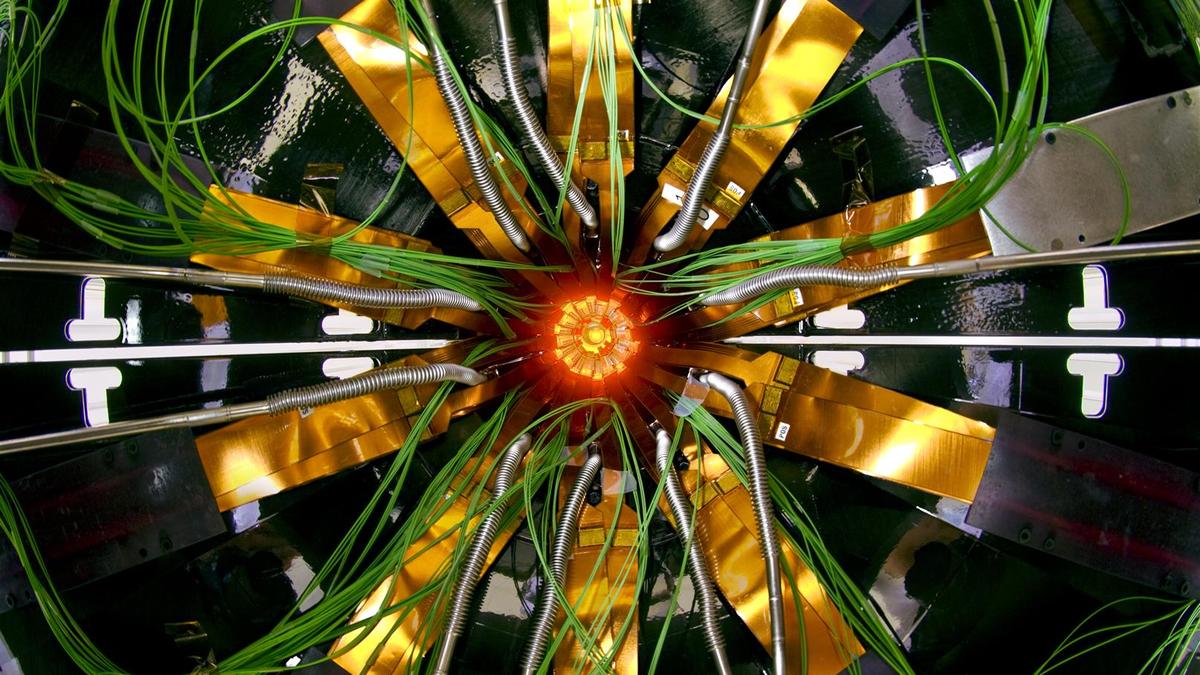
A new study out of the ALICE collaboration at the LHC has provided the answer. The collaboration works with the ALICE detector, one of nine detectors on the LHC. At four points on its ring, the LHC smashes together opposing beams of protons at high energy. The collisions produce a morass of particles and reactions between them. The detectors have computers and sensors that are triggered when they identify reactions of interest and which they record and analyse.

For the new study, the ALICE collaboration used a technique called femtoscopy to infer how and when particles were produced by checking whether two particles come out with very similar velocities more often than chance would predict. Its basic object was a ratio called the correlation function. The numerator was how often a given pair (a pion and a deuteron) is seen with a small relative momentum. The denominator was how often such pairs would form assuming they had no affinity for each other.

The team was looking specifically for a particle called Δ(1232) resonance. (‘Δ’ is pronounced ‘delta’.) The resonance is a very short-lived excited version of a proton or a neutron that quickly decays. Δ(1232) in particular decays into a pion and a proton or neutron. If a deuteron is later formed using that same proton (or neutron), then the pion and the deuteron would appear to be ‘linked’ in the data by having a correlated momentum.

ALICE reported just this signal in the pion-deuteron data, meaning many of the deuterons are formed after the Δ decays, rather than directly at the start.

Where a nucleus is born

If the pions were only bumping into deuterons that already existed, some of those collisions should have broken the deuteron apart (which is fragile, remember). In that case, the data should’ve shown a dip around the Δ region. ALICE, however, found a positive signal, meaning deuterons were forming after Δ particles decayed and the pions from the same decay were correlated with the new deuterons.

Norwegian University of Science and Technology physics professor Michael Kachelriess called the finding a “great achievement” to Physics World.

From the size of the Δ signal, the team estimated that around 62% of deuterons were produced following Δ decays. They figured if they included other short-lived resonances as well, about 80% of deuterons would be formed by coalescence.

This seems to be the answer to why deuterons can survive the LHC’s high-energy collisions. Resonances usually travel a short distance before they decay, so the coalescence that forms deuterons happens slightly later and slightly away from the most violent part of the collision. Thus the deuterons are also ‘born’ into a less extreme environment.

Cosmic rays, dark matter

In sum, most deuterons aren’t born as readymade nuclei at the instant of collision but are instead assembled shortly afterwards from existing protons and neutrons, with help from pions nearby. This should change how theorists model the way nuclei (and anti-nuclei) are produced in high-energy particulate reactions.

In fact the ALICE team’s paper, published on December 10, noted that scientists can use this insight to build more realistic models of reactions induced by cosmic rays.

Cosmic rays are very energetic protons and atomic nuclei hurtling through space and which often collide with other nuclei in outer space. When scientists are studying telescope data of these collisions or are modelling them in the lab, e.g. for astronomy research or because they’re sending a probe to that part of space, they’ll need to know which signals are coming from which sources.

“These findings not only explain a long-standing puzzle in nuclear physics but could have far-reaching implications for astrophysics and cosmology,” the ALICE team said in a statement.

“Light nuclei and antinuclei are also produced in interactions between cosmic rays and the interstellar medium, and theymay be created in processes involving the dark matter that pervades the universe. By building reliable models for the production of light nuclei and anti-nuclei, physicists can better interpret cosmic-ray data and look for possible dark-matter signals.”

mukunth.v@thehindu.co.in

Published – January 28, 2026 05:30 am IST



Source link

Science

Post navigation

Previous Post: Trump says will ‘de-escalate’ in Minneapolis after shooting backlash
Next Post: Access Denied

Related Posts

  • Cashew nutshell marine biofuel causes problems for some ships: testing agency
    Cashew nutshell marine biofuel causes problems for some ships: testing agency Science
  • Genetic enigma: two new studies reveal why some cats are orange
    Genetic enigma: two new studies reveal why some cats are orange Science
  • How do high-altitude birds take to the air when thin air offers little lift?
    How do high-altitude birds take to the air when thin air offers little lift? Science
  • V. Narayanan, who is set to take over as ISRO Chairman, terms his new assignment ‘a great responsibility’
    V. Narayanan, who is set to take over as ISRO Chairman, terms his new assignment ‘a great responsibility’ Science
  • Behind India’s record performance at International Math Olympiad 2024
    Behind India’s record performance at International Math Olympiad 2024 Science
  • More than seven decades of science for peace
    More than seven decades of science for peace Science

More Related Articles

Green Humour by Rohan Chakravarty on Coca Cola going back on their plastic recycling goals Green Humour by Rohan Chakravarty on Coca Cola going back on their plastic recycling goals Science
Dinosaur-killing asteroid impact fouled Earth’s atmosphere with dust Dinosaur-killing asteroid impact fouled Earth’s atmosphere with dust Science
Bacterial cell walls could hold clues to better human health, say CCMB scientists Bacterial cell walls could hold clues to better human health, say CCMB scientists Science
Iceland’s ‘Mammoth’ raises potential for carbon capture Iceland’s ‘Mammoth’ raises potential for carbon capture Science
Scientists identify molten layer deep within interior of Mars Scientists identify molten layer deep within interior of Mars Science
New species of finless snake eel named after Kanniyakumari New species of finless snake eel named after Kanniyakumari Science
SiteLock

Archives

  • January 2026
  • December 2025
  • November 2025
  • October 2025
  • September 2025
  • August 2025
  • July 2025
  • June 2025
  • May 2025
  • April 2025
  • March 2025
  • February 2025
  • January 2025
  • December 2024
  • November 2024
  • October 2024
  • September 2024
  • August 2024
  • July 2024
  • June 2024
  • May 2024
  • April 2024
  • March 2024
  • February 2024
  • January 2024
  • December 2023
  • November 2023
  • October 2023
  • September 2023
  • August 2023
  • July 2023
  • June 2023
  • May 2023
  • April 2023
  • March 2023
  • February 2023
  • January 2023
  • December 2022
  • November 2022
  • October 2022
  • September 2022
  • August 2022
  • July 2022
  • June 2022
  • May 2022

Categories

  • Business
  • Nation
  • Science
  • Sports
  • World

Recent Posts

  • Ten people die in New York City’s frigid cold, raising questions about city’s preparedness
  • Oil Steady Near Four-Month High On Weak Dollar And Iran Risks
  • Access Denied
  • To make sense of cosmic rays, CERN team tracks a fragile nucleus
  • Trump says will ‘de-escalate’ in Minneapolis after shooting backlash

Recent Comments

  1. Donaldnek on UP Teacher Who Asked Students To Slap Muslim Classmate
  2. Stephenbug on UP Teacher Who Asked Students To Slap Muslim Classmate
  3. Donaldnek on UP Teacher Who Asked Students To Slap Muslim Classmate
  4. KevinUnece on UP Teacher Who Asked Students To Slap Muslim Classmate
  5. WalterSew on UP Teacher Who Asked Students To Slap Muslim Classmate
  • Two Russians die in Ukraine drone attacks: local authorities
    Two Russians die in Ukraine drone attacks: local authorities World
  • Pakistan to privatise all state-owned firms, except strategic enterprises: PM Sharif
    Pakistan to privatise all state-owned firms, except strategic enterprises: PM Sharif Business
  • MSMEs to be hit by 18% GST for job work
    MSMEs to be hit by 18% GST for job work Business
  • Top 10 Donors To Political Parties
    Top 10 Donors To Political Parties Nation
  • Indian-origin motel manager beheaded in U.S.; co-worker arrested
    Indian-origin motel manager beheaded in U.S.; co-worker arrested World
  • Ex-Pak PM Imran Khan, Wife Bushra Bibi Indicted In New Corruption Case
    Ex-Pak PM Imran Khan, Wife Bushra Bibi Indicted In New Corruption Case World
  • Rafael Nadal Keeps His Clay Dream Alive As He Battles Past Pedro Cachin
    Rafael Nadal Keeps His Clay Dream Alive As He Battles Past Pedro Cachin Sports
  • Women’s ODI World Cup: South Africa sends Pakistan packing
    Women’s ODI World Cup: South Africa sends Pakistan packing Sports

Editor-in-Chief:
Mohammad Ariff,
MSW, MAJMC, BSW, DTL, CTS, CNM, CCR, CAL, RSL, ASOC.
editor@artifex.news

Associate Editors:
1. Zenellis R. Tuba,
zenelis@artifex.news
2. Haris Daniyel
daniyel@artifex.news

Photograher:
Rohan Das
rohan@artifex.news

Artifex.News offers Online Paid Internships to college students from India and Abroad. Interns will get a PRESS CARD and other online offers.
Send your CV (Subjectline: Paid Internship) to internship@artifex.news

Links:
Associate Journalism
About Us
Privacy Policy

News Links:
Breaking News
World
Nation
Sports
Business
Entertainment
Lifestyle

Registered Office:
72/A, Elliot Road, Kolkata - 700016
Tel: 033-22277777, 033-22172217
Email: office@artifex.news

Editorial Office / News Desk:
No. 13, Mezzanine Floor, Esplanade Metro Rail Station,
12 J. L. Nehru Road, Kolkata - 700069.
(Entry from Gate No. 5)
Tel: 033-46011099, 033-46046046
Email: editor@artifex.news

Copyright © 2023 Artifex.News Newsportal designed by Artifex Infotech.