





Imagine you’re a detective looking for proof of something extraordinary. You find what looks like the perfect clue, a smoking gun that seems to prove your theory. But what if that clue could be explained by something more ordinary?
Many physicists around the world are trying to create and identify special materials with unusual electronic properties called topological materials. They could potentially revolutionise quantum computing, but finding them also requires a willingness to question initial results that seem too good to be true, even when millions of dollars or great academic prestige are at stake.
There have already been many high-profile cases in this area where physicists have announced sensational findings only to withdraw them later after independent scientists spotted mistakes or even fraud in their work. Recently, physicist Ranga Dias was found to have fabricated data to claim a room-temperature superconductor. Many parts of his work have since been discredited.
These and other such incidents have fanned a broader conversation in the community about reproducibility, the idea that scientists should be able to repeat others’ experiments in the same conditions and get the same results.
Messy materials
When scientists study materials at very small scales, things can get messy in ways they may not anticipate. These materials can produce signals that look like the exotic phenomena scientists are searching for, the smoking gun, but are actually caused by more ordinary effects.
The authors of a new review in Science have called this the ‘smoking gun’ problem. Scientists predict what a dramatic discovery should look like, then go searching for that pattern. But at the atomic scale, there are so many things happening that they can accidentally find patterns that match their expectations even when the exotic physics they’re looking for isn’t actually there.
To understand how, the team performed four experiments with deceptively exciting signals. And based on them they’ve called for researchers to be honest about how they make certain discoveries and to openly discuss alternative explanations.
Indian Institute of Science professor of condensed matter physics Vijay Shenoy was direct, however. “What the authors state as best practices are, in my opinion, just common sense,” he told The Hindu. “Most folks working in the area know these points.”
He also said “the race to be the first [to claim an exciting finding] is the cause of the tumult — and all this is fuelled by the editors of the fancy journals.” Indeed, in addition to the other stakes to which researchers are sometimes exposed, many of the more ‘prestigious’ journals also have a history of expecting sensational results in the studies they publish.
Strengthening supercurrent
A superconductor is a material that conducts electricity with zero resistance.
Normally, when you apply a magnetic field to a superconductor, it weakens the superconductivity. But in the team’s experiment, the opposite happened: the supercurrent got stronger as the researchers increased the strength of the magnetic field. This seemed like evidence of an exotic type of superconductivity that physicists call triplet pairing, which is connected to topological materials.
In the first experiment, the team studied small connections made of special materials.
When they looked at different voltage settings, the researchers found this behaviour only happened in a specific, narrow regime. Most of the time, the magnetic field reduced the supercurrent, as expected. The strange increase turned out to be caused by mundane features in the connections between the superconductor and the detector, not exotic physics.
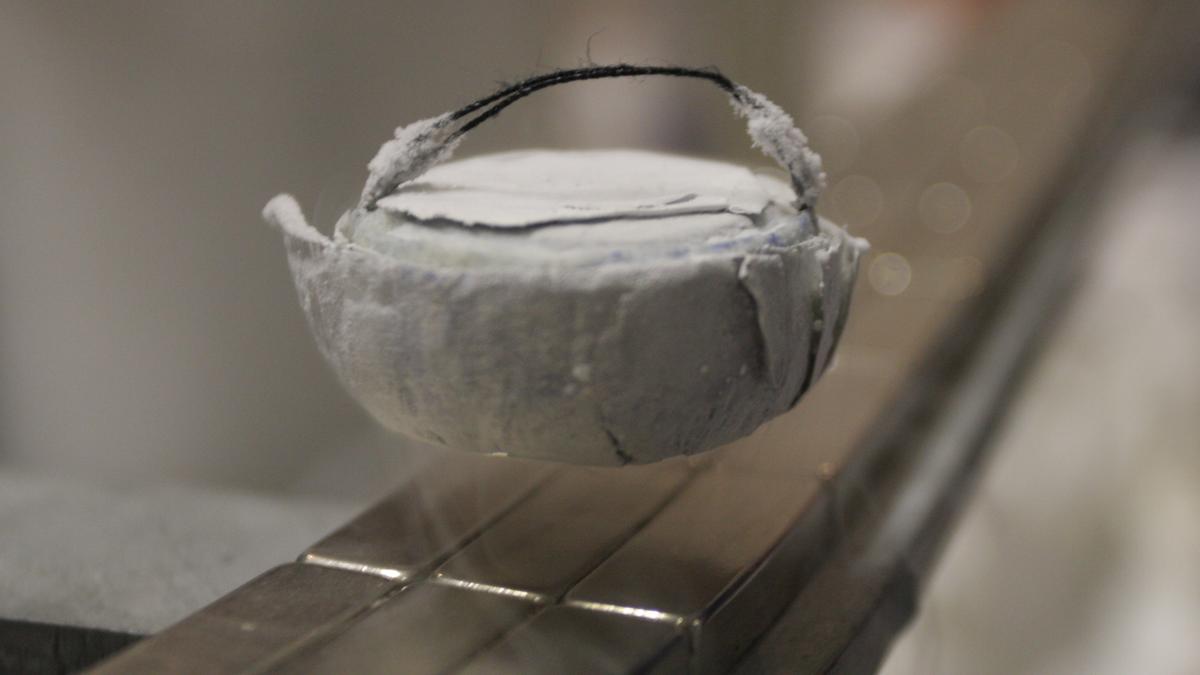
The LK-99 story from 2023 provides a real-world example. A South Korean team claimed to have found a material called copper-doped lead apatite, later dubbed LK-99, that was a superconductor in ambient conditions — an entity famously called the holy grail of materials science.
But when independent researchers synthesised the material and broadened the checks, they couldn’t find definitive evidence of zero electrical resistance in ambient conditions. Subsequently, multiple researchers argued that what looked like evidence of superconductivity in LK-99 could arise from impurities introduced when it was synthesised in the lab.
Undulating plateau
Second, the team looked for Majorana particles, quantum particles that are their own antiparticles (if that sounds weird, it is). These particles would show up as peaks on a graph in their measurements. But they found something even better: a plateau, where the signal stayed constant over a range of conditions. This was exciting because fleeting peaks could be caused by ordinary effects whereas a stable plateau suggested a persistent underlying phenomenon.
When they checked other settings in the same device or measured at different times, they found plateaus at different heights: some higher than expected, some lower. This showed they could ‘tune’ their device to produce whatever plateau height they wanted.
This is because the plateaus were actually caused by unintended quantum dots, small regions where electrons get trapped, in their device — not Majorana particles.
There’s a real-world example here as well. In 2017, a research team from the University of California, Los Angeles, reported an exciting result while studying a material that could carry electricity only along its edges in an unusual way. They connected this material to a superconductor and measured how easily electric current flowed through the device, and saw a flat plateau where the signal stayed almost constant over a range of settings. Many people thought it might be a sign of an exotic kind of quantum behaviour linked to Majorana particles.
But later work revealed that in devices of this kind, a plateau can sometimes emerge from the way the metal contacts touch the material, among other factors. And these effects could ‘trap’ the readings into a flat value for a while even if no Majorana particles are involved.
Staircase illusion
When studying how certain electric circuits behave when struck by radio waves, scientists expect to see a staircase pattern called Shapiro steps: the current increases in steps when the voltage is changed, not continuously For the exotic fractional Josephson effect associated with Majorana particles, every other step should disappear, i.e. you’d only see steps 2, 4, 6, but not 1, 3, 5. And that’s exactly what they observed.
But at different settings and frequencies, the pattern changed. Sometimes even-numbered steps disappeared. Sometimes extra steps appeared. The team realised that the device wasn’t in the right conditions for topological effects anyway. Among others, it needed a strong magnetic field, which wasn’t applied.
The missing steps were probably caused by other effects in the circuit, like heating or electrical noise, not exotic physics. It’s like looking at a staircase in dim lighting where every other step is in shadow: it might look like those steps are missing, but they’re hidden by ordinary circumstances.
Fractional charges
The researchers studied a quantum dot, a small artificial atom (its inventors won the 2023 Nobel Prize for chemistry). As they varied the voltage, they expected to see a regular pattern as electrons were added one by one. Instead, they saw the pattern shift by fractions, especially by about 1/3. This could mean particles with fractional charges, like 1/3rd of an electron’s charge, were being added to the dot. Fractional charges could be evidence of anyons.
Fractional charges should only appear in very specific conditions, specifically in something called the fractional quantum Hall effect, which requires strong magnetic fields. But the researchers observed their readings with no magnetic field.
The real explanation turned out to be simpler: there were (undesirable) regions nearby that could trap electrons. When an electron jumped into one of these nearby traps, it changed the electrical environment of the main quantum dot by just the right amount to make it look like a fractional charge had been added.
In all four cases, the initial data looked promising. But when the researchers measured over wider ranges of conditions, collected more data over more time, studied multiple samples instead of just one, and actively looked for alternative explanations, they found the exciting signals probably weren’t evidence of the exotic physics they were hoping for.
Share all data
The new review isn’t saying these discoveries are impossible or that the researchers were doing bad science but that at the ‘nanoscopic’ scales at which topological effects play out, materials are complicated and many different effects can create apparently similar patterns.
To navigate this landscape, the team recommended some changes to the way researchers research. The first was for them to share all their data rather than just the ‘exciting’ parts. For instance, if they collect data from 10 devices over six months, they’re better off sharing all of it, not just the one device that looked most promising.
Second, the team recommended researchers should look for data to confirm their hypothesis as well as search for conditions in which the effect should disappear or change, and confirm that it actually does. Further, scientists should also openly discuss alternative explanations in their papers.
Finally, the team said researchers should be transparent about how much they had to fine-tune their setup until the effect they were looking for appeared. If they had to adjust five different settings to very precise values to see the effect, that could mean they’ve accidentally found a quirk of their specific device rather than a fundamental physical phenomenon.
mukunth.v@thehindu.co.in