



Skip to content
  • Facebook
  • X
  • Linkedin
  • WhatsApp
  • YouTube
  • Associate Journalism
  • About Us
  • Privacy Policy
  • 033-46046046
  • editor@artifex.news
Artifex.News

Artifex.News

Stay Connected. Stay Informed.

  • Breaking News
  • World
  • Nation
  • Sports
  • Business
  • Science
  • Entertainment
  • Lifestyle
  • Toggle search form
  • 2 Security Personnel Killed, 11 Injured In Anti-Terror Operation In Pak
    2 Security Personnel Killed, 11 Injured In Anti-Terror Operation In Pak World
  • Liverpool Boss Arne Slot Charged After Clashing With Officials
    Liverpool Boss Arne Slot Charged After Clashing With Officials Sports
  • 1st T20I Live: Shubman Gill-Led India Eye Winning Start vs Zimbabwe
    1st T20I Live: Shubman Gill-Led India Eye Winning Start vs Zimbabwe Sports
  • Sensex jumps 1,022.50 points; Nifty inches near record high on U.S. fed rate cut hopes
    Sensex jumps 1,022.50 points; Nifty inches near record high on U.S. fed rate cut hopes Business
  • Access Denied
    Access Denied Nation
  • Ten Indian nationals indicted in U.S. for visa fraud conspiracy
    Ten Indian nationals indicted in U.S. for visa fraud conspiracy Nation
  • Pawan Singh, BJP’s Pick From Asansol, Says He Won’t Contest Lok Sabha Polls
    Pawan Singh, BJP’s Pick From Asansol, Says He Won’t Contest Lok Sabha Polls Nation
  • Nawaz Sharif Alleges Ex-Chief Justice Conspired To Oust Him As Pak PM In 2017
    Nawaz Sharif Alleges Ex-Chief Justice Conspired To Oust Him As Pak PM In 2017 World
How the Aravalli Hills formed and why they look the way they do

How the Aravalli Hills formed and why they look the way they do

Posted on December 28, 2025 By admin


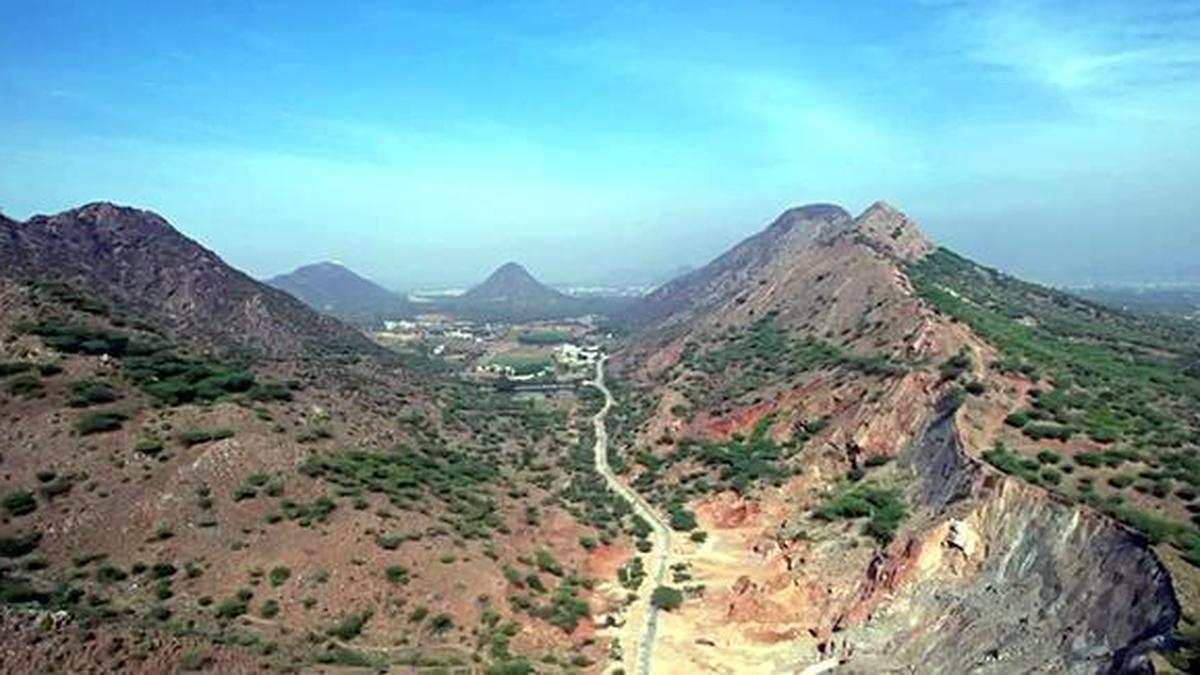
A drone view of the Aravalli Hills in Ajmer.
| Photo Credit: ANI

The Aravalli Hills look modest today but they sit on some of the oldest and most studied rocks in India. Geologists care about them because they preserve a long record of how a piece of the earth’s crust in northwestern India was built, deformed, heated, and intruded by magma, then worn down.

The Hills’ features are better understood as part of a belt of ancient rocks that many scholars have called the Aravalli-Delhi orogenic belt. Within this belt, geologists have distinguished two broad successions of rocks, called the older Aravalli Supergroup and the younger Delhi Supergroup.

Making the Aravalli

Before the Aravalli sediments were laid down, an older crustal foundation already existed in the region. Research has described this basement and the overlying Aravalli succession as a connected system, with sediments accumulating on older crust. Many researchers have interpreted the earliest phase as one in which the crust stretched and thinned, creating basins. Rivers and shallow seas then filled these basins with sand, mud, and carbonate sediments and in some places with volcanic material.

This means the ‘raw material’ for the Aravalli Hills first appeared as sedimentary layers in the basins rather than as a preexisting ridge.

According to geologists, these basins later closed when tectonic forces pushed the crustal blocks together. The layered rocks folded, broke along faults, and were carried over one another along thrusts. As the rocks were buried deeper and were heated, many of them changed (metamorphism), with sandstone turning into quartzite, mudstone into phyllite or schist, and limestone into marble. Studies have also confirmed the presence of large crustal structures consistent with this kind of compression and thrusting at depth.

There were also episodes when magma rose into the crust and crystallised as granitoid bodies. Using zircon dating, geologists have constrained when such intrusions formed. One 2003 study reported a zircon age of about 967.8 million years, give or take 1.2 million years, for the Chang pluton granitoid gneiss in central Rajasthan. This kind of dated intrusion is a mark that tectonic and thermal activity continued long after the earlier sedimentation.

Even after compression and intrusion, the present landscape didn’t appear overnight. Over a very long span of time, while the more resistant rocks, especially quartzite, tended to remain as ridges, wind and water wore the weaker rocks down faster. A 2022 review of the Delhi Supergroup and Delhi Basin emphasised that the belt’s history spans long intervals and multiple tectonic and thermal episodes, which geologists have said could explain why the present hills are really remnants rather than a young, steep mountain range.

Geology to environment

The geology of the Aravalli Hills influences the local soils and movement of water by the kinds of rocks present, the way those rocks break and weather, and the rainfall patterns.

Quartzite is common in many Aravalli ridges. This type of rock is tough because it forms when sandstone is buried and heated until the grains recrystallise and lock together. When quartzite reaches the surface, it often forms rocky ridges with thin soils. Thin soils hold less water and fewer nutrients, which affects what plants can grow and how quickly the slopes erode after being disturbed. In practical terms, the ridge can support vegetation but it’s also easier to damage and slower to recover if the soil is stripped away.

Hard crystalline and metamorphic rocks usually don’t store much water in pores the way sand does. Instead groundwater often lies in fractures and joints and in weathered zones, which means it’s unevenly distributed. Some locations yield water because the rock fractures connect well while nearby locations are dry because the rock is less broken or the weathered layer is thin.

In many parts of the Aravalli Hills, most of the monsoon rains arrive in a few months and there are long dry periods in between. One July 2025 study of the Northern Ridge in Delhi described a climate with hot summers and annual rainfall averaging 710 mm — the kind of seasonality known to favour plants that can tolerate drought.

Because the Hills’ soils are typically thin and there’s little water outside the southwest monsoon, even small disturbances can have lasting effects. Quarrying and mining both remove soil and alter the local drainage. A field study in the Asola Bhatti area in 2018 reported patterns of soil erosion consistent with such disturbances and linked them to lower soil richness and diversity. The researchers also noted that the soil could regenerate in some sites but only if conditions allowed.

Published – December 28, 2025 12:23 pm IST



Source link

Science

Post navigation

Previous Post: Access Denied
Next Post: Editors Council accuses section in Bangladesh’s interim government of allowing violence

Related Posts

  • Soft matter: the unusual yet persistent physics inside your bathroom cabinet
    Soft matter: the unusual yet persistent physics inside your bathroom cabinet Science
  • What is ‘Net Zero’, anyway? A short history of a monumental concept
    What is ‘Net Zero’, anyway? A short history of a monumental concept Science
  • Scientists, diplomats should discuss evolution of quantum computing: Marilyne Andersen
    Scientists, diplomats should discuss evolution of quantum computing: Marilyne Andersen Science
  • Why we need to change the way we talk about antibiotic resistance
    Why we need to change the way we talk about antibiotic resistance Science
  • When you spill coffee, why does it leave circular stains?
    When you spill coffee, why does it leave circular stains? Science
  • UN holds emergency talks over sky-high costs for COP30 climate summit
    UN holds emergency talks over sky-high costs for COP30 climate summit Science

More Related Articles

India adds 641 new animal species, 339 new plant taxa in 2023 India adds 641 new animal species, 339 new plant taxa in 2023 Science
The Science Quiz | Remembering a star that was briefly the brightest… The Science Quiz | Remembering a star that was briefly the brightest… Science
Nobel Prize 2024: When and where to watch the announcements? Nobel Prize 2024: When and where to watch the announcements? Science
Patent applications for HIV prevention drug opposed in India Patent applications for HIV prevention drug opposed in India Science
Does research strengthen teaching? – The Hindu Does research strengthen teaching? – The Hindu Science
Why is India on the U.S. blacklist on fentanyl? | Explained Why is India on the U.S. blacklist on fentanyl? | Explained Science
SiteLock

Archives

  • May 2026
  • April 2026
  • March 2026
  • February 2026
  • January 2026
  • December 2025
  • November 2025
  • October 2025
  • September 2025
  • August 2025
  • July 2025
  • June 2025
  • May 2025
  • April 2025
  • March 2025
  • February 2025
  • January 2025
  • December 2024
  • November 2024
  • October 2024
  • September 2024
  • August 2024
  • July 2024
  • June 2024
  • May 2024
  • April 2024
  • March 2024
  • February 2024
  • January 2024
  • December 2023
  • November 2023
  • October 2023
  • September 2023
  • August 2023
  • July 2023
  • June 2023
  • May 2023
  • April 2023
  • March 2023
  • February 2023
  • January 2023
  • December 2022
  • November 2022
  • October 2022
  • September 2022
  • August 2022
  • July 2022
  • June 2022
  • May 2022

Categories

  • Business
  • Nation
  • Science
  • Sports
  • World

Recent Posts

  • Maruti Suzuki crosses 3 million vehicle dispatches through railways, eyes 35% share by rail
  • Delhi High Court refuses to entertain PIL to prevent suicides
  • Gold ETF prices revive as investors flock on higher import duties on yellow metal
  • Kashmir MLA ‘boycotts’ L-G’s drug campaign after demolition drive in his constituency
  • Assam ships first legal agarwood chips to West Asia

Recent Comments

  1. Jeffreyroure on UP Teacher Who Asked Students To Slap Muslim Classmate
  2. Stevemonge on UP Teacher Who Asked Students To Slap Muslim Classmate
  3. RichardClage on UP Teacher Who Asked Students To Slap Muslim Classmate
  4. StevenLek on UP Teacher Who Asked Students To Slap Muslim Classmate
  5. Leonardren on UP Teacher Who Asked Students To Slap Muslim Classmate
  • Access Denied Sports
  • Access Denied Sports
  • After 4 Decades, Bhopal Rid Of Toxic Waste From 1984 Gas Tragedy
    After 4 Decades, Bhopal Rid Of Toxic Waste From 1984 Gas Tragedy Nation
  • Sudip Chatterjee’s patient knock keeps Bengal afloat on day one
    Sudip Chatterjee’s patient knock keeps Bengal afloat on day one Sports
  • “Appreciate Relationship With India, But China Remains Challenge”: US
    “Appreciate Relationship With India, But China Remains Challenge”: US Nation
  • Mid-Air Drama Over Maharashtra Ex Minister’s Son’s Trip to Bangkok
    Mid-Air Drama Over Maharashtra Ex Minister’s Son’s Trip to Bangkok Nation
  • Nice Suspend Defender Youcef Atal For Alleged Anti-Semitic Post
    Nice Suspend Defender Youcef Atal For Alleged Anti-Semitic Post Sports
  • Access Denied Sports

Editor-in-Chief:
Mohammad Ariff,
MSW, MAJMC, BSW, DTL, CTS, CNM, CCR, CAL, RSL, ASOC.
editor@artifex.news

Associate Editors:
1. Zenellis R. Tuba,
zenelis@artifex.news
2. Haris Daniyel
daniyel@artifex.news

Photograher:
Rohan Das
rohan@artifex.news

Artifex.News offers Online Paid Internships to college students from India and Abroad. Interns will get a PRESS CARD and other online offers.
Send your CV (Subjectline: Paid Internship) to internship@artifex.news

Links:
Associate Journalism
About Us
Privacy Policy

News Links:
Breaking News
World
Nation
Sports
Business
Entertainment
Lifestyle

Registered Office:
72/A, Elliot Road, Kolkata - 700016
Tel: 033-22277777, 033-22172217
Email: office@artifex.news

Editorial Office / News Desk:
No. 13, Mezzanine Floor, Esplanade Metro Rail Station,
12 J. L. Nehru Road, Kolkata - 700069.
(Entry from Gate No. 5)
Tel: 033-46011099, 033-46046046
Email: editor@artifex.news

Copyright © 2023 Artifex.News Newsportal designed by Artifex Infotech.