

Skip to content
  • Facebook
  • X
  • Linkedin
  • WhatsApp
  • Associate Journalism
  • About Us
  • Privacy Policy
  • 033-46046046
  • editor@artifex.news
Artifex.News

Artifex.News

Stay Connected. Stay Informed.

  • Breaking News
  • World
  • Nation
  • Sports
  • Business
  • Science
  • Entertainment
  • Lifestyle
  • Toggle search form
  • Ranji Trophy | Home team Karnataka out to test misfiring Chandigarh
    Ranji Trophy | Home team Karnataka out to test misfiring Chandigarh Sports
  • Woman Among 3 Arrested For Killing Noida Contractor Over Alleged Affair
    Woman Among 3 Arrested For Killing Noida Contractor Over Alleged Affair Nation
  • Germany to resume cooperation with Palestinian UNRWA agency
    Germany to resume cooperation with Palestinian UNRWA agency World
  • India Signs 10-Year Contract To Operate Iran’s Key Chabahar Port
    India Signs 10-Year Contract To Operate Iran’s Key Chabahar Port World
  • Typhoon Gaemi: Eleven killed by mudslide in China as heavy rains drench region
    Typhoon Gaemi: Eleven killed by mudslide in China as heavy rains drench region World
  • 'Looking Forward To Face Australia': Harmanpreet Ahead Of Women's T20 WC
    'Looking Forward To Face Australia': Harmanpreet Ahead Of Women's T20 WC Sports
  • ISRO’s Chandrayaan-3 moon lander separates from propulsion module
    ISRO’s Chandrayaan-3 moon lander separates from propulsion module Science
  • Looking forward to speed up greater economic cooperation with India: Sri Lanka President Wickremesinghe
    Looking forward to speed up greater economic cooperation with India: Sri Lanka President Wickremesinghe World
Will new Act aid India’s nuclear development? | Explained

Will new Act aid India’s nuclear development? | Explained

Posted on December 20, 2025 By admin


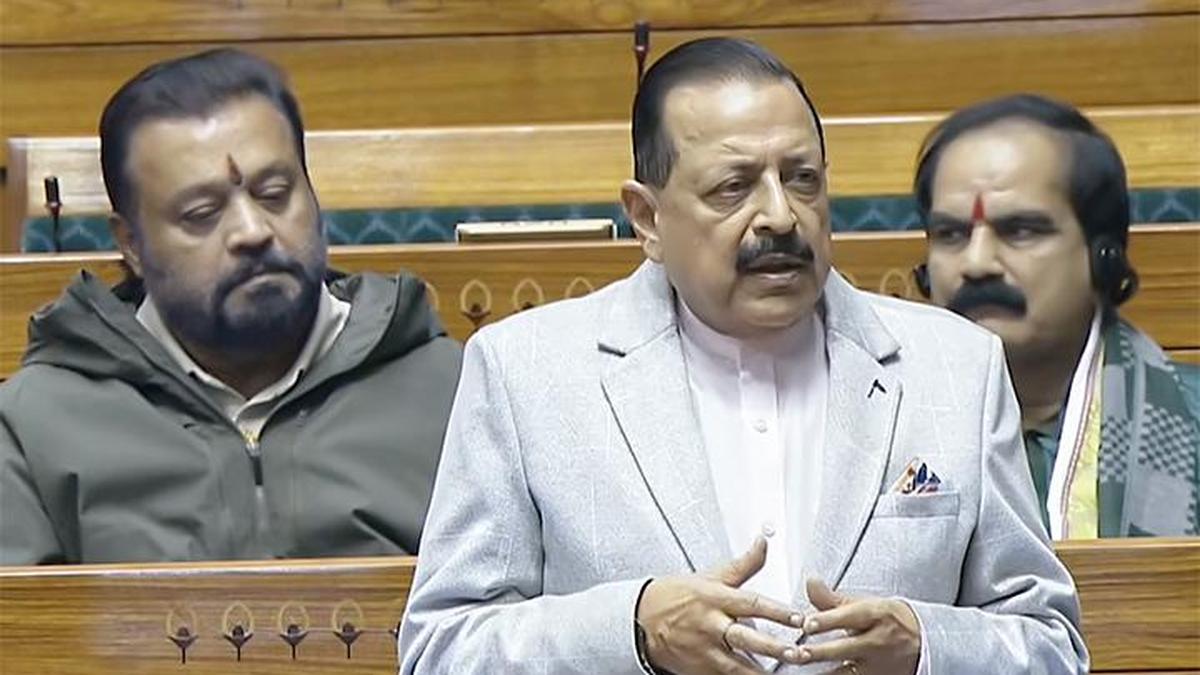
Union MoS Jitendra Singh speaks in the Lok Sabha during the ongoing Winter Session of the Parliament, in New Delhi.
| Photo Credit: ANI

The story so far: Parliament has brought into force the Sustainable Harnessing and Advancement of Nuclear Energy for Transforming India (SHANTI) Act which repeals legislation that governs nuclear activity — the Atomic Energy Act, 1962, and Civil Liability for Nuclear Damage (CLND) Act, 2010.

Why is SHANTI significant?

SHANTI encourages private companies to participate and potentially, allow foreign funding to flow in India’s nuclear sector. Currently, only public sector enterprises can build and operate nuclear power plants in the country. India has plans to increase its current nuclear capacity from 8.8 GW (or about 1.5% of the total installed) to 100 GW by 2047 and thereby increase the contribution of nuclear power to generated electricity from the current 3%. State-owned nuclear power utilities have projected that they will add about 54 GW with the rest, presumably, from private companies.

What are the major differences in SHANTI?

The heart of nuclear power plant operations is safety. Given nuclear energy’s chequered history with atom bombs, there is tight scrutiny of the movement of nuclear fuel (uranium) because of the possibility of it being diverted for producing weapons-grade plutonium. Accidents such as the Three Mile Island disaster in 1979, Chernobyl nuclear meltdown in 1986, and the Fukushima core meltdown following the tsunami in 2011 have contributed to extreme caution and restrictions in all aspects of nuclear plant operations. Currently, the global consensus is that in case of an accident, a plant operator must compensate victims commensurate with the level of damage. Damage can often exceed projections, as has been the case with Fukushima most recently. The agreement is that victims must be compensated immediately without waiting for ascertaining the causes and those responsible for the accident. Following this, however, the plant operator — if it can establish that it was not its management but rather faulty equipment, provided by a supplier, that led to the catastrophe — can claim recourse.

Editorial:On nuclear policy, the SHANTI Bill

The erstwhile CNLD allowed operators to claim recourse from a supplier of equipment under three instances: if a) the supplier and an operator have an explicit agreement (b) the nuclear incident has proved to be due to the suppliers or their equipment’s fault; (c) the nuclear incident has resulted from deliberate intent to cause nuclear damage. In SHANTI, clause (b) has been done away with. Despite the Indo-U.S. nuclear deal of 2008 that allowed India access to uranium and international nuclear technology (restricted, because of its nuclear tests of 1974 and 1998), American, and French makers of reactors were hesitant because as ‘suppliers’ they could in theory be held liable for billions of dollars. With the elimination of clause (b) and even the deletion of the word ‘supplier,’ this ‘problem’ vanishes. Ironically, in 2010, when the Bharatiya Janata Party (BJP) was in the Opposition, it insisted on such a clause and Congress parliamentarians pointed this out during the debate. The BJP-led government’s laconic response to this was that nuclear technology had changed and “changing times” required adapting to new realities.

Does SHANTI load the dice against operators?

The earlier laws enabled those affected by a nuclear accident to claim compensation from a nuclear plant operator for an amount up to ₹1,500 crore. Were nuclear damage to exceed this, the Centre would chip in through an insurance pool up to ₹4,000 crore. SHANTI goes for a graded approach. Only operators of plants above 3,600 MW are liable for a ₹3,000 crore penalty; from 3,600 MW to 1,500 MW, the amount is ₹1,500 crore; from 1,500 MW-750 MW, it is ₹750 crore; from 750 MV-150 MV, it is ₹300 crore; and it is ₹100 crore for plants under 150 MW. All India’s plants are currently 3,000 MW or lower. Science Minister Jitendra Singh, who piloted the legislation in Parliament, said this gradation was meant to “not scare off” potential private sector participants. During the debates, it was pointed out that the costs of reparations often went into billions of dollars, much more than what these caps suggested. The Act also gives a statutory form to the Atomic Energy Regulatory Board, though the Centre still controls functions such as appointing a chairman and providing major licences to an aspirant power plant operator.

Will SHANTI spur India’s nuclear vision?

The original vision of Homi Bhabha, the father of India’s atomic energy programme, was to provide for India’s energy security through nuclear power as well as make up for India’s scarcity of uranium through the use of thorium. This involves, in Stage 1, building and making pressurised heavy water reactors which uses natural uranium (U-238) to produce plutonium and energy. In the second stage, by using ‘fast breeder reactors,’ more plutonium and uranium-233 is made along with energy. In the final stage, U-233 is combined with the plentiful thorium to make electricity and create a self-sustaining U-233-and-thorium power-generating system. India has not yet reached the second stage; it only has a prototype Fast Breeder Reactor. Delayed for 20 years, it was to be active in 2025, but now the commissioning has been further pushed to September 2026. For its nuclear goals, India is looking to rely on Small Modular Reactors (SMRs). They are smaller versions of existing reactors in the U.S. and France that will need enriched uranium-235 (which India lacks), and produces all the radioactive elements — plutonium, strontium etc. — that India’s stage 1 produces. Just as modern airplanes or iPhones are built component by component across the world and assembled centrally, SMRs too will be built in the same way. Though smaller, they also produce less electricity per unit than a large reactor and are costlier unit-wise. They also do not address the problem of nuclear waste better than large reactors though some of them have incorporated better designs that can automatically cause a plant to shut down in case of a threat. While SMRs might help produce electricity, they don’t necessarily help with India’s quest to use thorium as fuel.

Published – December 21, 2025 02:28 am IST



Source link

Science Tags:india nuclear development, nuclear development, nuclear development india

Post navigation

Previous Post: The Pinochet fan – The Hindu

Related Posts

  • India’s ‘heat trap’ cities make summers worse, says government official
    India’s ‘heat trap’ cities make summers worse, says government official Science
  • Is the shallow pool in Paris really slowing Olympic swimmers down?
    Is the shallow pool in Paris really slowing Olympic swimmers down? Science
  • What is Parrondo’s paradox? – The Hindu
    What is Parrondo’s paradox? – The Hindu Science
  • Publish or perish: making sense of India’s research fraud epidemic
    Publish or perish: making sense of India’s research fraud epidemic Science
  • The INO that wasn’t and the JUNO that is
    The INO that wasn’t and the JUNO that is Science
  • Lightning strikes make collecting a fungus for traditional Chinese medicine a deadly pursuit
    Lightning strikes make collecting a fungus for traditional Chinese medicine a deadly pursuit Science

More Related Articles

Sci-Five | The Hindu Science Quiz: On Autism Sci-Five | The Hindu Science Quiz: On Autism Science
Sunita Williams, Butch Wilmore confident Boeing space capsule can safely return them to Earth, despite failures Sunita Williams, Butch Wilmore confident Boeing space capsule can safely return them to Earth, despite failures Science
PixxelSpace India-led consortium to establish India’s first commercial earth observation satellite constellation PixxelSpace India-led consortium to establish India’s first commercial earth observation satellite constellation Science
Gaganyaan astronaut to travel to ISS in joint mission with NASA, says Centre Gaganyaan astronaut to travel to ISS in joint mission with NASA, says Centre Science
Scientists report trees absorb methane as well Scientists report trees absorb methane as well Science
Forest loss from SE Asia rubber is up to 3 times more than thought: study Forest loss from SE Asia rubber is up to 3 times more than thought: study Science
SiteLock

Archives

  • December 2025
  • November 2025
  • October 2025
  • September 2025
  • August 2025
  • July 2025
  • June 2025
  • May 2025
  • April 2025
  • March 2025
  • February 2025
  • January 2025
  • December 2024
  • November 2024
  • October 2024
  • September 2024
  • August 2024
  • July 2024
  • June 2024
  • May 2024
  • April 2024
  • March 2024
  • February 2024
  • January 2024
  • December 2023
  • November 2023
  • October 2023
  • September 2023
  • August 2023
  • July 2023
  • June 2023
  • May 2023
  • April 2023
  • March 2023
  • February 2023
  • January 2023
  • December 2022
  • November 2022
  • October 2022
  • September 2022
  • August 2022
  • July 2022
  • June 2022
  • May 2022

Categories

  • Business
  • Nation
  • Science
  • Sports
  • World

Recent Posts

  • Will new Act aid India’s nuclear development? | Explained
  • The Pinochet fan – The Hindu
  • Flosdorf, Mudd, and a way to handle blood
  • Access Denied
  • Access Denied

Recent Comments

  1. dfb{{98991*97996}}xca on UP Teacher Who Asked Students To Slap Muslim Classmate
  2. "dfbzzzzzzzzbbbccccdddeeexca".replace("z","o") on UP Teacher Who Asked Students To Slap Muslim Classmate
  3. 1}}"}}'}}1%>"%>'%> on UP Teacher Who Asked Students To Slap Muslim Classmate
  4. bfg6520<s1﹥s2ʺs3ʹhjl6520 on UP Teacher Who Asked Students To Slap Muslim Classmate
  5. pHqghUme9356321 on UP Teacher Who Asked Students To Slap Muslim Classmate
  • Chile’s giant ‘living fossil’ frog faces threat from climate change and humans
    Chile’s giant ‘living fossil’ frog faces threat from climate change and humans Science
  • Rohit Sharma Provides Update On Axar Patel, Shreyas Iyer Ahead Of Australia ODIs
    Rohit Sharma Provides Update On Axar Patel, Shreyas Iyer Ahead Of Australia ODIs Sports
  • In A First, Niira Radia Shares Why Ratan Tata Decided To Build The Tata Nano
    In A First, Niira Radia Shares Why Ratan Tata Decided To Build The Tata Nano Nation
  • S Jaishankar On West’s Poll Critique
    S Jaishankar On West’s Poll Critique Nation
  • PM Modi In Maharashtra On Statue Collapse
    PM Modi In Maharashtra On Statue Collapse Nation
  • Latest Flashpoint In Trinamool vs Bengal Government: Rejected Bills
    Latest Flashpoint In Trinamool vs Bengal Government: Rejected Bills Nation
  • U.K. PM Rishi Sunak plans mandatory National Service for 18-year-olds if Tories win election
    U.K. PM Rishi Sunak plans mandatory National Service for 18-year-olds if Tories win election World
  • US Claims Hamas’ Number 3 Commander Marwan Issa Killed In Israeli Operation
    US Claims Hamas’ Number 3 Commander Marwan Issa Killed In Israeli Operation World

Editor-in-Chief:
Mohammad Ariff,
MSW, MAJMC, BSW, DTL, CTS, CNM, CCR, CAL, RSL, ASOC.
editor@artifex.news

Associate Editors:
1. Zenellis R. Tuba,
zenelis@artifex.news
2. Haris Daniyel
daniyel@artifex.news

Photograher:
Rohan Das
rohan@artifex.news

Artifex.News offers Online Paid Internships to college students from India and Abroad. Interns will get a PRESS CARD and other online offers.
Send your CV (Subjectline: Paid Internship) to internship@artifex.news

Links:
Associate Journalism
About Us
Privacy Policy

News Links:
Breaking News
World
Nation
Sports
Business
Entertainment
Lifestyle

Registered Office:
72/A, Elliot Road, Kolkata - 700016
Tel: 033-22277777, 033-22172217
Email: office@artifex.news

Editorial Office / News Desk:
No. 13, Mezzanine Floor, Esplanade Metro Rail Station,
12 J. L. Nehru Road, Kolkata - 700069.
(Entry from Gate No. 5)
Tel: 033-46011099, 033-46046046
Email: editor@artifex.news

Copyright © 2023 Artifex.News Newsportal designed by Artifex Infotech.