



Skip to content
  • Facebook
  • X
  • Linkedin
  • WhatsApp
  • YouTube
  • Associate Journalism
  • About Us
  • Privacy Policy
  • 033-46046046
  • editor@artifex.news
Artifex.News

Artifex.News

Stay Connected. Stay Informed.

  • Breaking News
  • World
  • Nation
  • Sports
  • Business
  • Science
  • Entertainment
  • Lifestyle
  • Toggle search form
  • Access Denied Sports
  • Windfall profit tax on crude oil cut; levy on diesel, ATF exports hiked
    Windfall profit tax on crude oil cut; levy on diesel, ATF exports hiked Business
  • Colombia Star James Rodriguez Leaves La Liga For Mexico
    Colombia Star James Rodriguez Leaves La Liga For Mexico Sports
  • Spanish woman gang rape case crimes against foreigners in India rarely result in convictions Data
    Spanish woman gang rape case crimes against foreigners in India rarely result in convictions Data World
  • India vs Australia Boxing day test: Border-Gavaskar Trophy fourth Test in Melbourne: Australian debutant Sam Konstas press conference
    India vs Australia Boxing day test: Border-Gavaskar Trophy fourth Test in Melbourne: Australian debutant Sam Konstas press conference Sports
  • Who gets to own the moon? India is uniquely positioned to answer
    Who gets to own the moon? India is uniquely positioned to answer Science
  • Day After Woman Allegedly Raped, Killed In Manipur, Another Shot Dead Today
    Day After Woman Allegedly Raped, Killed In Manipur, Another Shot Dead Today Nation
  • Investigation into PSLV failures ‘ongoing’, next launch date in June: Minister
    Investigation into PSLV failures ‘ongoing’, next launch date in June: Minister Science
Why has the claimed dark matter discovery sparked debate, caution?

Why has the claimed dark matter discovery sparked debate, caution?

Posted on December 18, 2025 By admin


Is it a false alarm or a discovery that solves one of the greatest mysteries in cosmology? This is the question weighing on astronomers as they examine a study published recently in the Journal of Cosmology and Astroparticle Physics, which claims to have finally detected the elusive ‘dark matter’.

Dark matter is believed to have been around for most of the 14-billion-year history of the universe. Astronomers began searching for it in the early 1930s after the Swiss astronomer Fritz Zwicky observed that galaxies in the Coma Cluster were moving too quickly for the amount of ordinary matter it contained. He realised the speed of their rotation was so great that they should have flown apart as they didn’t have enough matter to generate the gravity needed to hold them together. He deduced that some hidden mass could be providing the ‘extra gravity’ required for the galaxies to stay intact. He named this dark matter.

Invisible WIMPs

According to the Standard Model of particle physics, ordinary (baryonic) matter that makes up the world around us consists of elementary particles such as baryons (protons and neutrons) and electrons, along with the massless photons of electromagnetic radiation such as light. Baryons themselves are made up of even smaller particles called quarks and gluons. But all these fundamental particles form just 5% of all mass in the known universe. Dark matter accounts for 27%, while a mysterious force called ‘dark energy’ makes up the rest.

Physicists don’t know what dark matter is made up of, but one hypothesis they have is a hitherto unknown type of subatomic particle called WIMPs. The name is short for ‘weakly interacting massive particles’. According to physicists, WIMPs barely interact with normal matter and not at all with any form of electromagnetic radiation. Since dark matter doesn’t emit, absorb or reflect light, astronomers can only study its gravitational effect on visible matter, such as stars and galaxies.

The trick to finding it then is to spot its tell-tale signature: high-energy particles, such as gamma-ray photons that are released when two WIMPs collide and annihilate each other.

New claim

Tomonori Totani of the University of Tokyo has now claimed to have identified just such a gamma-ray signal in his study, using data from the Fermi Gamma-ray Space Telescope.

“We detected gamma rays with a photon energy of 20 giga-electron-volts (or 20 billion electron-volts, an extremely large amount of energy) extending in a halo-like structure towards the centre of the Milky Way galaxy” Prof. Totani said. “The gamma-ray emission component closely matches the shape expected from the dark matter halo.”

He added that the measured gamma ray energy spectrum “closely matches model predictions for the annihilation of hypothetical WIMPs with masses roughly 500-times that of a proton.”

Astronomers always knew dark matter must be virtually hiding in plain sight and that they’d find it sooner or later. Has Prof. Totani found it, however? Not quite, say experts, as the research data have to survive rigorous scrutiny and critical evaluation by more independent researchers.

‘Excess’ radiation

“When we see a signal that looks like it could be dark matter, we can check other regions that are rich in dark matter to look for a comparable signal there,” Tracy Slatyer, professor of physics and Director, MIT Centre for Theoretical Physics, told this correspondent via email.

“Studying the detailed properties of the signal would tell if it’s consistent with what we expect from dark matter or if it has traits more consistent with an alternative source. So far, we have had many signals that seemed at first glance like to be dark matter, but subsequent in-depth analysis revealed they were from a different source. Moreover, the overall size of the signal is not what you would expect from classic WIMP models (it is too large), and when we do the test of looking at other dark-matter-rich regions, we do not see a corresponding signal.”

According to Rishi Khatri of the Department of Theoretical Physics at the Tata Institute of Fundamental Research, Mumbai, the findings suggest the detection of an excess of radiation compared to what cosmologists expect from the model of the Milky Way galaxy.
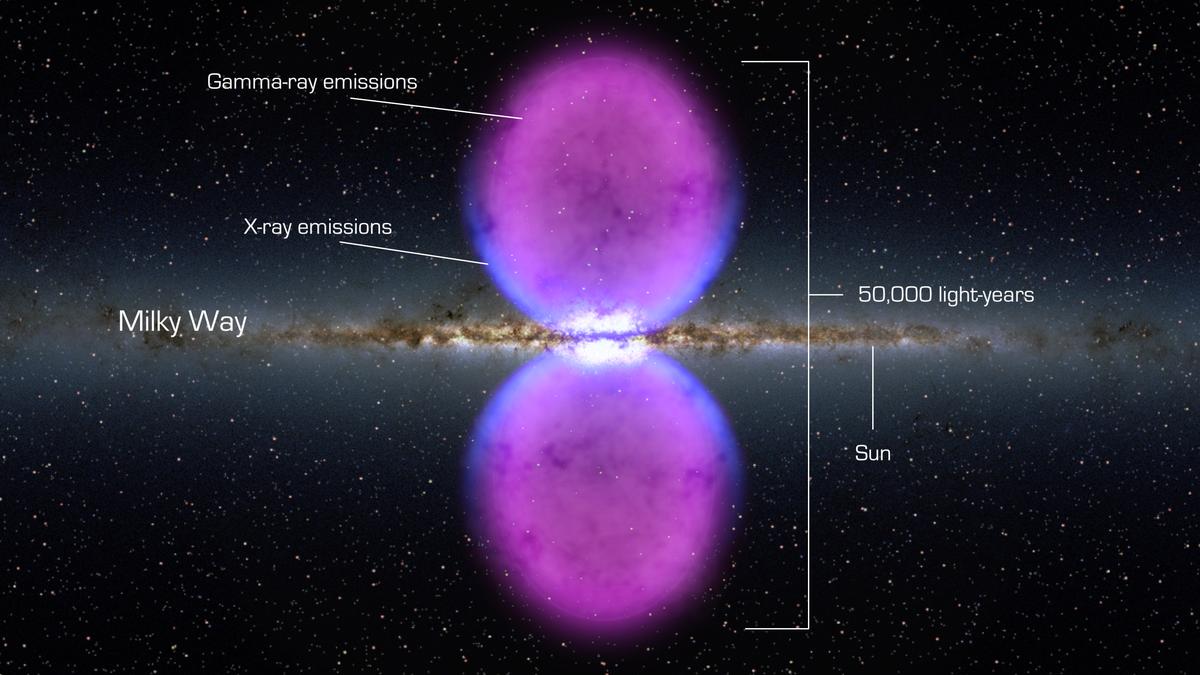
An illustration of the two gigantic X-ray/gamma-ray bubbles (blue-violet) known to be associated with the Milky Way (centre).

An illustration of the two gigantic X-ray/gamma-ray bubbles (blue-violet) known to be associated with the Milky Way (centre).
| Photo Credit:
NASA

“It is possible that this excess is just pointing to something missing in the model of our galaxy rather than dark matter.” Prof. Khatri said in an email interview. “Based on what the study claims, we can predict what kind of signal we can expect from other nearby galaxies and then try to observe these signals. There have been similar claims many times in the past about detection of dark matter but which turned out to be false.”

Radiation from other sources

Discoveries in particle physics have to typically reach a confidence level called ‘5 sigma’ before they are considered valid. Where does the new finding stand on this scale?

“The excess reported in the paper seems to be quite more than 5-sigma, without taking into account the uncertainty in modelling,” Prof. Khatri said. “The author has not given a number with the modelling uncertainty included. This should give you an idea about how uncertain we are about the uncertainty (i.e. error on the error bars) which is very important in such studies.”

An immediate task for astronomers would be to rule out the possibility of the radiation coming from some other sources of high-energy radiation like supernovae, the explosive deaths of massive stars; neutron stars, the ultra-dense collapsed cores of massive stars after supernova explosions; or black holes.

The gravity of dark matter, like normal matter, should cause the light passing nearby to bend, in a phenomenon called gravitational lensing. A spectacular example of this is the Bullet Cluster, where the collision of two clusters of galaxies resulted in the separation of dark matter from normal matter, and astronomers could discern the halos of dark matter around the galaxies by how they bent the path of light.

The LCDM model

If the findings stand up to scrutiny and it turns out that a dark matter particle has actually been found, the widely accepted Lambda-Cold Dark Matter model of the universe wouldn’t have to be modified. This is because, as Prof. Khatri said, “A new particle that would form dark matter is actually included in the LCDM model.”

Instead, “what we do not know is the exact nature of dark matter.”

And “if the dark matter is a 500 GeV WIMP as is claimed, it would be expected to have only very tiny interactions with other dark matter particles or with ordinary matter,” Prof. Slatyer said. “So it would be safe to treat it as having only gravitational interactions, and many of the predictions of LCDM could remain almost unchanged.”

One thing that can be said with certainty is that this grand cosmic narrative is at an exciting stage as astronomers untangle the fabric of the universe to try to understand its evolution and nature.

Prakash Chandra is a science writer.

Published – December 18, 2025 05:30 am IST



Source link

Science

Post navigation

Previous Post: U.S. Senate confirms private astronaut, Musk ally Jared Isaacman as NASA chief
Next Post: Access Denied

Related Posts

  • GSLV mission planned in January would be 100th launch from Sriharikota: ISRO chief
    GSLV mission planned in January would be 100th launch from Sriharikota: ISRO chief Science
  • Sci-Five | The Hindu Science Quiz: On Planetary Nebula
    Sci-Five | The Hindu Science Quiz: On Planetary Nebula Science
  • Study reveals how 3D environments affect bacterial growth and survival
    Study reveals how 3D environments affect bacterial growth and survival Science
  • UoH student’s research offers solution to acid fly problem in hostels
    UoH student’s research offers solution to acid fly problem in hostels Science
  • Scientists solve mystery of prehistoric ‘Burtele Foot’
    Scientists solve mystery of prehistoric ‘Burtele Foot’ Science
  • Life-saving numbers: what the 2026 U.S. cholesterol guidelines mean for everyone
    Life-saving numbers: what the 2026 U.S. cholesterol guidelines mean for everyone Science

More Related Articles

Daily Quiz: On earthquakes – The Hindu Daily Quiz: On earthquakes – The Hindu Science
James Watson, Nobel prize-winning DNA pioneer, dies at 97 James Watson, Nobel prize-winning DNA pioneer, dies at 97 Science
Chest X-ray interpretation using AI can detect more TB cases Chest X-ray interpretation using AI can detect more TB cases Science
The evolutionary history of flowering plants are threatened with extinction The evolutionary history of flowering plants are threatened with extinction Science
23 private companies in race for SSLV tech transfer from ISRO 23 private companies in race for SSLV tech transfer from ISRO Science
J. Craig Venter, who won the race to sequence the human genome, dies at 79 J. Craig Venter, who won the race to sequence the human genome, dies at 79 Science
SiteLock

Archives

  • May 2026
  • April 2026
  • March 2026
  • February 2026
  • January 2026
  • December 2025
  • November 2025
  • October 2025
  • September 2025
  • August 2025
  • July 2025
  • June 2025
  • May 2025
  • April 2025
  • March 2025
  • February 2025
  • January 2025
  • December 2024
  • November 2024
  • October 2024
  • September 2024
  • August 2024
  • July 2024
  • June 2024
  • May 2024
  • April 2024
  • March 2024
  • February 2024
  • January 2024
  • December 2023
  • November 2023
  • October 2023
  • September 2023
  • August 2023
  • July 2023
  • June 2023
  • May 2023
  • April 2023
  • March 2023
  • February 2023
  • January 2023
  • December 2022
  • November 2022
  • October 2022
  • September 2022
  • August 2022
  • July 2022
  • June 2022
  • May 2022

Categories

  • Business
  • Nation
  • Science
  • Sports
  • World

Recent Posts

  • Eighth Indian Open Para Athletics Championships
  • Himachal panchayat polls: 78.53% polling in first phase, women voters outnumber men
  • Mundamveli residents lay day-long siege to GCDA headquarters
  • Sports Ministry notifies formation of NSB and NST to streamline governance and minimise litigation
  • India’s energy strategy needs price correction

Recent Comments

  1. Josephcug on UP Teacher Who Asked Students To Slap Muslim Classmate
  2. MichaelDat on UP Teacher Who Asked Students To Slap Muslim Classmate
  3. RobertBRINA on UP Teacher Who Asked Students To Slap Muslim Classmate
  4. GeorgeKek on UP Teacher Who Asked Students To Slap Muslim Classmate
  5. Elbertcrumn on UP Teacher Who Asked Students To Slap Muslim Classmate
  • T20 World Cup: New York’s notorious drop-in pitches gets six ‘satisfactory’ ratings
    T20 World Cup: New York’s notorious drop-in pitches gets six ‘satisfactory’ ratings Sports
  • Kamala Harris’ Message As She Concedes To Trump
    Kamala Harris’ Message As She Concedes To Trump World
  • Access Denied
    Access Denied Nation
  • PM Modi Begins Parliament Session With ‘Emergency’ Swipe At Congress
    PM Modi Begins Parliament Session With ‘Emergency’ Swipe At Congress Nation
  • US Priest Spends ,000 Of Church Funds On Candy Crush, Arrested
    US Priest Spends $40,000 Of Church Funds On Candy Crush, Arrested World
  • Nasdaq, S&P 500 Edge Lower On Anthropic AI Shock; Dow Jones Rises Business
  • Access Denied
    Access Denied Nation
  • Access Denied Sports

Editor-in-Chief:
Mohammad Ariff,
MSW, MAJMC, BSW, DTL, CTS, CNM, CCR, CAL, RSL, ASOC.
editor@artifex.news

Associate Editors:
1. Zenellis R. Tuba,
zenelis@artifex.news
2. Haris Daniyel
daniyel@artifex.news

Photograher:
Rohan Das
rohan@artifex.news

Artifex.News offers Online Paid Internships to college students from India and Abroad. Interns will get a PRESS CARD and other online offers.
Send your CV (Subjectline: Paid Internship) to internship@artifex.news

Links:
Associate Journalism
About Us
Privacy Policy

News Links:
Breaking News
World
Nation
Sports
Business
Entertainment
Lifestyle

Registered Office:
72/A, Elliot Road, Kolkata - 700016
Tel: 033-22277777, 033-22172217
Email: office@artifex.news

Editorial Office / News Desk:
No. 13, Mezzanine Floor, Esplanade Metro Rail Station,
12 J. L. Nehru Road, Kolkata - 700069.
(Entry from Gate No. 5)
Tel: 033-46011099, 033-46046046
Email: editor@artifex.news

Copyright © 2023 Artifex.News Newsportal designed by Artifex Infotech.