




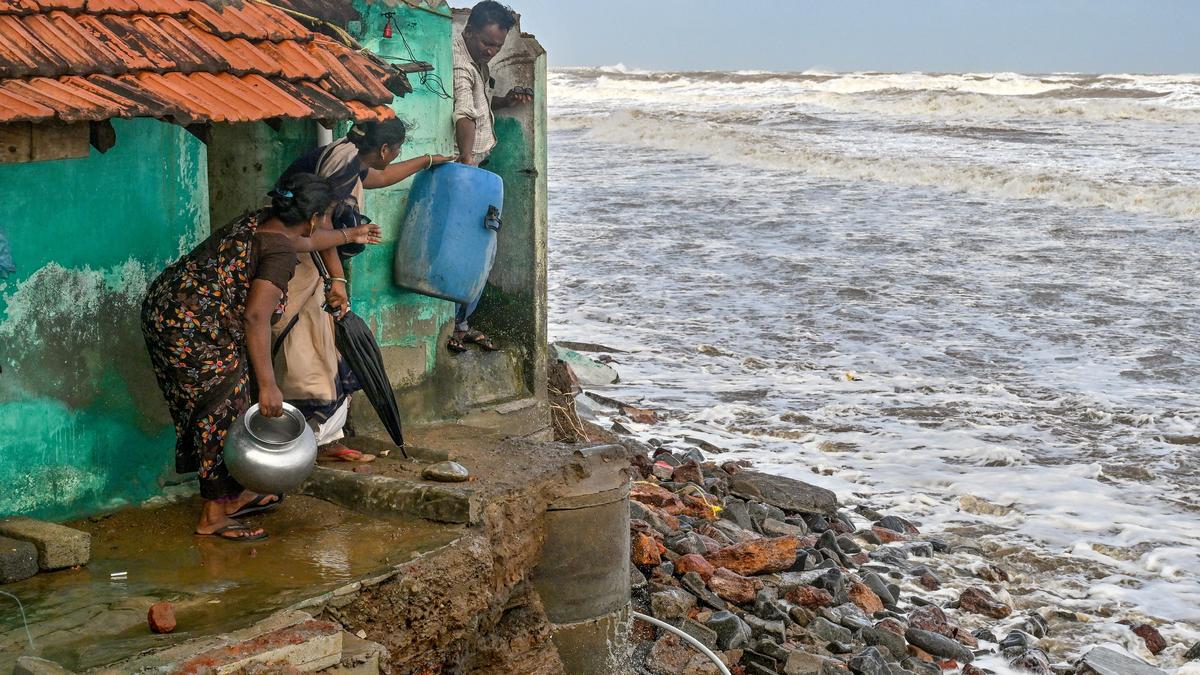
On November 12, Delhi’s air became distinctly unbreathable. A thick blanket of smog enveloped the capital, which recorded an average Air Quality Index (AQI) of over 400, and the pollution was categorised as “severe”. On November 9, Delhiites, aware of the possible respiratory ailments this relapsing crisis could lead to, protested at India Gate. Many were detained.
Meanwhile in April, the India Meteorological Department (IMD) and the Indian Institute of Tropical Meteorology, Pune, released a three-decade long study that established that rainwater, in several parts of the country, was becoming increasingly “acidic.”
In August, there was another environmental disaster, this time in the Himalayas: flash floods inundated Uttarkashi, washing away people and buildings, reportedly caused by a glacial lake burst. While it was small in scale, it was reminiscent of the 2013 Kedarnath tragedy, when over 6,000 people died after an avalanched ruptured the banks of the Chorabari Lake, causing it to burst and release 262 million litres of water within minutes. This was the worst environmental disaster in the country after the 2006 tsunami.
Real world v. models
But can we authoritatively attribute these environmental catastrophes to human-induced climate change? Put another way, while the irrefutable fact is the earth has warmed by more than 1º C since pre-industrial times thanks to human-generated greenhouse gases and there are local events that result in local environmental disasters as well, how sure we can we be that climate change made a cloudburst or a cyclone more likely?
This is where climate attribution science comes in. This field is concerned with estimating how the probability of events or their intensity, duration or frequency are altered by climate change.
“Models try to create a world where climate change didn’t happen and look at the real world where events happened,” earth system scientist Raghu Murtugudde explained. “Models are imperfect, and depending on which of these changes you try to estimate, you can get different answers. An event may have occurred naturally but attribution may say its intensity was made stronger or that its probability was increased and so on,” he told The Hindu.
In general the attribution of heat waves is more accurate than the attribution of extreme rain events, J. Srinivasan, honorary professor at the Divecha Centre for Climate Change, said.
“When a major heat wave strikes Europe or Asia, scientists try to estimate the contribution of increase in carbon dioxide to that particular heat wave. Their attribution will be accurate if the model is good at simulating the past heat waves in that region,” Prof. Srinivasan said.
For instance, acid rain in Visakhapatnam has been associated with fossil fuel emissions from a power plant and a shipping yard, among other activities in the vicinity. Delhi’s extreme pollution has been linked to the city’s many vehicles spewing carbon dioxide and, seasonally, to crop residue burning in neighbouring States (which release organic aerosols), the unchecked use of firecrackers during Diwali, and particular wind patterns.
Identifying point sources
Earlier this year, researchers at Utah State University reported studying the 2013 Kedarnath floods and finding through attribution analysis that northern India has received increasingly large amounts of rain in June since the late 1980s due to more greenhouse gases and aerosols in the atmosphere.
There are two forms of emission attribution, Amit Garg, professor at the Indian Institute of Management Ahmedabad, who specialises in energy, climate change, and sustainable development issues, told The Hindu.
“Point sources of emissions mean large sources at one location such as power plants, steel plants and cement plants, while non-point are dispersed sources such as cars and rice fields.”
A 2007 study published in Environmental Monitoring and Assessment investigated the chemical composition of precipitation over Jharkhand’s Dhanbad, the “coal city of India”. The rain water samples were found to have an average pH of 5.37, “indicating acidic to alkaline nature of rainwater.” This is how researchers tracked down the “point source” of emissions responsible.
Coal mining in Jharia, Dhanbad, emits methane, carbon dioxide, sulphur dioxide, nitrogen oxides, and “dust particles in the atmosphere … [that] act as centres for catalysing chemical reactions, leading to the formation of secondary pollutants such as smog and acid rain,” according to a 2025 paper in International Journal of Scientific Research in Science and Technology.
A nascent science
This said, climate attribution science is still firming up.
For instance chemical transport modelling can now track plumes and satellites can monitor emissions, and “the increase in model resolution has improved the accuracy of attribution,” says Prof. Srinivasan. “If the number of heat waves or floods increase in the simulation with increasing carbon dioxide, we can use statistics to estimate the probability that the increase in floods or heat waves was caused by an increase in carbon dioxide.”
Satellite observations are showing that cyclones are intensifying rapidly on account of high sea-surface temperatures, he added: “With global warming, the water vapour in the atmosphere increases. Weather forecasts from IMD have become more accurate and so deaths from cyclones have reduced dramatically.”
But when there isn’t enough data, “researchers run models for the planet’s climate without increasing greenhouse gas emissions and other anthropogenic forcings. Where there is sufficient data, they use trends in the data to compare conditions today with a period from the past in which human effects on the planet were relatively minimal,” Prof. Murtugudde wrote in The Hindu in May 2024.
One climate attribution model that needs to be better fine tuned is per-capita entitlements, according to Prof. Garg: “Climate change attribution would require per-capita entitlements for greenhouse-gas emissions and equivalent climate risk coverage across populations in all countries and generations for equity and justice.”
Attribution also could, in theory, translate into a way to fix responsibility, especially for rich and developed countries: as Prof. Garg said, “They should ideally commit to pay for the losses imposed on developing countries and the poor all over the world due to as unbridled GHG emissions growth since 1850s.”
India’s contribution to the global increase in cumulative CO2 emissions (since 1850) is less than 6%, Prof. Srinivasan said.
“So what we do in the next 10 years is not as relevant as what we plan to do during the next 50 years. India has made good progress in solar and wind power plants. In the case of batteries the availability of materials may be a bottleneck.”
Going to court
One paper published in Nature in April 2025 went a step further and asked: “Will it ever be possible to sue anyone for damaging the climate?” Because, the paper said, “the scientific and legal implications of an ‘end-to-end’ attribution that links fossil fuel producers to specific damages from warming” are now available.
Using emissions data from major fossil fuel companies, and advances in empirical climate economics, the authors described “the trillions in economic losses attributable to the extreme heat caused by emissions from individual companies.” If extreme weather events such as floods, droughts and extreme heat that upend lives “could be linked to climate change, the logic goes, injured parties could seek monetary or injunctive relief through courts.”