


Skip to content
  • Facebook
  • X
  • Linkedin
  • WhatsApp
  • YouTube
  • Associate Journalism
  • About Us
  • Privacy Policy
  • 033-46046046
  • editor@artifex.news
Artifex.News

Artifex.News

Stay Connected. Stay Informed.

  • Breaking News
  • World
  • Nation
  • Sports
  • Business
  • Science
  • Entertainment
  • Lifestyle
  • Toggle search form
  • Never Closed Doors To Pak, Terrorism Must Be At Centre Of Talks: Minister
    Never Closed Doors To Pak, Terrorism Must Be At Centre Of Talks: Minister Nation
  • S Jaishankar’s ‘Amrit Kaal’ Reference In US
    S Jaishankar’s ‘Amrit Kaal’ Reference In US Nation
  • “I Don’t Think It’s Appropriate…”: South Korea Manager On ‘Protecting’ Heung-Min Son
    “I Don’t Think It’s Appropriate…”: South Korea Manager On ‘Protecting’ Heung-Min Son Sports
  • Case Against Ramdev In Rajasthan For Hurting Religious Sentiments
    Case Against Ramdev In Rajasthan For Hurting Religious Sentiments Nation
  • Access Denied World
  • After Biren Singh’s House Attacked, Meitei Group Issues 24-Hour Ultimatum
    After Biren Singh’s House Attacked, Meitei Group Issues 24-Hour Ultimatum Nation
  • BTS are back: central Seoul locks down for K-pop supergroup’s first show in years
    BTS are back: central Seoul locks down for K-pop supergroup’s first show in years World
  • White House Slams Trump’s Pet-Eating Slur Against Migrants
    White House Slams Trump’s Pet-Eating Slur Against Migrants World
Lost in space? You might need just two stars to find your way

Lost in space? You might need just two stars to find your way

Posted on September 8, 2025 By admin


If you’re lost somewhere on the earth, you can use GPS or public landmarks to find your way back. Navigation in the vastness of space isn’t so easy, however — especially if you’re on a spacecraft racing billions of kilometres away from the earth. There is no GPS in space and where a landmark is depends on where you’re looking from.

But recently, astronomers found that a deceptively simple trick could help the New Horizons spacecraft find its way through space using only two stars.

‘Navigation is essential’

NASA launched New Horizons in 2006 to explore Pluto, its moons, and, later, objects in the Kuiper Belt, a disc of icy rocks and dust in the outer edge of the solar system. New Horizons flew by Pluto in 2015, beaming back stunning images of the dwarf planet and its moons. In 2024, the spacecraft went beyond 60x the sun-earth distance, a new record.

“Navigation is essential, just as it is on the earth,” Max Planck Institute for Astronomy staff member Coryn Bailer-Jones said. “Spacecraft have to know where they are and where they are heading for many reasons” — from planning their fuel use to pointing their antennae to send data back home.

Interplanetary missions like New Horizons are tracked by NASA’s Deep Space Network (DSN), a global array of giant radio antennae that send and receive signals from spacecraft. This system is precise but always earth-centred, i.e. the spacecraft’s location is measured relative to our planet. As spacecraft travel farther, signals between ground stations and the spacecraft drops, increasing communication time and decreasing signal strength. Therefore spacecraft that can find their way without asking for directions from the earth will be at an advantage.

The new study proposes a simple way to do this using stellar parallax, the same method early astronomers used to measure stars’ distances from the earth.

The findings were published in The Astronomical Journal in June.

One eye at a time

As the earth orbits the sun, a star’s position relative to other stars might seem to shift. This is called stellar parallax.

This is because every six months, the earth is on opposite sides of the sun, providing two different viewpoints. You can achieve the same effect by looking at a candle first with only your left right and then only your right eye: the candle will change position against the background.

The amount of shift is called the parallax angle and it’s directly related to the distance to the star.

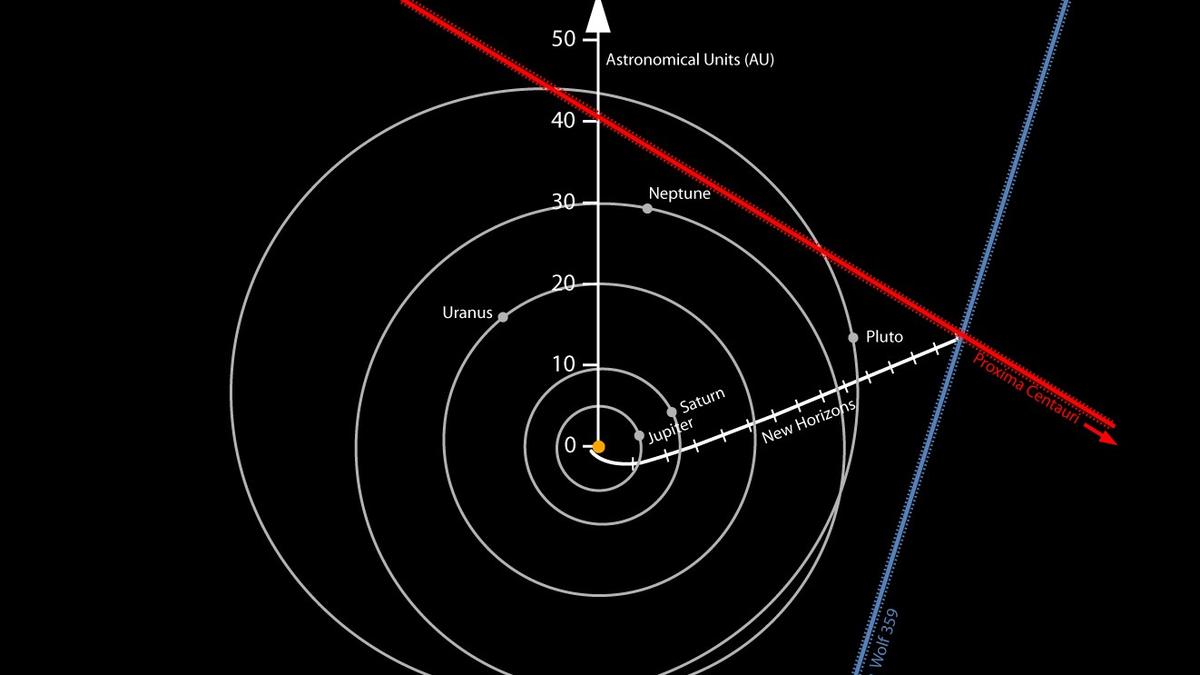
In the study, the astronomers observed two stars from the earth and using New Horizons’ instruments. They’re like two eyes that were 7 billion km apart on April 23, 2020, when the team made the observations.

The two stars were Proxima Centauri and Wolf 359, located 4.2 light-years and 7.9 light-years away from the earth, respectively.

“We wanted large parallaxes, which means using the closest stars,” U.S. National Science Foundation National Optical-Infrared Astronomy Research Laboratory astronomer and the study’s lead author Tod Lauer said.

“Proxima Centauri is the closest star besides the sun. Wolf 359 is in the top five. We also needed stars that were not too bright for the camera. Wolf 359 was … optimal for navigation as it’s close to 90º away from Proxima.”

Self-sufficient

For the study’s purposes, the European Space Agency’s Gaia spacecraft played a vital role: it provided the 3D positions of stars in a fixed, universal reference frame.

With these reference positions, the team measured how much the stars’ positions changed against the background by comparing their positions from New Horizons’ vantage point with those from the earth.

The parallax was 32.4 arcseconds for Proxima and 15.7 arcseconds for Wolf 359 at the time of measurement. (An arcsecond is equal to 1/3600th of a degree.)

This calculation indicated that New Horizons was positioned at 46.89-times the earth-sun distance — close to the 47.11 AU estimated by radio-tracking measurements from the earth.

The technique could be the simplest to navigate spacecraft because it doesn’t require special equipment, Lauer said.

“All it needs is a camera, a standard spacecraft computer, and a catalogue for reference positions on any spacecraft.”

The team wrote in its paper that its demonstration was “educational”, not yet ready for practical use.

“We can’t improve [the accuracy] that much with New Horizons, but a better camera on another spacecraft would help,” Lauer said.

Stars as compass

The “study is a good one and a nice demonstration,” Bailer-Jones, who wasn’t involved in the study, said. “As they themselves note, it is not of practical use to navigate New Horizons, because we can still use earth-based beacons for this [distance].”

“But for much deeper space missions, such as interstellar travel, where beacons are no longer usable, an extension of this method becomes very useful.”

He also said an existing method called stellar astrometric navigation also uses stars as well as accounts for the effects of special relativity to estimate a spacecraft’s 3D position and velocity by measuring the angular separation between two stars in the sky. The new study has proposed a simpler version of this method, he added.

Bailer-Jones also said researchers are investigating another method called pulsar navigation, which uses rapidly spinning neutron stars like lamps in space to show the way.

“It’s potentially much more accurate than stellar astrometric navigation, but it needs reasonable knowledge of the initial position, which the stellar astrometric navigation could supply,” he said.

Lauer said he grew up watching Star Trek and that in one scene, he noticed the stars appeared to move as a spacecraft found its way through deep space. Did the show’s producers know they were being accurate or had they simply missed a detail?

The new method has rendered this question irrelevant.

Shreejaya Karantha is a freelance science writer.

Published – September 08, 2025 05:30 am IST



Source link

Science

Post navigation

Previous Post: Trump attends U.S. Open as Rolex’s guest despite Swiss tariffs
Next Post: Is it possible to mint money from one’s hobbies?

Related Posts

  • Climate change could become the main driver of biodiversity decline by mid-century: report
    Climate change could become the main driver of biodiversity decline by mid-century: report Science
  • Reducing ammonia emissions through targeted fertilizer management
    Reducing ammonia emissions through targeted fertilizer management Science
  • Major cause of inflammatory bowel disease discovered
    Major cause of inflammatory bowel disease discovered Science
  • Science Quiz | The science of taste
    Science Quiz | The science of taste Science
  • India-Canada uranium deal and India’s nuclear programme | Explained
    India-Canada uranium deal and India’s nuclear programme | Explained Science
  • IN-SPACe announces pre-incubation programme for space startups
    IN-SPACe announces pre-incubation programme for space startups Science

More Related Articles

Rising temperatures are leading to torrential rains in the Himalayas Rising temperatures are leading to torrential rains in the Himalayas Science
Auction of world’s largest Mars meteorite sparks ownership debate Auction of world’s largest Mars meteorite sparks ownership debate Science
SpaceX loses contact with Starlink satellite after mishap SpaceX loses contact with Starlink satellite after mishap Science
Leprosy spread between red squirrels and people in medieval England: study Leprosy spread between red squirrels and people in medieval England: study Science
India’s private space sector | History, start-up boom, policy liberalisation & ISRO’s role explained India’s private space sector | History, start-up boom, policy liberalisation & ISRO’s role explained Science
Only united action can stop the hyacinth’s invasion Only united action can stop the hyacinth’s invasion Science
SiteLock

Archives

  • May 2026
  • April 2026
  • March 2026
  • February 2026
  • January 2026
  • December 2025
  • November 2025
  • October 2025
  • September 2025
  • August 2025
  • July 2025
  • June 2025
  • May 2025
  • April 2025
  • March 2025
  • February 2025
  • January 2025
  • December 2024
  • November 2024
  • October 2024
  • September 2024
  • August 2024
  • July 2024
  • June 2024
  • May 2024
  • April 2024
  • March 2024
  • February 2024
  • January 2024
  • December 2023
  • November 2023
  • October 2023
  • September 2023
  • August 2023
  • July 2023
  • June 2023
  • May 2023
  • April 2023
  • March 2023
  • February 2023
  • January 2023
  • December 2022
  • November 2022
  • October 2022
  • September 2022
  • August 2022
  • July 2022
  • June 2022
  • May 2022

Categories

  • Business
  • Nation
  • Science
  • Sports
  • World

Recent Posts

  • Assam swearing-in LIVE: Himanta Biswa Sarma to take oath as Chief Minister
  • Rupee falls to record low of 95.63 against U.S. dollar in early trade
  • PM Modi welcomes move to implement Ayushman Bharat scheme in West Bengal
  • Israeli lawmakers set up special tribunal, allow for death penalty for Hamas-led 2023 attackers
  • Union Minister Pemmasani urges Nitin Gadkari to resolve traffic woes at Guntur bypass

Recent Comments

  1. Richardsally on UP Teacher Who Asked Students To Slap Muslim Classmate
  2. MatthewUsalf on UP Teacher Who Asked Students To Slap Muslim Classmate
  3. Brucetrura on UP Teacher Who Asked Students To Slap Muslim Classmate
  4. Jeffreyroure on UP Teacher Who Asked Students To Slap Muslim Classmate
  5. Edwinloyaf on UP Teacher Who Asked Students To Slap Muslim Classmate
  • Israeli troops capture around 100 Hamas militants in north Gaza hospital, military says
    Israeli troops capture around 100 Hamas militants in north Gaza hospital, military says World
  • Freed Hamas Hostage Recounts Nightmarish Captivity
    Freed Hamas Hostage Recounts Nightmarish Captivity World
  • Access Denied Sports
  • Hardik Pandya set to feature in SMAT for Baroda, likely to return in Indian squad for T20 series against Proteas
    Hardik Pandya set to feature in SMAT for Baroda, likely to return in Indian squad for T20 series against Proteas Sports
  • F1 Great Lewis Hamilton ‘Invigorated’ By Ferrari Move Ahead Of New Season
    F1 Great Lewis Hamilton ‘Invigorated’ By Ferrari Move Ahead Of New Season Sports
  • Rahul Gandhi To Address 2 Poll Rallies In Jammu And Kashmir On September 4
    Rahul Gandhi To Address 2 Poll Rallies In Jammu And Kashmir On September 4 Nation
  • Access Denied Business
  • Access Denied Sports

Editor-in-Chief:
Mohammad Ariff,
MSW, MAJMC, BSW, DTL, CTS, CNM, CCR, CAL, RSL, ASOC.
editor@artifex.news

Associate Editors:
1. Zenellis R. Tuba,
zenelis@artifex.news
2. Haris Daniyel
daniyel@artifex.news

Photograher:
Rohan Das
rohan@artifex.news

Artifex.News offers Online Paid Internships to college students from India and Abroad. Interns will get a PRESS CARD and other online offers.
Send your CV (Subjectline: Paid Internship) to internship@artifex.news

Links:
Associate Journalism
About Us
Privacy Policy

News Links:
Breaking News
World
Nation
Sports
Business
Entertainment
Lifestyle

Registered Office:
72/A, Elliot Road, Kolkata - 700016
Tel: 033-22277777, 033-22172217
Email: office@artifex.news

Editorial Office / News Desk:
No. 13, Mezzanine Floor, Esplanade Metro Rail Station,
12 J. L. Nehru Road, Kolkata - 700069.
(Entry from Gate No. 5)
Tel: 033-46011099, 033-46046046
Email: editor@artifex.news

Copyright © 2023 Artifex.News Newsportal designed by Artifex Infotech.