



Skip to content
  • Facebook
  • X
  • Linkedin
  • WhatsApp
  • YouTube
  • Associate Journalism
  • About Us
  • Privacy Policy
  • 033-46046046
  • editor@artifex.news
Artifex.News

Artifex.News

Stay Connected. Stay Informed.

  • Breaking News
  • World
  • Nation
  • Sports
  • Business
  • Science
  • Entertainment
  • Lifestyle
  • Toggle search form
  • Access Denied Business
  • ZSI scientist discover new species of dogfish shark Squalus hima from India
    ZSI scientist discover new species of dogfish shark Squalus hima from India Science
  • Death toll in Zimbabwe ferry capsizing rises to 68: police
    Death toll in Zimbabwe ferry capsizing rises to 68: police World
  • Badshah Denies Involvement In Traffic Violation
    Badshah Denies Involvement In Traffic Violation Nation
  • Russia, Iran, China’s efforts to sway US voters may escalate, new Microsoft report says
    Russia, Iran, China’s efforts to sway US voters may escalate, new Microsoft report says World
  • Access Denied Sports
  • Record highs and volatile swings: Gold in 2025
    Record highs and volatile swings: Gold in 2025 Business
  • German lawmakers approve plan to attract more military recruits that stops short of conscription
    German lawmakers approve plan to attract more military recruits that stops short of conscription World
Uncovered: how RNA, amino acids may have linked on early earth

Uncovered: how RNA, amino acids may have linked on early earth

Posted on September 7, 2025 By admin


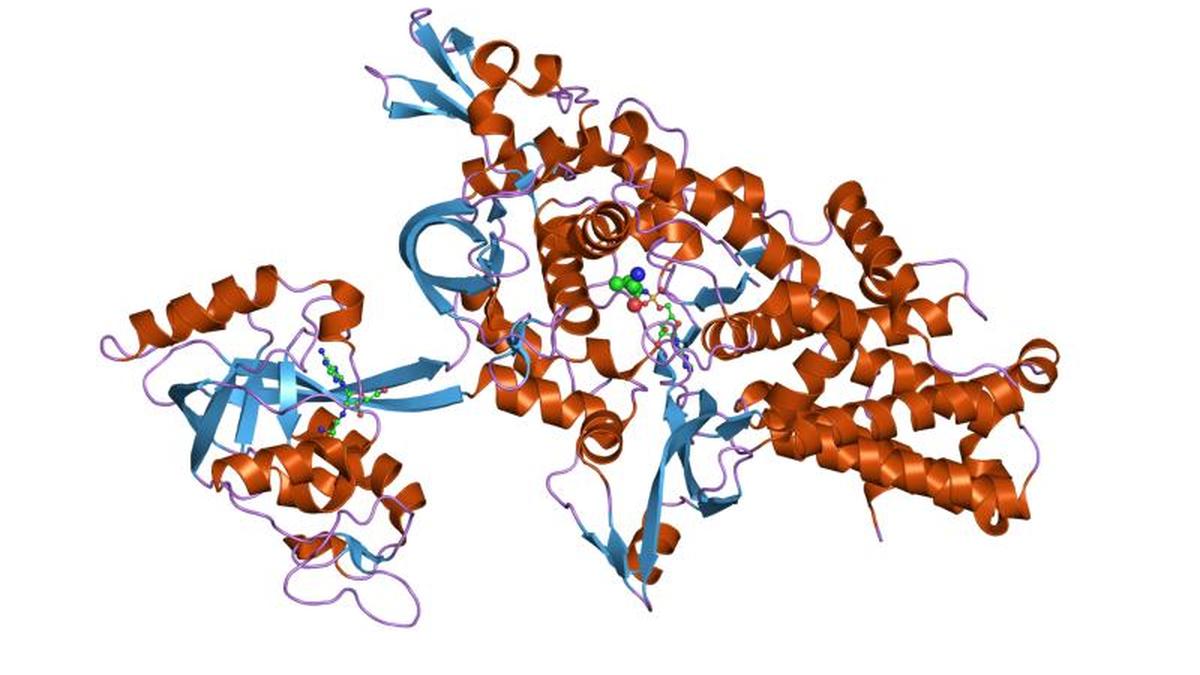
If amino acids are imagined as the beads and RNA as the thread, enzymes like the one shown here (leucyl-tRNA synthetase) string them together.
| Photo Credit: Public domain

Life depends on a partnership between RNA, which stores instructions, and proteins, which do the work of building and running cells. But how this partnership began has long puzzled scientists. To make a protein, constituent amino acids must be linked in the order encoded by RNA. Today, a complex biological machine called the ribosome handles this task — but only after each amino acid is first “loaded” onto an RNA adapter. The catch is that the enzymes responsible for this loading are themselves proteins, creating a chicken-and-egg puzzle that has intrigued chemists for decades.

A new study in Nature offers a glimpse of how this riddle might have been resolved. Researchers at University College London found that simple molecules called aminoacyl-thiols can link amino acids to RNA without enzymes.

Think of amino acids as beads and RNA as the thread. In cells today, enzymes act as skilled hands to string them together. The team showed that, in the right conditions, with aminoacyl-thiols the beads can fasten themselves to the thread in plain water, much like on the early earth.

More strikingly, this aminoacyl-thiol chemistry favours RNA over other, more reactive molecules, which is an unexpected selectivity that has astonished chemists.

“It’s remarkable that RNA, which is relatively unreactive, undergoes aminoacylation in water despite the presence of more reactive species,” said Tom Sheppard, a chemist at UCL not involved in the study.

He added that the chemistry appears robust across many amino acids and simple enough that other labs should be able to reproduce it. By giving RNA a clear chemical advantage, aminoacyl-thiols may have paved the way for the first steps of protein synthesis.

For scientists who study life’s beginnings, the discovery is more than a clever bit of chemistry: it’s a breakthrough that ties two of life’s building blocks together in conditions that could have existed billions of years ago.

“Previous research often looked at either how peptides (chains of amino acids) could form or how nucleotides could form, but rarely how the two might interact,” Sheppard said. “What makes this work significant is that it shows RNA and amino acids talking to each other directly, without any intermediary.”

“This opens a lot of exciting directions to investigate the origins and evolution of protein translation,” Matthew Powner, who led the work, said.

Selectivity and surprises

What struck the researchers the most was not just that the reaction worked but that it showed such uncanny precision. The amino acids latched onto RNA ends in a way that reflects how life does to this day.

Powner said the reactivity was the heart of the discovery: “If I had to pick only one thing that was the most astounding, it would be the unexpected reactivity between aminoacyl-thiols and RNA that led to unprecedented selectivity at neutral pH.”

Sheppard pointed out another interesting facet. Thioesters were once thought to be simple precursors to peptides, but the study found that they are not good at making peptides directly. “Instead,” he said, “they may have played a different role: guiding amino acids onto RNA.”

Even more intriguingly, the team discovered that a simple chemical switch could separate two key stages of modern protein synthesis. With thioesters, amino acids preferentially attach to RNA. But when those same molecules are converted into thioacids, the chemistry flips, favouring the formation of peptide bonds instead. That means the two steps of protein building — RNA-charging and peptide-linking — can be carried out in the same solution but under distinct chemical modes of activation.

The team did not stop there. They also explored where these aminoacyl-thiols might have come from. Their experiments suggested they could form from simple precursors such as nitriles and thiols, even under frigid conditions that concentrated the ingredients and sped up reactions.
This implies the chemistry linking amino acids to RNA may not have required rare settings: it could have unfolded in the ponds or frozen pools of a young earth.

Both Powner and Sheppard agreed that this chemistry is just a starting point. The peptidesmade so far are very short, and figuring out how to extend them will be the next challenge.

“One can imagine a gradual evolution of complexity in the aminoacylation reaction,” Sheppard said, “leading to increasing levels of control by RNA over the peptides that could be formed, and hence the development of a primitive coded peptide synthesis.”

Anirban Mukhopadhyay is a geneticist by training and science communicator from Delhi.

Published – September 07, 2025 05:30 am IST



Source link

Science

Post navigation

Previous Post: BCCI to elect new president during AGM on September 28
Next Post: Britain’s Crown Prosecution Service inspects Tihar jail as India intensifies efforts to extradite fugitives

Related Posts

  • ‘This is crucial juncture for space missions’, says Shubhanshu Shukla, as he prepares for second space voyage
    ‘This is crucial juncture for space missions’, says Shubhanshu Shukla, as he prepares for second space voyage Science
  • IIT-Kanpur team develops new way to predict solar cycles
    IIT-Kanpur team develops new way to predict solar cycles Science
  • The Science Quiz: The Russell-Einstein manifesto
    The Science Quiz: The Russell-Einstein manifesto Science
  • SpaceX took oxygen leak before Axiom-4 launch ‘lightly’: ISRO Chairman
    SpaceX took oxygen leak before Axiom-4 launch ‘lightly’: ISRO Chairman Science
  • Space Wrap: Historic Vikram-1 launch puts Indian spaceflight back on track
    Space Wrap: Historic Vikram-1 launch puts Indian spaceflight back on track Science
  • Sea otters get more prey and reduce tooth damage using tools
    Sea otters get more prey and reduce tooth damage using tools Science

More Related Articles

India’s reservoirs can host 102 GW of floating solar, says first national assessment India’s reservoirs can host 102 GW of floating solar, says first national assessment Science
ICE Cloud promises open, secure supercomputing for complex science research ICE Cloud promises open, secure supercomputing for complex science research Science
Sex systems drive faster mitochondrial evolution in many insects Sex systems drive faster mitochondrial evolution in many insects Science
Rocks’ carbon storage capacity vastly overestimated: study Rocks’ carbon storage capacity vastly overestimated: study Science
Daily Quiz | On renewable energy technologies Daily Quiz | On renewable energy technologies Science
After furore, Customs Department removes punitive tax on laboratory chemicals After furore, Customs Department removes punitive tax on laboratory chemicals Science
SiteLock

Archives

  • September 2026
  • August 2026
  • July 2026
  • June 2026
  • May 2026
  • April 2026
  • March 2026
  • February 2026
  • January 2026
  • December 2025
  • November 2025
  • October 2025
  • September 2025
  • August 2025
  • July 2025
  • June 2025
  • May 2025
  • April 2025
  • March 2025
  • February 2025
  • January 2025
  • December 2024
  • November 2024
  • October 2024
  • September 2024
  • August 2024
  • July 2024
  • June 2024
  • May 2024
  • April 2024
  • March 2024
  • February 2024
  • January 2024
  • December 2023
  • November 2023
  • October 2023
  • September 2023
  • August 2023
  • July 2023
  • June 2023
  • May 2023
  • April 2023
  • March 2023
  • February 2023
  • January 2023
  • December 2022
  • November 2022
  • October 2022
  • September 2022
  • August 2022
  • July 2022
  • June 2022
  • May 2022

Categories

  • Business
  • Nation
  • Science
  • Sports
  • World

Recent Posts

  • Arsenal thrashed by Brighton, sorry Spurs lose again
  • Shamli Police book six over alleged ‘misleading’ social media posts on Ayush Malik High Court proceedings
  • Why has U.S. deployed ‘space weapons’? |Explained
  • How will the U.S.’s Sanctioning Act affect India? | Explained
  • The digital recruiter | Shahzad Bhatti

Recent Comments

  1. AlvinNet on UP Teacher Who Asked Students To Slap Muslim Classmate
  2. AlvinNet on UP Teacher Who Asked Students To Slap Muslim Classmate
  3. Jamesslits on UP Teacher Who Asked Students To Slap Muslim Classmate
  4. MichaelClear on UP Teacher Who Asked Students To Slap Muslim Classmate
  5. Jamesslits on UP Teacher Who Asked Students To Slap Muslim Classmate
  • What makes Skyroot’s Vikram-1 launch unique? | Explained
    What makes Skyroot’s Vikram-1 launch unique? | Explained Nation
  • “Tumko Kuch Nahi Pata”: When MS Dhoni Got Schooled On Stumping By Wife Sakshi
    “Tumko Kuch Nahi Pata”: When MS Dhoni Got Schooled On Stumping By Wife Sakshi Sports
  • Meta says ‘self-defeating’ for EU to hit U.S. tech firms over Greenland
    Meta says ‘self-defeating’ for EU to hit U.S. tech firms over Greenland World
  • In West Bengal, BJP To Test Mamata Banerjee’s Mettle Over Sandeshkhali, Corruption
    In West Bengal, BJP To Test Mamata Banerjee’s Mettle Over Sandeshkhali, Corruption Nation
  • Iran calls for release of pilots captured in Qatar during West Asia war
    Iran calls for release of pilots captured in Qatar during West Asia war World
  • FIFA WORLD CUP 2026 | An improbable relationship that has overcome many obstacles
    FIFA WORLD CUP 2026 | An improbable relationship that has overcome many obstacles Sports
  • Access Denied Sports
  • Rohit Sharma Can Play For 2 More Years, Virat Kohli…”: Harbhajan Singh Makes Big Prediction
    Rohit Sharma Can Play For 2 More Years, Virat Kohli…”: Harbhajan Singh Makes Big Prediction Sports

Editor-in-Chief:
Mohammad Ariff,
MSW, MAJMC, BSW, DTL, CTS, CNM, CCR, CAL, RSL, ASOC.
editor@artifex.news

Associate Editors:
1. Zenellis R. Tuba,
zenelis@artifex.news
2. Haris Daniyel
daniyel@artifex.news

Photograher:
Rohan Das
rohan@artifex.news

Artifex.News offers Online Paid Internships to college students from India and Abroad. Interns will get a PRESS CARD and other online offers.
Send your CV (Subjectline: Paid Internship) to internship@artifex.news

Links:
Associate Journalism
About Us
Privacy Policy

News Links:
Breaking News
World
Nation
Sports
Business
Entertainment
Lifestyle

Registered Office:
72/A, Elliot Road, Kolkata - 700016
Tel: 033-22277777, 033-22172217
Email: office@artifex.news

Editorial Office / News Desk:
No. 13, Mezzanine Floor, Esplanade Metro Rail Station,
12 J. L. Nehru Road, Kolkata - 700069.
(Entry from Gate No. 5)
Tel: 033-46011099, 033-46046046
Email: editor@artifex.news

Copyright © 2023 Artifex.News Newsportal designed by Artifex Infotech.