





Skip to content
  • Facebook
  • X
  • Linkedin
  • WhatsApp
  • YouTube
  • Associate Journalism
  • About Us
  • Privacy Policy
  • 033-46046046
  • editor@artifex.news
Artifex.News

Artifex.News

Stay Connected. Stay Informed.

  • Breaking News
  • World
  • Nation
  • Sports
  • Business
  • Science
  • Entertainment
  • Lifestyle
  • Toggle search form
  • IPL 2025 Mega Auction Day 2: Full List Of Players Who Are To Go Under The Hammer
    IPL 2025 Mega Auction Day 2: Full List Of Players Who Are To Go Under The Hammer Sports
  • Access Denied Business
  • BCCI To Sign Both Gautam Gambhir And WV Raman As Coaches? Report Makes Intriguing Proposal
    BCCI To Sign Both Gautam Gambhir And WV Raman As Coaches? Report Makes Intriguing Proposal Sports
  • 2 Sisters Die By Suicide, Father Accuses Relative Of Molesting Them: Cops
    2 Sisters Die By Suicide, Father Accuses Relative Of Molesting Them: Cops Nation
  • Indian Team Management Holds Brief Meeting With Skipper Rohit Sharma, Head Coach Ahead Of Asia Cup Final: Report
    Indian Team Management Holds Brief Meeting With Skipper Rohit Sharma, Head Coach Ahead Of Asia Cup Final: Report Sports
  • “Gone Too Far”: Ravichandran Ashwin Names James Anderson, Joe Root In Damning Review Of Bazball
    “Gone Too Far”: Ravichandran Ashwin Names James Anderson, Joe Root In Damning Review Of Bazball Sports
  • Anushka Sharma Stunned, Athiya Shetty Distraught As Virat Kohli Disappoints In MCG Test
    Anushka Sharma Stunned, Athiya Shetty Distraught As Virat Kohli Disappoints In MCG Test Sports
  • Access Denied World
How charge-coupled devices revolutionised digital imaging

How charge-coupled devices revolutionised digital imaging

Posted on August 21, 2025 By admin


A charge-coupled device (CCD) is a remarkable electronic component used to capture images by converting light into electrical signals. Its invention marked a significant milestone in technology, influencing fields such as photography, astronomy, medicine, and many others.

What is a CCD?

At the time it was invented in 1969, the CCD was a pioneering technology that converted light into electrical signals using an array of capacitors that transferred electric charges in a sequence. Today, CCD technology has fundamentally transformed how we capture, analyse, and share visual information, representing one of the most important technological advances of the 20th century.

A CCD consists of an integrated circuit made up of an array of small picture elements called pixels. Each pixel acts like a small light sensor that collects photons (the particles of light) and converts them into electrical charges. These charges are then transferred across the device, one pixel at a time, to be read and processed into a digital image.

Imagine a grid where every little square captures some light and turns it into an electric signal that can be measured and displayed as part of a complete picture. That’s what a CCD does.

How was the CCD invented?

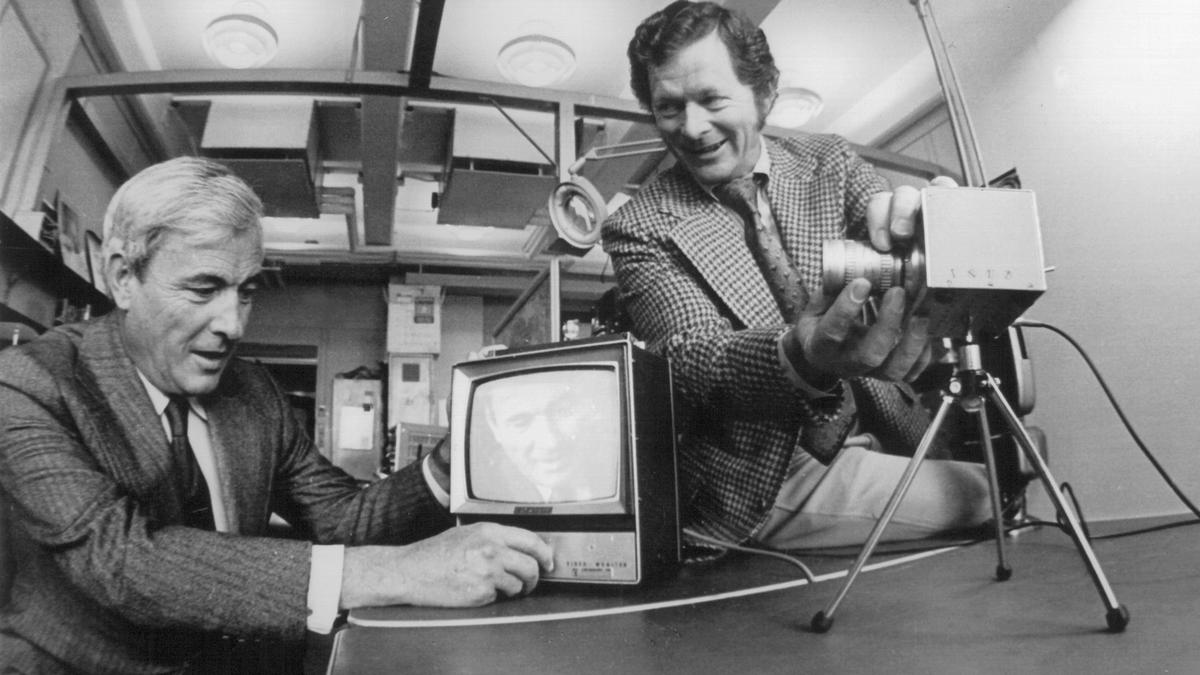
Willard Boyle and George Smith at Bell Telephone Laboratories in New Jersey in the U.S. invented the first CCD in 1969 (Smith passed away on May 28, 2025.) They were initially working on using semiconductor technology to create new types of memory devices. During a brainstorming session, they realised that an electric charge could be stored and moved on small capacitors arranged close together.

Boyle and Smith came up with the idea to connect these capacitors in a way that allowed electrical charges to be shifted along the device, a process they called “charge coupling”. This way, the charges could be transferred in a controlled manner, paving the way for its use in capturing images by converting light into electrical signals.

Their groundbreaking work earned them the Nobel Prize for physics in 2009, highlighting the profound impact of CCDs on science and technology.

Soon after, companies like Fairchild Semiconductor and Sony further developed CCDs, making them practical for mass production and use in cameras and other imaging devices.

How does a CCD work?

A CCD operates using the photoelectric effect, where light that falls on the device generates electron-hole pairs in the semiconductor material.

Specifically, when photons enter a CCD, they strike the semiconductor material beneath each pixel. This energy knocks electrons loose, creating a small group of electrons proportional to the intensity of light in that pixel. Each pixel is essentially a small capacitor that holds these electrons. The amount of charge in each pixel varies depending on how much light the pixel has received.

A voltage is applied to electrodes placed over the pixels in a sequence that moves the charges from one pixel to the next, like passing buckets of water along a line. This is why it’s called a “charge-coupled” device, and this process continues until all the charge has reached a readout register.

The accumulated charge from each pixel is then converted into a voltage signal, which can be amplified and digitised by connected electronics to form a digital image.

This sequential transfer and reading process allows the CCD to create a precise and high-quality representation of a scene being captured.

Where are CCDs used?

Since 1969, CCDs have revolutionised many fields by improving their ability to capture light as data. At the household level, CCDs made possible the rise of digital cameras by replacing film with sensors that captured images electronically. This allowed people to view their images instantly, edit them, and store them in hard drives, greatly influencing everyday life and media. They’re also used in CCTV cameras to provide high-quality video feeds for security in places like banks, shopping malls, and hospitals.

CCDs play a vital role in medical diagnostics, including in X-ray imaging, computed tomography (CT) scans, and endoscopy. Their high resolution and sensitivity produce clearer images that help doctors determine more accurate diagnoses and treatments. In the same vein, because of their sensitivity and precision, CCDs are also used in microscopes, spectrometers, and particle detectors where they allow scientists to analyse images in detail, for example, when they study cells, the structure of materials, and other physical phenomena.

In astronomy, CCDs have become the gold standard for astronomical imaging. Telescopes fit with CCDs can capture faint and distant celestial objects with more sensitivity and accuracy than traditional photographic plates. This capability has vastly increased astronomers’ understanding of the universe, helping them discover distant galaxies, detect exoplanets, and study cosmic phenomena.

Published – August 21, 2025 08:30 am IST



Source link

Science

Post navigation

Previous Post: Why India needs a national space law urgently | Explained
Next Post: Access Denied

Related Posts

  • Why India’s Green Revolution isn’t a blueprint to feed a hungry planet
    Why India’s Green Revolution isn’t a blueprint to feed a hungry planet Science
  • Is climate change making tropical storms more frequent? Scientists say it’s unclear
    Is climate change making tropical storms more frequent? Scientists say it’s unclear Science
  • ISRO’s PSLV-C60 Mission: 10 payload from non-government entities successfully deployed on POEM-4 
    ISRO’s PSLV-C60 Mission: 10 payload from non-government entities successfully deployed on POEM-4  Science
  • Earth ended a streak of 13 hot months in June, EU climate service says
    Earth ended a streak of 13 hot months in June, EU climate service says Science
  • The Science Quiz | Promethium bound…
    The Science Quiz | Promethium bound… Science
  • Budget gives science missions big numbers but core funding gaps persist
    Budget gives science missions big numbers but core funding gaps persist Science

More Related Articles

SpaceX Starship, the brash giant that could redefine the plot SpaceX Starship, the brash giant that could redefine the plot Science
New research traces how Africa’s wildcats became today’s house cats New research traces how Africa’s wildcats became today’s house cats Science
Astronomers puzzle over ‘inside out’ planetary system Astronomers puzzle over ‘inside out’ planetary system Science
What is the Minor Planet Centre? What is the Minor Planet Centre? Science
IISc scientists find a way to break down ‘biofilm barriers’ by using cow’s gut enzyme to aid entry of drugs IISc scientists find a way to break down ‘biofilm barriers’ by using cow’s gut enzyme to aid entry of drugs Science
Data from all-civilian crew details health effects of space travel Data from all-civilian crew details health effects of space travel Science
SiteLock

Archives

  • May 2026
  • April 2026
  • March 2026
  • February 2026
  • January 2026
  • December 2025
  • November 2025
  • October 2025
  • September 2025
  • August 2025
  • July 2025
  • June 2025
  • May 2025
  • April 2025
  • March 2025
  • February 2025
  • January 2025
  • December 2024
  • November 2024
  • October 2024
  • September 2024
  • August 2024
  • July 2024
  • June 2024
  • May 2024
  • April 2024
  • March 2024
  • February 2024
  • January 2024
  • December 2023
  • November 2023
  • October 2023
  • September 2023
  • August 2023
  • July 2023
  • June 2023
  • May 2023
  • April 2023
  • March 2023
  • February 2023
  • January 2023
  • December 2022
  • November 2022
  • October 2022
  • September 2022
  • August 2022
  • July 2022
  • June 2022
  • May 2022

Categories

  • Business
  • Nation
  • Science
  • Sports
  • World

Recent Posts

  • As model code ends, wall posters make a comeback in Tiruchi
  • Explosion at coal mine in Colombia, at least four trapped
  • Telangana hotel association seek LPG relief, urge PM Modi for rationalisation
  • Air India has terminated over 1,000 staff in last 3 years for ethical breaches: CEO
  • 1,656 Plus Two students to get year-long special coaching to crack NEET, CUET, JEE Mains

Recent Comments

  1. EnriqueExins on UP Teacher Who Asked Students To Slap Muslim Classmate
  2. Andrewfoods on UP Teacher Who Asked Students To Slap Muslim Classmate
  3. DonaldStype on UP Teacher Who Asked Students To Slap Muslim Classmate
  4. RaymondMuh on UP Teacher Who Asked Students To Slap Muslim Classmate
  5. Williamdox on UP Teacher Who Asked Students To Slap Muslim Classmate
  • Access Denied Sports
  • Telangana Congress Candidate Jeevan Reddy Slaps Woman During Campaign
    Telangana Congress Candidate Jeevan Reddy Slaps Woman During Campaign Nation
  • Thousands Of Fans On Streets As Afghanistan Reach Historic T20 World Cup Semi-finals. Watch
    Thousands Of Fans On Streets As Afghanistan Reach Historic T20 World Cup Semi-finals. Watch Sports
  • US Surgeons Report Longest Successful Pig-To-Human Kidney Transplant
    US Surgeons Report Longest Successful Pig-To-Human Kidney Transplant World
  • Rahul Gandhi Faces Delhi Police Crime Branch Probe Over Parliament Tussle
    Rahul Gandhi Faces Delhi Police Crime Branch Probe Over Parliament Tussle Nation
  • Andre Russell Slams Haris Rauf For 107m Six In Major League Cricket. Watch.
    Andre Russell Slams Haris Rauf For 107m Six In Major League Cricket. Watch. Sports
  • Access Denied Sports
  • Rachin Ravindra: the World Cup breakout star from New Zealand with Indian roots
    Rachin Ravindra: the World Cup breakout star from New Zealand with Indian roots Sports

Editor-in-Chief:
Mohammad Ariff,
MSW, MAJMC, BSW, DTL, CTS, CNM, CCR, CAL, RSL, ASOC.
editor@artifex.news

Associate Editors:
1. Zenellis R. Tuba,
zenelis@artifex.news
2. Haris Daniyel
daniyel@artifex.news

Photograher:
Rohan Das
rohan@artifex.news

Artifex.News offers Online Paid Internships to college students from India and Abroad. Interns will get a PRESS CARD and other online offers.
Send your CV (Subjectline: Paid Internship) to internship@artifex.news

Links:
Associate Journalism
About Us
Privacy Policy

News Links:
Breaking News
World
Nation
Sports
Business
Entertainment
Lifestyle

Registered Office:
72/A, Elliot Road, Kolkata - 700016
Tel: 033-22277777, 033-22172217
Email: office@artifex.news

Editorial Office / News Desk:
No. 13, Mezzanine Floor, Esplanade Metro Rail Station,
12 J. L. Nehru Road, Kolkata - 700069.
(Entry from Gate No. 5)
Tel: 033-46011099, 033-46046046
Email: editor@artifex.news

Copyright © 2023 Artifex.News Newsportal designed by Artifex Infotech.