





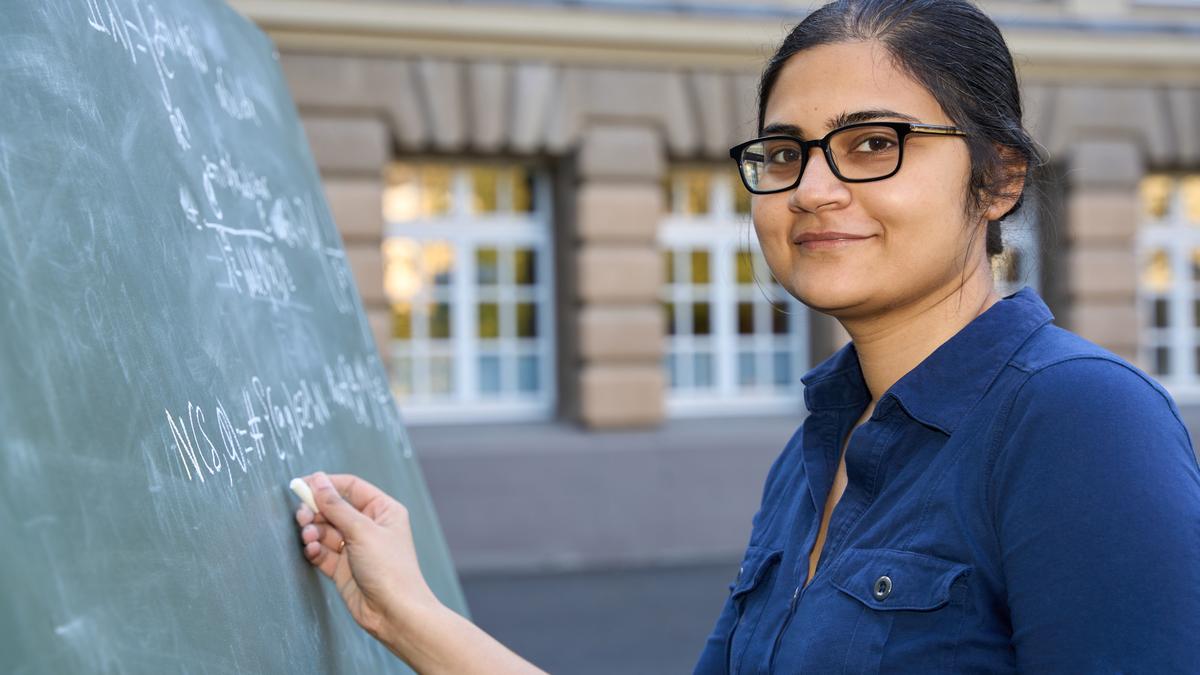
When Rajula Srivastava was first notified about a prestigious prize, she was quick to dismiss it. All she got was a cryptic email from the personal email address of mathematician Terence Tao asking if she was free for a chat. Tao, a professor at the University of California, Los Angeles, is widely considered one of the most gifted mathematicians of our time. Srivastava couldn’t think of a reason why he would want to talk to her.
“I obviously thought it was a scam,” she said.
But then she got a second email from him ten minutes later, asking to Zoom. After ascertaining that the email was not fake, she proceeded to cautiously respond. During their chat, Tao broke the news that she had won the Maryam Mirzakhani New Frontiers Prize, an initiative of the Breakthrough Prize in Mathematics, for her work in harmonic analysis and analytic number theory. She couldn’t believe it.
“I told him I thought it was a scam, and he found that very funny, [saying] ‘maybe I want to scam a theorem out of you or something’,” she said with a laugh. “It was surreal, the way [the call] went.”
A fondness for puzzles
Srivastava, a Hirzebruch Research Instructor at the University of Bonn and the Max Planck Institute for Mathematics in Germany, grew up in a science-loving family.
In school, mathematics happened to be the subject she enjoyed the most among all the sciences: because it involved the least amount of memorisation. “Once you understand the logic behind things, you don’t have to memorize a lot of things … beyond the multiplication tables in kindergarten,” she said.
She also realised she didn’t like doing lab work but she did enjoy solving puzzles. At the age of 15 she decided she wanted to be a mathematician and went on to do an integrated master’s degree in the National Institute of Science Education and Research (NISER), Bhubaneshwar, where she majored in maths.
She then wrote her master’s thesis in harmonic analysis, the study of functions and how they can be represented in terms of their frequencies — a topic she had begun to like. For her PhD, she chose to go to the University of Wisconsin-Madison mainly because of its big harmonic analysis group.
Just like music can be broken down into harmonies, signals can be broken down into the frequencies that make them up. “But you need to be able to do it in a sensible way, so that the information you have in this breakdown should be such that you should be able to reconstruct your complicated signal once more from these pieces,” Srivastava explained.
That’s the basic idea of harmonic analysis, where one breaks down functions in terms of their frequencies or “harmonics” using a method called the Fourier transformation. One can imagine these frequencies to lie on a line, but you can also ask these questions in higher dimensions, Srivastava said. “Then it’s also about geometry, about the patterns and the shapes in which these waves are arranged.”
To imagine a three-dimensional wave, picture a sound wave travelling in all directions via the molecules in air, or the ripples from an earthquake as it reverberates through the ground. In each case, there is a point at which the vibration originates, and the emanating waves then form the shape of a sphere. The vibrations travel radially outwards, perpendicular to the expanding wave. Her work mostly focused on waves in three or even higher dimensions.
Spotting numbers on a line
After her PhD, Srivastava went on to do her postdoctoral research in Germany, accepting a joint position between the mathematics department at the University of Bonn and the Max Planck Institute of Mathematics at Bonn. In her time there, from 2022 to 2024, she started diverging into problems at the interface of harmonic analysis and number theory.
Her husband, who is also a mathematician and a number theorist, first introduced her to counting problems. More than the potential applications of the number theoretical problems, however, Srivastava was motivated by sheer curiosity. With her expertise in harmonic analysis, she knew she had a bag of tools at her disposal. Could she now use them to count things?
She offered a simple example. While positioning integers on the number line, we learn that rational numbers have an exact address on the line. Even if it is a fraction, like say 5/7, the number line can be chopped up into smaller and smaller parts until we have an exact location for it. Irrational numbers don’t have an exact address, but one can still make a well-educated guess.
“We can say that it’s between 1/1,000,000 and 2/1,000,000, [for example], which is a very tiny part and use those fractions to approximate your point,” she explained. “You’re saying up to this error, it is between these two fractions.”
But she worked on a similar question in higher dimensions. Instead of a line, imagine a three-dimensional shape like a sphere. Now if the point you want to map is somewhere on the manifold of this shape, what can you say about its approximability? “That’s how the geometry comes in,” she said.
In higher dimensions, the fractions lie on a grid or lattice instead of being equally spaced on a one-dimensional number line. “So I have a lattice, and I have a shape inside the lattice. And then I’m asking: how close can points of this lattice get to points on the manifold?”
That’s how the two ideas — of harmonic analysis and counting points in 3D space — converge. “If you know that your waves live on a nice shape, then you know something about those waves or [their] frequencies,” she said. As both the wave frequencies and lattices are periodic, she worked on using the waves’ periodicity to count points on a shape within a lattice. Working on these problems eventually went on to win her the Maryam Mirzakhani New Frontiers Prize.
More conferences in India
Even as one of only two women out of the 25 students doing maths in her department at NISER, she didn’t feel any specific barriers to her progress during her integrated master’s program in India. She was confident, doing well in her exams, and didn’t have the need to constantly prove herself to others. But that changed when she went abroad: now she was not only a woman but she was also non-white. She eventually formed a community and received support from both men and women, but she still felt some alienation at the start when she moved out of India.
“You feel that you need to prove yourself more. You have less of a community to fall back on because there’s just less of you,” Srivastava said. “Sometimes if you’re the only brown woman in the room, you also somehow feel that you’re scrutinised more. Like, if you’re asking a question, then it better be a good question, not something stupid.” She thinks things are changing now, though, with more women of colour doing maths.
Srivastava is coming full circle in her own career. Currently a visiting research fellow at the University of Edinburgh, she will soon move back to the University of Wisconsin-Madison and continue working on the intersection of harmonic analysis and number theory. She decided to move abroad long term because her husband is German and it was logistically easier to move to the US than to India for both of them.
Another reason was more exposure to people and resources and being updated on new research developments, since many of the big conferences don’t happen in India. “I feel like they should do more [conferences] in developing countries, not just India, but also other countries of the Global South,” she said.
Srivastava enjoys being part of a broader community: friends and associates who all speak the common language of maths and whom she was able to meet and collaborate with on problems once she moved out of India. But she’s also grateful to her early education in India, and to how many Indian universities, including hers, invest a lot in their students with scholarships and low fees.
Like writing a poem
But doing maths can also be very frustrating at times, she said. Like when one spends most of the time researching answers to a problem instead of being able to just sit down and solve it. “Sometimes you have the broad outline, that this is how it should work. But actually implementing all the steps might take time,” she said. “Sometimes the ideas might come in a week, but just to write things might take months.”
The rewards from small victories, like penning down one small theorem as part of a larger proof, keep her going. She also greatly values the independence of not having immediate deadlines and not needing to rely on expensive resources to work on her research questions. The latter is often the case in other fields like biology.
“In math, you pretty much just need pen and paper. You can be anywhere, and you can just start thinking about [the problem],” she said. “Maybe you need a board and chalk, and that’s it.”
On a day-to-day basis, if she’s really focused on a problem, maths is almost like meditation for Srivastava. She described how some think of it like a cross between art and science. “There’s something which is just in your brain and then somehow you prove [it], and then it’s true. Once it’s true, it will always stay,” she said.
“In some ways, it’s like writing a story or a poem. I like the fact that you can create something which lasts in that way.”
Rohini Subrahmanyam is a freelance journalist in Bengaluru.