


Skip to content
  • Facebook
  • X
  • Linkedin
  • WhatsApp
  • YouTube
  • Associate Journalism
  • About Us
  • Privacy Policy
  • 033-46046046
  • editor@artifex.news
Artifex.News

Artifex.News

Stay Connected. Stay Informed.

  • Breaking News
  • World
  • Nation
  • Sports
  • Business
  • Science
  • Entertainment
  • Lifestyle
  • Toggle search form
  • Chinese sailors wield knives, axe in disputed sea clash with Philippines
    Chinese sailors wield knives, axe in disputed sea clash with Philippines World
  • Re-Exam For 1,563 Candidates To Be Held At 6 Centres Today
    Re-Exam For 1,563 Candidates To Be Held At 6 Centres Today Nation
  • Access Denied Sports
  • Businesses shut down because of law, online gaming companies tell Supreme Court
    Businesses shut down because of law, online gaming companies tell Supreme Court Business
  • The virtues of the tomato, a healthy vegetable
    The virtues of the tomato, a healthy vegetable Science
  • Trudeau apologises for recognition of Nazi unit war veteran in Canadian Parliament
    Trudeau apologises for recognition of Nazi unit war veteran in Canadian Parliament World
  • UP Government Defends Kanwar Order, Tells Supreme Court It Was Ensure Peace
    UP Government Defends Kanwar Order, Tells Supreme Court It Was Ensure Peace Nation
  • MEA spokesperson Arindam Bagchi appointed India’s ambassador to UN in Geneva
    MEA spokesperson Arindam Bagchi appointed India’s ambassador to UN in Geneva World
How does the Indian harmonium produce its lively music?

How does the Indian harmonium produce its lively music?

Posted on July 31, 2025 By admin


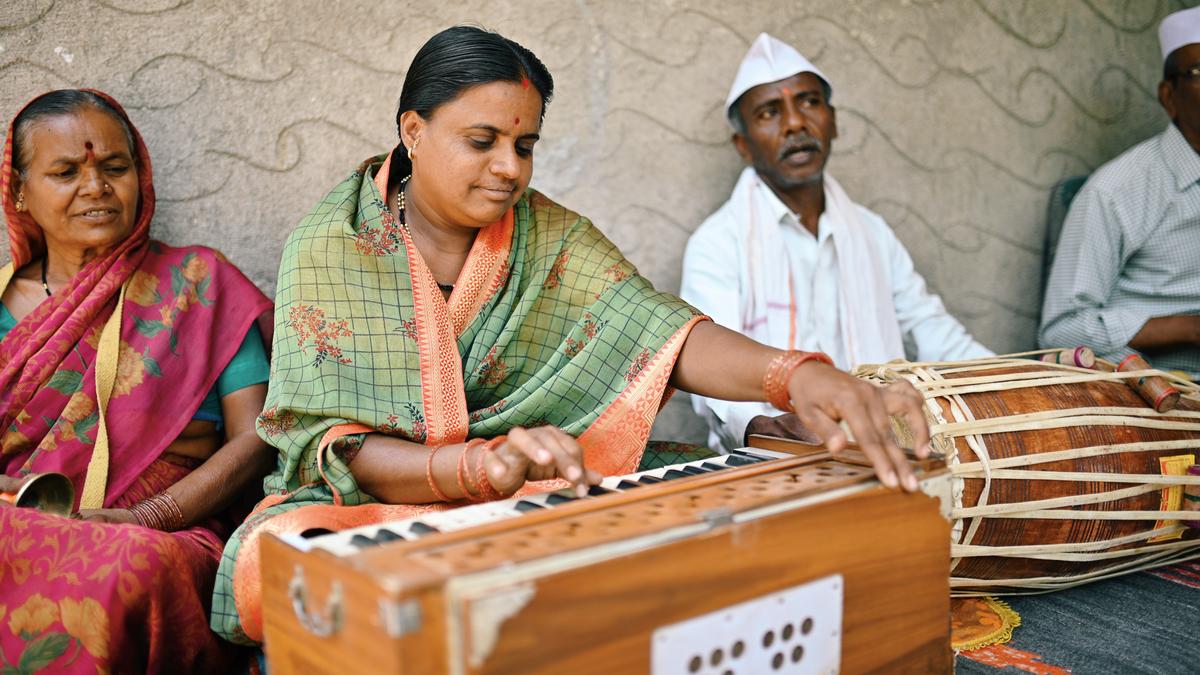
The Indian portable harmonium is a close cousin of the larger foot-pumped organs once found in European churches and homes. It’s a wooden box roughly the size of a small suitcase. You sit on the floor behind it and pump a pair of bellows with one hand and play piano-like keys with the other. All these instruments work on the same simple idea: air is pushed past metal strips called reeds; when they vibrate, musical notes are created. The sound of the harmonium has been a staple of both Indian folk music and mainstream cinema.

How does a harmonium use air?

A harmonium doesn’t have strings, membranes or electronic circuits. Instead, its ‘fuel’ is air in motion.

When the bellows attached to the instrument are pulled open, they suck some of the air in the room into their folded chambers, funnelled through inlet valves. When you push the bellows closed, the air is squeezed forward into an airtight wooden compartment that lies directly under the harmonium keys.

Because the compartment’s walls don’t move, the air pressure within rises above normal atmospheric pressure by a small amount, usually a few kilopascals. The compartment also holds a slender internal spring or a weighted flap that helps maintain this pressure, even if you don’t pump the bellows at a regular rate.

In fact, as long as you pump the bellows every few seconds, the reeds will feel enough pressure to make sounds.

How does a harmonium make sound?

The keyboard on top of the harmonium resembles a piano in miniature. But unlike in a piano, each key is only a lever. If you press a key, its far end tilts upward inside the box, lifting a pallet lined with felt.

The pallet covers a hole that leads from the pressurised wooden compartment to a single metal reed. When the key is at rest, the pallet closes the hole and no air flows. When you press the key, the pallet opens, allowing high-pressure air to rush through the hole and towards the reed.

Most Indian harmoniums expose 1.5 to 3 reeds to each hole. A stop rod next to the keyboard allows you to choose which set of reeds, called a bank, is active at any time. If you slide out one stop rod, an extra airway opens so the same key can expose a second bank that is tuned to one octave higher or lower, creating a more organ-like tone.

How does each reed operate?

Every reed is essentially a tongue of brass or phosphor-bronze nailed on top of a rectangular slot in a metal frame. When air pressure rises on the front side, the tongue bends slightly into the slot, allowing a puff of air to slip past to the rear. The same puff now exerts pressure on the back side of the tongue, pushing it forward again.

This rapid seesawing motion sets up a vibration with a frequency of hundreds of hertz for higher notes and around 100 Hz for the lower ones.

The vibrating reed shreds the air stream into pulses, which bounce around inside the box before spreading into the room as sound waves. Because the reed is fixed at one end and free at the other, its pitch depends mainly on its length, thickness, and mass. The shorter or thinner the reed, the higher its natural frequency will be.

Unlike flutes or trumpets, the harmonium’s reeds sit inside a wooden cavity rather than an open pipe. As a result, larger cavities produce lower notes and vice versa. The wooden compartment, the leather that makes the bellows, and even the player’s lap all absorb or reflect certain frequencies, giving each instrument a unique timbre.

Because warmer air is less dense, reeds in such an atmosphere will also have a slightly higher pitch. Professional players thus often carry small screwdrivers to tweak the reeds’ sounds before a performance.

Why does the sound seem ‘alive’?

The harder you pump the bellows, the louder the sounds will be. This is simply because stronger pumping raises the pressure in the compartment and moves the reeds harder. Fluent players often use quick pulses on the bellows to produce sharp accents and ease off to create graceful decrescendos. Many designs also include a coupling lever that, when engaged, connects a key to the key one octave higher, so pressing a single note automatically depresses its octave partner without forcing the player’s fingers to stretch. Second, because the reed’s vibrations feed on the pumping, the instrument can be made to respond to the smallest motions. Players can brighten a note by pumping in a short burst or stall it to thin the note.

More fundamentally, the sounds of an Indian harmonium seem ‘alive’ because the instrument doesn’t run on the clinical power of electrical energy but on a human body in motion. This may also explain why it became a staple of Indian classical, devotional, and folk music, including its willingness to accompany singers outdoors, through power cuts, and even play through the humid monsoons.

Published – July 31, 2025 08:30 am IST



Source link

Science

Post navigation

Previous Post: Samsung Q2 profit drops 55% on weak AI chip sales, China curbs
Next Post: Access Denied

Related Posts

  • Not your everyday forecast: Odd weather you won’t believe is real
    Not your everyday forecast: Odd weather you won’t believe is real Science
  • Partial lunar eclipse to take place tonight
    Partial lunar eclipse to take place tonight Science
  • Lab-grown human ‘embryo’ created without eggs or sperm
    Lab-grown human ‘embryo’ created without eggs or sperm Science
  • A beetle-fungi combo threatens plantations in rubber capital Kerala
    A beetle-fungi combo threatens plantations in rubber capital Kerala Science
  • Why do clouds have different shapes?
    Why do clouds have different shapes? Science
  • Skyroot expects to double rocket launches amid Chandrayaan-3’s success
    Skyroot expects to double rocket launches amid Chandrayaan-3’s success Science

More Related Articles

LPG crisis: India needs to electrify heat and win thermal independence LPG crisis: India needs to electrify heat and win thermal independence Science
BlueWalker 3 satellite outshines most stars in the night sky BlueWalker 3 satellite outshines most stars in the night sky Science
Can compete with Govt’s CNAP mandate, Truecaller CEO says Can compete with Govt’s CNAP mandate, Truecaller CEO says Science
Cyborg botany: how scientists are turning plants into circuit boards Cyborg botany: how scientists are turning plants into circuit boards Science
Climate change could become the main driver of biodiversity decline by mid-century: report Climate change could become the main driver of biodiversity decline by mid-century: report Science
Lost in space? You might need just two stars to find your way Lost in space? You might need just two stars to find your way Science
SiteLock

Archives

  • May 2026
  • April 2026
  • March 2026
  • February 2026
  • January 2026
  • December 2025
  • November 2025
  • October 2025
  • September 2025
  • August 2025
  • July 2025
  • June 2025
  • May 2025
  • April 2025
  • March 2025
  • February 2025
  • January 2025
  • December 2024
  • November 2024
  • October 2024
  • September 2024
  • August 2024
  • July 2024
  • June 2024
  • May 2024
  • April 2024
  • March 2024
  • February 2024
  • January 2024
  • December 2023
  • November 2023
  • October 2023
  • September 2023
  • August 2023
  • July 2023
  • June 2023
  • May 2023
  • April 2023
  • March 2023
  • February 2023
  • January 2023
  • December 2022
  • November 2022
  • October 2022
  • September 2022
  • August 2022
  • July 2022
  • June 2022
  • May 2022

Categories

  • Business
  • Nation
  • Science
  • Sports
  • World

Recent Posts

  • Vijay govt. says it needs time to ‘restructure’ Magalir Urimai Thogai programme; funds to be disbursed soon
  • Wholesale price inflation rises to 8.3% in April on sharp spike in fuel, power, crude
  • Ten new MLCs sworn in at Maharashtra Vidhan Bhavan
  • Frederic Soyez replaces Sreejesh as junior men’s hockey team coach
  • Mamata appears before Calcutta High Court to argue Bengal post-poll violence case

Recent Comments

  1. RafaelNar on UP Teacher Who Asked Students To Slap Muslim Classmate
  2. CarlosExorb on UP Teacher Who Asked Students To Slap Muslim Classmate
  3. Robertfloup on UP Teacher Who Asked Students To Slap Muslim Classmate
  4. Davidcag on UP Teacher Who Asked Students To Slap Muslim Classmate
  5. OrvalMaync on UP Teacher Who Asked Students To Slap Muslim Classmate
  • Access Denied
    Access Denied Nation
  • “Hopes Are Very High”: Irfan Pathan On India’s Prospects In Champions Trophy 2025
    “Hopes Are Very High”: Irfan Pathan On India’s Prospects In Champions Trophy 2025 Sports
  • Prithvi Shaw Angry After Getting Dropped vs MI? Animated Chat With Ricky Ponting Sparks Speculation
    Prithvi Shaw Angry After Getting Dropped vs MI? Animated Chat With Ricky Ponting Sparks Speculation Sports
  • Access Denied
    Access Denied Nation
  • Insurance can better cataract surgery outcomes for India’s elderly: study
    Insurance can better cataract surgery outcomes for India’s elderly: study Science
  • Apple lays off more than 600 workers in California in its first major round of post-pandemic cuts
    Apple lays off more than 600 workers in California in its first major round of post-pandemic cuts Business
  • Access Denied World
  • Australia Marks 10 Years Since Death Of Cricketer Phillip Hughes
    Australia Marks 10 Years Since Death Of Cricketer Phillip Hughes Sports

Editor-in-Chief:
Mohammad Ariff,
MSW, MAJMC, BSW, DTL, CTS, CNM, CCR, CAL, RSL, ASOC.
editor@artifex.news

Associate Editors:
1. Zenellis R. Tuba,
zenelis@artifex.news
2. Haris Daniyel
daniyel@artifex.news

Photograher:
Rohan Das
rohan@artifex.news

Artifex.News offers Online Paid Internships to college students from India and Abroad. Interns will get a PRESS CARD and other online offers.
Send your CV (Subjectline: Paid Internship) to internship@artifex.news

Links:
Associate Journalism
About Us
Privacy Policy

News Links:
Breaking News
World
Nation
Sports
Business
Entertainment
Lifestyle

Registered Office:
72/A, Elliot Road, Kolkata - 700016
Tel: 033-22277777, 033-22172217
Email: office@artifex.news

Editorial Office / News Desk:
No. 13, Mezzanine Floor, Esplanade Metro Rail Station,
12 J. L. Nehru Road, Kolkata - 700069.
(Entry from Gate No. 5)
Tel: 033-46011099, 033-46046046
Email: editor@artifex.news

Copyright © 2023 Artifex.News Newsportal designed by Artifex Infotech.