

Skip to content
  • Facebook
  • X
  • Linkedin
  • WhatsApp
  • YouTube
  • Associate Journalism
  • About Us
  • Privacy Policy
  • 033-46046046
  • editor@artifex.news
Artifex.News

Artifex.News

Stay Connected. Stay Informed.

  • Breaking News
  • World
  • Nation
  • Sports
  • Business
  • Science
  • Entertainment
  • Lifestyle
  • Toggle search form
  • Morning Digest | Gaza crossing opens for foreigners and wounded; October gross GST collections climb to ₹1.72 lakh crore, and more
    Morning Digest | Gaza crossing opens for foreigners and wounded; October gross GST collections climb to ₹1.72 lakh crore, and more World
  • Meloni rules out U.S. military move on Greenland, urges strong NATO Arctic presence
    Meloni rules out U.S. military move on Greenland, urges strong NATO Arctic presence World
  • Jasprit Bumrah, Wife Sanjana Ganesan Blessed With Baby Boy, Shares Picture On Instagram
    Jasprit Bumrah, Wife Sanjana Ganesan Blessed With Baby Boy, Shares Picture On Instagram Sports
  • Access Denied Sports
  • Access Denied
    Access Denied Nation
  • Access Denied
    Access Denied Nation
  • Vodafone sells 18% stake in Indus Towers for ₹15,300 crore
    Vodafone sells 18% stake in Indus Towers for ₹15,300 crore Business
  • Protesters go on strike in Israel demanding ceasefire, release of Gaza hostages
    Protesters go on strike in Israel demanding ceasefire, release of Gaza hostages World
The first human-made object recovered from space

The first human-made object recovered from space

Posted on August 9, 2025 By admin


Tech talk

The Discoverer 13 was an Earth-orbiting satellite designed to test a number of aspects. Bear in mind that this was in 1960, the early years of the Space Age. Among other things, the Discoverer 13 was designed to test engineering techniques and to attempt deceleration and reentry through the atmosphere. If the deceleration and reentry went as per plan, there was also the task of recovering the instrument package from the sea.

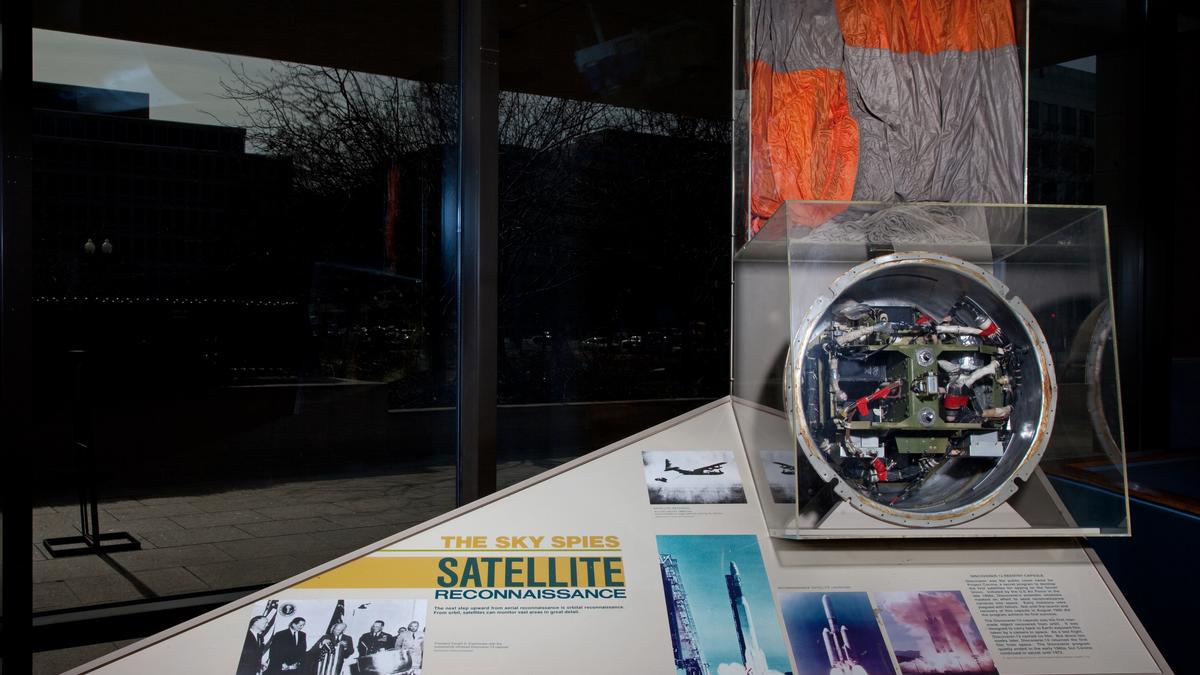
Out of everything that this satellite was designed to carry to the orbit, the most important was the 120 lb (54.4 kg) recovery capsule. This capsule, which was bowl-shaped in configuration, contained an American flag. While the bowl part of it was 22 inches in diameter and 27 inches deep, the conical afterbody increased the total length to nearly 40 inches. Out of the 120 lb, a monitoring system accounted for 40 lb, or one-third of the total.

The launch, which took place on August 10, 1960, was on a Thor-Agena from Vandenberg complex. The first stage separated at an altitude of about 130 km and the Agena placed the satellite in a near-polar orbit – 250 x 705 km, 82.9 degree orbit.

The reentry capsule

The satellite system, which included a telemetry system, a tape recorder, a horizon scanner, and receivers for command signals from the ground in addition to the reentry capsule, completed 17 orbits before the command for the recovery sequence was given. This command was sent on August 11 from a ground station on Kodiak Island, Alaska.

Reentry capsule of Discoverer 13. Notice the bowl-shaped configuration.
| Photo Credit:
Transferred from the United States Air Force for National Air and Space Museum

The command triggered the Agena to pitch down 60 degrees before the recovery vehicle was ejected using small springs. The vehicle spun up for stability, achieved using a cold gas system. Once the Thiokol retrorocket mounted at the end of the afterbody fired, the velocity was reduced by 400 m/s and then the spin system despun (a mechanism or system that counteracts the inherent spinning motion of a spacecraft, allowing a specific part to remain stable and pointed in a desired direction) the spacecraft.

Before it started heating up owing the the reentry, the orbit ejection subsystem dropped off, leaving the heat shield and the capsule. A small parachute was deployed at at altitude of 15,000m, before the radio beacon and strobe lights were activated. The heat shield was then released and after further stabilisation, the larger parachute was deployed. Throughout this time, the monitoring system sitting inside the capsule kept reporting on select events like the firing of the retrorocket and jettisoning off the heat shield.

Around 11:30 p.m. UT (1:30 p.m. local time) on August 11, the capsule splashed down in the Pacific Ocean 610 km north-north-west of Honolulu, Hawaii. The responsibility of retrieving the capsule fell upon the U.S. Navy and their ship, the Haiti Victory, sent out a helicopter for the same.

Frogmen jumped into the water from the helicopter in the vicinity of where the capsule had splashed down, before attaching a collar to the capsule to aid its retrieval by the helicopter. By 3:30-4:15 p.m. local time, the capsule was taken and brought back to the Haiti Victory, before it made its way to the Pearl Harbor.

The first human-made object ever recovered from orbit was thus retrieved successfully. The public celebration that followed included presenting the flag that was inside the capsule to President Dwight Eisenhower on August 15.

As for the Agena stage, it reentered the atmosphere months later. On November 14, it burned up in the atmosphere during reentry.
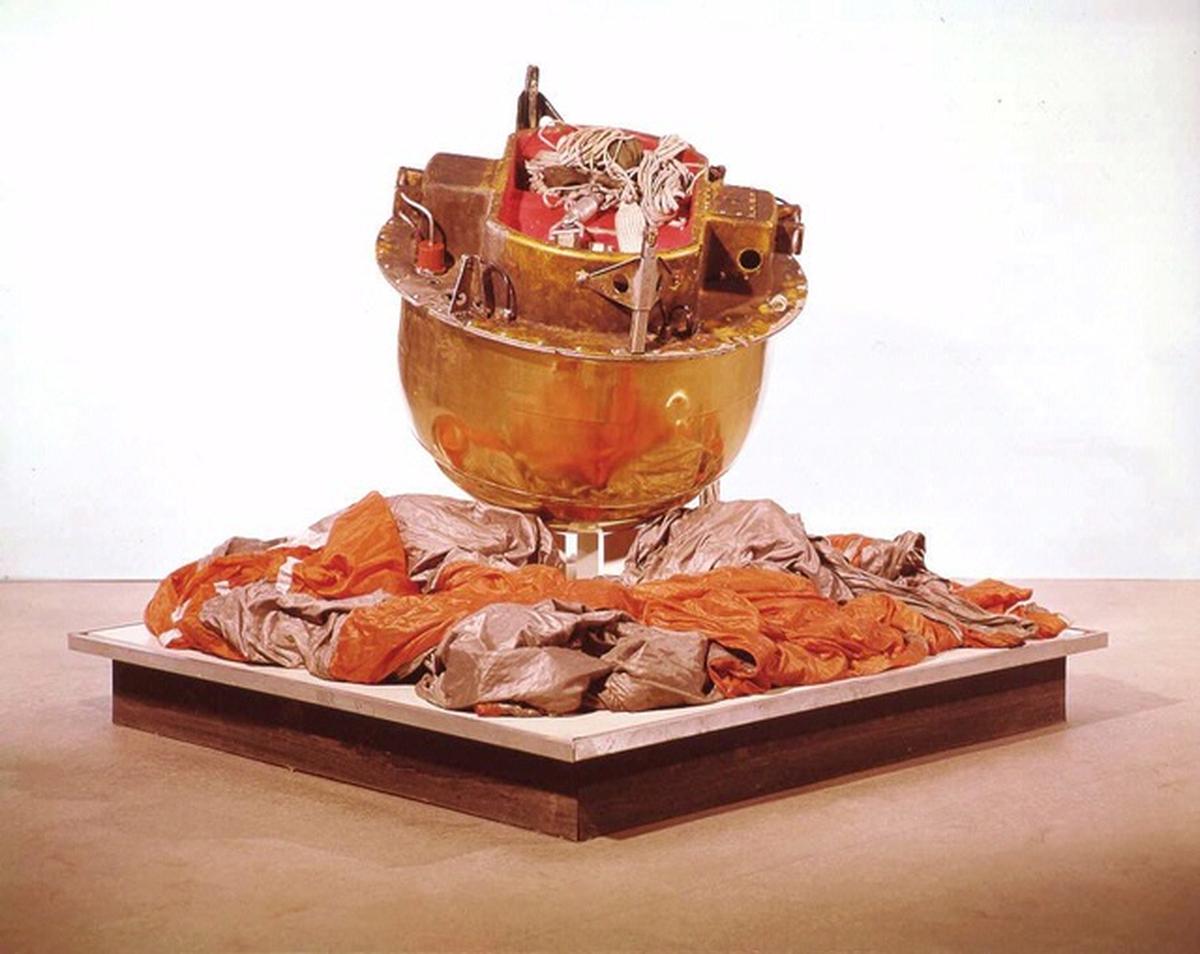
This is the Discoverer 13 reentry capsule along with the capsule cover and parachute.

This is the Discoverer 13 reentry capsule along with the capsule cover and parachute.
| Photo Credit:
Transferred from the United States Air Force for National Air and Space Museum

Secret revealed

This remained the story of Discoverer 13 for years – three-and-a-half decades, to be particular. It was only in 1995 that documents pertaining to this programme were declassified, thereby making it public knowledge.

According to these documents, the Discoverer programme, of which Discoverer 13 was a part, was a classified operation. It was managed by the Advanced Projects Research Agency of the U.S. Department of Defense and the U.S. Air Force.

The primary objective of this classified operation was, in fact, to develop a film-return photographic surveillance satellite. This was planned in order to assess how fast Soviet Union – their Cold War foes – was producing long-range bombers and ballistic missiles. In addition to this, the U.S. were also eager to find out where they were being deployed. Further, they were looking to take photos over the Sino-Soviet bloc to replace the U2 spyplanes.

The Discoverer programme was actually part of the secret Corona programme. The photoreconnaissance satellite programme was employed to make maps and charts for the Department of Defense, as well as other U.S. government mapping programmes.

For decades, however, the whole programme was presented as something else, with only a select few knowing the ulterior motive. The story that was woven was about a programme to orbit large satellites to test satellite subsystems; investigating the communication and environmental aspects of sending humans to space; and included carrying biological packages for return to Earth from orbit. While it wasn’t entirely false, it wasn’t entirely true either, as revealed by the documents in 1995.

Even though Discoverer 13 carried only diagnostic instruments and didn’t have any cameras or film, its success paved the way for future missions that did just that. It started off immediately as the Discoverer 14 with cameras and films was launched a week later (August 18).

By February 1962, 38 Discoverer satellites had been launched. The satellite reconnaissance programme continued until 1972 as the Corona project. By May 1972, more than 120 Corona satellites had flown successfully and managed to photograph the Soviet Union, China, and other nations. More than two decades passed after this before a formal acknowledgement of reconnaissance programmes, past and present, was made.

Images, used for educational purposes, have been transferred from the United States Air Force for Smithsonian National Air and Space Museum.

Published – August 10, 2025 12:19 am IST



Source link

Science

Post navigation

Previous Post: Govt may roll out ₹2,250 crore export promotion mission soon: Official
Next Post: How is AI reshaping India’s infotech sector? | Explained

Related Posts

  • Earth’s oldest, tiniest creatures are poised to be climate change winners
    Earth’s oldest, tiniest creatures are poised to be climate change winners Science
  • If diamonds and pencils are made out of carbon, how is it that pencils can write?
    If diamonds and pencils are made out of carbon, how is it that pencils can write? Science
  • Three astronauts return to Earth after a year in space. NASA’s Frank Rubio sets US space record
    Three astronauts return to Earth after a year in space. NASA’s Frank Rubio sets US space record Science
  • How Sunita Williams ended up stranded in space: The unexpected ordeal
    How Sunita Williams ended up stranded in space: The unexpected ordeal Science
  • Study finds the Ganga river is drying faster than in 1,300 years
    Study finds the Ganga river is drying faster than in 1,300 years Science
  • Brumation: Winter is coming for reptiles
    Brumation: Winter is coming for reptiles Science

More Related Articles

Communication a vital skill in today’s era of AI: Vishwanathan Anand Communication a vital skill in today’s era of AI: Vishwanathan Anand Science
How quantum algorithms solve problems that classical computers can’t How quantum algorithms solve problems that classical computers can’t Science
Why are numbers arranged differently on keypads and calculators? Why are numbers arranged differently on keypads and calculators? Science
Upper stage of historic PSLV-37 mission re-enters atmosphere 8 years after launch: ISRO Upper stage of historic PSLV-37 mission re-enters atmosphere 8 years after launch: ISRO Science
Is Russia testing a new anti-satellite weapon? | Explained Is Russia testing a new anti-satellite weapon? | Explained Science
What is ‘The Wow!’ signal? What is ‘The Wow!’ signal? Science
SiteLock

Archives

  • May 2026
  • April 2026
  • March 2026
  • February 2026
  • January 2026
  • December 2025
  • November 2025
  • October 2025
  • September 2025
  • August 2025
  • July 2025
  • June 2025
  • May 2025
  • April 2025
  • March 2025
  • February 2025
  • January 2025
  • December 2024
  • November 2024
  • October 2024
  • September 2024
  • August 2024
  • July 2024
  • June 2024
  • May 2024
  • April 2024
  • March 2024
  • February 2024
  • January 2024
  • December 2023
  • November 2023
  • October 2023
  • September 2023
  • August 2023
  • July 2023
  • June 2023
  • May 2023
  • April 2023
  • March 2023
  • February 2023
  • January 2023
  • December 2022
  • November 2022
  • October 2022
  • September 2022
  • August 2022
  • July 2022
  • June 2022
  • May 2022

Categories

  • Business
  • Nation
  • Science
  • Sports
  • World

Recent Posts

  • IPL 2026 | We now have an understanding of what works for us, says KKR assistant coach Watson
  • Stampede case: Karnataka High Court permits DNA executives to travel abroad
  • ‘Substantial’ gap between what FTAs promise and what regulations currently permit, CEA Nageswaran warns
  • Palakkad sexual assault case: Bail plea hearing on May 19
  • EU weighs extending carbon market to flights beyond Europe

Recent Comments

  1. AaronPrido on UP Teacher Who Asked Students To Slap Muslim Classmate
  2. AaronThymn on UP Teacher Who Asked Students To Slap Muslim Classmate
  3. Matthewerano on UP Teacher Who Asked Students To Slap Muslim Classmate
  4. JorgeBousa on UP Teacher Who Asked Students To Slap Muslim Classmate
  5. Jamesemifs on UP Teacher Who Asked Students To Slap Muslim Classmate
  • DOJ pushed to prosecute Kilmar Abrego Garcia only after mistaken deportation, judge’s order says
    DOJ pushed to prosecute Kilmar Abrego Garcia only after mistaken deportation, judge’s order says World
  • South Africans vote in a pivotal election as president says he has no doubt his ANC party will win
    South Africans vote in a pivotal election as president says he has no doubt his ANC party will win World
  • Access Denied
    Access Denied Nation
  • Israel And Iran Wanted A Zero-Sum Game. Now Both Are Losing
    Israel And Iran Wanted A Zero-Sum Game. Now Both Are Losing World
  • Access Denied World
  • Somalis vote in the first one-person, one-vote local election in decades
    Somalis vote in the first one-person, one-vote local election in decades World
  • Access Denied Sports
  • Parents hoping to adopt orphans of Wayanad landslide may not have their wish granted
    Parents hoping to adopt orphans of Wayanad landslide may not have their wish granted Nation

Editor-in-Chief:
Mohammad Ariff,
MSW, MAJMC, BSW, DTL, CTS, CNM, CCR, CAL, RSL, ASOC.
editor@artifex.news

Associate Editors:
1. Zenellis R. Tuba,
zenelis@artifex.news
2. Haris Daniyel
daniyel@artifex.news

Photograher:
Rohan Das
rohan@artifex.news

Artifex.News offers Online Paid Internships to college students from India and Abroad. Interns will get a PRESS CARD and other online offers.
Send your CV (Subjectline: Paid Internship) to internship@artifex.news

Links:
Associate Journalism
About Us
Privacy Policy

News Links:
Breaking News
World
Nation
Sports
Business
Entertainment
Lifestyle

Registered Office:
72/A, Elliot Road, Kolkata - 700016
Tel: 033-22277777, 033-22172217
Email: office@artifex.news

Editorial Office / News Desk:
No. 13, Mezzanine Floor, Esplanade Metro Rail Station,
12 J. L. Nehru Road, Kolkata - 700069.
(Entry from Gate No. 5)
Tel: 033-46011099, 033-46046046
Email: editor@artifex.news

Copyright © 2023 Artifex.News Newsportal designed by Artifex Infotech.