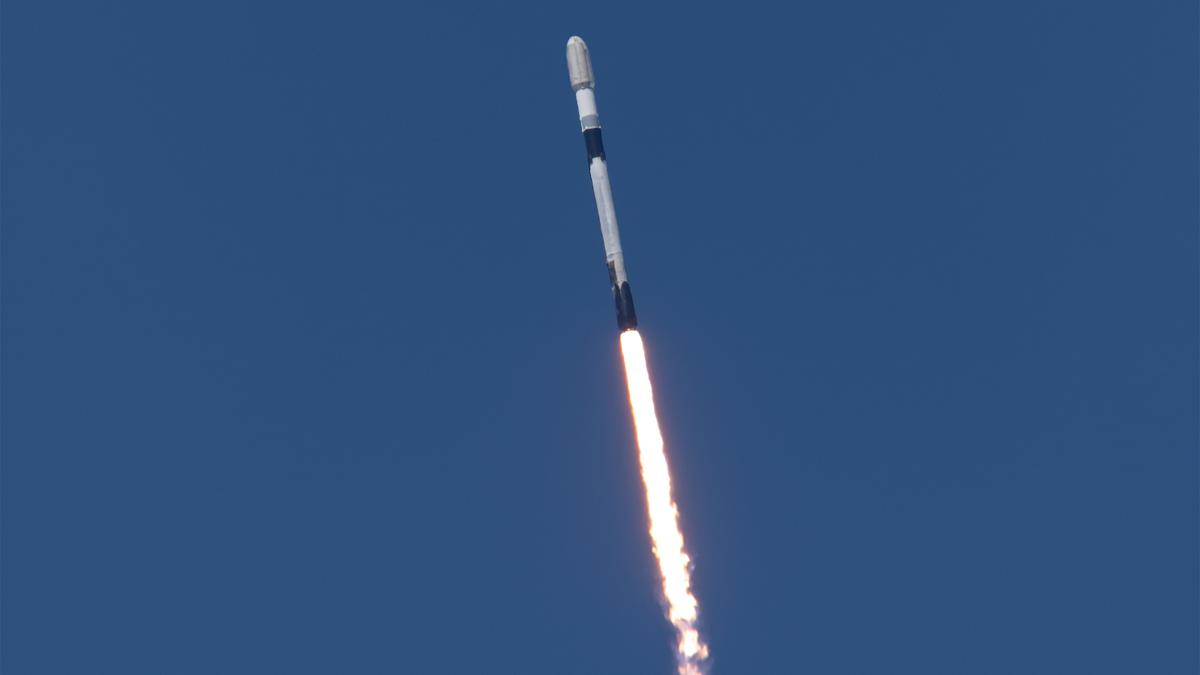





The story so far: On February 14, the chairman of the Intelligence Committee of the U.S. House of Representatives, Mike Turner, called the media’s attention to “information concerning a serious national security threat” and urged President Joe Biden to declassify it so more experts could be recruited to mitigate the danger it allegedly posed. A flurry of news reports followed, quoting various sources and referring to some kind of Russian space-based weapon.
What do we know about the ‘weapon’?
On February 15, a day after Mr. Turner’s statement, U.S. National Security Council spokesperson John Kirby confirmed the claims referred to a space-based “anti-satellite weapon” of Russian provenance. Mr. Kirby also said Russia hadn’t yet deployed the ‘capability’ in question — meaning the object wasn’t yet in orbit — and that it would violate the Outer Space Treaty (OST), a multilateral agreement that prohibits the placement of weapons of mass destruction in earth’s orbit.
By this time, some news reports had also quoted anonymous sources saying that the Russian capability was either nuclear in nature or that the satellite bearing the capability would be nuclear-powered. Mr. Kirby’s statements didn’t directly address these concerns. However, since he said the capability would violate the OST, the nuclear concern isn’t out of the question yet. (The OST is against nuclear weapons in space, not nuclear-powered satellites.)
On February 16, President Biden confirmed Mr. Turner had referred “to a new Russian nuclear anti-satellite capability” and added there were no indications what Russia had decided to do with it. However, the White House has refused to declassify information about it.
What are anti-satellite weapons?
Anti-satellite (ASAT) weapons are designed to debilitate and/or destroy satellites that are already in orbit and operational. ASAT weapons violate the OST through the latter’s Article VII, which holds parties to the treaty liable for damaging satellites belonging to other parties, and Article IX, which asks parties to refrain from the “harmful contamination” of space.
Russia, in the form of the erstwhile Soviet Union, has had ASAT capabilities since at least 1968. While the Cold War motivated ASAT weapon tests on either side of the Atlantic, the respective programmes refused to dwindle once relations thawed. Most of these weapons are kinetic, meaning they destroy satellites in orbit by rocketing into them or detonating an explosive near them, and blowing them to pieces. Because of the low gravity and lack of an atmosphere, the resulting debris can stay in orbit for a long time depending on their size. This result violates Article IX of the OST.
Are there space-based nuclear weapons?
In a high-altitude test in 1962 called Starfish Prime, the U.S. detonated a thermonuclear bomb 400 km above ground. It remains the largest nuclear test conducted in space.
A Thor rocket launched the warhead to a point west of Hawaii, where its detonation had a yield of 1.4 megatonnes. More importantly, it set off an electromagnetic pulse (EMP) much larger than physicists had expected, damaging a few hundred street-lights in Hawaii, 1,500 km away. The charged particles and radiation emitted by the blast became ensnared in and accelerated by the earth’s magnetic field, distorting the ionosphere and resulting in bright aurorae.
Starfish Prime was part of the U.S.’s high-altitude nuclear tests in 1962. The Soviet Union also conducted such tests around then with similar effects. For example, Test 184 on October 22, 1962, detonated a 300-kilotonne warhead 290 km above ground. The resulting EMP induced a very high current in more than 500 km of electric cables and eventually triggered a fire that burned down a power plant.
How will a nuclear weapon affect satellites?
The principal threats to other satellites from a space-based nuclear weapon are the EMP and the release of charged particles.
Starfish Prime itself temporarily knocked out roughly a third of all satellites in orbit at the time – and illustrates a failing relevant to the current context. An EMP from a nuclear weapon in space will affect all satellites around the point of detonation, including Russian satellites, those of its strategic allies (such as China), and of countries not involved in a particular conflict. It would also grossly violate the OST. Depending on the strength, location, and directedness of the explosion, it could also blow a large number of satellites to pieces, more than what a ‘conventional’ kinetic ASAT weapon might.
Scott Tilley, an amateur radio operator with a name for tracking down ‘lost’ satellites, wrote on X that “the damage is not immediate to most [satellites] but rather caused by new and intensified radiation belts”. (However, researchers have been working on tamping down disturbances caused by space-based nuclear explosions in radiation belts around the earth through a process called radiation-belt remediation).
Eventually, the result is more dud satellites and debris, raising concerns of the Kessler effect: when there is a certain level of debris in low-earth orbit, collisions among themselves as well as with other satellites could produce more debris, leading to a “collisional cascade” that rapidly increases the amount of debris in orbit.
There is one more possibility. In 1987, the Soviet Union launched a rocket bearing a high-power laser that could target and destroy other satellites. The launch failed. But Marco Langbroek, a lecturer at Delft Technical University, the Netherlands, raised the possibility of the Russians launching a similar laser powered by a nuclear energy source.
What do the U.S.’s claims imply?
Modern civilisation depends heavily on satellites, which means they can be assets or vulnerabilities. But the inability to target a nuclear weapon in space — at certain satellites over others — mitigates its usefulness. This is why some security researchers have suggested that if the Russian capability is nuclear, it will be a weapon of last resort. Some others have said the ‘nuclear’ component is likely to be limited to the power source. “That Russia is developing a system powered by a nuclear source… that has electronic warfare capabilities once in orbit is more likely than the theory that Russia is developing a weapon that carries a nuclear explosive warhead,” Daryl Kimball, executive director of the Arms Control Association advocacy group, told Reuters.
This said, Mr. Turner’s comment, which alerted the world to the possibility, provoked sharp reactions in the U.S. His peers in the Republican Party accused him of attempting to drum up support for Ukraine and that he wished to have an “unreformed” version of the Foreign Intelligence Surveillance Act passed, CNN reported. After the U.S. had warned its allies in Europe of the potential threat, the Kremlin called the claim a “malicious fabrication” and a ruse to allocate more funds for the war effort in Ukraine.