




Skip to content
  • Facebook
  • X
  • Linkedin
  • WhatsApp
  • YouTube
  • Associate Journalism
  • About Us
  • Privacy Policy
  • 033-46046046
  • editor@artifex.news
Artifex.News

Artifex.News

Stay Connected. Stay Informed.

  • Breaking News
  • World
  • Nation
  • Sports
  • Business
  • Science
  • Entertainment
  • Lifestyle
  • Toggle search form
  • Macron orders France’s nuclear-powered aircraft carrier to Mediterranean
    Macron orders France’s nuclear-powered aircraft carrier to Mediterranean World
  • At least 25 civilians killed in 48 hours in Sudan: activists, medic
    At least 25 civilians killed in 48 hours in Sudan: activists, medic World
  • Rishi Sunak On Yemen Airstrikes Against Houthi In Red Sea
    Rishi Sunak On Yemen Airstrikes Against Houthi In Red Sea World
  • Access Denied
    Access Denied Nation
  • Access Denied Business
  • UP Cops Allegedly Plant Gun On Teacher’s Bike, Arrest Him For Arms Smuggling
    UP Cops Allegedly Plant Gun On Teacher’s Bike, Arrest Him For Arms Smuggling Nation
  • No ceasefire yet, says Israeli envoy, defends Israel war a year after October 7 attacks
    No ceasefire yet, says Israeli envoy, defends Israel war a year after October 7 attacks World
  • ‘Not Injured’: Neeraj Chopra On Pulling Out Of Ostrava Golden Spike Meet
    ‘Not Injured’: Neeraj Chopra On Pulling Out Of Ostrava Golden Spike Meet Sports
New microscope reveals molecular jostling faster than ever before

New microscope reveals molecular jostling faster than ever before

Posted on July 28, 2025 By admin


More than a century ago, a 26-year-old Albert Einstein explained Brownian motion in one of four papers he published in his annus mirabilis, the miraculous year, called because these papers shot him to fame. Brownian motion is the random jittering of small particles in a fluid, caused because they’re constantly colliding with molecules around them.

Now, scientists at the California Institute of Technology (Caltech) have developed a breakthrough imaging technique that enables real-time filming of these molecular motions. Their findings were published in Nature Communications.

‘Surreal experience’

Conventional microscopes are invasive and have limited fields of view. Other microscopes still can’t distinguish individual molecules, which are around tens of angstroms in size (1 angstrom = 0.0000000001 m). To compare, one human hair is about a million angstrom thick.

The Caltech team has now found a way to indirectly detect molecules by observing their interactions with light. Their technique also taps into the Brownian motion of particles.

Using the device they have reported that they can see down to tens of angstroms. “It was a surreal experience to visualise molecular sizes in real-time at the angstrom scale,” Yogeshwar Nath Mishra, who co-led the study when at Caltech’s Jet Propulsion Laboratory and who is now an assistant professor at IIT-Jodhpur, said.

“Even more remarkable was the realisation that no existing technique can achieve this level of detail.”

Need for speed

The more massive a particle, the slower its Brownian motion. “[It] is like watching how much a spinning object twists after being nudged by light. Small molecules spin fast and scramble the light more. Big molecules spin slowly and keep it aligned,” Lihong Wang, director of the Caltech Optical Imaging Laboratory and who supervised the study, said.

So by measuring how fast a molecule changes the properties of light, they could determine its size.

The Egyptian-American chemist Ahmed Zewail from Caltech was the first to measure particle motion at super-short time scales. This work allowed his team to observe chemical reactions as they happened for the first time. He was awarded the Nobel Prize for chemistry in 1999.

“While traditional techniques often rely on time-consuming point-by-point scanning, our approach captures the scene in a single shot,” Wang said. “We also achieved imaging speeds of hundreds of billions of frames per second, making it possible to observe molecular interactions in unprecedented slow motion.”

The device is thus the world’s fastest single-shot microscope.

“Finally, unlike [traditional methods] which require extensive sample preparation and often damage the specimen, our method is non-intrusive, enabling direct, in-situ measurements,” Wang added.

“Some of the most exciting features of this microscope include its wide-field imaging capability, offering an image area of a few square centimetres, an order of magnitude larger than conventional microscopes,” per Mishra. “To the best of our knowledge, our work is the first ever to achieve the feat of single-shot 2D molecular sizing.”

Playing jigsaw

They tested their microscope using a molecule called fluorescein-dextran. Fluorescein is a food colouring dye. Fluorescein-dextran is used to monitor blood flow, drug delivery, and tissue and cell labelling. These fluorescent molecules come in the form of powders. The scientists blended them with water and used clean pipettes to pour drops of these samples into cuvettes (clear, short, rectangular tubes for holding liquid samples).

Florescein powder dropped into a solution of tapwater glows a bright green under a typical blacklight after around 15 seconds.
| Photo Credit:
Bricksnite (CC BY)

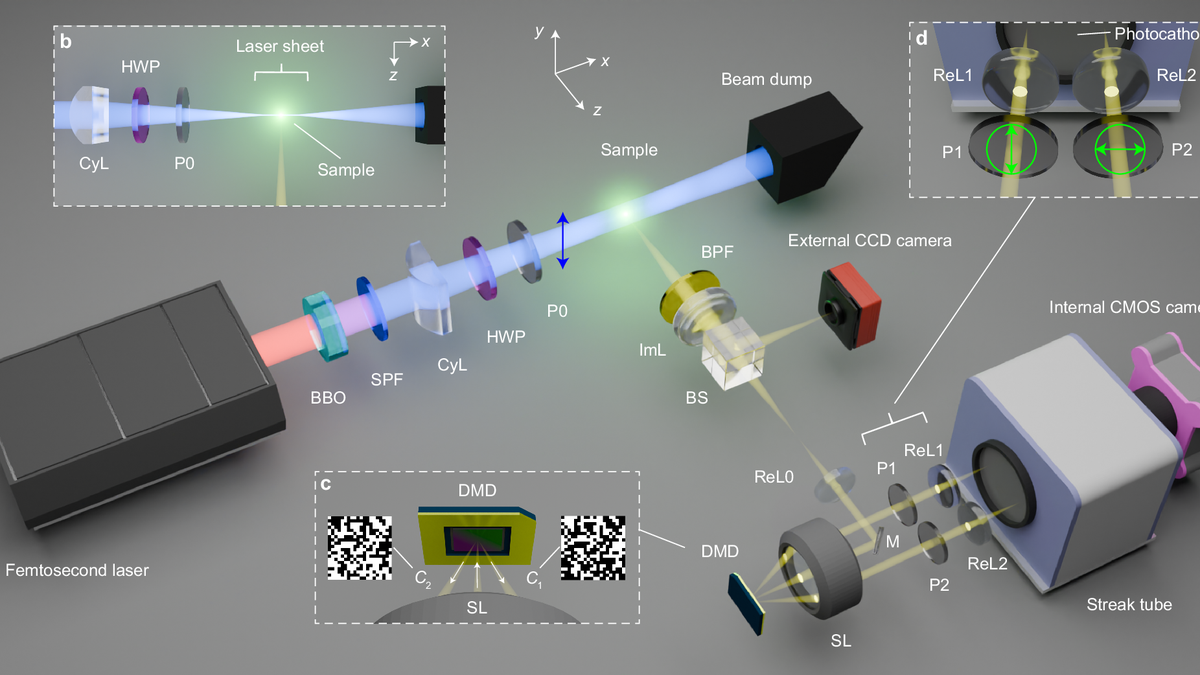
Then they turned to ultrashort pulses from a laser. These lasers aren’t unlike those used in LASIK and cataract surgeries. The laser sheet slices through the sample in the cuvette. As it does, the sample emits light that falls on an array of small square mirrors making up a digital micromirror device (DMD).

The DMD’s job is to shape the light beam. Researchers use software code to tilt each individual mirror in this light-crafter depending on the corresponding pixel in the input image.

“Imagine you’re trying to solve a jigsaw puzzle, but instead of having all the pieces, you only have a few of them — and surprisingly, you can still figure out what the full picture looks like,” Wang said.

This idea underpins the team’s technique, which can reconstruct the full picture from very few measurements provided the structure is repetitive. The DMD converts the transient scene into a random jigsaw pattern from which researchers can extract information about the full picture.

The light finally passes through a streak tube that converts the photons in light to electrons. A phosphor screen collects these electrons as they sweep across it and creates a pattern of streaks. The streak pattern reveals the pulse duration from which scientists can infer the sizes of the molecules.

Ensemble of molecules

“It is an interesting piece of work. The key in this work is the use of the streak camera to detect dynamics in nanoseconds. This is within the actual lifetimes of the molecules and wouldn’t be possible with slow detectors or photodetectors,” Basudev Roy, an associate professor at IIT Madras who works on super-resolution microscopy and wasn’t involved in the recent study, said.

The size of molecules measured using their technique concurred with previous estimates. “It still sees an ensemble of molecules inside a detection region — it still doesn’t see a single molecule yet. But the dynamics indicate chemical compositions and also chemical reactions,” Roy said.

“Surprisingly, we found out that the technique also works in gas phases. … Initially, we assumed it would be challenging to apply [it] in turbulent environments, such as within a flame,” said study co-lead Peng Wang of Caltech.

The team observed black carbon nanoparticles in flames through the microscope. “Our data in the gas phase turned out to work excellently and the molecule size matches … experimental observation well,” Peng said.

This new imaging technique could help better visualise processes and transform biomedical research, disease detection, drug design, and nanomaterial fabrication, among others.

Unnati Ashar is a freelance science journalist.

Published – July 28, 2025 05:30 am IST



Source link

Science

Post navigation

Previous Post: The tale of the tigers
Next Post: Deep-brain stimulation: nudging neurons – The Hindu

Related Posts

  • More than just a pigment: What is melanin?
    More than just a pigment: What is melanin? Science
  • Great Barrier Reef suffering ‘one of the most severe’ coral bleaching events on record
    Great Barrier Reef suffering ‘one of the most severe’ coral bleaching events on record Science
  • As El Niño starts flip to La Niña, Latin America asked to be on alert
    As El Niño starts flip to La Niña, Latin America asked to be on alert Science
  • Trump administration fires entire National Science Board
    Trump administration fires entire National Science Board Science
  • Craig the elephant, and the promise and problem of wildlife icons
    Craig the elephant, and the promise and problem of wildlife icons Science
  • US faces risk of losing to China in second moon race
    US faces risk of losing to China in second moon race Science

More Related Articles

After traversing 100 metres, Pragyan prepares for long night of -200 degree Celsius on Moon After traversing 100 metres, Pragyan prepares for long night of -200 degree Celsius on Moon Science
Putting the gene editing tool to use Putting the gene editing tool to use Science
A colossus who helped shape Kerala’s scientific establishment A colossus who helped shape Kerala’s scientific establishment Science
Could quakes explain why gold nuggets are found in quartz veins? Could quakes explain why gold nuggets are found in quartz veins? Science
India is the world’s largest plastic polluter according to new study  India is the world’s largest plastic polluter according to new study  Science
Why NASA’s Mars Sample Return mission has a shaky future Why NASA’s Mars Sample Return mission has a shaky future Science
SiteLock

Archives

  • May 2026
  • April 2026
  • March 2026
  • February 2026
  • January 2026
  • December 2025
  • November 2025
  • October 2025
  • September 2025
  • August 2025
  • July 2025
  • June 2025
  • May 2025
  • April 2025
  • March 2025
  • February 2025
  • January 2025
  • December 2024
  • November 2024
  • October 2024
  • September 2024
  • August 2024
  • July 2024
  • June 2024
  • May 2024
  • April 2024
  • March 2024
  • February 2024
  • January 2024
  • December 2023
  • November 2023
  • October 2023
  • September 2023
  • August 2023
  • July 2023
  • June 2023
  • May 2023
  • April 2023
  • March 2023
  • February 2023
  • January 2023
  • December 2022
  • November 2022
  • October 2022
  • September 2022
  • August 2022
  • July 2022
  • June 2022
  • May 2022

Categories

  • Business
  • Nation
  • Science
  • Sports
  • World

Recent Posts

  • China, U.S. should be ‘partners not rivals’, says Xi Jinping after meeting Donald Trump
  • Iran working on Hormuz ‘protocol’ to cover ‘costs’, says Deputy Foreign Minister Gharibabadi
  • Zydus Lifesciences arm to acquire U.S. oncology firm Assertio for $166 million
  • Israel-Iran war LIVE: Iran working on Hormuz ‘protocol’ to cover ‘costs’, says Dy FM Gharibabadi
  • Russia to fulfil all agreements on energy supply to India: FM Lavrov

Recent Comments

  1. OrvalMaync on UP Teacher Who Asked Students To Slap Muslim Classmate
  2. Jeffreyroure on UP Teacher Who Asked Students To Slap Muslim Classmate
  3. Stevemonge on UP Teacher Who Asked Students To Slap Muslim Classmate
  4. RichardClage on UP Teacher Who Asked Students To Slap Muslim Classmate
  5. StevenLek on UP Teacher Who Asked Students To Slap Muslim Classmate
  • Teachers Demand Vice-Chancellor’s Removal In Top Meghalaya University
    Teachers Demand Vice-Chancellor’s Removal In Top Meghalaya University Nation
  • Not In Selectors’ Scheme Of Things, Jharkhand Spin Stalwart Shahbaz Nadeem Calls It Quits
    Not In Selectors’ Scheme Of Things, Jharkhand Spin Stalwart Shahbaz Nadeem Calls It Quits Sports
  • Why is the Strait of Hormuz critical to global energy flows? | Explained
    Why is the Strait of Hormuz critical to global energy flows? | Explained World
  • Access Denied
    Access Denied Nation
  • Andre Russell’s Debut Music Video ‘Ladki Tu Kamaal Ki’ Is Fire Ft. Avika Gor. Watch
    Andre Russell’s Debut Music Video ‘Ladki Tu Kamaal Ki’ Is Fire Ft. Avika Gor. Watch Sports
  • Terrorist Killed In Encounter With Security Forces In J&K’s Kulgam
    Terrorist Killed In Encounter With Security Forces In J&K’s Kulgam Nation
  • Access Denied
    Access Denied Nation
  • Access Denied World

Editor-in-Chief:
Mohammad Ariff,
MSW, MAJMC, BSW, DTL, CTS, CNM, CCR, CAL, RSL, ASOC.
editor@artifex.news

Associate Editors:
1. Zenellis R. Tuba,
zenelis@artifex.news
2. Haris Daniyel
daniyel@artifex.news

Photograher:
Rohan Das
rohan@artifex.news

Artifex.News offers Online Paid Internships to college students from India and Abroad. Interns will get a PRESS CARD and other online offers.
Send your CV (Subjectline: Paid Internship) to internship@artifex.news

Links:
Associate Journalism
About Us
Privacy Policy

News Links:
Breaking News
World
Nation
Sports
Business
Entertainment
Lifestyle

Registered Office:
72/A, Elliot Road, Kolkata - 700016
Tel: 033-22277777, 033-22172217
Email: office@artifex.news

Editorial Office / News Desk:
No. 13, Mezzanine Floor, Esplanade Metro Rail Station,
12 J. L. Nehru Road, Kolkata - 700069.
(Entry from Gate No. 5)
Tel: 033-46011099, 033-46046046
Email: editor@artifex.news

Copyright © 2023 Artifex.News Newsportal designed by Artifex Infotech.