


Skip to content
  • Facebook
  • X
  • Linkedin
  • WhatsApp
  • YouTube
  • Associate Journalism
  • About Us
  • Privacy Policy
  • 033-46046046
  • editor@artifex.news
Artifex.News

Artifex.News

Stay Connected. Stay Informed.

  • Breaking News
  • World
  • Nation
  • Sports
  • Business
  • Science
  • Entertainment
  • Lifestyle
  • Toggle search form
  • North Carolina labour official backs federal rule to hike H-1B wages
    North Carolina labour official backs federal rule to hike H-1B wages World
  • Rohit Sharma To Play Ranji Trophy For 1st Time In Decade, Named In Mumbai Squad Alongside Yashasvi Jaiswal
    Rohit Sharma To Play Ranji Trophy For 1st Time In Decade, Named In Mumbai Squad Alongside Yashasvi Jaiswal Sports
  • Access Denied
    Access Denied Nation
  • Team Thackeray Leader’s Son Dies Of Heart Attack During Argument With Rickshaw Driver
    Team Thackeray Leader’s Son Dies Of Heart Attack During Argument With Rickshaw Driver Nation
  • Priyanka Gandhi Hits Out At BJP’s Smriti Irani
    Priyanka Gandhi Hits Out At BJP’s Smriti Irani Nation
  • Bangladesh PM Hasina surveys destruction as unrest recedes
    Bangladesh PM Hasina surveys destruction as unrest recedes World
  • Access Denied
    Access Denied Nation
  • Access Denied
    Access Denied Nation
Telescopes spot start of planet formation in Orion

Telescopes spot start of planet formation in Orion

Posted on July 23, 2025 By admin


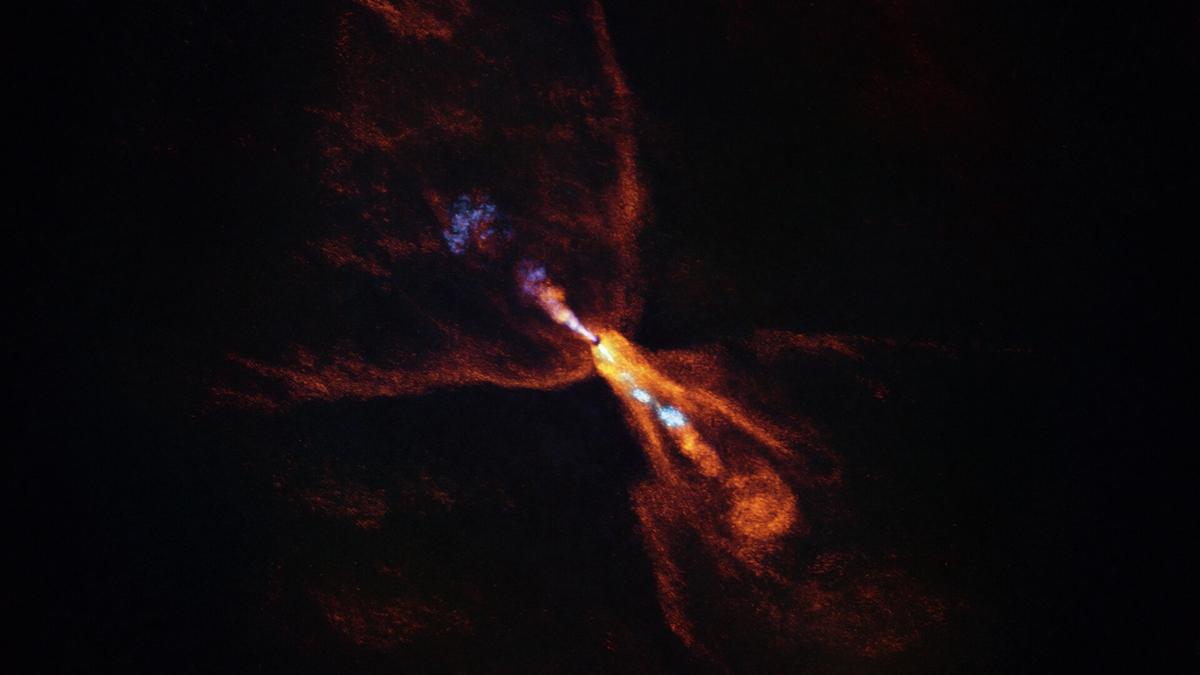
HOPS-315, a baby star where astronomers have observed evidence for the earliest stages of planet formation, as imaged by ALMA.
| Photo Credit: ALMA(ESO/NAOJ/NRAO)/M. McClure et al.

When rocky worlds like the earth began to form, dust in the young Solar System was first heated until it vaporised and then cooled so that the very first, refractory (i.e. heat-loving) minerals could crystallise. Catching that moment in another star system would show astronomers exactly how planet formation begins — but no one had seen it before. A new study in Nature this month has reported just such an event.

By examining the star HOPS‑315 in Orion, whose protoplanetary disc is tilted just enough for someone on or near the earth to peer deeper within, researchers from France, the Netherlands, Sweden, Taiwan, and the US observed raw rock vapour cool and crystallise.

The protoplanetary disc is a flat, rotating pancake-shaped mass of gas and dust that surrounds a newborn star. Inside it, dust grains bump together, stick, and gradually grow into rocks, planets, moons, and other bodies while the gas creates atmospheres and influences the planets’ long-term orbits.

The observations themselves were conducted by the NASA James Webb Space Telescope and the Atacama Large Millimeter/sub‑millimeter Array (ALMA) observatory in Chile. In 2023, the team used the NIRSpec and MIRI integral‑field spectrographs onboard the telescope to collect sharp energy readings across a range of frequencies. Eight months later, ALMA observed the same system for signs of carbon monoxide, silicon monoxide and sulphur monoxide.

Together, the telescope traced warm gas and dust only a few stellar radii from the star while ALMA mapped cooler gas farther out.

The telescope’s data contained evidence of a strong band of silicon monoxide gas at around 470 K as well as crystalline silicates. Both lay within 2.2 AU of the star — well inside Mercury’s orbit if this were in the solar system. (1 AU equals the earth-sun distance.)

The team also ran computer simulations, which predicted that around 1 AU from the star, temperatures hovered around 1,300 K, which is the temperature at which dust just begins to evaporate. The study’s energy readings matched the prediction: that interstellar grains must have vaporised there, releasing silicon monoxide gas that then cooled and re-condensed into fresh shards of crystals.

According to the study, the relative quantities of crystals of forsterite, enstatite, and tentative silica were reminiscent of inclusions — i.e. minerals trapped inside minerals — that have been found in primitive meteorites on the earth, meaning that a similar condensation chemistry is under way around the star.

The ALMA data also revealed no slow silicon monoxide at the star’s position whereas the Webb telescope’s data was blueshifted by around 10 km/s. Together, they indicate that the minerals lay inside the rising disc atmosphere, the thin upper layer of gas and dust above the mid‑plane of the protoplanetary disc, rather than in the material pouring out of the star.

Thus the study has reported the first evidence of solid matter condensing out of rock vapour around a star, a.k.a. the first step of planet formation.

Published – July 23, 2025 02:47 pm IST



Source link

Science

Post navigation

Previous Post: Trump tariffs: US–Japan deal finalized; Indonesia holds lessons and warnings for India
Next Post: Sensex jumps nearly 540 points on buying in bluechip banks, oil shares

Related Posts

  • Google celebrates India’s Chandrayaan-3 feat with special doodle
    Google celebrates India’s Chandrayaan-3 feat with special doodle Science
  • What helped Vikram lander to soft-land on the moon
    What helped Vikram lander to soft-land on the moon Science
  • Erich von Daeniken, Swiss author who popularised ancient‑alien theories, dies at 90
    Erich von Daeniken, Swiss author who popularised ancient‑alien theories, dies at 90 Science
  • ISRO lines up 7 launches, including uncrewed Gaganyaan mission by March 2026
    ISRO lines up 7 launches, including uncrewed Gaganyaan mission by March 2026 Science
  • A beginner’s guide to quantum computing | Explained
    A beginner’s guide to quantum computing | Explained Science
  • ‘Anything that moves, NASA-ISRO satellite will see with unprecedented fidelity’
    ‘Anything that moves, NASA-ISRO satellite will see with unprecedented fidelity’ Science

More Related Articles

Studies zero in on biology TB bacteria use to evade immune response Studies zero in on biology TB bacteria use to evade immune response Science
How mangroves’ cells helps plants survive in saltwater How mangroves’ cells helps plants survive in saltwater Science
18th International Olympiad on Astronomy and Astrophysics inaugurated in Mumbai  18th International Olympiad on Astronomy and Astrophysics inaugurated in Mumbai  Science
India’s first State-led Centre of Excellence for space tech launched in Bengaluru India’s first State-led Centre of Excellence for space tech launched in Bengaluru Science
Failure of atomic clock cripples ISRO’s NavIC system Failure of atomic clock cripples ISRO’s NavIC system Science
Science Snapshots: March 29, 2026 Science Snapshots: March 29, 2026 Science
SiteLock

Archives

  • May 2026
  • April 2026
  • March 2026
  • February 2026
  • January 2026
  • December 2025
  • November 2025
  • October 2025
  • September 2025
  • August 2025
  • July 2025
  • June 2025
  • May 2025
  • April 2025
  • March 2025
  • February 2025
  • January 2025
  • December 2024
  • November 2024
  • October 2024
  • September 2024
  • August 2024
  • July 2024
  • June 2024
  • May 2024
  • April 2024
  • March 2024
  • February 2024
  • January 2024
  • December 2023
  • November 2023
  • October 2023
  • September 2023
  • August 2023
  • July 2023
  • June 2023
  • May 2023
  • April 2023
  • March 2023
  • February 2023
  • January 2023
  • December 2022
  • November 2022
  • October 2022
  • September 2022
  • August 2022
  • July 2022
  • June 2022
  • May 2022

Categories

  • Business
  • Nation
  • Science
  • Sports
  • World

Recent Posts

  • BEST conductor dies in accident involving four buses in Mumbai
  • Pope Leo decries European military spending as ‘betrayal’ of diplomacy
  • Scent Of Rain, Shutterfly, Stud Poker and Starzella please
  • New factional battle lines emerge in Congress hours after nomination of Kerala CM
  • Trump invites Chinese President Xi Jinping for September 24 visit at White House

Recent Comments

  1. JamesHeR on UP Teacher Who Asked Students To Slap Muslim Classmate
  2. RafaelNar on UP Teacher Who Asked Students To Slap Muslim Classmate
  3. CarlosExorb on UP Teacher Who Asked Students To Slap Muslim Classmate
  4. Robertfloup on UP Teacher Who Asked Students To Slap Muslim Classmate
  5. Davidcag on UP Teacher Who Asked Students To Slap Muslim Classmate
  • Access Denied
    Access Denied Nation
  • Symptoms Of Guillain-Barre Syndrome And How To Prevent It
    Symptoms Of Guillain-Barre Syndrome And How To Prevent It Nation
  • Bangladesh PM Hasina surveys destruction as unrest recedes
    Bangladesh PM Hasina surveys destruction as unrest recedes World
  • Access Denied Sports
  • Bizarre! Pakistan Cricket Board Chairman Stops T20 World Cup Squad Reveal. Report Claims Reason For Displeasure
    Bizarre! Pakistan Cricket Board Chairman Stops T20 World Cup Squad Reveal. Report Claims Reason For Displeasure Sports
  • Janmashtami Celebrations Across The Country
    Janmashtami Celebrations Across The Country Nation
  • Access Denied Business
  • Incremental change: The Hindu Editorial on Corporate Average Fuel Efficiency-III
    Incremental change: The Hindu Editorial on Corporate Average Fuel Efficiency-III Business

Editor-in-Chief:
Mohammad Ariff,
MSW, MAJMC, BSW, DTL, CTS, CNM, CCR, CAL, RSL, ASOC.
editor@artifex.news

Associate Editors:
1. Zenellis R. Tuba,
zenelis@artifex.news
2. Haris Daniyel
daniyel@artifex.news

Photograher:
Rohan Das
rohan@artifex.news

Artifex.News offers Online Paid Internships to college students from India and Abroad. Interns will get a PRESS CARD and other online offers.
Send your CV (Subjectline: Paid Internship) to internship@artifex.news

Links:
Associate Journalism
About Us
Privacy Policy

News Links:
Breaking News
World
Nation
Sports
Business
Entertainment
Lifestyle

Registered Office:
72/A, Elliot Road, Kolkata - 700016
Tel: 033-22277777, 033-22172217
Email: office@artifex.news

Editorial Office / News Desk:
No. 13, Mezzanine Floor, Esplanade Metro Rail Station,
12 J. L. Nehru Road, Kolkata - 700069.
(Entry from Gate No. 5)
Tel: 033-46011099, 033-46046046
Email: editor@artifex.news

Copyright © 2023 Artifex.News Newsportal designed by Artifex Infotech.