





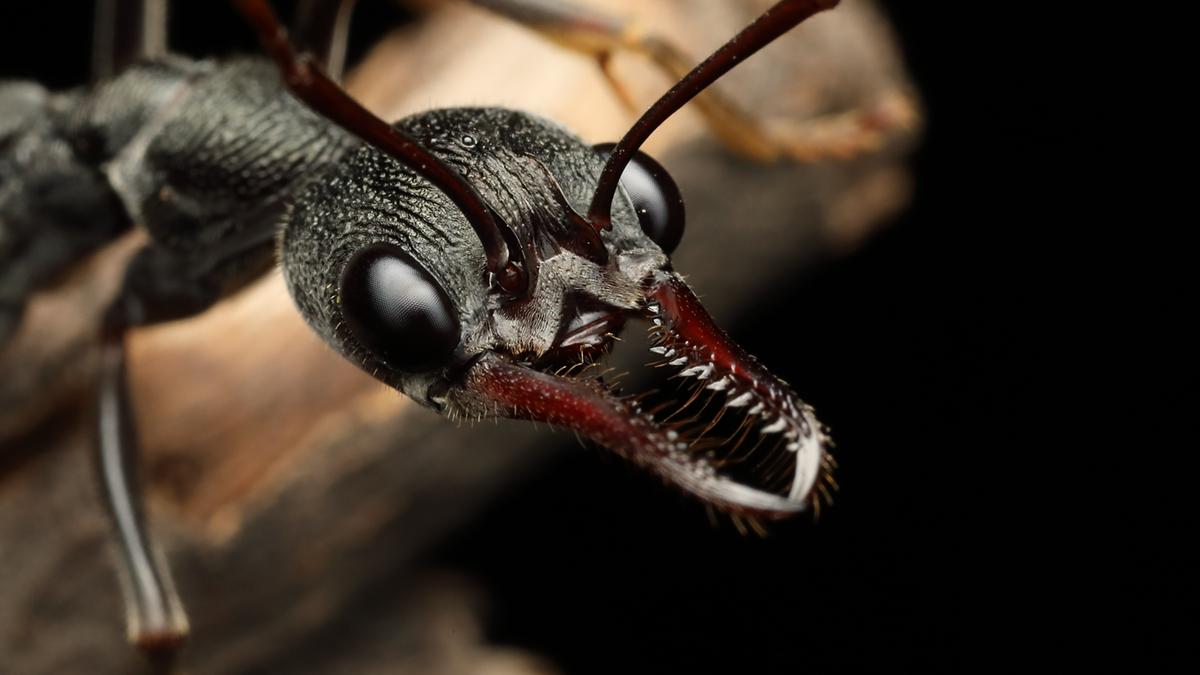
Many nocturnal animals, including insects like ants and bees, follow the moon’s position to find their way when they go foraging. But the moon waxes and wanes in a cycle and can be obscured by clouds or overhanging tree canopies, so the animals can’t always directly track its position.
Now, for the first time, scientists at Macquarie University, Sydney, have found that two nocturnal bull ant species (Myrmecia pyriformis and Myrmecia midas) make their way at night with the help of polarised moonlight, which, while being dimmer even than moonlight, contains unusual patterns that can point the way.
This is also only the second instance of an animal being found to use polarised moonlight to orient itself.
Returning late
Seen from the ground, both sunlight and moonlight contain characteristic polarisation patterns. The way these patterns are oriented in the sky, rather than the location of the light source alone, allows animals to use it as a compass.
The study found the nocturnal bull ants were able to detect and use polarised moonlight throughout the lunar cycle for foraging, even under a crescent moon when moonlight is 80% less intense.
The polarisation patterns in moonlight are also a million-times dimmer than in sunlight. So while many animals are known to use the latter, very few use the former. The first animal found to use polarised moonlight was the dung beetle.
Scientists already knew M. pyriformis and M. midas ants used polarised sunlight to navigate, but this light fades as the sun sets. The study’s researchers were also aware most of the foraging M. midas ants returned overnight while the night-time activity of M. pyriformis ants increased on full-moon nights.
The e-vector pattern
The sun and the moon both emit unpolarised light. Light is an electromagnetic wave, with the electric field oscillating perpendicular to the magnetic field, and both fields oscillating perpendicular to the wave’s direction of motion.
When the light moves through the earth’s atmosphere, it is scattered by particles in the air and becomes polarised. Polarisation denotes a specific orientation of the electric field.
Both sunlight and moonlight scattered in the atmosphere become linearly polarised, meaning the electric field oscillates in a single, fixed plane perpendicular to the wave’s motion. The scattered light is also oriented 90º to the incident light.
As numerous light waves are scattered in this way, an unusual pattern emerges in the sky when seen through a filter that can detect polarised light. This is called the e-vector pattern.
“[W]hen the sun/moon is near the horizon, the pattern of polarised skylight is particularly simple, with uniform direction of polarisation approximately parallel to the north-south axes,” the researchers wrote in their paper.
The stability of this pattern gives an animal that can detect it a natural compass.
Under the moon
The researchers created linearly polarised light and cast it on a population of nocturnal bull ants in the wild, then tracked the ants’ ability to orient themselves relative to their two nests, located more than 50 metres apart.
Under full, waxing, and waning moon conditions, the researchers rotated their polariser clockwise by 45° and later counterclockwise by 45°. In each instance, the e-vector of the light falling on the ants changed. The ants responded by adjusting their path to the left and later to the right. Once the foragers crossed the area where the researchers’ light was being cast, they adjusted once more to reorient themselves according to the e-vector pattern in the sky.
The researchers used paired tests to compare the magnitude of these shifts between the initial orientation and the filter exit and again between the filter exit and the reorientation. The paired tests are a statistical tool with which researchers can determine whether paired observations — shift magnitudes in this case — differ between two samples.
“Shift magnitude is the number of degrees the ants alter their headings under the filter,” Cody Freas, a doctoral student at Macquarie University and one of the study’s coauthors, said.
While the nocturnal bull ants were found to use polarised moonlight throughout the lunar cycle, their heading shift magnitudes dropped during the waning phases. The researchers called this finding “unexpected”. Likewise, foraging ants had substantially higher shift magnitudes during the waxing full moon and waxing quarter moon phases compared to the waning phases.
Under the new moon, when the ambient moonlight e-vector disappeared, the paths of the foraging ants didn’t change significantly when the polarisation filter was rotated in either direction. The ants also didn’t reorient their paths to a meaningful degree once they exited the filter.
The researchers used another statistical test to compare the differences in shift magnitudes when the filter was rotated clockwise and counter-clockwise across lunar phases.
Shift magnitudes, vector distances
During the full moon, when moonlight reaches 80% of its maximum intensity, the shift magnitudes were 36.6º to 43º at Nest 1 and 21.5º to 28.9º at Nest 2. According to Freas, the difference between the two nests is likely due to the long distance that foragers at Nest 1 traversed on their trip to the foraging tree, 6 m, versus 2.5 m from Nest 2.
“At short vector lengths, like at Nest 2, the vector, which is informed by the sky compass, becomes less reliable,” he said, adding that the longer the distance, the more “powerful” the guidance is.
“Thus, if the ant walks 6 m to the foraging tree, we can say that the ant has a 6-m vector pointing back to the nest. This vector also [shrinks] as the ant travels in the nest direction. It’s an updating estimate of how far away the nest is at any point. So when we release an ant halfway home, it still has the vector from where it was captured (6 m).”
According to Clarke Scholtz, emeritus professor of entomology at the University of Pretoria, South Africa, and Marie Dacke, a professor of sensory biology at Lund University, Sweden, “The methods used in the study are appropriate.” Neither was involved in the study.
“While we cannot compare solar and moonlight polarisation navigation in outbound ants …, striking similarities occur when comparing solar and moonlight polarisation navigation in ants homing to the nest,” the researchers wrote in their paper.
“… it remains unknown if these ants are tracking their lunar polarisation compass by using a time-compensated lunar compass, or if the compass is updated with reference to other cues, such as the panorama, throughout the night,” they added. Honeybees and desert ants have been known to use such cues together with sunlight. They said future research could check whether the ants have a way to say where the moon is after specific intervals by “exposing or blocking access to the sky and familiar panorama for set time periods when the moon is naturally visible overnight…”.
Madhurima Pattanayak is a freelance science writer and journalist based in Kolkata.
Published – February 20, 2025 05:30 am IST