




Skip to content
  • Facebook
  • X
  • Linkedin
  • WhatsApp
  • YouTube
  • Associate Journalism
  • About Us
  • Privacy Policy
  • 033-46046046
  • editor@artifex.news
Artifex.News

Artifex.News

Stay Connected. Stay Informed.

  • Breaking News
  • World
  • Nation
  • Sports
  • Business
  • Science
  • Entertainment
  • Lifestyle
  • Toggle search form
  • Canadian Tourist, 24, Dies After Falling From Moving Train In Thailand
    Canadian Tourist, 24, Dies After Falling From Moving Train In Thailand World
  • Ex-Pakistan Star Shockingly Backs Michael Vaughan’s ‘IPL Better Than Playing Pakistan’ Dig
    Ex-Pakistan Star Shockingly Backs Michael Vaughan’s ‘IPL Better Than Playing Pakistan’ Dig Sports
  • Access Denied Sports
  • Daily Quiz: On events happened on October 29
    Daily Quiz: On events happened on October 29 World
  • Access Denied Sports
  • Pakistan’s ruling coalition supports former ISI chief Faiz Hameed’s impending court-martial
    Pakistan’s ruling coalition supports former ISI chief Faiz Hameed’s impending court-martial World
  • Exhilarating Euros knocking it out of the park
    Exhilarating Euros knocking it out of the park Sports
  • S Jaishankar Pushes For India Seat At UN Body, Replugs PM’s No War Message
    S Jaishankar Pushes For India Seat At UN Body, Replugs PM’s No War Message Nation
Only the second animal to find its way by polarised moonlight found

Only the second animal to find its way by polarised moonlight found

Posted on February 20, 2025 By admin


Many nocturnal animals, including insects like ants and bees, follow the moon’s position to find their way when they go foraging. But the moon waxes and wanes in a cycle and can be obscured by clouds or overhanging tree canopies, so the animals can’t always directly track its position.

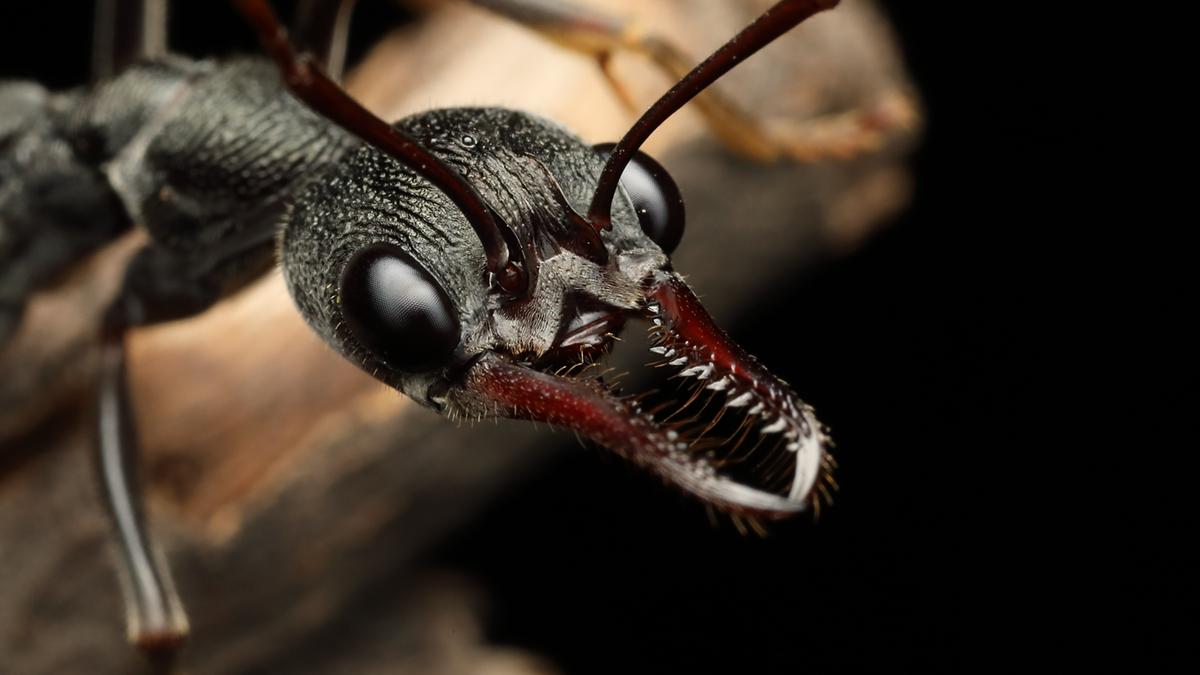
Now, for the first time, scientists at Macquarie University, Sydney, have found that two nocturnal bull ant species (Myrmecia pyriformis and Myrmecia midas) make their way at night with the help of polarised moonlight, which, while being dimmer even than moonlight, contains unusual patterns that can point the way.

This is also only the second instance of an animal being found to use polarised moonlight to orient itself.

Returning late

Seen from the ground, both sunlight and moonlight contain characteristic polarisation patterns. The way these patterns are oriented in the sky, rather than the location of the light source alone, allows animals to use it as a compass.

The study found the nocturnal bull ants were able to detect and use polarised moonlight throughout the lunar cycle for foraging, even under a crescent moon when moonlight is 80% less intense.

The polarisation patterns in moonlight are also a million-times dimmer than in sunlight. So while many animals are known to use the latter, very few use the former. The first animal found to use polarised moonlight was the dung beetle.

Scientists already knew M. pyriformis and M. midas ants used polarised sunlight to navigate, but this light fades as the sun sets. The study’s researchers were also aware most of the foraging M. midas ants returned overnight while the night-time activity of M. pyriformis ants increased on full-moon nights.

The e-vector pattern

The sun and the moon both emit unpolarised light. Light is an electromagnetic wave, with the electric field oscillating perpendicular to the magnetic field, and both fields oscillating perpendicular to the wave’s direction of motion.

When the light moves through the earth’s atmosphere, it is scattered by particles in the air and becomes polarised. Polarisation denotes a specific orientation of the electric field.

Both sunlight and moonlight scattered in the atmosphere become linearly polarised, meaning the electric field oscillates in a single, fixed plane perpendicular to the wave’s motion. The scattered light is also oriented 90º to the incident light.

As numerous light waves are scattered in this way, an unusual pattern emerges in the sky when seen through a filter that can detect polarised light. This is called the e-vector pattern.

“[W]hen the sun/moon is near the horizon, the pattern of polarised skylight is particularly simple, with uniform direction of polarisation approximately parallel to the north-south axes,” the researchers wrote in their paper.

The stability of this pattern gives an animal that can detect it a natural compass.

Under the moon

The researchers created linearly polarised light and cast it on a population of nocturnal bull ants in the wild, then tracked the ants’ ability to orient themselves relative to their two nests, located more than 50 metres apart.

Under full, waxing, and waning moon conditions, the researchers rotated their polariser clockwise by 45° and later counterclockwise by 45°. In each instance, the e-vector of the light falling on the ants changed. The ants responded by adjusting their path to the left and later to the right. Once the foragers crossed the area where the researchers’ light was being cast, they adjusted once more to reorient themselves according to the e-vector pattern in the sky.

The researchers used paired tests to compare the magnitude of these shifts between the initial orientation and the filter exit and again between the filter exit and the reorientation. The paired tests are a statistical tool with which researchers can determine whether paired observations — shift magnitudes in this case — differ between two samples.

“Shift magnitude is the number of degrees the ants alter their headings under the filter,” Cody Freas, a doctoral student at Macquarie University and one of the study’s coauthors, said.

While the nocturnal bull ants were found to use polarised moonlight throughout the lunar cycle, their heading shift magnitudes dropped during the waning phases. The researchers called this finding “unexpected”. Likewise, foraging ants had substantially higher shift magnitudes during the waxing full moon and waxing quarter moon phases compared to the waning phases.

Under the new moon, when the ambient moonlight e-vector disappeared, the paths of the foraging ants didn’t change significantly when the polarisation filter was rotated in either direction. The ants also didn’t reorient their paths to a meaningful degree once they exited the filter.

The researchers used another statistical test to compare the differences in shift magnitudes when the filter was rotated clockwise and counter-clockwise across lunar phases.

Shift magnitudes, vector distances

During the full moon, when moonlight reaches 80% of its maximum intensity, the shift magnitudes were 36.6º to 43º at Nest 1 and 21.5º to 28.9º at Nest 2. According to Freas, the difference between the two nests is likely due to the long distance that foragers at Nest 1 traversed on their trip to the foraging tree, 6 m, versus 2.5 m from Nest 2.

“At short vector lengths, like at Nest 2, the vector, which is informed by the sky compass, becomes less reliable,” he said, adding that the longer the distance, the more “powerful” the guidance is.

“Thus, if the ant walks 6 m to the foraging tree, we can say that the ant has a 6-m vector pointing back to the nest. This vector also [shrinks] as the ant travels in the nest direction. It’s an updating estimate of how far away the nest is at any point. So when we release an ant halfway home, it still has the vector from where it was captured (6 m).”

According to Clarke Scholtz, emeritus professor of entomology at the University of Pretoria, South Africa, and Marie Dacke, a professor of sensory biology at Lund University, Sweden, “The methods used in the study are appropriate.” Neither was involved in the study.

“While we cannot compare solar and moonlight polarisation navigation in outbound ants …, striking similarities occur when comparing solar and moonlight polarisation navigation in ants homing to the nest,” the researchers wrote in their paper.

“… it remains unknown if these ants are tracking their lunar polarisation compass by using a time-compensated lunar compass, or if the compass is updated with reference to other cues, such as the panorama, throughout the night,” they added. Honeybees and desert ants have been known to use such cues together with sunlight. They said future research could check whether the ants have a way to say where the moon is after specific intervals by “exposing or blocking access to the sky and familiar panorama for set time periods when the moon is naturally visible overnight…”.

Madhurima Pattanayak is a freelance science writer and journalist based in Kolkata.

Published – February 20, 2025 05:30 am IST


Source link

Science

Post navigation

Previous Post: Trump Administration Tells Pentagon To Slash Budget
Next Post: Israeli fire kills three Palestinians in West Bank refugee camp

Related Posts

  • The Uncut Diamond: Book explores the life of pioneering physicist and meteorologist Anna Mani
    The Uncut Diamond: Book explores the life of pioneering physicist and meteorologist Anna Mani Science
  • President launches India’s first homegrown CAR T-cell therapy for cancer treatment, calls it ‘new hope’
    President launches India’s first homegrown CAR T-cell therapy for cancer treatment, calls it ‘new hope’ Science
  • Frequent mass wasting in Tibet a cause for worry in India
    Frequent mass wasting in Tibet a cause for worry in India Science
  • Unmasking Guillain-Barré Syndrome: revelations from studies at NIMHANS
    Unmasking Guillain-Barré Syndrome: revelations from studies at NIMHANS Science
  • In Frames | Starling murmurations
    In Frames | Starling murmurations Science
  • IIT Bombay researchers show one way how animals find their way home
    IIT Bombay researchers show one way how animals find their way home Science

More Related Articles

How OpenAI’s ChatGPT helped scientists crack a tedious physics problem How OpenAI’s ChatGPT helped scientists crack a tedious physics problem Science
Earthquake in Delhi-NCR, Bihar: What is a shallow earthquake that struck Delhi? Earthquake in Delhi-NCR, Bihar: What is a shallow earthquake that struck Delhi? Science
Microplastics threaten Goa’s estuarine fisheries, human consumers Microplastics threaten Goa’s estuarine fisheries, human consumers Science
BITS Pilani Hyderabad scientists develop smart wound dressing to kill infection-causing bacteria BITS Pilani Hyderabad scientists develop smart wound dressing to kill infection-causing bacteria Science
US Ambassador Eric Garcetti proposes development of “QUAD satellite” with India-U.S. partnership US Ambassador Eric Garcetti proposes development of “QUAD satellite” with India-U.S. partnership Science
Study finds gene mutation that turns familiar faces into strangers Study finds gene mutation that turns familiar faces into strangers Science
SiteLock

Archives

  • May 2026
  • April 2026
  • March 2026
  • February 2026
  • January 2026
  • December 2025
  • November 2025
  • October 2025
  • September 2025
  • August 2025
  • July 2025
  • June 2025
  • May 2025
  • April 2025
  • March 2025
  • February 2025
  • January 2025
  • December 2024
  • November 2024
  • October 2024
  • September 2024
  • August 2024
  • July 2024
  • June 2024
  • May 2024
  • April 2024
  • March 2024
  • February 2024
  • January 2024
  • December 2023
  • November 2023
  • October 2023
  • September 2023
  • August 2023
  • July 2023
  • June 2023
  • May 2023
  • April 2023
  • March 2023
  • February 2023
  • January 2023
  • December 2022
  • November 2022
  • October 2022
  • September 2022
  • August 2022
  • July 2022
  • June 2022
  • May 2022

Categories

  • Business
  • Nation
  • Science
  • Sports
  • World

Recent Posts

  • Traffic diversions in Darussalam for 45 days for construction work
  • Watch: ‘We’re going to have a fantastic future together’: Trump to Xi Jinping
  • Thoothukudi will see highest Tasmac closures of liquor shops near schools, places of worship
  • Sensex climbs 450 points on positive Asian peers
  • India bans sugar exports till September 30

Recent Comments

  1. CarlosExorb on UP Teacher Who Asked Students To Slap Muslim Classmate
  2. Robertfloup on UP Teacher Who Asked Students To Slap Muslim Classmate
  3. Davidcag on UP Teacher Who Asked Students To Slap Muslim Classmate
  4. OrvalMaync on UP Teacher Who Asked Students To Slap Muslim Classmate
  5. Jeffreyroure on UP Teacher Who Asked Students To Slap Muslim Classmate
  • Access Denied Business
  • 7 militants killed in northwestern Pakistan in military operation: Army
    7 militants killed in northwestern Pakistan in military operation: Army World
  • Genetic enigma: two new studies reveal why some cats are orange
    Genetic enigma: two new studies reveal why some cats are orange Science
  • Southwest Airlines Flight Makes Hair-Raising Drop To 400 Feet From Ocean
    Southwest Airlines Flight Makes Hair-Raising Drop To 400 Feet From Ocean World
  • Up Against China, India Table Tennis Star Harmeet Desai Says India ‘Can Beat Any Team’
    Up Against China, India Table Tennis Star Harmeet Desai Says India ‘Can Beat Any Team’ Sports
  • Donald Trump’s Daughter Ivanka Shows Off Her Surfing Skills At Miami Beach
    Donald Trump’s Daughter Ivanka Shows Off Her Surfing Skills At Miami Beach World
  • “IPL Trophy Not Won By Celebration, Aggression, Beating CSK”: Ambati Rayudu Slams RCB
    “IPL Trophy Not Won By Celebration, Aggression, Beating CSK”: Ambati Rayudu Slams RCB Sports
  • Access Denied Sports

Editor-in-Chief:
Mohammad Ariff,
MSW, MAJMC, BSW, DTL, CTS, CNM, CCR, CAL, RSL, ASOC.
editor@artifex.news

Associate Editors:
1. Zenellis R. Tuba,
zenelis@artifex.news
2. Haris Daniyel
daniyel@artifex.news

Photograher:
Rohan Das
rohan@artifex.news

Artifex.News offers Online Paid Internships to college students from India and Abroad. Interns will get a PRESS CARD and other online offers.
Send your CV (Subjectline: Paid Internship) to internship@artifex.news

Links:
Associate Journalism
About Us
Privacy Policy

News Links:
Breaking News
World
Nation
Sports
Business
Entertainment
Lifestyle

Registered Office:
72/A, Elliot Road, Kolkata - 700016
Tel: 033-22277777, 033-22172217
Email: office@artifex.news

Editorial Office / News Desk:
No. 13, Mezzanine Floor, Esplanade Metro Rail Station,
12 J. L. Nehru Road, Kolkata - 700069.
(Entry from Gate No. 5)
Tel: 033-46011099, 033-46046046
Email: editor@artifex.news

Copyright © 2023 Artifex.News Newsportal designed by Artifex Infotech.