
Skip to content
  • Facebook
  • X
  • Linkedin
  • WhatsApp
  • YouTube
  • Associate Journalism
  • About Us
  • Privacy Policy
  • 033-46046046
  • editor@artifex.news
Artifex.News

Artifex.News

Stay Connected. Stay Informed.

  • Breaking News
  • World
  • Nation
  • Sports
  • Business
  • Science
  • Entertainment
  • Lifestyle
  • Toggle search form
  • Even Ganga’s Originating Point Is Polluted, Green Tribunal Told
    Even Ganga’s Originating Point Is Polluted, Green Tribunal Told Nation
  • Tanker lorry operators stage flash strike at Feroke in Kerala over alleged police inaction in arresting attacker
    Tanker lorry operators stage flash strike at Feroke in Kerala over alleged police inaction in arresting attacker Nation
  • Access Denied Sports
  • Access Denied Business
  • Chief Justice On Bail Issue
    Chief Justice On Bail Issue Nation
  • T20 World Cup 2024 | Afghanistan’s coming-of-age story: no longer a shock or upset
    T20 World Cup 2024 | Afghanistan’s coming-of-age story: no longer a shock or upset Sports
  • Head Of US Secret Service To Trump
    Head Of US Secret Service To Trump World
  • Central Bank of India Q3 profit jumps 33% to ₹959 crore
    Central Bank of India Q3 profit jumps 33% to ₹959 crore Business
Scientists uncover a magnetic misunderstanding about Uranus

Scientists uncover a magnetic misunderstanding about Uranus

Posted on November 12, 2024 By admin


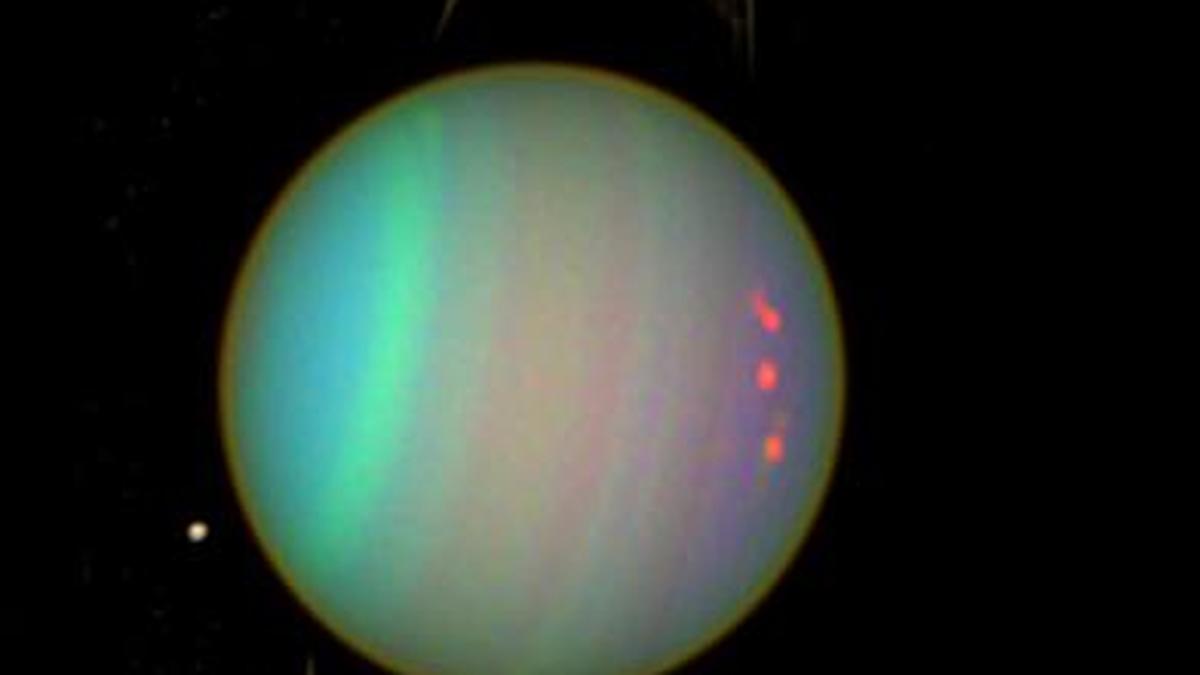
This NASA Hubble Space Telescope Advanced Camera for Surveys image, released on January 22, 2004, of Uranus reveals the planet’s faint rings and several of its satellites.
| Photo Credit: AFP/NASA

In 1781, German-born British astronomer William Herschel made Uranus the first planet discovered with the aid of a telescope. This frigid planet, our solar system’s third largest, remains a bit of an enigma 243 years later. And some of what we thought we knew about it turns out to be off the mark.

Much of the knowledge about Uranus was gleaned when NASA’s robotic spacecraft Voyager 2 conducted a five-day flyby in 1986. But scientists have now discovered that the probe visited at a time of unusual conditions – an intense solar wind event – that led to misleading observations about Uranus, and specifically its magnetic field.

The solar wind is a high-speed flow of charged particles emanating from the sun. The researchers took a fresh look at eight months of data from around the time of Voyager 2’s visit and found that it encountered Uranus just a few days after the solar wind had squashed its magnetosphere – the planet’s protective magnetic bubble – to about 20% of its usual volume.

“We found that the solar wind conditions present during the flyby only occur 4% of the time. The flyby occurred during the maximum peak solar wind intensity in that entire eight-month period,” said space plasma physicist Jamie Jasinski of NASA’s Jet Propulsion Laboratory, lead author of the study published on Monday in the journal Nature Astronomy.

“We would have observed a much bigger magnetosphere if Voyager 2 had arrived a week earlier,” Jasinski said.

Such a visit likely would have shown that the Uranus magnetosphere is similar to those of Jupiter, Saturn and Neptune, the solar system’s other giant planets, the researchers said. A magnetosphere is a region of space surrounding a planet where the planet’s magnetic field dominates, creating a protective zone against solar and cosmic particle radiation.

The Voyager 2 observations left a misimpression about the magnetosphere of Uranus as lacking in plasma and possessing uncommonly intense belts of highly energetic electrons.

Plasma – the fourth state of matter after solids, liquids and gases – is a gas whose atoms have been split into high-energy subatomic particles. Plasma is a common feature in the magnetosphere of other planets so its low concentration observed around Uranus was puzzling.

“The plasma environment of any planetary magnetosphere is usually formed of plasma from the solar wind, plasma from any moons present inside the magnetosphere and plasma from the atmosphere of the planet,” Jasinski said.

“At Uranus, we did not see plasma from the solar wind or from the moons. And the plasma that was measured was very tenuous,” Jasinski said.

Uranus, blue-green in color due to the methane contained in an atmosphere comprised mostly of hydrogen and helium, has a diameter of about 31,500 miles (50,700 km). It is big enough to fit 63 Earths inside it. Among the solar system’s eight planets, only Jupiter and Saturn are larger.

Its unusual tilt makes Uranus appear to orbit the sun like a rolling ball. Uranus, which orbits almost 20 times further from the sun than Earth does, has 28 known moons and two sets of rings.

The Voyager 2 observations had suggested that its two largest moons – Titania and Oberon – often orbit outside the magnetosphere. The new study indicates they tend to stay inside the protective bubble, making it easier for scientists to magnetically detect potential subsurface oceans.

“Both are thought to be prime candidates for hosting liquid water oceans in the Uranian system due to their large size relative to the other major moons,” Jet Propulsion Laboratory planetary scientist and study co-author Corey Cochrane said.

Scientists are eager to learn whether subsurface oceans on moons in the outer solar system have conditions suitable to support life. NASA on Oct. 14 launched a spacecraft on a mission to Jupiter’s moon Europa to address that very question.

“A future mission to Uranus is crucial to understanding not only the planet and magnetosphere, but also its atmosphere, rings and moons,” Jasinski said.

Published – November 12, 2024 08:36 am IST


Source link

Science

Post navigation

Previous Post: Israeli ministers send mixed signals over Lebanon ceasefire
Next Post: Aston Villa’s Morgan Rogers Receives First England Call-Up After Mass Withdrawal

Related Posts

  • Rhinos can’t sweat, making them vulnerable to overheating
    Rhinos can’t sweat, making them vulnerable to overheating Science
  • White-throated sparrows show sex in nature is not a simple binary
    White-throated sparrows show sex in nature is not a simple binary Science
  • Why India urgently needs a legal framework for genomics
    Why India urgently needs a legal framework for genomics Science
  • Capturing sunlight in a bottle and using it when needed
    Capturing sunlight in a bottle and using it when needed Science
  • Plant-based foods reduce the burden of cancer, diabetes
    Plant-based foods reduce the burden of cancer, diabetes Science
  • Australian scientists discover new ‘lucifer’ bee with devil-like horns
    Australian scientists discover new ‘lucifer’ bee with devil-like horns Science

More Related Articles

Stubble burning in Punjab, Haryana contributes only 14% of PM2.5 in Delhi-NCR: study Stubble burning in Punjab, Haryana contributes only 14% of PM2.5 in Delhi-NCR: study Science
Blue Origin pushes back first launch of giant New Glenn rocket Blue Origin pushes back first launch of giant New Glenn rocket Science
CSIR-CCMB scientists discover novel way to expedite tissue repair and regeneration CSIR-CCMB scientists discover novel way to expedite tissue repair and regeneration Science
Sorry, Musk: autonomous surgery is decades away, not three years Sorry, Musk: autonomous surgery is decades away, not three years Science
The holy trinity of cancer care: biochemistry, microbiology and pathology The holy trinity of cancer care: biochemistry, microbiology and pathology Science
First LVM3 launch vehicle equipped with semi-cryogenic stage slated to fly in 2027 First LVM3 launch vehicle equipped with semi-cryogenic stage slated to fly in 2027 Science
SiteLock

Archives

  • September 2026
  • August 2026
  • July 2026
  • June 2026
  • May 2026
  • April 2026
  • March 2026
  • February 2026
  • January 2026
  • December 2025
  • November 2025
  • October 2025
  • September 2025
  • August 2025
  • July 2025
  • June 2025
  • May 2025
  • April 2025
  • March 2025
  • February 2025
  • January 2025
  • December 2024
  • November 2024
  • October 2024
  • September 2024
  • August 2024
  • July 2024
  • June 2024
  • May 2024
  • April 2024
  • March 2024
  • February 2024
  • January 2024
  • December 2023
  • November 2023
  • October 2023
  • September 2023
  • August 2023
  • July 2023
  • June 2023
  • May 2023
  • April 2023
  • March 2023
  • February 2023
  • January 2023
  • December 2022
  • November 2022
  • October 2022
  • September 2022
  • August 2022
  • July 2022
  • June 2022
  • May 2022

Categories

  • Business
  • Nation
  • Science
  • Sports
  • World

Recent Posts

  • U.S. State Department clears $2.7 billion Ukraine defence package
  • Operation Toofan to trace drug money through UPI, crypto wallets
  • Houthis say Saudi Arabia launched 26 strikes in Yemen over 24 hours
  • Odisha government plans 870-Acre Silicon Valley hub in Cuttack’s Naraj for semiconductor, IT projects
  • Bihar announces OTS scheme for brick kilns, waives ₹90 crore interest on outstanding dues

Recent Comments

  1. AlvinNet on UP Teacher Who Asked Students To Slap Muslim Classmate
  2. AlvinNet on UP Teacher Who Asked Students To Slap Muslim Classmate
  3. Jamesslits on UP Teacher Who Asked Students To Slap Muslim Classmate
  4. MichaelClear on UP Teacher Who Asked Students To Slap Muslim Classmate
  5. Jamesslits on UP Teacher Who Asked Students To Slap Muslim Classmate
  • Understanding insect societies with Bengaluru-based Raghavendra Gadagkar
    Understanding insect societies with Bengaluru-based Raghavendra Gadagkar Science
  • US-Iran tensions: Russia urges restraint as U.S. builds up military assets near Iran
    US-Iran tensions: Russia urges restraint as U.S. builds up military assets near Iran World
  • Access Denied Sports
  • Access Denied World
  • Iran responsible for ‘physical violence‘ that killed Mahsa Amini: U.N. probe
    Iran responsible for ‘physical violence‘ that killed Mahsa Amini: U.N. probe World
  • Access Denied Sports
  • Fire in Cuttack’s SCB hospital ICU leaves at least 10 dead
    Fire in Cuttack’s SCB hospital ICU leaves at least 10 dead Nation
  • Access Denied Sports

Editor-in-Chief:
Mohammad Ariff,
MSW, MAJMC, BSW, DTL, CTS, CNM, CCR, CAL, RSL, ASOC.
editor@artifex.news

Associate Editors:
1. Zenellis R. Tuba,
zenelis@artifex.news
2. Haris Daniyel
daniyel@artifex.news

Photograher:
Rohan Das
rohan@artifex.news

Artifex.News offers Online Paid Internships to college students from India and Abroad. Interns will get a PRESS CARD and other online offers.
Send your CV (Subjectline: Paid Internship) to internship@artifex.news

Links:
Associate Journalism
About Us
Privacy Policy

News Links:
Breaking News
World
Nation
Sports
Business
Entertainment
Lifestyle

Registered Office:
72/A, Elliot Road, Kolkata - 700016
Tel: 033-22277777, 033-22172217
Email: office@artifex.news

Editorial Office / News Desk:
No. 13, Mezzanine Floor, Esplanade Metro Rail Station,
12 J. L. Nehru Road, Kolkata - 700069.
(Entry from Gate No. 5)
Tel: 033-46011099, 033-46046046
Email: editor@artifex.news

Copyright © 2023 Artifex.News Newsportal designed by Artifex Infotech.