




Skip to content
  • Facebook
  • X
  • Linkedin
  • WhatsApp
  • YouTube
  • Associate Journalism
  • About Us
  • Privacy Policy
  • 033-46046046
  • editor@artifex.news
Artifex.News

Artifex.News

Stay Connected. Stay Informed.

  • Breaking News
  • World
  • Nation
  • Sports
  • Business
  • Science
  • Entertainment
  • Lifestyle
  • Toggle search form
  • Pune Teen Driver’s Father Had Elaborate Escape Plan. How He Was Caught
    Pune Teen Driver’s Father Had Elaborate Escape Plan. How He Was Caught Nation
  • Meerut-Based Kanohar Electricals Applies For IPO To Raise Rs 300 Crore Business
  • Antony Blinken On US Campus Protests
    Antony Blinken On US Campus Protests World
  • Harvinder Singh, Preethi Pal To Be India’s Flag-Bearers For Paralympics Closing Ceremony
    Harvinder Singh, Preethi Pal To Be India’s Flag-Bearers For Paralympics Closing Ceremony Sports
  • Pakistan Stick With Winning Formula For Rawalpindi Finale Against England
    Pakistan Stick With Winning Formula For Rawalpindi Finale Against England Sports
  • How subpar treatment options allow sickle cell disease to persist | Explained
    How subpar treatment options allow sickle cell disease to persist | Explained Science
  • Access Denied World
  • Delhi Man Attempts Suicide On Instagram Live, Saved By Police
    Delhi Man Attempts Suicide On Instagram Live, Saved By Police Nation
Major Boeing-made communications satellite disintegrates in orbit

Major Boeing-made communications satellite disintegrates in orbit

Posted on October 22, 2024 By admin


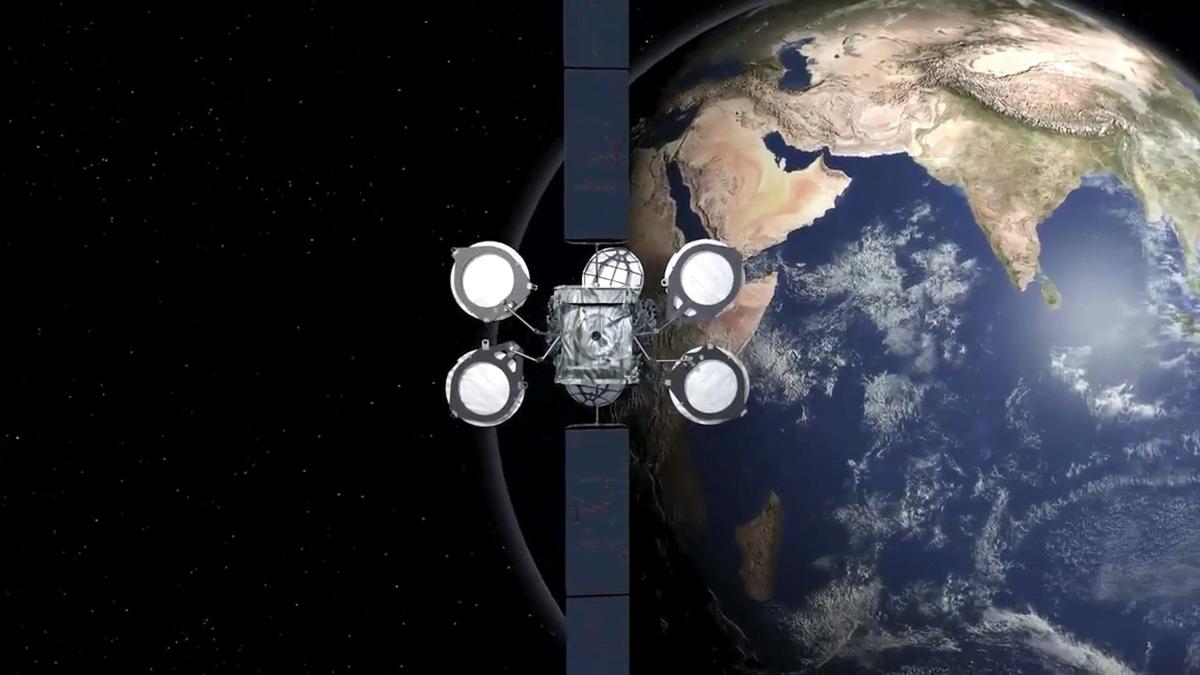
A large communications satellite has broken up in orbit, affecting users in Europe, Central Africa, the Middle East, Asia and Australia, and adding to the growing swarm of space junk clouding our planet’s neighbourhood.

The Intelsat 33e satellite provided broadband communication from a point some 35,000km above the Indian Ocean, in a geostationary orbit around the equator.

Initial reports on October 20 said Intelsat 33e had experienced a sudden power loss. Hours later, US Space Forces-Space confirmed the satellite appears to have broken up into at least 20 pieces.

So what happened? And is this a sign of things to come as more and more satellites head into orbit?

A space whodunnit

There are no confirmed reports about what caused the breakup of Intelsat 33e. However, it is not the first event of its kind.

In the past we’ve seen deliberate satellite destructions, accidental collisions, and loss of satellites due to increased solar activity.

What we do know is that Intelsat 33e has a history of issues while in orbit. Designed and manufactured by Boeing, the satellite was launched in August 2016.

In 2017, the satellite reached its desired orbit three months later than anticipated, due to a reported issue with its primary thruster, which controls its altitude and acceleration.

More propulsion troubles emerged when the satellite performed something called a station keeping activity, which keeps it at the right altitude. It was burning more fuel than expected, which meant its mission would end around 3.5 years early, in 2027. Intelsat lodged a $78 million insurance claim as a result of these problems.

However, at the time of its breakup, the satellite was reportedly not insured.

Intelsat is investigating what went wrong, but we may never know exactly what caused the satellite to fragment. We do know another Intelsat satellite of the same model, a Boeing-built EpicNG 702 MP, failed in 2019.

More importantly, we can learn from the aftermath of the breakup: space junk.

30 blue-whales of space junk

The amount of debris in orbit around Earth is increasing rapidly. The European Space Agency (ESA) estimates there are more than 40,000 pieces larger than 10cm in orbit, and more than 130,000,000 smaller than 1cm.

The total mass of human-made space objects in Earth orbit is some 13,000 tonnes. That’s about the same mass as 90 adult male blue whales. About one third of this mass is debris (4,300 tonnes), mostly in the form of leftover rocket bodies.

Tracking and identifying space debris is a challenging task. At higher altitudes, such as Intelsat 33e’s orbit around 35,000km up, we can only see objects above a certain size.

One of the most concerning things about the loss of Intelsat 33e is that the breakup likely produced debris that is too small for us to see from ground level with current facilities.

The past few months have seen a string of uncontrolled breakups of decommissioned and abandoned objects in orbit.

In June, the RESURS-P1 satellite fractured in low Earth orbit (an altitude of around 470km), creating more than 100 trackable pieces of debris. This event also likely created many more pieces of debris too small to be tracked.

In July, another decommissioned satellite – the Defense Meteorological Satellite Program (DMSP) 5D-2 F8 spacecraft – broke up. In August, the upper stage of a Long March 6A (CZ-6A) rocket fragmented, creating at least 283 pieces of trackable debris, and potentially hundreds of thousands of untrackable fragments.

It is not yet known whether this most recent event will affect other objects in orbit. This is where continuous monitoring of the sky becomes vital, to understand these complex space debris environments.

Who is responsible?

When space debris is created, who is responsible for cleaning it up or monitoring it?

In principle, the country that launched the object into space has the burden of responsibility where fault can be proved. This was explored in the 1972 Convention of International Liability for Damage Caused by Space Objects.

In practice, there is often little accountability. The first fine over space debris was issued in 2023 by the US Federal Communications Commission.

It’s not clear whether a similar fine will be issued in the case of Intelsat 33e.

Looking ahead

As the human use of space accelerates, Earth orbit is growing increasingly crowded. To manage the hazards of orbital debris, we will need continuous monitoring and improved tracking technology alongside deliberate efforts to minimise the amount of debris.

Most satellites are much closer to Earth than Intelsat 33e. Often these low Earth orbit satellites can be safely brought down from orbit (or “de-orbited”) at the end of their missions without creating space debris, especially with a bit of forward planning.

In September, ESA’s Cluster 2 “Salsa” satellite was de-orbited with a targeted re-entry into Earth’s atmosphere, burning up safely.

Of course, the bigger the space object, the more debris it can produce. NASA’s Orbital Debris Program Office calculated the International Space Station would produce more than 220 million debris fragments if it broke up in orbit, for example.

Accordingly, planning for de-orbiting of the station (ISS) at the end of its operational life in 2030 is now well underway, with the contract awarded to SpaceX.

Sara Webb is lecturer, Centre for Astrophysics and Supercomputing; Christopher Fluke is professor; and Tallulah Waterson is a PhD student at the Centre for Astrophysics and Supercomputing – all at the Swinburne University of Technology. This article is republished from The Conversation.

Published – October 22, 2024 09:05 am IST



Source link

Science

Post navigation

Previous Post: Italian Surfer, 36, Dies After Being Impaled By Swordfish In Indonesia
Next Post: Bangladesh vs South Africa, 1st Test Day 2, Live Score Updates

Related Posts

  • Sci-Five | The Hindu Science Quiz: On Electroreception
    Sci-Five | The Hindu Science Quiz: On Electroreception Science
  • What it takes to move heat action plans from advisories to mandates
    What it takes to move heat action plans from advisories to mandates Science
  • Right against climate change a distinct fundamental and human right, SC judgment
    Right against climate change a distinct fundamental and human right, SC judgment Science
  • In search of the elusive and threatened fishing cat
    In search of the elusive and threatened fishing cat Science
  • The INO that wasn’t and the JUNO that is
    The INO that wasn’t and the JUNO that is Science
  • Nobel Prize in Physics 2023: Three scientists win for research on electrons in flashes of light
    Nobel Prize in Physics 2023: Three scientists win for research on electrons in flashes of light Science

More Related Articles

The Science Quiz | Condensed matter physics The Science Quiz | Condensed matter physics Science
Next decade will define Indian space exploration: Shubhanshu Shukla Next decade will define Indian space exploration: Shubhanshu Shukla Science
ISRO chief V. Narayanan says PSLV-C61/EOS-09 failure analysis completed, report to be sent to PM soon ISRO chief V. Narayanan says PSLV-C61/EOS-09 failure analysis completed, report to be sent to PM soon Science
Revolutionising home-food preservation, one jar at a time Revolutionising home-food preservation, one jar at a time Science
Science quiz | Poisons that became medicines Science quiz | Poisons that became medicines Science
‘Underwhelming Indian genomics research, and gatekeeping’ ‘Underwhelming Indian genomics research, and gatekeeping’ Science
SiteLock

Archives

  • May 2026
  • April 2026
  • March 2026
  • February 2026
  • January 2026
  • December 2025
  • November 2025
  • October 2025
  • September 2025
  • August 2025
  • July 2025
  • June 2025
  • May 2025
  • April 2025
  • March 2025
  • February 2025
  • January 2025
  • December 2024
  • November 2024
  • October 2024
  • September 2024
  • August 2024
  • July 2024
  • June 2024
  • May 2024
  • April 2024
  • March 2024
  • February 2024
  • January 2024
  • December 2023
  • November 2023
  • October 2023
  • September 2023
  • August 2023
  • July 2023
  • June 2023
  • May 2023
  • April 2023
  • March 2023
  • February 2023
  • January 2023
  • December 2022
  • November 2022
  • October 2022
  • September 2022
  • August 2022
  • July 2022
  • June 2022
  • May 2022

Categories

  • Business
  • Nation
  • Science
  • Sports
  • World

Recent Posts

  • MP pulls up Adani Total Gas for delay in PNG supply line project for Udupi district
  • Heavy Russian strikes on Kyiv kill one, wound 31; Ukraine links attack to Trump-Xi summit
  • Vijay govt. says it needs time to ‘restructure’ Magalir Urimai Thogai programme; funds to be disbursed soon
  • Premier League title race: Manchester City keeps pressure on Arsenal with win over Crystal Palace
  • Wholesale price inflation rises to 8.3% in April on sharp spike in fuel, power, crude

Recent Comments

  1. JamesHeR on UP Teacher Who Asked Students To Slap Muslim Classmate
  2. RafaelNar on UP Teacher Who Asked Students To Slap Muslim Classmate
  3. CarlosExorb on UP Teacher Who Asked Students To Slap Muslim Classmate
  4. Robertfloup on UP Teacher Who Asked Students To Slap Muslim Classmate
  5. Davidcag on UP Teacher Who Asked Students To Slap Muslim Classmate
  • Access Denied Sports
  • Trump issues ‘last warning’ to Hamas over hostages
    Trump issues ‘last warning’ to Hamas over hostages World
  • Access Denied Business
  • Access Denied World
  • Access Denied Business
  • Access Denied Sports
  • Will the trophy and medals be couriered to the Indian team?
    Will the trophy and medals be couriered to the Indian team? Sports
  • Access Denied
    Access Denied Nation

Editor-in-Chief:
Mohammad Ariff,
MSW, MAJMC, BSW, DTL, CTS, CNM, CCR, CAL, RSL, ASOC.
editor@artifex.news

Associate Editors:
1. Zenellis R. Tuba,
zenelis@artifex.news
2. Haris Daniyel
daniyel@artifex.news

Photograher:
Rohan Das
rohan@artifex.news

Artifex.News offers Online Paid Internships to college students from India and Abroad. Interns will get a PRESS CARD and other online offers.
Send your CV (Subjectline: Paid Internship) to internship@artifex.news

Links:
Associate Journalism
About Us
Privacy Policy

News Links:
Breaking News
World
Nation
Sports
Business
Entertainment
Lifestyle

Registered Office:
72/A, Elliot Road, Kolkata - 700016
Tel: 033-22277777, 033-22172217
Email: office@artifex.news

Editorial Office / News Desk:
No. 13, Mezzanine Floor, Esplanade Metro Rail Station,
12 J. L. Nehru Road, Kolkata - 700069.
(Entry from Gate No. 5)
Tel: 033-46011099, 033-46046046
Email: editor@artifex.news

Copyright © 2023 Artifex.News Newsportal designed by Artifex Infotech.