




Skip to content
  • Facebook
  • X
  • Linkedin
  • WhatsApp
  • YouTube
  • Associate Journalism
  • About Us
  • Privacy Policy
  • 033-46046046
  • editor@artifex.news
Artifex.News

Artifex.News

Stay Connected. Stay Informed.

  • Breaking News
  • World
  • Nation
  • Sports
  • Business
  • Science
  • Entertainment
  • Lifestyle
  • Toggle search form
  • Access Denied
    Access Denied Nation
  • England Seal Euro 2024 Berth As Kane Double Sinks Italy
    England Seal Euro 2024 Berth As Kane Double Sinks Italy Sports
  • Access Denied Business
  • Access Denied Sports
  • India Versus Pakistan, Asia Cup 2023: Babar Azam Bamboozled By Hardik Pandya. Reaction Is Viral – Watch
    India Versus Pakistan, Asia Cup 2023: Babar Azam Bamboozled By Hardik Pandya. Reaction Is Viral – Watch Sports
  • Access Denied Sports
  • Access Denied
    Access Denied Nation
  • “No Place In Team If…”: Ex-Pakistan Captain’s Fires Ultimatum To Babar Azam, Mohammad Rizwan
    “No Place In Team If…”: Ex-Pakistan Captain’s Fires Ultimatum To Babar Azam, Mohammad Rizwan Sports
Revolutionising home-food preservation, one jar at a time

Revolutionising home-food preservation, one jar at a time

Posted on November 29, 2025 By admin


What with near-instant delivery of whatever food item that we seek — be it ready-to-eat or even to prepare — and supermarkets around every corner in an urban expanse, it might not be long before the need to preserve food at home becomes a forgotten art. And yet, home-food preservation was a tricky affair even as recently as the 19th Century. Forget supermarkets and instant delivery platforms, even refrigeration was still largely preliminary back then, with home refrigerators still a thing of the future.

The beginnings of home canning

If we were to go back by 200 years, we’ll be confronted with a world that was just coming to terms with modern heat-based canning, pioneered by French chef and confectioner Nicolas Appert in the first decade of that century. While it worked remarkably well and was able to preserve a wide range of foods without adding any chemical preservatives, it was easier done in an industrial setting. It was extremely cumbersome, to say the least, for most home cooks, who had to wait for another 50 years for something easier.

John Landis Mason.
| Photo Credit:
Wikimedia Commons

That came courtesy John Landis Mason, a New Jersey-born son of a Scottish farmer. Mason was seeking a way to improve the home canning process, which in itself was still in its infancy.

Up until then, home canning involved the usage of wax to create airtight seal above the food that was being preserved. Stoppered with corks, the jars were then sealed with wax before being boiled. Far from foolproof, the messy process was quite difficult to carry out at homes. In order to keep themselves fed through winters, most people largely still took to smoking, salting, drying, and fermenting for canning.

A simple invention
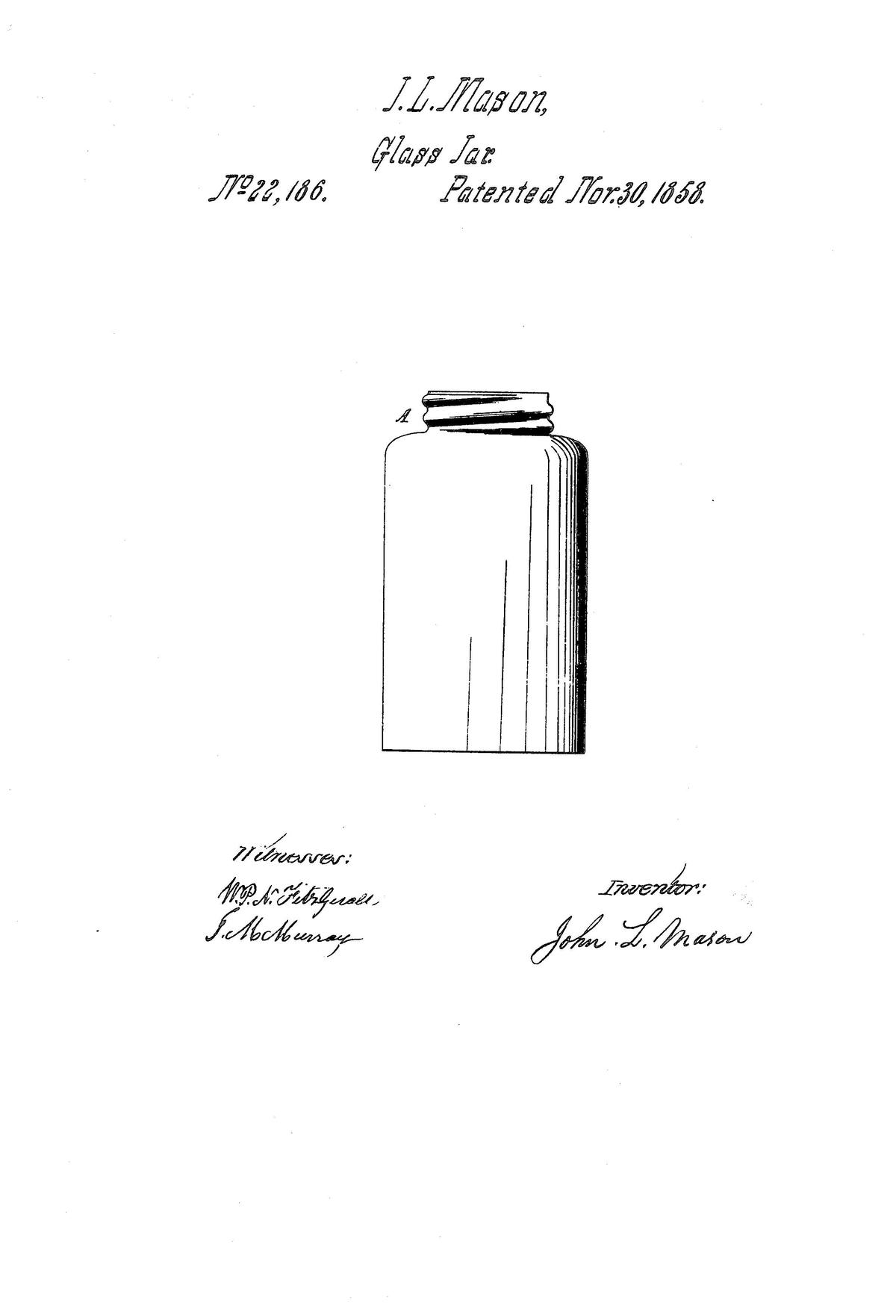
Patent drawing from Mason’s 1858 patent.

Patent drawing from Mason’s 1858 patent.
| Photo Credit:
U.S. Patent US22186A

Mason’s invention was simple. He “invented new and useful Improvements in the necks of bottles, jars, etc., especially such as are intended to be air and water tight,” and received a patent for the same on November 30, 1858. Not only were these Mason jars made of manganese-bleached glass transparent and hence allowed users to see what was inside, but the threaded neck and screw-on lid enabled the formation of a seal even as hot contents cooled.

While Mason showcased uncanny shrewdness in coming up with the jar that he had, he was far from shrewd as a businessman. His 1858 patent didn’t cover all aspects of his invention and it wasn’t until a full decade later that he chose to address that.
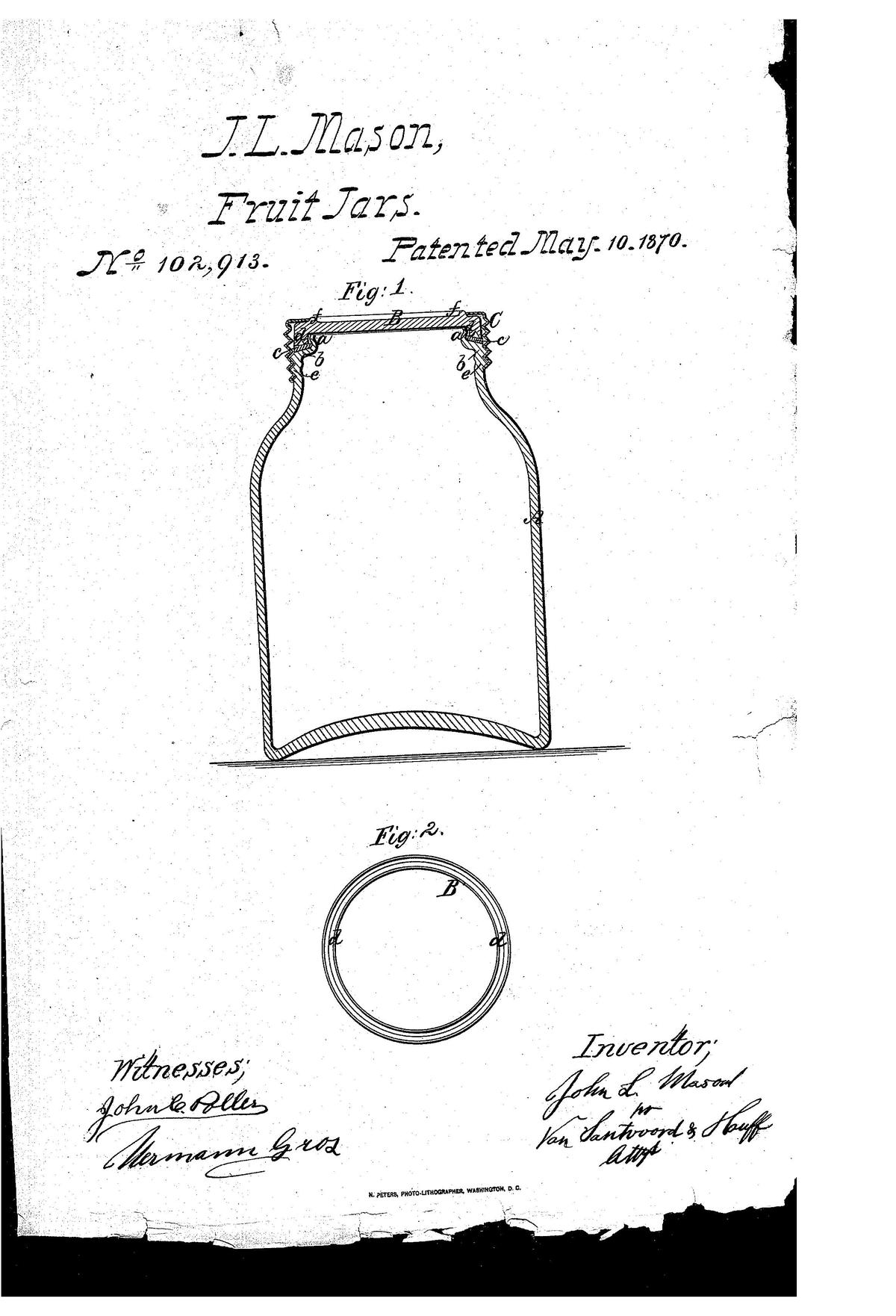
Patent drawing from Mason’s 1870 patent.

Patent drawing from Mason’s 1870 patent.
| Photo Credit:
U.S. Patent US102913A

Chief among these was the rubber ring on the underside of flat metal lids that was instrumental with respect to creating the airtight seal, thereby making wax usage unnecessary. By the time Mason decided to act in 1868, his jars were already everywhere. His attempt to regain control over his jars were a disaster, and when he died in 1902, he was allegedly penniless.

Ball brothers get the ball rolling

His invention, however, fared way way better. By 1880, soon after Mason’s initial patent had expired, the Ball brothers — Edmund, Frank, George, Lucius and William — got the ball rolling. With a $200 loan from their uncle, the brothers bought the small Wooden Jacket Can Company of Buffalo, New York. They switched over to the production of tin cans and glass jars, changed the company’s name to Ball Brothers Manufacturing Company, and before long, were the largest producers of Mason jars in the U.S.

By the end of the 19th Century, people in the U.S. were able to eat a wider variety of fruits and vegetables than ever before, throughout the year. Nutrition levels improved overall as Mason jars made it possible to have certain fruits and vegetables that were previously unavailable in the winter months.

World War thrust

Both World Wars provided a boom to home canning and naturally, to Mason jars as well. As the government rationed foods and the cans used to hold them, there were propaganda posters that featured Mason jars encouraging the public to cultivate victory gardens and preserve what they grew at home. The decade between 1939 and 1949 alone saw three million canning jars being bought by Americans.

World War II propaganda poster.

World War II propaganda poster.
| Photo Credit:
Northwestern University Libraries

The post-war years saw the popularity of Mason jars go down. What with improvements in industrial canning and freezing technologies to go alongside the migration of people from rural suburbs to urban houses with refrigerators, the usage of Mason jars reduced from late 1940s onwards.

There’s been a revival of sorts in this century, but it hasn’t always been for the original purpose. Yes, Mason jars continue to be used for preserving food at home. But they are increasingly being used in restaurants and kitchens, just to create the right ambience. What’s more, Mason jars are also doubling up as flower vases, drinking jars, utensil holders, or maybe even holders for stationery items!

Mason jars that serve as flower vases.

Mason jars that serve as flower vases.
| Photo Credit:
Special arrangement

The pandemic boom

Just like how the World Wars provided a boom, the Covid-19 pandemic also provided an unexpected impetus to the re-adoption of Mason jars. With much of the world locked down, many Americans turned to home gardening as a let out during a difficult time. And when the time came to preserve the bumper crops of veggies and fruits, they turned again to Mason jars to help them out home canning.

Mason might have gained little out of his invention, but he left the world with an object that remains both functional and beautiful. What’s even more fascinating is that his same basic design has stood the test of time, thriving even now, more than 150 years later. The years in between have seen a few iterations and a number of related patents, but Mason’s screw-top Mason jar remains the most sought after even today.

Published – November 30, 2025 12:23 am IST



Source link

Science

Post navigation

Previous Post: Access Denied
Next Post: The Durand Line: Fragile frontier

Related Posts

  • Hypoxia rewires membrane lipids, drives pancreatic cells to move: IIT-Bombay study
    Hypoxia rewires membrane lipids, drives pancreatic cells to move: IIT-Bombay study Science
  • Science for All: Chocolate flavour is affected by microbes, scientists find
    Science for All: Chocolate flavour is affected by microbes, scientists find Science
  • Deep tech investments in India doubling every three years, crossed  billion between 2021-23: Report
    Deep tech investments in India doubling every three years, crossed $1 billion between 2021-23: Report Science
  • Bumrah’s ball to Rizwan shows energy conservation law in action
    Bumrah’s ball to Rizwan shows energy conservation law in action Science
  • Will AI help fix India’s energy demand or will its own needs surge?
    Will AI help fix India’s energy demand or will its own needs surge? Science
  • Science quiz | Poisons that became medicines
    Science quiz | Poisons that became medicines Science

More Related Articles

Study finds long-term dynamics of transplanted stem cells Study finds long-term dynamics of transplanted stem cells Science
Why do our brains fall for optical illusions? Why do our brains fall for optical illusions? Science
Android phones have brought early quake warnings to 98 countries Android phones have brought early quake warnings to 98 countries Science
NIAB scientists working on next generation vaccine against ‘Leptospirosis’ NIAB scientists working on next generation vaccine against ‘Leptospirosis’ Science
SpaceX’s Polaris Dawn mission: Who are the astronauts doing the spacewalk? SpaceX’s Polaris Dawn mission: Who are the astronauts doing the spacewalk? Science
Why BSL-3 lab for Nipah confirmation is unnecessary Why BSL-3 lab for Nipah confirmation is unnecessary Science
SiteLock

Archives

  • May 2026
  • April 2026
  • March 2026
  • February 2026
  • January 2026
  • December 2025
  • November 2025
  • October 2025
  • September 2025
  • August 2025
  • July 2025
  • June 2025
  • May 2025
  • April 2025
  • March 2025
  • February 2025
  • January 2025
  • December 2024
  • November 2024
  • October 2024
  • September 2024
  • August 2024
  • July 2024
  • June 2024
  • May 2024
  • April 2024
  • March 2024
  • February 2024
  • January 2024
  • December 2023
  • November 2023
  • October 2023
  • September 2023
  • August 2023
  • July 2023
  • June 2023
  • May 2023
  • April 2023
  • March 2023
  • February 2023
  • January 2023
  • December 2022
  • November 2022
  • October 2022
  • September 2022
  • August 2022
  • July 2022
  • June 2022
  • May 2022

Categories

  • Business
  • Nation
  • Science
  • Sports
  • World

Recent Posts

  • NCRB data testifies to UP’s strong law and order: DGP
  • There are very few players in world cricket who can strike the ball like Finn Allen: Boucher
  • Magyar to become Hungary’s ‘regime change’ PM
  • Indian sailor killed in dhow fire near Strait of Hormuz
  • PM Modi, leaders pays homage to Tagore on Rabindra Jayanti

Recent Comments

  1. CalebKar on UP Teacher Who Asked Students To Slap Muslim Classmate
  2. Alvinadubs on UP Teacher Who Asked Students To Slap Muslim Classmate
  3. CharlesVOX on UP Teacher Who Asked Students To Slap Muslim Classmate
  4. Robertgop on UP Teacher Who Asked Students To Slap Muslim Classmate
  5. ShaneElden on UP Teacher Who Asked Students To Slap Muslim Classmate
  • Israel’s Supreme Court says government is not giving Palestinian prisoners enough food
    Israel’s Supreme Court says government is not giving Palestinian prisoners enough food World
  • BJP Drops 4 Sitting MPs In Odisha, Names 18 Of 21 Candidates
    BJP Drops 4 Sitting MPs In Odisha, Names 18 Of 21 Candidates Nation
  • Bank of India raises ₹2,690 crore through Infra Bonds
    Bank of India raises ₹2,690 crore through Infra Bonds Business
  • Pilgrims commence the final rites of Haj as Muslims celebrate Id al-Adha
    Pilgrims commence the final rites of Haj as Muslims celebrate Id al-Adha World
  • Igor Stimac, Indian Football Coach, Sacked; AIFF Unhappy With Him For This Reason
    Igor Stimac, Indian Football Coach, Sacked; AIFF Unhappy With Him For This Reason Sports
  • Access Denied
    Access Denied Nation
  • India Brings 100 Metric Tonnes Of Gold Back From UK, Fills RBI Vaults
    India Brings 100 Metric Tonnes Of Gold Back From UK, Fills RBI Vaults Nation
  • Access Denied Sports

Editor-in-Chief:
Mohammad Ariff,
MSW, MAJMC, BSW, DTL, CTS, CNM, CCR, CAL, RSL, ASOC.
editor@artifex.news

Associate Editors:
1. Zenellis R. Tuba,
zenelis@artifex.news
2. Haris Daniyel
daniyel@artifex.news

Photograher:
Rohan Das
rohan@artifex.news

Artifex.News offers Online Paid Internships to college students from India and Abroad. Interns will get a PRESS CARD and other online offers.
Send your CV (Subjectline: Paid Internship) to internship@artifex.news

Links:
Associate Journalism
About Us
Privacy Policy

News Links:
Breaking News
World
Nation
Sports
Business
Entertainment
Lifestyle

Registered Office:
72/A, Elliot Road, Kolkata - 700016
Tel: 033-22277777, 033-22172217
Email: office@artifex.news

Editorial Office / News Desk:
No. 13, Mezzanine Floor, Esplanade Metro Rail Station,
12 J. L. Nehru Road, Kolkata - 700069.
(Entry from Gate No. 5)
Tel: 033-46011099, 033-46046046
Email: editor@artifex.news

Copyright © 2023 Artifex.News Newsportal designed by Artifex Infotech.