Skip to content
  • Facebook
  • X
  • Linkedin
  • WhatsApp
  • YouTube
  • Associate Journalism
  • About Us
  • Privacy Policy
  • 033-46046046
  • editor@artifex.news
Artifex.News

Artifex.News

Stay Connected. Stay Informed.

  • Breaking News
  • World
  • Nation
  • Sports
  • Business
  • Science
  • Entertainment
  • Lifestyle
  • Toggle search form
  • “What Will Happen To Us?” Long Wait For Assam Rat Hole Miner’s Wife, Baby
    “What Will Happen To Us?” Long Wait For Assam Rat Hole Miner’s Wife, Baby Nation
  • Access Denied Sports
  • Access Denied
    Access Denied Nation
  • NCLT orders insolvency proceedings against Coffee Day Enterprises
    NCLT orders insolvency proceedings against Coffee Day Enterprises Business
  • Access Denied Business
  • Injury-Plagued Pakistan Look To See Of Sri Lanka Threat For A Place In Asia Cup Final
    Injury-Plagued Pakistan Look To See Of Sri Lanka Threat For A Place In Asia Cup Final Sports
  • So Many Unforgettable Memories: Bhuvneshwar Kumar Pens Emotional Farewell Note For SRH
    So Many Unforgettable Memories: Bhuvneshwar Kumar Pens Emotional Farewell Note For SRH Sports
  • India’s Shreyanka Patil Nominated For ICC Women’s Emerging Cricketer Of The Year 2024
    India’s Shreyanka Patil Nominated For ICC Women’s Emerging Cricketer Of The Year 2024 Sports
How firms like Samsung view labour | Explained

How firms like Samsung view labour | Explained

Posted on October 17, 2024 By admin


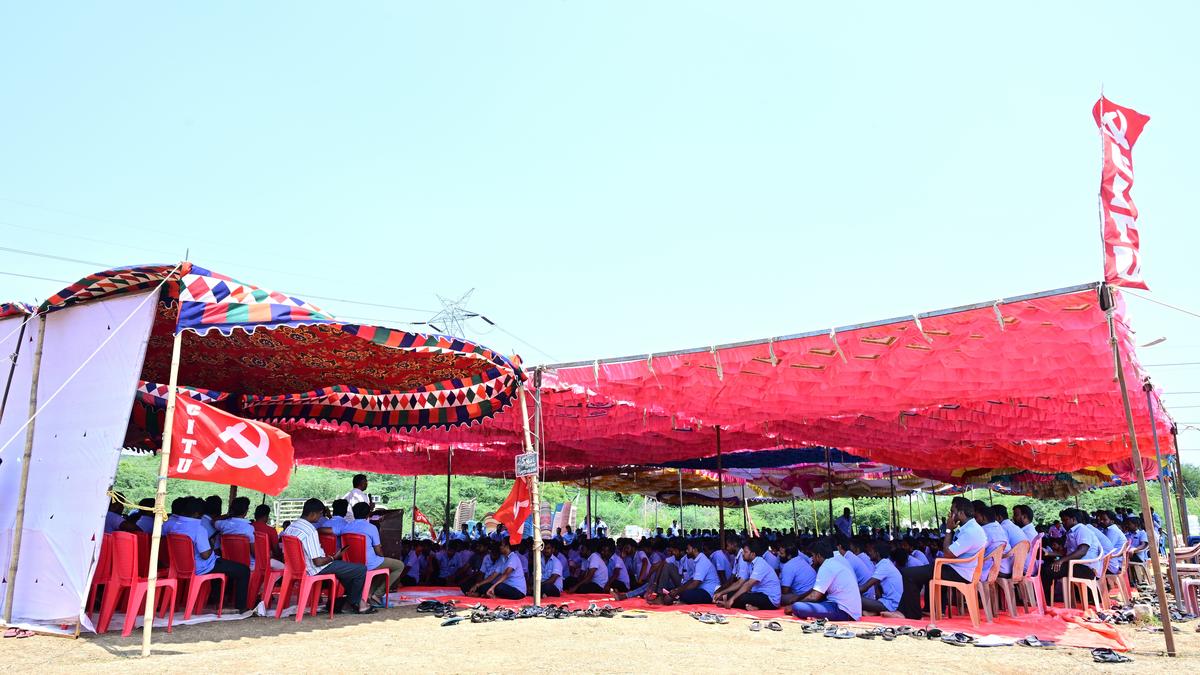
Samsung India factory workers on their 25th day of strike at Sunguvarchatram near Kancheepuram on October 3.
| Photo Credit: VELANKANNI RAJ. B

The story so far:On October 15, the Tamil Nadu labour department announced that the month-long strike at Samsung’s manufacturing facility in Sriperumbudur has ended after successful negotiations between the workers and company management. The Samsung India Workers’ Union (SIWU), affiliated to the Centre for Indian Trade Unions, announced the withdrawal of the strike and said they will return to work on October 17. While workers have raised various economic demands such as an incremental increase in their salaries over the next two years, at the heart of their protest is the demand for the recognition of SIWU. The management has continued to stonewall this particular demand, and the workers have resorted to the judicial route, with the matter now pending before the Madras High Court.

When did Samsung India start?

The South Korean company, Samsung commenced its operations in India in 1995. The biggest generator of revenue for the company in India are smartphone devices, with most of these manufactured at its second plant in Noida, Uttar Pradesh. Its facility in Sriperumbudur was established in 2007, and produces consumer durables such as televisions, refrigerators, washing machines and air conditioners. It employs close to 5,000 workers. In 2022, the company signed an MoU with Tamil Nadu government, through an investment of ₹1,588 crore, to set up a new plant to produce compressors for refrigerators.

How do East Asian firms view unions?

Forming a workers’ union in a foreign-owned enterprise in India is a challenge in itself, with the need to pass through several political-bureaucratic loops to get it registered. However, getting it recognised by the management has often proved to be even more difficult. Labour subordination and disciplining has remained the default setting of most East Asian companies operating in India, especially in the past two decades. Some notable workers’ protests in different parts of India have been at manufacturing facilities with East Asian capital — Honda Scooters and Motorcycles in 2005, Maruti Suzuki in 2011-12, Wistron in 2020 and Foxconn in 2021. The stressful working conditions in these factories are shaped and determined by their management philosophy, which largely draws inspiration from the Japanese production method called Kaizen — that is, continuous improvement to increase work intensity and reduce idle time. Over the years, through offshore supply chains, global manufacturing in the electronics industry has been reordered into just-in-time production — a system in which products are created to meet demand rather than in surplus or in advance of need. As companies adopt this model to increase efficiency, the output is ramped up ahead of product launches and peak sales periods. It leads to punishing work ethic, regimented culture of rules and unyielding deadlines.

It is in this context that the demand for representative associations is pertinent from a labour-centric perspective. However, past experiences — the ready reference being Maruti Suzuki workers’ struggles to form a union — reflect the reluctance of managements. They remain extremely wary of unions, especially those with communist affiliations, and are apprehensive of their militant actions. As is visible in the present case, while there has been some conciliation towards other demands, Samsung has remained adamant on not recognising SIWU.

Also read | On Samsung workers’ right to unionise

What about labour in South Korea?

Companies in South Korea such as Samsung are called Chaebols. These are large, diversified business conglomerates owned and controlled by families or their close kin for generations. Chaebols have dominated South Korean economy since the 1960s and have also had significant links to the country’s polity. Their origins can be traced to the encouragement and support provided by the authoritarian military dictatorship to rebuild the economy post the Korean war in 1953. The export-led growth strategy of Chaebols was dependent on their labour management strategies which was a combination of minimising labour costs, and intensification of work. Since then the work environment has moved from militaristic labour control and subordination in the 1970s to more paternalistic management practices such as welfare schemes and subsidies in later years. According to scholars Seung-Ho Kwon and Michael O’Donnell, as independent trade unions emerged in the country in the 1980s, the Chaebols brought in automated production systems, introduced external subcontractors and restructured as well as decentralised their operations to curb labour power (including transnational investments). Presently, Samsung, founded by Lee Byung-chul in 1938, is the country’s largest Chaebol.

What are the concerns for India?

The prolonging of the strike causes concerns for both central and State governments — for the former, regarding India’s manufacturing ambitions and becoming an alternative to China, and for the latter, who are forced to strike a balance between attracting foreign investments and signifying its political-governing philosophy of dignity and justice. The resolution of the issue is therefore a matter of prestige and urgency rather than any pro-labour development.

Anand P. Krishnan is a Fellow at the Centre of Excellence for Himalayan Studies, Shiv Nadar Institution of Eminence, Delhi NCR, and an Adjunct Fellow, at Institute of Chinese Studies, Delhi.

Published – October 17, 2024 08:30 am IST


Source link

Business Tags:labour rights in india, samsung strike in tamil nadu, samsung workers protest, samsung workers salary

Post navigation

Previous Post: Serena Williams Has Grapefruit-Sized Cyst Removed From Neck
Next Post: Amazon.com joins push for nuclear power to meet data centre demand

Related Posts

  • Access Denied Business
  • Chinese lenders discontinue high yield deposit products to cut costs
    Chinese lenders discontinue high yield deposit products to cut costs Business
  • Insurance regulator IRDAI retains LIC, GIC Re, New India Assurance as D-Slls  
    Insurance regulator IRDAI retains LIC, GIC Re, New India Assurance as D-Slls   Business
  • Access Denied Business
  • Rupee rises 3 paise to 88.63 against U.S. dollar
    Rupee rises 3 paise to 88.63 against U.S. dollar Business
  • Access Denied Business

More Related Articles

Finance Ministry notifies constitution of GST Appellate Tribunals Finance Ministry notifies constitution of GST Appellate Tribunals Business
Loanable funds theory: how interest rates are determined in the loan market  Loanable funds theory: how interest rates are determined in the loan market  Business
Markets bounce back in early trade after massive drop on value-buying at lower levels Markets bounce back in early trade after massive drop on value-buying at lower levels Business
Access Denied Business
Hardeep Puri meets British Columbia Premier, discusses LNG prospects, LPG imports, cooperation in green hydrogen Hardeep Puri meets British Columbia Premier, discusses LNG prospects, LPG imports, cooperation in green hydrogen Business
Wheels India inks pact with Japan’s Topy Industries for aluminium alloy wheels Wheels India inks pact with Japan’s Topy Industries for aluminium alloy wheels Business
SiteLock

Archives

  • May 2026
  • April 2026
  • March 2026
  • February 2026
  • January 2026
  • December 2025
  • November 2025
  • October 2025
  • September 2025
  • August 2025
  • July 2025
  • June 2025
  • May 2025
  • April 2025
  • March 2025
  • February 2025
  • January 2025
  • December 2024
  • November 2024
  • October 2024
  • September 2024
  • August 2024
  • July 2024
  • June 2024
  • May 2024
  • April 2024
  • March 2024
  • February 2024
  • January 2024
  • December 2023
  • November 2023
  • October 2023
  • September 2023
  • August 2023
  • July 2023
  • June 2023
  • May 2023
  • April 2023
  • March 2023
  • February 2023
  • January 2023
  • December 2022
  • November 2022
  • October 2022
  • September 2022
  • August 2022
  • July 2022
  • June 2022
  • May 2022

Categories

  • Business
  • Nation
  • Science
  • Sports
  • World

Recent Posts

  • Maruti Suzuki crosses 3 million vehicle dispatches through railways, eyes 35% share by rail
  • Delhi High Court refuses to entertain PIL to prevent suicides
  • Gold ETF prices revive as investors flock on higher import duties on yellow metal
  • Kashmir MLA ‘boycotts’ L-G’s drug campaign after demolition drive in his constituency
  • Assam ships first legal agarwood chips to West Asia

Recent Comments

  1. Jeffreyroure on UP Teacher Who Asked Students To Slap Muslim Classmate
  2. Stevemonge on UP Teacher Who Asked Students To Slap Muslim Classmate
  3. RichardClage on UP Teacher Who Asked Students To Slap Muslim Classmate
  4. StevenLek on UP Teacher Who Asked Students To Slap Muslim Classmate
  5. Leonardren on UP Teacher Who Asked Students To Slap Muslim Classmate
  • Access Denied World
  • Access Denied World
  • Access Denied Sports
  • Michael Gambon, actor who played Albus Dumbledore in six ‘Harry Potter’ movies, dies at age 82
    Michael Gambon, actor who played Albus Dumbledore in six ‘Harry Potter’ movies, dies at age 82 World
  • Gurugram Teen Sex Assaulted 9-Year-Old Neighbour Then Burnt Her Alive: Cops
    Gurugram Teen Sex Assaulted 9-Year-Old Neighbour Then Burnt Her Alive: Cops Nation
  • Iran says progress made towards U.S. talks despite attack jitters
    Iran says progress made towards U.S. talks despite attack jitters World
  • Access Denied World
  • Access Denied Business

Editor-in-Chief:
Mohammad Ariff,
MSW, MAJMC, BSW, DTL, CTS, CNM, CCR, CAL, RSL, ASOC.
editor@artifex.news

Associate Editors:
1. Zenellis R. Tuba,
zenelis@artifex.news
2. Haris Daniyel
daniyel@artifex.news

Photograher:
Rohan Das
rohan@artifex.news

Artifex.News offers Online Paid Internships to college students from India and Abroad. Interns will get a PRESS CARD and other online offers.
Send your CV (Subjectline: Paid Internship) to internship@artifex.news

Links:
Associate Journalism
About Us
Privacy Policy

News Links:
Breaking News
World
Nation
Sports
Business
Entertainment
Lifestyle

Registered Office:
72/A, Elliot Road, Kolkata - 700016
Tel: 033-22277777, 033-22172217
Email: office@artifex.news

Editorial Office / News Desk:
No. 13, Mezzanine Floor, Esplanade Metro Rail Station,
12 J. L. Nehru Road, Kolkata - 700069.
(Entry from Gate No. 5)
Tel: 033-46011099, 033-46046046
Email: editor@artifex.news

Copyright © 2023 Artifex.News Newsportal designed by Artifex Infotech.