



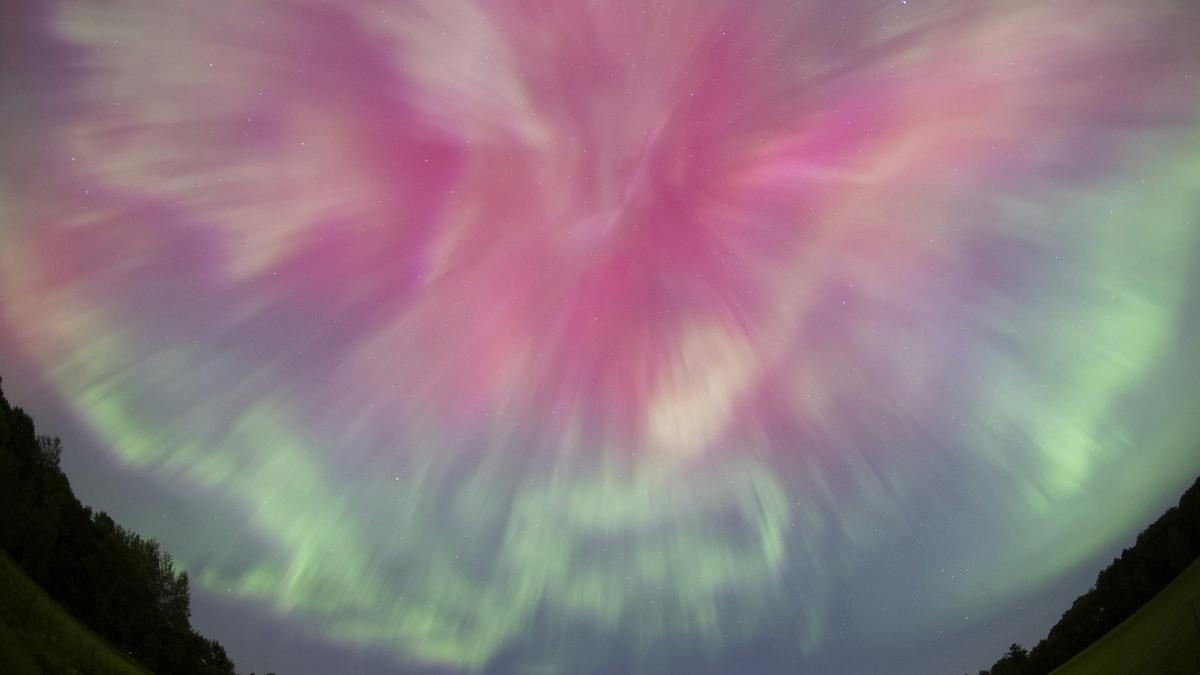
A geomagnetic storm lit up the night sky in parts of the US during the first weekend in October. South Africa’s National Space Agency (SANSA) told reporters that the storm had originated from a solar flare “that erupted from sunspot 3842 on October 3”. It said this was the strongest earth-facing solar flare recorded by SANSA in the past seven years and that the eruption briefly affected high-frequency radio communications, “resulting in a total radio blackout over the African region which lasted for up to 20 minutes”.
What is a geomagnetic storm? The Conversation Africa asked SANSA’s Amoré Elsje Nel, who researches geomagnetics, to explain.
What is a geomagnetic storm and how common are they?
A geomagnetic storm is a disturbance in the earth’s magnetic field caused by solar activity. There’s a reaction called nuclear fusion that occurs continuously deep within the Sun’s core. This generates massive amounts of energy. Some of the energy is released as light (sunlight), some as radiation (solar flares), and some as charged particles.
The Sun also continuously emits a stream of charged particles known as the solar wind. Occasionally, the Sun releases larger bursts of energy, called coronal mass ejections. It sends clouds of these charged particles, or plasma, hurtling through space. I like to explain it to children this way: the Sun sometimes drinks a soda too fast and then burps. This “burp” is the cloud of plasma which then travels through space. These emissions don’t always hit us. But when they do, they collide with the earth’s magnetic field, disrupt it, and lead to a geomagnetic storm.
The earth’s magnetic field is an invisible force that surrounds our planet, acting like a giant magnet with a north and south pole. It helps protect us from harmful solar radiation by deflecting charged particles from the Sun.
The solar flare from 3842 emitted both X-flares (radiation) and a coronal mass ejection. X-flares are radiation; they travel at almost the speed of light and reach the earth within minutes. That’s what caused the brief communications disruption SANSA mentioned on 3 October. But the coronal mass ejection takes much longer to reach us. We’d predicted it would do so over the past weekend but in fact it only reached us on the morning of 8 October.
Geomagnetic storms occur fairly often. Minor ones happen multiple times per year. The severity of a storm depends on how strong the solar event was that caused it. Larger, more intense storms are less common but can happen every few years. Solar events are closely tied to the Sun’s 11-year solar cycle, which has periods of high and low activity. During the peak of the cycle, called solar maximum, more sunspots and solar flares occur, increasing the likelihood of solar storms.
We are now heading towards the peak of Solar Cycle 25, which will be in July 2025. Solar maxima usually last between two and three years.
Are these storms dangerous? What damage can they cause?
Geomagnetic storms are not typically harmful to humans directly, but they can pose risks to modern technology and infrastructure. One of the most notable dangers is to power grids. Powerful storms can induce electric currents in power lines, potentially overloading transformers and causing blackouts, as happened in Quebec, Canada, in 1989.
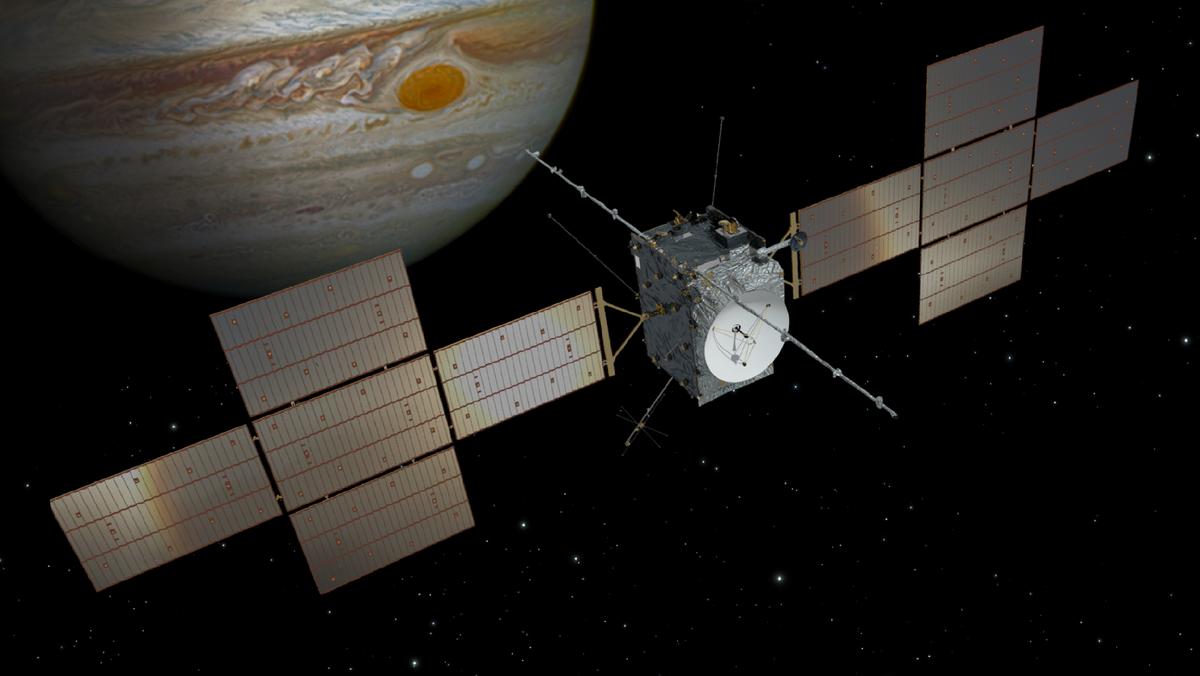
Satellites in space are also vulnerable. A strong storm can damage electronics onboard, disrupt communication signals, and shorten the lifespan of the satellites themselves.
In aviation, geomagnetic storms can disrupt radio communication and GPS signals, which are vital for aircraft navigation. This is especially important for flights that pass near the polar regions, where the effects of geomagnetic storms are more pronounced. Astronauts and spacecraft are also at risk – the extra radiation can be dangerous for equipment and human health.
Are there any upsides to this phenomenon?
Aurorae are a visually stunning aspect of geomagnetic storms. These colourful displays in the night sky occur when charged particles from the Sun get captured in the earth’s magnetic field lines, and funnel down towards the poles. Here they interact with the earth’s atmosphere, releasing energy that produces shimmering lights.
Aurorae can be seen at both the north and south pole, aptly named the northern and southern lights. If storms are big enough, it’s possible to see them in regions much further away from the poles. This happened in South Africa on May 11, 2024.
Studying geomagnetic storms provides valuable insights into space weather. By understanding how the Sun’s activity affects the earth, scientists can better predict future storms and work to protect the technologies we rely on. The study of geomagnetic storms also contributes to our understanding of the Sun and space in general.
Can monitoring the storms mitigate the risks?
Geomagnetic storms are monitored using various instruments on the earth and in space. On the earth, magnetometers measure changes in the magnetic field, allowing scientists to track disturbances as they happen. SANSA operates a dense network of Global Navigation Satellite System receivers in Africa, and magnetometer stations in various parts of southern Africa, for this reason. The agency is currently setting up a magnetometer station in Ethiopia, too. This will improve our ability to monitor geomagnetic storms.
In space, satellites equipped with sensors monitor the Sun’s activity and detect solar flares or coronal mass ejections before they reach the earth. This data feeds into prediction models used in space weather centres across the globe.
Once a storm is detected, agencies like SANSA issue alerts and forecasts. These warnings help industries such as power grid operators, satellite companies and aviation authorities to prepare for a storm.
For example, power companies can temporarily shut down or reconfigure parts of the grid to avoid overloading during a storm. Satellite operators can place their spacecraft into safer operating modes, such as switching off electronic components, and airlines can reroute flights away from high-risk areas.
Monitoring alone can’t prevent all the damage caused by geomagnetic storms. But it can greatly reduce the risks. Thanks to early warning systems we can protect crucial infrastructure and minimise the effect these storms have on our daily lives.
Amoré Elsje Nel is applied geomagnetic researcher, South African National Space Agency. This article is republished from The Conversation.
Published – October 10, 2024 05:24 pm IST