
Skip to content
  • Facebook
  • X
  • Linkedin
  • WhatsApp
  • YouTube
  • Associate Journalism
  • About Us
  • Privacy Policy
  • 033-46046046
  • editor@artifex.news
Artifex.News

Artifex.News

Stay Connected. Stay Informed.

  • Breaking News
  • World
  • Nation
  • Sports
  • Business
  • Science
  • Entertainment
  • Lifestyle
  • Toggle search form
  • Ramdev In Court After Patanjali Apology Over Misleading Ads
    Ramdev In Court After Patanjali Apology Over Misleading Ads Nation
  • Access Denied
    Access Denied Nation
  • Uttarakhand BJP Arrested For Assaulting Girl, Expelled From Party
    Uttarakhand BJP Arrested For Assaulting Girl, Expelled From Party Nation
  • Sri Lanka to treat Iranian sailors according to ‘international law’
    Sri Lanka to treat Iranian sailors according to ‘international law’ World
  • Silent Revolution, Minister Says Women In India’s Labour Force Doubled In 7 Years
    Silent Revolution, Minister Says Women In India’s Labour Force Doubled In 7 Years Nation
  • Access Denied
    Access Denied Nation
  • UN Confirms US’ Withdrawal Notification From Paris Climate Change Agreement
    UN Confirms US’ Withdrawal Notification From Paris Climate Change Agreement World
  • Deepfake Shared As N Sitharaman, RBI Chief Endorsing Investment Project
    Deepfake Shared As N Sitharaman, RBI Chief Endorsing Investment Project Nation
NASA to launch mission on Oct. 10 to look for habitable spots on Europa moon

NASA to launch mission on Oct. 10 to look for habitable spots on Europa moon

Posted on October 9, 2024 By admin


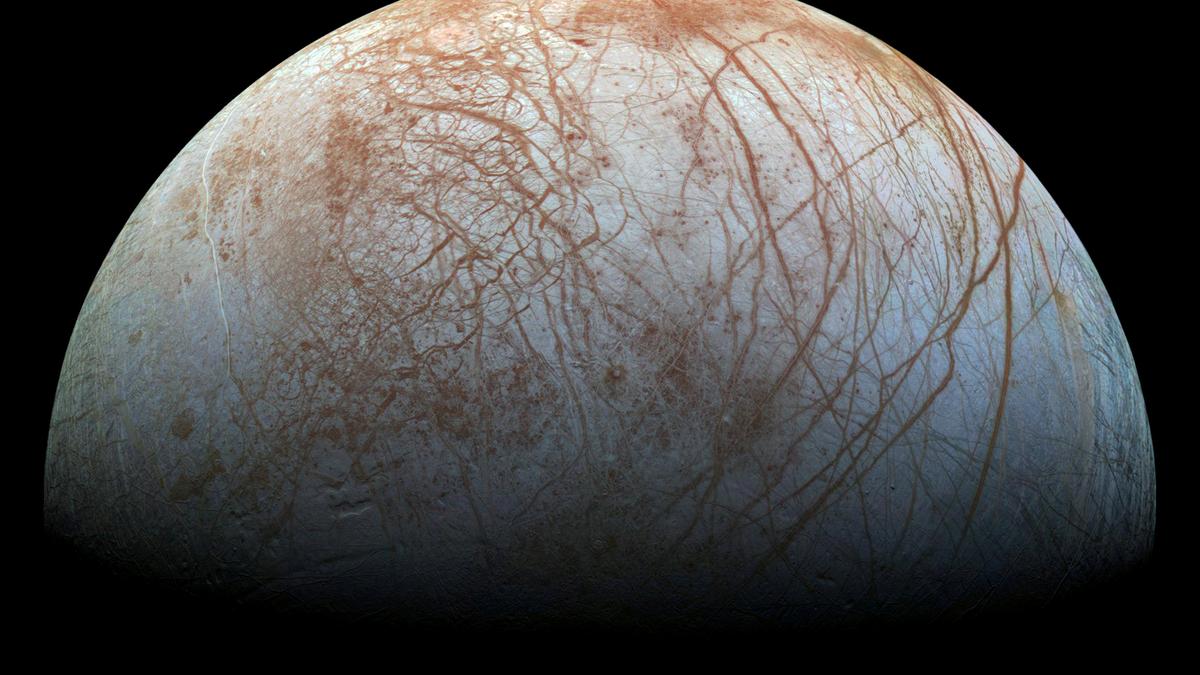
A view of Jupiter’s moon Europa created from images taken by NASA’s Galileo spacecraft in the late 1990’s, according to NASA, obtained by Reuters May 14, 2018.
| Photo Credit: Reuters

On October 10, NASA is launching a hotly anticipated new mission to Jupiter’s fourth-largest moon, Europa.

Called Europa Clipper, the spacecraft will conduct a detailed study of the moon, looking for potential places where Europa might host alien life.

It’s the largest planetary exploration spacecraft NASA has ever made: as wide as a basketball court when its solar sails are unfolded. It has a mass of about 6,000 kilograms – the weight of a large African elephant.

But why are we sending a hulking spacecraft all the way to Europa?

Looking for life away from Earth

The search for life in places other than Earth usually focuses on our neighbour Mars, a planet that’s technically in the “habitable zone” of our Solar System. But Mars is not an attractive place to live, due to its lack of atmosphere and high levels of radiation. However, it’s close to Earth, making it relatively easy to send missions to explore it.

But there are other places in the Solar System that could support life – some of the moons of Jupiter and Saturn. Why? They have liquid water.

Here on Earth, water is the solvent of life: water dissolves salts and sugars, and facilitates the chemical reactions needed for life on Earth to proceed. It’s possible life forms exist elsewhere that rely on liquid methane or carbon dioxide or something else, but life as we know it uses water.

The reason there’s liquid water so far out in the Solar System is because Jupiter and Saturn, the gas giants, wield immense gravitational power over their moons.

Saturn’s moons, Titan and Enceladus, are stretched and compressed by gravity as they go around their host planet. This movement results in vast underground oceans with a surface of solid ice, with plumes of water vapour exploding 9,600 kilometres from the surface.

It is strongly suspected that Europa is the same. While we know a lot about Europa from more than four centuries of observation, we have not confirmed it has an under-ice liquid ocean like Titan and Enceladus.

But all clues point to yes. Europa has a smooth surface despite being hit by many meteors, suggesting the surface is young, recently replaced. Ice volcanoes raining down water over the surface would make sense.

It also has a magnetic field, suggesting that like Earth, Europa has a liquid layer inside (on Earth, this liquid is molten rock).

What will Europa Clipper do?

At the surface, Europa is bombarded by high levels of space radiation, concentrated by Jupiter. But deeper down, the thick ice sheet could be protecting life in the liquid subsurface ocean.

This means it would be difficult for us to find concrete evidence for life without drilling down deep. But where to look? Through flybys of the icy moon, Europa Clipper will be looking at areas where life could be dwelling under the icy shell.

To achieve this, Europa Clipper has nine scientific instruments. These include a wide-angle camera to study geologic activity and a thermal imaging system to measure surface texture and detect warmer regions on the surface.

There’s also a spectrometer for looking at the chemical composition of the gases and surface of Europa, and for any explosive plumes of water from the surface. The mission also has tools for mapping the moon’s surface.

Other instruments will measure the depth and salt levels of the moon’s ocean and the thickness of its ice shell, and also how Europa flexes within the strong gravitational pull of Jupiter.

Excitingly, a mass spectrometer will analyse the gases of the moon’s faint atmosphere and potential plumes of water. By examining the material ejected from the plumes, we can understand what is hidden within the under-ice oceans of Europa.

A dust analyser will also look at matter that has been ejected from Europa’s surface by tiny meteorites or released from the plumes.

Unfortunately, we will have to wait a while for any discoveries. Europa Clipper will take more than five years to reach Jupiter. And the mission is only equipped to look for the potential of life, not life itself. If we see evidence that might point towards life, we will need future missions to return and explore Europa in depth.

So we must be patient. But this is an exciting opportunity for humanity to get one step closer to find life beyond our own home planet.

This article is republished from The Conversation under a Creative Commons license. Read the original article.

Published – October 09, 2024 05:34 pm IST



Source link

Science Tags:astronomy news, Europa Clipper, Europa missions, Jupiter moons, NASA, NASA missions, science news

Post navigation

Previous Post: People with autism, ADHD likelier to have eating disorders: study
Next Post: Women's T20 WC Live: Shafali's Powerful Batting Gives India Momentum vs SL

Related Posts

  • Tropical forests may be getting too hot for photosynthesis
    Tropical forests may be getting too hot for photosynthesis Science
  • Self-sustainable science and tech ecosystem with larger participation by private sector need of the hour: Jitendra Singh
    Self-sustainable science and tech ecosystem with larger participation by private sector need of the hour: Jitendra Singh Science
  • Budget 2025: FM opens up Nuclear power sector to private players and incentivises distribution reforms
    Budget 2025: FM opens up Nuclear power sector to private players and incentivises distribution reforms Science
  • Why do fish in schools have an easier time swimming in rough waters?
    Why do fish in schools have an easier time swimming in rough waters? Science
  • NISAR mission will showcase Indian space engineering on global scale: ex-ISRO scientist
    NISAR mission will showcase Indian space engineering on global scale: ex-ISRO scientist Science
  • Micrographia: Hooke’s monumental masterpiece – The Hindu
    Micrographia: Hooke’s monumental masterpiece – The Hindu Science

More Related Articles

Why India needs political change to retain women in STEM Why India needs political change to retain women in STEM Science
What role does Arctic sea ice play in Indian monsoon? What role does Arctic sea ice play in Indian monsoon? Science
In a first, Indian Institute of Astrophysics astronomers spot ultraviolet emissions from novae in Andromeda galaxy In a first, Indian Institute of Astrophysics astronomers spot ultraviolet emissions from novae in Andromeda galaxy Science
Did an ancient Vaigai flood contribute to Keezhadi’s abandonment? Did an ancient Vaigai flood contribute to Keezhadi’s abandonment? Science
How can small-scale farmers benefit from trees on farms? How can small-scale farmers benefit from trees on farms? Science
NASA astronaut Sunita Williams retires NASA astronaut Sunita Williams retires Science
SiteLock

Archives

  • May 2026
  • April 2026
  • March 2026
  • February 2026
  • January 2026
  • December 2025
  • November 2025
  • October 2025
  • September 2025
  • August 2025
  • July 2025
  • June 2025
  • May 2025
  • April 2025
  • March 2025
  • February 2025
  • January 2025
  • December 2024
  • November 2024
  • October 2024
  • September 2024
  • August 2024
  • July 2024
  • June 2024
  • May 2024
  • April 2024
  • March 2024
  • February 2024
  • January 2024
  • December 2023
  • November 2023
  • October 2023
  • September 2023
  • August 2023
  • July 2023
  • June 2023
  • May 2023
  • April 2023
  • March 2023
  • February 2023
  • January 2023
  • December 2022
  • November 2022
  • October 2022
  • September 2022
  • August 2022
  • July 2022
  • June 2022
  • May 2022

Categories

  • Business
  • Nation
  • Science
  • Sports
  • World

Recent Posts

  • Cuba has run out of diesel and fuel oil amid U.S. oil blockade
  • Karnataka’s Leader of Opposition R Ashok to reduce escort vehicles, travel by Namma Metro
  • China, U.S. should be ‘partners not rivals’, says Xi Jinping after meeting Donald Trump
  • UAE ‘denies reports’ of secret Netanyahu visit
  • Iran working on Hormuz ‘protocol’ to cover ‘costs’, says Deputy Foreign Minister Gharibabadi

Recent Comments

  1. OrvalMaync on UP Teacher Who Asked Students To Slap Muslim Classmate
  2. Jeffreyroure on UP Teacher Who Asked Students To Slap Muslim Classmate
  3. Stevemonge on UP Teacher Who Asked Students To Slap Muslim Classmate
  4. RichardClage on UP Teacher Who Asked Students To Slap Muslim Classmate
  5. StevenLek on UP Teacher Who Asked Students To Slap Muslim Classmate
  • Mayank Yadav’s 155.8 Kmph Ripper Faster Than Umran Malik’s Record? Check Full IPL List
    Mayank Yadav’s 155.8 Kmph Ripper Faster Than Umran Malik’s Record? Check Full IPL List Sports
  • Access Denied
    Access Denied Nation
  • New Zealand Pip Bangladesh To Secure Direct Entry To ICC Women’s World Cup 2025
    New Zealand Pip Bangladesh To Secure Direct Entry To ICC Women’s World Cup 2025 Sports
  • Pakistan sets up deportation centres to hold migrants who are in the country illegally
    Pakistan sets up deportation centres to hold migrants who are in the country illegally World
  • India vs England: T20 World Cup 2024 Live Cricket Score, Live Score Of Today's Match on NDTV Sports
    India vs England: T20 World Cup 2024 Live Cricket Score, Live Score Of Today's Match on NDTV Sports Sports
  • Access Denied Sports
  • Ratan Tata, former Tata Group chairman, dies at age 86
    Ratan Tata, former Tata Group chairman, dies at age 86 Business
  • Access Denied World

Editor-in-Chief:
Mohammad Ariff,
MSW, MAJMC, BSW, DTL, CTS, CNM, CCR, CAL, RSL, ASOC.
editor@artifex.news

Associate Editors:
1. Zenellis R. Tuba,
zenelis@artifex.news
2. Haris Daniyel
daniyel@artifex.news

Photograher:
Rohan Das
rohan@artifex.news

Artifex.News offers Online Paid Internships to college students from India and Abroad. Interns will get a PRESS CARD and other online offers.
Send your CV (Subjectline: Paid Internship) to internship@artifex.news

Links:
Associate Journalism
About Us
Privacy Policy

News Links:
Breaking News
World
Nation
Sports
Business
Entertainment
Lifestyle

Registered Office:
72/A, Elliot Road, Kolkata - 700016
Tel: 033-22277777, 033-22172217
Email: office@artifex.news

Editorial Office / News Desk:
No. 13, Mezzanine Floor, Esplanade Metro Rail Station,
12 J. L. Nehru Road, Kolkata - 700069.
(Entry from Gate No. 5)
Tel: 033-46011099, 033-46046046
Email: editor@artifex.news

Copyright © 2023 Artifex.News Newsportal designed by Artifex Infotech.