Skip to content
  • Facebook
  • X
  • Linkedin
  • WhatsApp
  • YouTube
  • Associate Journalism
  • About Us
  • Privacy Policy
  • 033-46046046
  • editor@artifex.news
Artifex.News

Artifex.News

Stay Connected. Stay Informed.

  • Breaking News
  • World
  • Nation
  • Sports
  • Business
  • Science
  • Entertainment
  • Lifestyle
  • Toggle search form
  • Colombo mulls converting Adani power project to a G2G deal: Sri Lankan media 
    Colombo mulls converting Adani power project to a G2G deal: Sri Lankan media  Business
  • Access Denied
    Access Denied Nation
  • IND vs NZ, 1st Test: India Fold Up For 462, Set New Zealand 107 To Win On Final Day
    IND vs NZ, 1st Test: India Fold Up For 462, Set New Zealand 107 To Win On Final Day Sports
  • Killed Hezbollah Commander Was Wanted For Deadly 1983 US Embassy, Marine Blasts
    Killed Hezbollah Commander Was Wanted For Deadly 1983 US Embassy, Marine Blasts World
  • Rajasthan Minister Claims “Love Affairs” Behind Some Student Suicides In Kota
    Rajasthan Minister Claims “Love Affairs” Behind Some Student Suicides In Kota Nation
  • West Asia Crisis: U.S. says 2,000 targets hit as Iran retaliates across Gulf
    West Asia Crisis: U.S. says 2,000 targets hit as Iran retaliates across Gulf World
  • Hand Grenade Found At Gate Of Missing Man’s House In Manipur
    Hand Grenade Found At Gate Of Missing Man’s House In Manipur Nation
  • DeepSeek “Fantastic” But Not Miracle, Not Built In  Million: Bernstein Report
    DeepSeek “Fantastic” But Not Miracle, Not Built In $5 Million: Bernstein Report World
What role does Arctic sea ice play in Indian monsoon?

What role does Arctic sea ice play in Indian monsoon?

Posted on September 4, 2024 By admin


Incessant rainfall has wreaked havoc in India’s southeast, leaving at least 17 dead in Andhra Pradesh and thousands homeless and at the mercy of floods in Telangana.

The Indian Meteorological Department has also warned of heavy rains in parts of Gujarat, Himachal Pradesh, and Delhi. 

Unpredictable, erratic rainfall has been becoming the norm for the Indian monsoon. Once a bringer of relief and hope to the subcontinent, these rains are now a herald of drought and floods.

Climate change is an important reason why. However, a closer look into climate models shows the intricate play of surface temperature, pressure gradients, air currents and even sea ice that is responsible for bringing rain to the Indian landmass. 

In a study published in the journal Remote Sensing of Environment in June, researchers from India’s National Centre for Polar and Ocean Research (NCPOR), under the Ministry of Earth Sciences, and South Korea’s Korea Polar Research Institute have found that seasonal changes in the Arctic sea ice affect the Indian monsoon as well.

Watch | How climate change is affecting monsoon forecast and disaster management

What is the Indian Summer Monsoon Rainfall?

The Indian summer monsoon rainfall (ISMR) over the Indian subcontinent, from July to September, and with most of the rains recorded in July and August, is one of the most prominent monsoon systems in the world.

In summer months, sunlight warms the Central Asian and Indian landmass more and faster than the surrounding ocean. This creates a low pressure band at the Tropic of Cancer called the intertropical convergence zone.

Trade winds blowing from the southeast are subsequently deflected towards the Indian landmass due to the Coriolis force and the low pressure after they cross the equator. As they blow over the Arabian Sea, the winds pick up moisture and deposit that as rain over India.

Over the landmass itself, this southwest monsoon splits into two. The Arabian Sea arm brings rain to the west coast while the other arm travels to the Bay of Bengal and brings rain to India’s eastern and northeastern parts.

The arms finally converge over Punjab and Himachal Pradesh as the Arabian Sea arm moves inward and the Bay of Bengal arm moves along the Himalaya. 

The ISMR is much more complex than scientists first anticipated. In the last two decades, climate models have shown that the surface temperatures of the Indian, the Atlantic, and the Pacific Oceans affect the ISMR. The circum-global teleconnection (CGT), a large-scale atmospheric wave flowing at the mid-latitudes, seemed to significantly influence the monsoon as well.

How does Arctic sea ice influence the Indian monsoon?

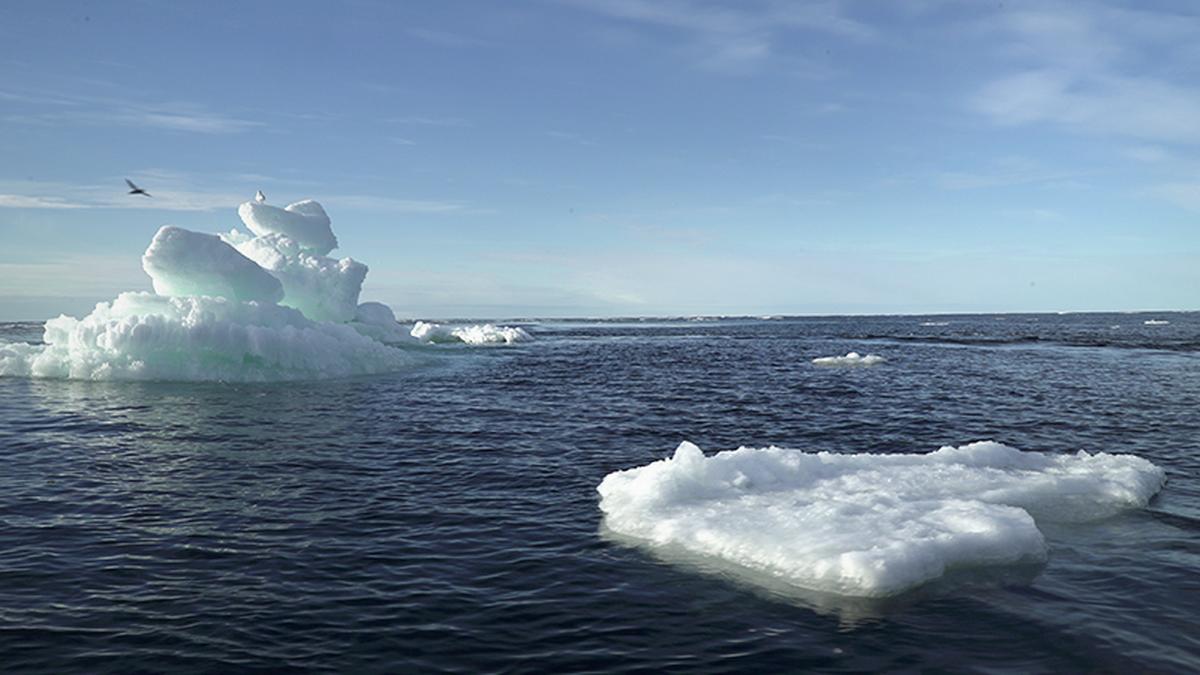
In recent years, scientists have also suggested that declining levels of Arctic sea ice, due to climate change, could influence the monsoon’s temperament, too.

In the new study, researchers used observational data from 1980 to 2020 and climate models (specifically Coupled Model Intercomparison Project Phases 5 and 6) to check how the Arctic sea ice levels affect atmospheric circulations that in turn influence the ISMR.

The results revealed distinct and at times contrasting patterns. According to the paper, less sea ice in the central Arctic leads to lower rain in western and peninsular India but more rain in central and northern India.

On the other hand, lower sea ice levels in the upper latitudes, particularly in the Barents-Kara Sea region encompassing the Hudson Bay, the Gulf of St. Lawrence and the Sea of Okhotsk, delay the monsoon’s onset and render it more unpredictable.

Several atmospheric systems also influence this pattern. The scientists found that when sea ice levels in the Central Arctic increase, the heat transferred from the ocean to the atmosphere triggers a cyclonic circulation at slightly lower latitudes, like in the North Atlantic.

This bolsters the Rossby waves, fast-flowing streams of air high in the atmosphere created by the earth’s rotation and differences in temperature and weather systems that move west to east.

“To put it simply, imagine giant loops in a river of air high above us. These loops can push warm or cold air across the planet and steer storms around, changing weather patterns as they go,” Avinash Kumar, an NCPOR scientist and one of the study’s coauthors, told The Hindu.

The enhanced Rossby waves result in high pressure over northwest India and low pressure over the Mediterranean region. This in turn strengthens a narrow, concentrated band of wind, called the Asian jet stream, over the Caspian Sea, causing the subtropical easterly jet — a jet stream blowing over the Indian subcontinent during summer — to shift northward.

As a result, an anomalous high pressure region is created over Central Asia, disrupting atmospheric stability over the Indian landmass and bringing more rain over western and peninsular India.

On the other hand, low sea ice over the Barents-Kara Sea region triggers a series of air currents that produce an anomalous high pressure over southwest China.

This correlates with a positive Arctic Oscillation — high pressure over the northern Atlantic and Pacific oceans along with a weakening of the CGT, which connects weather events in different parts of the world. 

As sea ice levels decrease in the region, heat rises from the Barents-Kara sea, creating an anticyclonic circulation (calm, clear skies) over northwest Europe. This disturbs the upper atmospheric region over subtropical Asia and India.

This instability, coupled with high surface temperature of the Arabian Sea and the moisture picked up from the surrounding water bodies promotes high rainfall over northeastern India while leaving central and northwest regions of the country without much

Does climate change also play a role?

Now that scientists know a little more about the forces that conspire to bring or withhold rain over India, what can we say about the role of climate change?

“Climate change, by accelerating the reduction of Arctic sea ice, exacerbates the variability and unpredictability of the ISMR,” Dr. Kumar said. “Lower Arctic sea ice can lead to more frequent and severe droughts in some regions while causing excessive rainfall and flooding in others.”

Apart from highlighting the physical pathways in which the Arctic sea ice affects the Indian monsoon, the current study shows the urgent need to expand research on climate dynamics and for scientists to prepare more accurate forecasts of the ever-changing monsoons. 



Source link

Science Tags:Arctic sea ice, Climate change, Climate change and arctic sea ice, climate change and monsoon, indian monsoon

Post navigation

Previous Post: Woman killed in front of her father for ‘refusing’ marriage proposal in Pakistan
Next Post: Paralympics Live: India's Day Begins With Cycling, 20 Medals Already In Bag

Related Posts

  • How dual-use satellites are blurring the lines of modern space war
    How dual-use satellites are blurring the lines of modern space war Science
  • Science quiz: On vexillography – The Hindu
    Science quiz: On vexillography – The Hindu Science
  • Indian Institute of Science study reveals how cancer cells adapt while moving across tissues
    Indian Institute of Science study reveals how cancer cells adapt while moving across tissues Science
  • Will new Act aid India’s nuclear development? | Explained
    Will new Act aid India’s nuclear development? | Explained Science
  • Sci-Five | The Hindu Science Quiz: On Solstice
    Sci-Five | The Hindu Science Quiz: On Solstice Science
  • GSLV-F14 Launch: GSLV-F14 carrying INSAT-3DS to lift off on Feb 17: ISRO
    GSLV-F14 Launch: GSLV-F14 carrying INSAT-3DS to lift off on Feb 17: ISRO Science

More Related Articles

Did Venus ever have oceans? Scientists have an answer Did Venus ever have oceans? Scientists have an answer Science
Debris of rockets with ISRO logo found near uninhabited island in Maldives Debris of rockets with ISRO logo found near uninhabited island in Maldives Science
Right against climate change a distinct fundamental and human right, SC judgment Right against climate change a distinct fundamental and human right, SC judgment Science
ISRO dispatches crew module for first uncrewed mission of Gaganyaan ISRO dispatches crew module for first uncrewed mission of Gaganyaan Science
Human DNA will have to be edited if humans are to settle on other planets Human DNA will have to be edited if humans are to settle on other planets Science
Blue: the colour that moved kings before poets Blue: the colour that moved kings before poets Science
SiteLock

Archives

  • May 2026
  • April 2026
  • March 2026
  • February 2026
  • January 2026
  • December 2025
  • November 2025
  • October 2025
  • September 2025
  • August 2025
  • July 2025
  • June 2025
  • May 2025
  • April 2025
  • March 2025
  • February 2025
  • January 2025
  • December 2024
  • November 2024
  • October 2024
  • September 2024
  • August 2024
  • July 2024
  • June 2024
  • May 2024
  • April 2024
  • March 2024
  • February 2024
  • January 2024
  • December 2023
  • November 2023
  • October 2023
  • September 2023
  • August 2023
  • July 2023
  • June 2023
  • May 2023
  • April 2023
  • March 2023
  • February 2023
  • January 2023
  • December 2022
  • November 2022
  • October 2022
  • September 2022
  • August 2022
  • July 2022
  • June 2022
  • May 2022

Categories

  • Business
  • Nation
  • Science
  • Sports
  • World

Recent Posts

  • Visakhapatnam Collector calls for inter-departmental synergy to boost investments
  • Kohli’s masterful knock powers Royal Challengers to the top
  • Vijay Narayan earns rare distinction of being Advocate General under two different governments
  • Learn from Sri Lanka’s experience on impact of fertilizer supply chains: experts
  • Sewage pollution of Cooum, groundwater depletion raise alarm

Recent Comments

  1. Leonardren on UP Teacher Who Asked Students To Slap Muslim Classmate
  2. NathanQuins on UP Teacher Who Asked Students To Slap Muslim Classmate
  3. Davidgof on UP Teacher Who Asked Students To Slap Muslim Classmate
  4. NathanJobre on UP Teacher Who Asked Students To Slap Muslim Classmate
  5. Davidcag on UP Teacher Who Asked Students To Slap Muslim Classmate
  • Geminid Meteor Shower To Light Up The Sky This Weekend
    Geminid Meteor Shower To Light Up The Sky This Weekend World
  • Rahul Gandhi Spreading Propaganda On Agniveer Scheme: Amit Shah
    Rahul Gandhi Spreading Propaganda On Agniveer Scheme: Amit Shah Nation
  • Pant, Iyer’s Case Divides Gautam Gambhir And Ajit Agarkar, Triggers Heated Debate: Report
    Pant, Iyer’s Case Divides Gautam Gambhir And Ajit Agarkar, Triggers Heated Debate: Report Sports
  • Hegseth says U.S. ready to share tools to help allies counter ‘aggressive’ China
    Hegseth says U.S. ready to share tools to help allies counter ‘aggressive’ China World
  • Access Denied
    Access Denied Nation
  • Postal ballots in Bangladesh elections 2026: a step-by-step guide on how to use it
    Postal ballots in Bangladesh elections 2026: a step-by-step guide on how to use it World
  • Access Denied Business
  • Pakistan ends lockdown of its capital after Imran Khan supporters are dispersed by police
    Pakistan ends lockdown of its capital after Imran Khan supporters are dispersed by police World

Editor-in-Chief:
Mohammad Ariff,
MSW, MAJMC, BSW, DTL, CTS, CNM, CCR, CAL, RSL, ASOC.
editor@artifex.news

Associate Editors:
1. Zenellis R. Tuba,
zenelis@artifex.news
2. Haris Daniyel
daniyel@artifex.news

Photograher:
Rohan Das
rohan@artifex.news

Artifex.News offers Online Paid Internships to college students from India and Abroad. Interns will get a PRESS CARD and other online offers.
Send your CV (Subjectline: Paid Internship) to internship@artifex.news

Links:
Associate Journalism
About Us
Privacy Policy

News Links:
Breaking News
World
Nation
Sports
Business
Entertainment
Lifestyle

Registered Office:
72/A, Elliot Road, Kolkata - 700016
Tel: 033-22277777, 033-22172217
Email: office@artifex.news

Editorial Office / News Desk:
No. 13, Mezzanine Floor, Esplanade Metro Rail Station,
12 J. L. Nehru Road, Kolkata - 700069.
(Entry from Gate No. 5)
Tel: 033-46011099, 033-46046046
Email: editor@artifex.news

Copyright © 2023 Artifex.News Newsportal designed by Artifex Infotech.