





Skip to content
  • Facebook
  • X
  • Linkedin
  • WhatsApp
  • YouTube
  • Associate Journalism
  • About Us
  • Privacy Policy
  • 033-46046046
  • editor@artifex.news
Artifex.News

Artifex.News

Stay Connected. Stay Informed.

  • Breaking News
  • World
  • Nation
  • Sports
  • Business
  • Science
  • Entertainment
  • Lifestyle
  • Toggle search form
  • Access Denied Business
  • Access Denied Sports
  • Maharashtra State Buses To Beed, Latur Stopped After Maratha Protesters Throw Stones
    Maharashtra State Buses To Beed, Latur Stopped After Maratha Protesters Throw Stones Nation
  • How To Register, Other Key Details
    How To Register, Other Key Details Nation
  • New push for mRNA bird flu vaccine development: WHO 
    New push for mRNA bird flu vaccine development: WHO  Science
  • Stock markets open lower amid surging oil prices, foreign fund outflows
    Stock markets open lower amid surging oil prices, foreign fund outflows Business
  • Access Denied Sports
  • Hindu businessman Khokon Das dies three days after attack in Bangladesh
    Hindu businessman Khokon Das dies three days after attack in Bangladesh World
Scientists spin diamonds at a billion RPM to test the limits of physics

Scientists spin diamonds at a billion RPM to test the limits of physics

Posted on October 3, 2024 By admin


As scientists’ understanding of the basic properties of matter has improved over time, they have been able to engineer materials with the best properties for specific applications. Such bespoke materials have revolutionised various sectors, including medical diagnostics, spaceflight, cryptography, commercial electronics, and computing. One such material is the fluorescent nanodiamond (FND).

FNDs are nanometre-sized diamonds made of carbon nanoparticles. They are produced in a high temperature and high pressure process. FNDs are stable under light and aren’t toxic to living things, so they have many applications in high-resolution imaging, microscale temperature sensing, and correlative microscopy, among others. In biology, scientists use FNDs to track cells and their progeny over long periods.

Fluorescence is the property of some materials to emit light of lower frequency when irradiated with light of a higher frequency. But unlike many other nano-scale fluorescent materials, FNDs don’t blink when irradiated for a long time. Their fluorescence lifespan is greater than 10 nanoseconds (ns) — a relatively long duration — which makes them better than quantum dots, whose inventors won the chemistry Nobel Prize last year.

In a recent study published in Nature Communications, physicists from Purdue University in the U.S. reported levitating FNDs in a high vacuum and spinning them very fast. It sounds like a simple, even comical, feat but is actually quite difficult. And now that it has been successfully demonstrated, it paves the way for multiple applications in industry, especially as sensors, and in fundamental research.

Quantum spin

One of the basic features of the building blocks of matter, like electrons and nuclei, is a property called spin. At any given moment, its value is a combination of two states called up and down. For a simplistic illustration, the spin of an electron can be 30% up and 70% down. If the down component is zero, the spin will be up, and vice versa. A computer can map these values to 0s and 1s and use the electrons to encode information. This is how a magnetic hard drive in a computer stores your data.

When a quantum computer manipulates the spin of some particles to perform its operations, each particle is called a spin qubit of the computer.

The Berry phase

The Purdue University team made some FNDs and spun them at an ultra-fast rate, making multiple notable findings.

For one, the team was able to record the Berry phase of the spin qubits due to the rotation.

Depending on the context, an electron can be a particle or a wave. When it’s a wave, it will have properties like frequency, wavelength, and phase. The phase of a wave tells us how much of a wave is completed in a given amount of time. This is like checking how much of an eye-blink has been completed in, say, 2 milliseconds, how far up the Sun has risen by 11 am or what fraction of an F1 race has been completed after 30 minutes.

There are some simple ways to control the state of an electron inside a material, like changing its energy by varying the strength and direction of an applied magnetic field. Say we cycle the electron through multiple states before bringing it back to its original state. If the electron wave’s phase in the final state is different from the original one, the phase difference is called the Berry phase.

It’s named for Michael Berry, a physicist who provided a generalised description of this attribute in 1986. (Indian physicist S. Pancharatnam had discovered a particular form of it 30 years prior.) The Berry phase is important for us to understand certain quantum effects and the properties of strange materials called topological insulators. By showing they could measure the Berry phase of the spin qubits due to the rotation, the Purdue team’s work opens the door for using FNDs in new contexts.

Testing the limits

Reconciling quantum physics with the classical physics of gravity is one of the biggest open problems in modern science. In the past, physicists have proposed that rapidly rotating FNDs containing spin qubits can be used to “test the limit of quantum mechanics and the quantum nature of gravity,” per the statement. But they hadn’t been able to put together a functional version of the setup required until now.

The Purdue researchers confined the FNDs in a cage made of electric and magnetic fields, and used the electric fields to set them spinning at up to 20 million times per second.

“With this method, the rotation frequency of a levitated nanodiamond is extremely stable and easily controllable,” the team wrote in its paper.

Tongcang Li, a professor of physics, astronomy and electrical and computer engineering at Purdue and the study leader, said in a statement, “In the past, experiments with these floating diamonds had trouble in preventing their loss in vacuum and reading out the spin qubits. However, in our work, we successfully levitated a diamond in a high vacuum … For the first time, we could observe and control the behaviour of the spin qubits inside the levitated diamond in high vacuum.”

Applications in industry

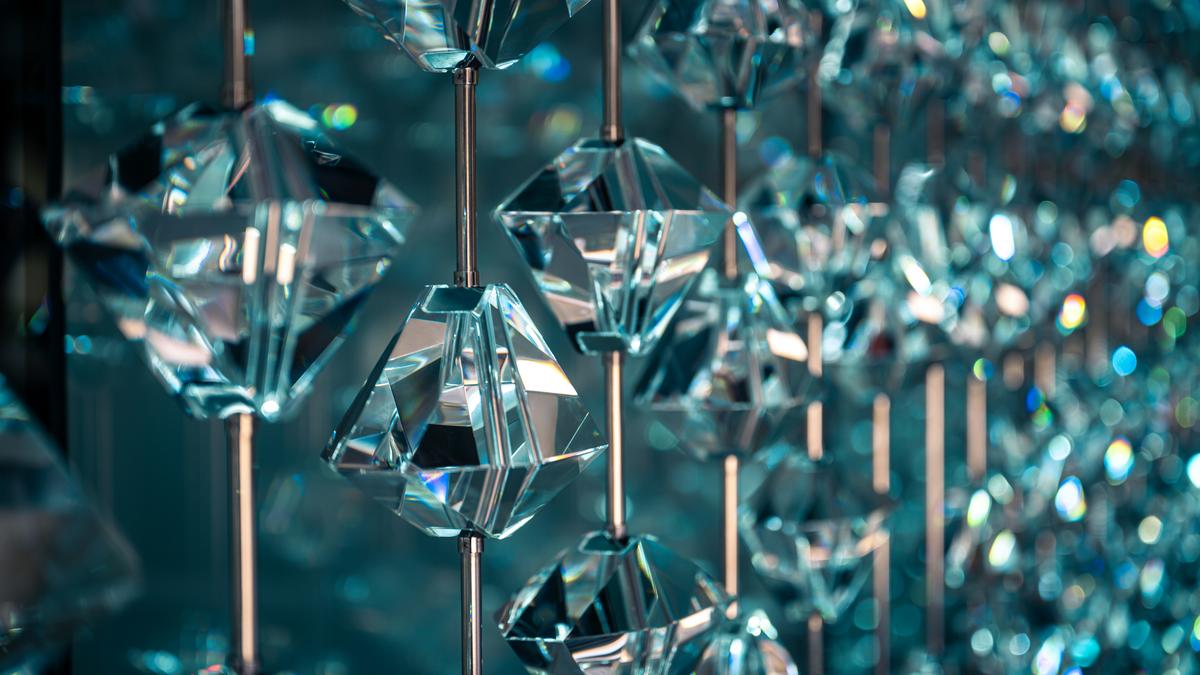
When the FNDs were irradiated with lasers, they emitted light of different colours in different directions. As the statement put it, it was as if the diamonds were throwing the world’s smallest disco party.

But beyond such simple pleasures, levitated FNDs are also sensitive to acceleration and electric fields, which means they can be used as sensors in many high-value industries and strategic sectors. The researchers also wrote in their paper that “the effect of the Berry phase generated by rotation … will be useful for creating a gyroscope for rotation sensing”.

FNDs can also be doped to enhance their electrical, magnetic, thermal, and/or optical properties. For instance, some carbon atoms in an FND can be replaced with nitrogen atoms. The substitution creates points in the atomic lattice called nitrogen vacancy (NV) centres. These NV centres host the electron spin qubits. When they are illuminated by green light, they emit red light, and vice versa.

The nitrogen atom has three valence electrons that can form bonds with three of the four valence electrons of carbon. When a neutral nitrogen vacancy centre (denoted NV0) accepts one more electron from the donor carbon atoms in the lattice, it forms a negatively charged centre called NV−. Physicists expect that FNDs containing NV− centres can be used to produce the macroscopic version of the quantum superposition of electrons.

In sum, FNDs may be smaller than small, but they can pack a punch to reverberate across both theoretical and applied physics.

Qudsia Gani is an assistant professor in the Department of Physics, Government Degree College Pattan, Baramulla.

Published – October 03, 2024 05:30 am IST



Source link

Science

Post navigation

Previous Post: S Jaishankar Meets Kamala Harris’ National Security Advisor In US
Next Post: Iran President Says It Does Not Seek War but Will Respond If…

Related Posts

  • A Konkan secret, the sada needs more light
    A Konkan secret, the sada needs more light Science
  • Self-sustainable science and tech ecosystem with larger participation by private sector need of the hour: Jitendra Singh
    Self-sustainable science and tech ecosystem with larger participation by private sector need of the hour: Jitendra Singh Science
  • What is a superkilonova?
    What is a superkilonova? Science
  • Mitochondria keep your brain cells alive − helping them run smoothly may protect against Parkinson’s disease
    Mitochondria keep your brain cells alive − helping them run smoothly may protect against Parkinson’s disease Science
  • Why can’t anything travel faster than light and what would happen if it did?
    Why can’t anything travel faster than light and what would happen if it did? Science
  • Africa dramatically dried out 5,500 years ago
    Africa dramatically dried out 5,500 years ago Science

More Related Articles

Summer of insect-counting gets underway in Germany Summer of insect-counting gets underway in Germany Science
Ladakh aurorae validate space weather tracking efforts, scientists say Ladakh aurorae validate space weather tracking efforts, scientists say Science
A (very) basic guide to artificial intelligence A (very) basic guide to artificial intelligence Science
America’s first Black astronaut candidate finally goes to space 60 years later on Bezos rocket America’s first Black astronaut candidate finally goes to space 60 years later on Bezos rocket Science
SpaceX’s xAI to compete in Pentagon contest for autonomous drone technology SpaceX’s xAI to compete in Pentagon contest for autonomous drone technology Science
Science for all Why did scientists create a new type of nanopasta which is thinner than spaghetti Science for all Why did scientists create a new type of nanopasta which is thinner than spaghetti Science
SiteLock

Archives

  • May 2026
  • April 2026
  • March 2026
  • February 2026
  • January 2026
  • December 2025
  • November 2025
  • October 2025
  • September 2025
  • August 2025
  • July 2025
  • June 2025
  • May 2025
  • April 2025
  • March 2025
  • February 2025
  • January 2025
  • December 2024
  • November 2024
  • October 2024
  • September 2024
  • August 2024
  • July 2024
  • June 2024
  • May 2024
  • April 2024
  • March 2024
  • February 2024
  • January 2024
  • December 2023
  • November 2023
  • October 2023
  • September 2023
  • August 2023
  • July 2023
  • June 2023
  • May 2023
  • April 2023
  • March 2023
  • February 2023
  • January 2023
  • December 2022
  • November 2022
  • October 2022
  • September 2022
  • August 2022
  • July 2022
  • June 2022
  • May 2022

Categories

  • Business
  • Nation
  • Science
  • Sports
  • World

Recent Posts

  • Visakhapatnam Collector calls for inter-departmental synergy to boost investments
  • Kohli’s masterful knock powers Royal Challengers to the top
  • Vijay Narayan earns rare distinction of being Advocate General under two different governments
  • Learn from Sri Lanka’s experience on impact of fertilizer supply chains: experts
  • Sewage pollution of Cooum, groundwater depletion raise alarm

Recent Comments

  1. Leonardren on UP Teacher Who Asked Students To Slap Muslim Classmate
  2. NathanQuins on UP Teacher Who Asked Students To Slap Muslim Classmate
  3. Davidgof on UP Teacher Who Asked Students To Slap Muslim Classmate
  4. NathanJobre on UP Teacher Who Asked Students To Slap Muslim Classmate
  5. Davidcag on UP Teacher Who Asked Students To Slap Muslim Classmate
  • IND in SL: India surprised about Sri Lanka’s strong showing: Nayar
    IND in SL: India surprised about Sri Lanka’s strong showing: Nayar Sports
  • Asia Cup 2023 – “My School Cricket Tournament Had More Audience”: Low Attendance For Pakistan vs Nepal Opener Shocks Fans
    Asia Cup 2023 – “My School Cricket Tournament Had More Audience”: Low Attendance For Pakistan vs Nepal Opener Shocks Fans Sports
  • Access Denied World
  • England Great Doesn’t Mince Words, Takes Swipe At Gautam Gambhir Over Ricky Ponting Remarks
    England Great Doesn’t Mince Words, Takes Swipe At Gautam Gambhir Over Ricky Ponting Remarks Sports
  • Food price momentum indicates continuing build up: RBI officials
    Food price momentum indicates continuing build up: RBI officials Business
  • Cricket World Cup 2023: Heinrich Klaasen-Marco Jansen Post Highest 6th Wicket Partnership For South Africa In ODIs
    Cricket World Cup 2023: Heinrich Klaasen-Marco Jansen Post Highest 6th Wicket Partnership For South Africa In ODIs Sports
  • Access Denied Sports
  • Former IPS officer’s wife found dead at Jubilee Hills residence in Hyderabad, Nepal gang role suspected
    Former IPS officer’s wife found dead at Jubilee Hills residence in Hyderabad, Nepal gang role suspected Nation

Editor-in-Chief:
Mohammad Ariff,
MSW, MAJMC, BSW, DTL, CTS, CNM, CCR, CAL, RSL, ASOC.
editor@artifex.news

Associate Editors:
1. Zenellis R. Tuba,
zenelis@artifex.news
2. Haris Daniyel
daniyel@artifex.news

Photograher:
Rohan Das
rohan@artifex.news

Artifex.News offers Online Paid Internships to college students from India and Abroad. Interns will get a PRESS CARD and other online offers.
Send your CV (Subjectline: Paid Internship) to internship@artifex.news

Links:
Associate Journalism
About Us
Privacy Policy

News Links:
Breaking News
World
Nation
Sports
Business
Entertainment
Lifestyle

Registered Office:
72/A, Elliot Road, Kolkata - 700016
Tel: 033-22277777, 033-22172217
Email: office@artifex.news

Editorial Office / News Desk:
No. 13, Mezzanine Floor, Esplanade Metro Rail Station,
12 J. L. Nehru Road, Kolkata - 700069.
(Entry from Gate No. 5)
Tel: 033-46011099, 033-46046046
Email: editor@artifex.news

Copyright © 2023 Artifex.News Newsportal designed by Artifex Infotech.