



Skip to content
  • Facebook
  • X
  • Linkedin
  • WhatsApp
  • YouTube
  • Associate Journalism
  • About Us
  • Privacy Policy
  • 033-46046046
  • editor@artifex.news
Artifex.News

Artifex.News

Stay Connected. Stay Informed.

  • Breaking News
  • World
  • Nation
  • Sports
  • Business
  • Science
  • Entertainment
  • Lifestyle
  • Toggle search form
  • Access Denied Sports
  • Indian-American Democrat Leader Claimed He Got “Racially” Targeted Online. Turns Out He Staged It
    Indian-American Democrat Leader Claimed He Got “Racially” Targeted Online. Turns Out He Staged It World
  • Zimbabwe vs India: Zimbabwe vs India 2024 Live Cricket Score, Live Score Of Today's Match on NDTV Sports
    Zimbabwe vs India: Zimbabwe vs India 2024 Live Cricket Score, Live Score Of Today's Match on NDTV Sports Sports
  • Gold prices jump ₹535 to record ₹1,17,800/10g on U.S. govt shutdown, Fed cut hopes
    Gold prices jump ₹535 to record ₹1,17,800/10g on U.S. govt shutdown, Fed cut hopes Business
  • Opposition Split On Parliament Block Over Adani, Trinamool Skips Key Meet
    Opposition Split On Parliament Block Over Adani, Trinamool Skips Key Meet Nation
  • Rane Brake Lining Q1 standalone net slids by 11% to ₹5.2 crore
    Rane Brake Lining Q1 standalone net slids by 11% to ₹5.2 crore Business
  • Access Denied
    Access Denied Nation
  • Afghanistan vs India live score over Super Eight – Match 3 T20 6 10 updates
    Afghanistan vs India live score over Super Eight – Match 3 T20 6 10 updates Sports
Africa dramatically dried out 5,500 years ago

Africa dramatically dried out 5,500 years ago

Posted on May 9, 2024 By admin


Around five and half millenia ago, northern Africa went through a dramatic transformation. The Sahara desert expanded and grasslands, forests and lakes favoured by humans disappeared. Humans were forced to retreat to the mountains, the oases, and the Nile valley and delta.

As a relatively large and dispersed population was squeezed into smaller and more fertile areas, it needed to innovate new ways to produce food and organise society. Soon after, one of the world’s first great civilisations emerged – ancient Egypt.

This transition from the most recent “African humid period”, which lasted from 15,000 to 5,500 years ago, to the current dry conditions in northern Africa is the clearest example of a climate tipping point in recent geological history. Climate tipping points are thresholds that, once crossed, result in dramatic climate change to a new stable climate.

Our new study published in Nature Communications reveals that before northern Africa dried out, its climate “flickered” between two stable climatic states before tipping permanently. This is the first time it’s been shown such flickering happened in Earth’s past. And it suggests that places with highly variable cycles of changing climate today may in some cases by headed for tipping points of their own.

Whether we will have any warnings of climate tipping points is one of the biggest concerns of climate scientists today. As we pass global warming of 1.5˚C, the most likely tipping points involve the collapse of ice sheets in Greenland or Antarctica, tropical coral reefs dying off, or abrupt thawing of Arctic permafrost.

Some say that there will be warning signs of these major climate shifts. However, these depend very much on the actual type of tipping point, and the interpretation of these signals is therefore difficult. One of the big questions is whether tipping points will be characterised by flickering or whether the climate will initially appear to become more stable before tipping over in one go.

620,000 years of environmental history

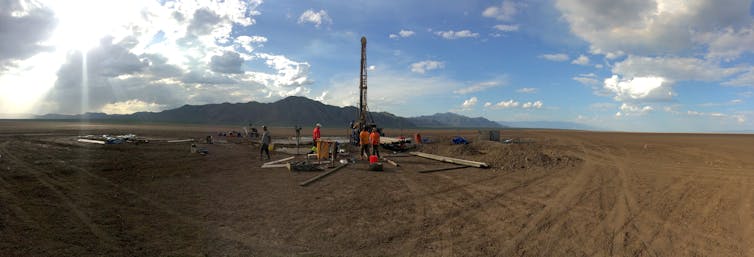
To investigate further, we gathered an international team of scientists and went to the basin of Chew Bahir in southern Ethiopia. There was an extensive lake here during the last African humid period, and deposits of sediment, several kilometres deep, underneath the lake bed record the history of climate-driven lake level fluctuations very precisely.

Today, the lake has largely disappeared and the deposits can be drilled relatively cheaply without the need for a drill rig on a floating platform or on a drillship. We drilled 280 metres below the dry lake bed – almost as deep as the Eiffel Tower is tall – and extracted hundreds of tubes of mud around 10 centimetres in diameter.

Drilling for ancient lake sediment in Chew Bahir.Asfawossen Asrat

By putting these tubes together in order they form a so-called sediment core. That core contains vital chemical and biological information which records the past 620,000 years of eastern African climate and environmental history.

We now know that at the end of the African humid period there was around 1,000 years in which the climate alternated regularly between being intensely dry and wet.

In total, we observed at least 14 dry phases, each of which lasted between 20 and 80 years and recurred at intervals of about 160 years. Later there were seven wet phases, of a similar duration and frequency. Finally, around 5,500 years ago a dry climate prevailed for good.

Climate flickering

These high-frequency, extreme wet-dry fluctuations represent a pronounced climate flickering. Such flickering can be simulated in climate model computer programs and also happened in earlier climate transitions at Chew Bahir.

We see the same types of flickering during a previous change from humid to dry climate around 379,000 years ago in the same sediment core. It looks like a perfect copy of the transition at the end of the African humid period.

This is important because this transition was natural, as it occurred long before humans had any influence on the environment. Knowing such a change can occur naturally counters the argument made by some academics that the introduction of livestock and new agricultural techniques may have accelerated the end of the last African humid period.

Conversely, humans in the region were undoubtedly affected by the climate tipping. The flickering would have had a dramatic impact, easily noticed by a single human, compared to the slow climate transition spanning tens of generations.

It could perhaps explain why the archaeological findings in the region are so different, even contradictory, at times of the transition. People retreated during the dry phases and then some came back during the wet phases. Ultimately, humans retreated to the places that were consistently wet like the Nile valley.

Confirmation of climate flickering as precursors to a major climate tipping is important because it may also provide insights into possible early warning signals for large climate changes in future.

It seems that highly variable climate conditions such as rapid wet–dry cycles may warn of a significant shift in the climate system. Identifying these precursors now may provide the warning we need that future warming will take us across one of more of the sixteen identified critical climate tipping points.

This is particularly important for regions such as eastern Africa whose nearly 500 million people are already highly vulnerable to climate change induced impacts such as drought.The Conversation

Martin H. Trauth, Professor, University of Potsdam; Asfawossen Asrat, Professor, Addis Ababa University, and Mark Maslin, Professor of Natural Sciences, UCL

This article is republished from The Conversation under a Creative Commons license. Read the original article.

Source link

Science Tags:500 years ago, africa dried out 5, climate news, science news, weather news

Post navigation

Previous Post: Sci-Five: The Hindu Science Quiz: On Bioluminescence
Next Post: The price of Kim Kardashian’s Met Gala corset look? Guts, lungs, heart

Related Posts

  • How do woodpeckers protect their brains?
    How do woodpeckers protect their brains? Science
  • National Science Day 2024: Why sustainable funding matters for India’s ‘science power’ ambition | Explained
    National Science Day 2024: Why sustainable funding matters for India’s ‘science power’ ambition | Explained Science
  • Science quiz: Formation of the solar system
    Science quiz: Formation of the solar system Science
  • ISRO invites proposals from Indian scientists to analyse data from Aditya-L1 mission
    ISRO invites proposals from Indian scientists to analyse data from Aditya-L1 mission Science
  • Science Snapshots: March 15, 2026
    Science Snapshots: March 15, 2026 Science
  • Watch | Chandrayaan-3’s journey from the Moon’s orbit to its surface
    Watch | Chandrayaan-3’s journey from the Moon’s orbit to its surface Science

More Related Articles

Countries tighten research security as China’s dominance grows Countries tighten research security as China’s dominance grows Science
Quiz | Easy like Sunday morning: Space and beyond Quiz | Easy like Sunday morning: Space and beyond Science
The Science Quiz: Scientific terms beginning with ‘X’ The Science Quiz: Scientific terms beginning with ‘X’ Science
Veteran nuclear scientist Rajagopala Chidambaram dies at 88 Veteran nuclear scientist Rajagopala Chidambaram dies at 88 Science
Science Quiz on rivers and cities Science Quiz on rivers and cities Science
Killings of invasive owls to ramp up on US West Coast in a bid to save native birds Killings of invasive owls to ramp up on US West Coast in a bid to save native birds Science
SiteLock

Archives

  • May 2026
  • April 2026
  • March 2026
  • February 2026
  • January 2026
  • December 2025
  • November 2025
  • October 2025
  • September 2025
  • August 2025
  • July 2025
  • June 2025
  • May 2025
  • April 2025
  • March 2025
  • February 2025
  • January 2025
  • December 2024
  • November 2024
  • October 2024
  • September 2024
  • August 2024
  • July 2024
  • June 2024
  • May 2024
  • April 2024
  • March 2024
  • February 2024
  • January 2024
  • December 2023
  • November 2023
  • October 2023
  • September 2023
  • August 2023
  • July 2023
  • June 2023
  • May 2023
  • April 2023
  • March 2023
  • February 2023
  • January 2023
  • December 2022
  • November 2022
  • October 2022
  • September 2022
  • August 2022
  • July 2022
  • June 2022
  • May 2022

Categories

  • Business
  • Nation
  • Science
  • Sports
  • World

Recent Posts

  • China, U.S. should be ‘partners not rivals’, says Xi Jinping after meeting Donald Trump
  • Iran working on Hormuz ‘protocol’ to cover ‘costs’, says Deputy Foreign Minister Gharibabadi
  • Zydus Lifesciences arm to acquire U.S. oncology firm Assertio for $166 million
  • Israel-Iran war LIVE: Iran working on Hormuz ‘protocol’ to cover ‘costs’, says Dy FM Gharibabadi
  • Russia to fulfil all agreements on energy supply to India: FM Lavrov

Recent Comments

  1. OrvalMaync on UP Teacher Who Asked Students To Slap Muslim Classmate
  2. Jeffreyroure on UP Teacher Who Asked Students To Slap Muslim Classmate
  3. Stevemonge on UP Teacher Who Asked Students To Slap Muslim Classmate
  4. RichardClage on UP Teacher Who Asked Students To Slap Muslim Classmate
  5. StevenLek on UP Teacher Who Asked Students To Slap Muslim Classmate
  • Access Denied World
  • Budget 2023 | SKM, activists criticise allocations to agriculture, food security
    Budget 2023 | SKM, activists criticise allocations to agriculture, food security Business
  • Jasprit Bumrah Brutally Mocks Mohammed Siraj On The Field. This Is The Reason
    Jasprit Bumrah Brutally Mocks Mohammed Siraj On The Field. This Is The Reason Sports
  • PM Modi Proposes “Global Development Compact” At Global South Summit
    PM Modi Proposes “Global Development Compact” At Global South Summit Nation
  • Chief Justice DY Chandrachud Worked For Months On New Insignia Of Supreme Court: Sources
    Chief Justice DY Chandrachud Worked For Months On New Insignia Of Supreme Court: Sources Nation
  • FPIs withdraw ₹325 crore from Indian equities so far in April
    FPIs withdraw ₹325 crore from Indian equities so far in April Business
  • California city mayor pleads guilty of being Chinese agent; quits post
    California city mayor pleads guilty of being Chinese agent; quits post World
  • Magnitude 6.1 earthquake causes scattered damage in Indonesia’s Papua region
    Magnitude 6.1 earthquake causes scattered damage in Indonesia’s Papua region World

Editor-in-Chief:
Mohammad Ariff,
MSW, MAJMC, BSW, DTL, CTS, CNM, CCR, CAL, RSL, ASOC.
editor@artifex.news

Associate Editors:
1. Zenellis R. Tuba,
zenelis@artifex.news
2. Haris Daniyel
daniyel@artifex.news

Photograher:
Rohan Das
rohan@artifex.news

Artifex.News offers Online Paid Internships to college students from India and Abroad. Interns will get a PRESS CARD and other online offers.
Send your CV (Subjectline: Paid Internship) to internship@artifex.news

Links:
Associate Journalism
About Us
Privacy Policy

News Links:
Breaking News
World
Nation
Sports
Business
Entertainment
Lifestyle

Registered Office:
72/A, Elliot Road, Kolkata - 700016
Tel: 033-22277777, 033-22172217
Email: office@artifex.news

Editorial Office / News Desk:
No. 13, Mezzanine Floor, Esplanade Metro Rail Station,
12 J. L. Nehru Road, Kolkata - 700069.
(Entry from Gate No. 5)
Tel: 033-46011099, 033-46046046
Email: editor@artifex.news

Copyright © 2023 Artifex.News Newsportal designed by Artifex Infotech.