


Skip to content
  • Facebook
  • X
  • Linkedin
  • WhatsApp
  • YouTube
  • Associate Journalism
  • About Us
  • Privacy Policy
  • 033-46046046
  • editor@artifex.news
Artifex.News

Artifex.News

Stay Connected. Stay Informed.

  • Breaking News
  • World
  • Nation
  • Sports
  • Business
  • Science
  • Entertainment
  • Lifestyle
  • Toggle search form
  • Buying black tickets for RCB matches? new m-ticket system could land you in trouble
    Buying black tickets for RCB matches? new m-ticket system could land you in trouble Sports
  • Access Denied Sports
  • Access Denied Sports
  • Access Denied Sports
  • Government Strong, Will Bring Every Indian Home Safely From Israel: BJP
    Government Strong, Will Bring Every Indian Home Safely From Israel: BJP Nation
  • Access Denied
    Access Denied Nation
  • Not for Russia to ‘decide’ if West can deploy troops to Ukraine: NATO chief Mark Rutte
    Not for Russia to ‘decide’ if West can deploy troops to Ukraine: NATO chief Mark Rutte World
  • Hindustan Zinc to pay ₹19 as second interim payout
    Hindustan Zinc to pay ₹19 as second interim payout Business
Hidden craters suggest earth once had a Saturn-like ring

Hidden craters suggest earth once had a Saturn-like ring

Posted on September 17, 2024 By admin


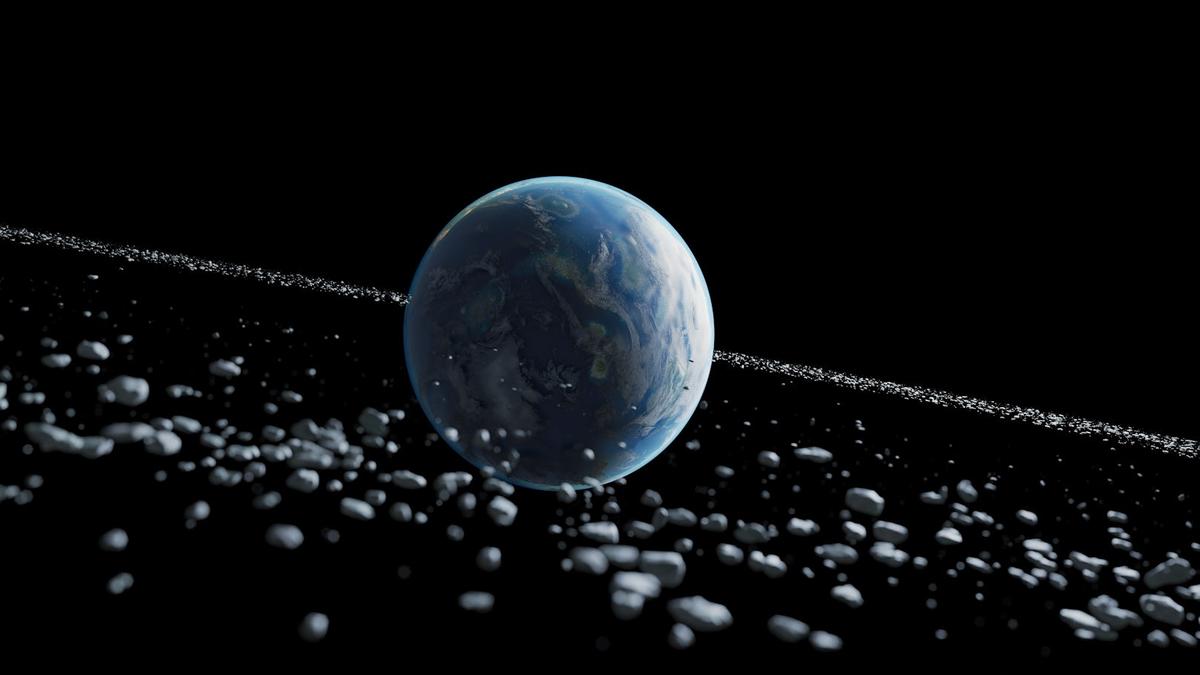
The rings of Saturn are some of the most famous and spectacular objects in the Solar System. Earth may once have had something similar.

In a paper published last week in Earth & Planetary Science Letters, my colleagues and I present evidence that Earth may have had a ring.

The existence of such a ring, forming around 466 million years ago and persisting for a few tens of millions of years, could explain several puzzles in our planet’s past.

The case for a ringed Earth

Around 466 million years ago, a lot of meteorites started hitting Earth. We know this because many impact craters formed in a geologically brief period.

In the same period we also find deposits of limestone across Europe, Russia and China containing very high levels of debris from a certain type of meteorite. The meteorite debris in these sedimentary rocks show signs that they were exposed to space radiation for much less time than we see in meteorites that fall today.

Many tsunamis also occurred at this time, as can be seen from other unusual jumbled up sedimentary rocks.

We think all these features are likely related to one another. But what links them together?

A pattern of craters

We know of 21 meteorite impact craters that formed during this high-impact period. We wanted to see if there was a pattern in their locations.

Using models of how Earth’s tectonic plates moved in the past, we mapped out where all these craters were when they first formed. We found all of the craters are on continents that were close to the equator in this period, and none are in places that were closer to the poles.

So all the impacts occurred close to the equator. But is this actually a fair sample of the impacts that occurred?

Well, we measured how much of Earth’s land surface suitable for preserving a crater was near the equator at that time. Only about 30% of the suitable land was close to the equator, with 70% at higher latitudes.

Under normal circumstances, asteroids hitting Earth can hit at any latitude, at random, as we see in craters on the Moon, Mars and Mercury.

So it’s extremely unlikely that all 21 craters from this period would form close to the equator if they were unrelated to one another. We would expect to see many other craters at higher latitudes as well.

We think the best explanation for all this evidence is that a large asteroid broke up during a close encounter with Earth. Over several tens of millions of years, the asteroid’s debris rained down onto Earth, creating the pattern of craters, sediments and tsunamis we describe above.

How rings form

You may know that Saturn isn’t the only planet with rings. Jupiter, Neptune and Uranus have less obvious rings, too. Some scientists have even suggested that Phobos and Deimos, the small moons of Mars, may be remnants of an ancient ring.

So we know a lot about how rings form. Here’s how it works.

When a small body (like an asteroid) passes close to a large body (like a planet), it gets stretched by gravity. If it gets close enough (inside a distance called the Roche limit), the small body will break apart into lots of tiny pieces and a small number of bigger pieces.

All those fragments will be jostled around and gradually evolved into a debris ring orbiting the equator of the larger body. Over time, the material in the ring will fall down to the larger body, where the larger pieces will form impact craters. These craters will be located close to the equator.

So if Earth destroyed and captured a passing asteroid around 466 million years ago, it would explain the anomalous locations of the impact craters, the meteorite debris in sedimentary rocks, craters and tsunamis, and the meteorites’ relatively brief exposure to space radiation.

A giant sunshade?

Back then, the continents were in different positions due to continental drift. Much of North America, Europe and Australia were close to the equator, whereas Africa and South America were at higher southern latitudes.

The ring would have been around the equator. And since Earth’s axis is tilted relative to its orbit around the Sun, the ring would have shaded parts of Earth’s surface.

This shading in turn might have caused global cooling, as less sunlight reached the planet’s surface.

This brings us to another interesting puzzle. Around 465 million years ago, our planet began cooling dramatically. By 445 million years ago it was in the Hirnantian Ice Age, the coldest period in the past half a billion years.

Was a ring shading Earth responsible for this extreme cooling? The next step in our scientific sleuthing is to make mathematical models of how asteroids break up and disperse, and how the resulting ring evolves over time. This will set the scene for climate modelling that explores how much cooling could be imposed by such a ring.

This article is republished from The Conversation under a Creative Commons license. Read the original article.

Published – September 17, 2024 03:19 pm IST



Source link

Science Tags:astronomy news, Earth had a ring like saturn?, Earth’s ring, hidden craters on earth’s surface, science news

Post navigation

Previous Post: “Maze Lene Do Unko…”: Rohit Sharma Mocks Test Rivals Ahead Of Bangladesh Series
Next Post: Brain undergoes major changes in pregnancy, some fleeting, some enduring, new study shows

Related Posts

  • What is gold?
    What is gold? Science
  • Can light pollution be a new risk factor for Alzheimer’s?
    Can light pollution be a new risk factor for Alzheimer’s? Science
  • Ritual to Reality: Unmasking the evolution of hand hygiene post-covid-19
    Ritual to Reality: Unmasking the evolution of hand hygiene post-covid-19 Science
  • Study reveals history and oceanic voyages of remarkable baobab tree
    Study reveals history and oceanic voyages of remarkable baobab tree Science
  • Why does sadness cause us to shed tears?
    Why does sadness cause us to shed tears? Science
  • Daily Quiz: On H2 fuel and batteries
    Daily Quiz: On H2 fuel and batteries Science

More Related Articles

What ended the ‘dark ages’ in the early universe? Webb telescope finds clue What ended the ‘dark ages’ in the early universe? Webb telescope finds clue Science
Long UPSC prep cycles take heavy toll on aspirants’ mental health Long UPSC prep cycles take heavy toll on aspirants’ mental health Science
How is India responding to crowding disasters? | Explained How is India responding to crowding disasters? | Explained Science
Steve Smith’s eye-blacks and the slippery slope of cricket’s tool rules Steve Smith’s eye-blacks and the slippery slope of cricket’s tool rules Science
Could global warming impede weather and climate forecasting? Could global warming impede weather and climate forecasting? Science
Hanle protects its dark skies and builds a future on stargazing Hanle protects its dark skies and builds a future on stargazing Science
SiteLock

Archives

  • May 2026
  • April 2026
  • March 2026
  • February 2026
  • January 2026
  • December 2025
  • November 2025
  • October 2025
  • September 2025
  • August 2025
  • July 2025
  • June 2025
  • May 2025
  • April 2025
  • March 2025
  • February 2025
  • January 2025
  • December 2024
  • November 2024
  • October 2024
  • September 2024
  • August 2024
  • July 2024
  • June 2024
  • May 2024
  • April 2024
  • March 2024
  • February 2024
  • January 2024
  • December 2023
  • November 2023
  • October 2023
  • September 2023
  • August 2023
  • July 2023
  • June 2023
  • May 2023
  • April 2023
  • March 2023
  • February 2023
  • January 2023
  • December 2022
  • November 2022
  • October 2022
  • September 2022
  • August 2022
  • July 2022
  • June 2022
  • May 2022

Categories

  • Business
  • Nation
  • Science
  • Sports
  • World

Recent Posts

  • BEST conductor dies in accident involving four buses in Mumbai
  • Nayar reckons KKR got a par total, rues missed chances
  • Pope Leo decries European military spending as ‘betrayal’ of diplomacy
  • Scent Of Rain, Shutterfly, Stud Poker and Starzella please
  • New factional battle lines emerge in Congress hours after nomination of Kerala CM

Recent Comments

  1. JamesHeR on UP Teacher Who Asked Students To Slap Muslim Classmate
  2. RafaelNar on UP Teacher Who Asked Students To Slap Muslim Classmate
  3. CarlosExorb on UP Teacher Who Asked Students To Slap Muslim Classmate
  4. Robertfloup on UP Teacher Who Asked Students To Slap Muslim Classmate
  5. Davidcag on UP Teacher Who Asked Students To Slap Muslim Classmate
  • Radhika Gupta Explains Why FOMO Doesn’t Work In A Volatile Market Business
  • Thai PM orders probe into death of activist in pre-trial detention
    Thai PM orders probe into death of activist in pre-trial detention World
  • High Court Upholds Rs 3-Crore Compensation To Woman In Domestic Violence Case
    High Court Upholds Rs 3-Crore Compensation To Woman In Domestic Violence Case Nation
  • Access Denied
    Access Denied Nation
  • Access Denied Sports
  • Bangladesh interim government urges protesters to surrender all illegal firearms within a week
    Bangladesh interim government urges protesters to surrender all illegal firearms within a week World
  • Access Denied World
  • Access Denied Sports

Editor-in-Chief:
Mohammad Ariff,
MSW, MAJMC, BSW, DTL, CTS, CNM, CCR, CAL, RSL, ASOC.
editor@artifex.news

Associate Editors:
1. Zenellis R. Tuba,
zenelis@artifex.news
2. Haris Daniyel
daniyel@artifex.news

Photograher:
Rohan Das
rohan@artifex.news

Artifex.News offers Online Paid Internships to college students from India and Abroad. Interns will get a PRESS CARD and other online offers.
Send your CV (Subjectline: Paid Internship) to internship@artifex.news

Links:
Associate Journalism
About Us
Privacy Policy

News Links:
Breaking News
World
Nation
Sports
Business
Entertainment
Lifestyle

Registered Office:
72/A, Elliot Road, Kolkata - 700016
Tel: 033-22277777, 033-22172217
Email: office@artifex.news

Editorial Office / News Desk:
No. 13, Mezzanine Floor, Esplanade Metro Rail Station,
12 J. L. Nehru Road, Kolkata - 700069.
(Entry from Gate No. 5)
Tel: 033-46011099, 033-46046046
Email: editor@artifex.news

Copyright © 2023 Artifex.News Newsportal designed by Artifex Infotech.