







Flour, chocolate, cocoa powder, eggs, and butter are all the ingredients to make a sweet treat you crave.
The only thing you need right now is a step-by-step recipe to help you turn the ingredients into a yummy brownie.
Too big for its britches
Nature also has the ingredients it needs to ‘make’ living organisms, using a genetic instruction manual called the genome. A small change in the genome’s composition can determine whether the living thing being made is a flower that exhibits two petal colours, a cat that has big or small ears or if the coriander leaves will taste like soap to some people.
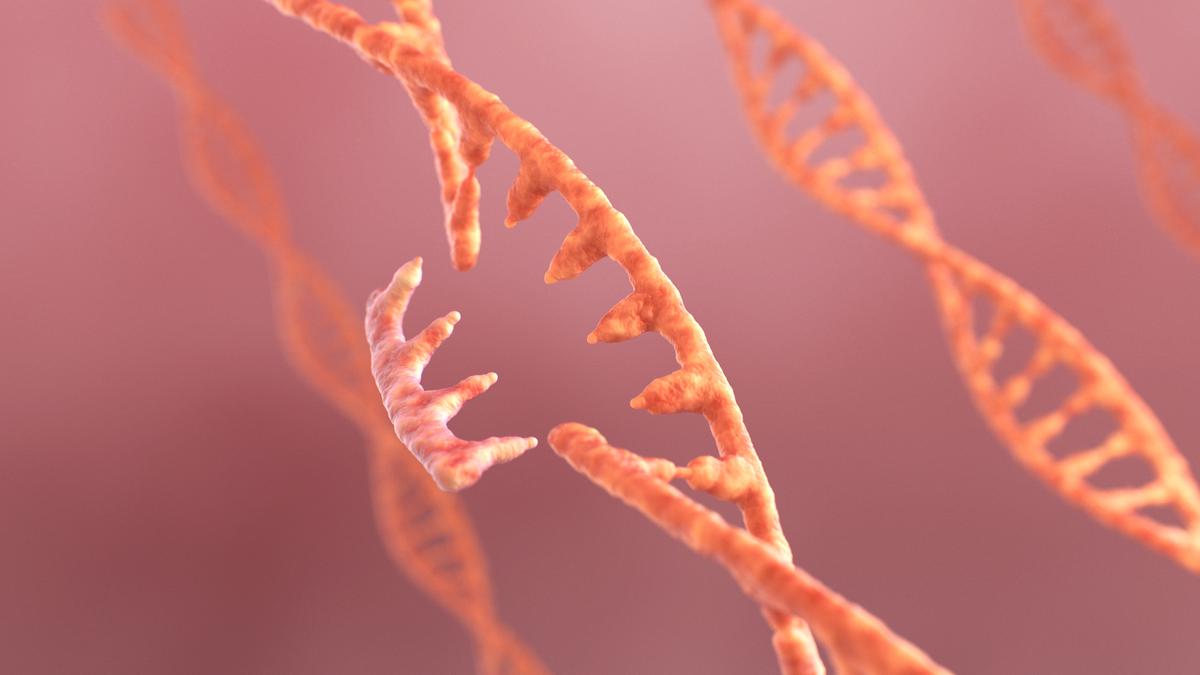
With the help of the gene-editing tool CRISPR, scientists today can precisely edit genomes to introduce desirable genetic traits or remove undesirable ones.
CRISPR holds the potential to revolutionise agriculture in particular by allowing agricultural scientists to increase crop yields and improve resistance to disease and anomalous weather through gene-editing. However, there has been a critical obstacle: a commonly used form of the CRISPR system is too big for plant genomes.
This system uses one of two proteins, Cas9 or Cas12, to target specific parts of the DNA. But they are too bulky for plant cells to accommodate.
Smaller is better
A team of researchers led by Kutubuddin Molla from the ICAR-National Rice Research Institute in Cuttack and Mirza Baig from the Pennsylvania State University in the U.S. presented an alternative that could solve this major problem in plant genome editing in a recent paper in the journal Plant Biotechnology Journal.
They reported developing a plant genome editor consisting of a protein called ISDra2TnpB, derived from bacteria called Deinococcus radiodurans (famous for being able to survive extreme environmental conditions). ISDra2TnpB is less than half the size of Cas9 and Cas12.
V.S. Sresty Tavva, principal scientist at the Crop Improvement Program at the Tata Institute for Genetics and Society (TIGS), Bengaluru, who wasn’t involved in the study, expressed enthusiasm over its findings.
“Currently, [since] there are not many options available for plant genome editors, the improved TnpB certainly adds value. One should utilise the advantage of the size of TnpB in generating edited plants for various traits of interest,” he said.
TnpB’s editing chops
TnpB is a protein made up of around 400 amino acid units (different combinations of the 20 amino acids make up all proteins). It belongs to a family of transposable elements, or transposons. Sometimes called “jumping genes”, transposons are parts of a genome that can move from one location to another.
The genome consists of two strands of DNA bonded to each other. Each strand is made up of building blocks called nucleotides. In turn, each nucleotide has three pieces; two are common to all of them whereas the identity of the third one can be one of four options: adenine (A), thymine (T), cytosine (C) or guanine (G). The DNA’s ‘sequence’ refers to the order in which nucleotides containing these four compounds are arranged.

In the new system, TnpB hitches a ride on a piece of RNA that guides it to the target DNA sequence. Once there the TnpB binds with the sequence and eliminates it. The cell that houses this DNA repairs the cut by restoring the ‘correct’ sequence. Thus, the genome is modified to replace an undesirable sequence with a desirable one.
The researchers behind the new study exploited the genome editing abilities of a TnpB-based system to achieve a 33.58% editing efficiency in an average plant genome on targets that Cas9 or Cas12 couldn’t reach. They demonstrated that the genome editor was effective on both types of flowering plants—monocots (like rice, which have one seed leaf) and dicots (like Arabidopsis, a plant related to cabbage and mustard that has two seed leaves).
Codons and regulators
The team also built four versions of the TnpB-based editing tool and tested them on rice protoplasts — plant cells without the cell wall — to identify the best among them. In their initial experiments, the versions had a low editing efficiency.
To improve it, Dr. Molla et al. did two things. First, they used a process called codon optimisation. For example, cells in the body make the amino acid lysine by following an instruction in the genome represented by a sequence of three nucleotides. Such sequences of three are called codons.
The codon sequence that contains the recipe for lysine varies in different types of organisms. TnpB is a protein extracted from D. radiodurans, a prokaryotic bacteria, which has a different codon for lysine than do eukaryotes like plants. So the researchers edited the codon bias of TnpB to match that of rice protoplasts to improve the editing efficiency, Dr. Molla explained.
The second thing the researchers tweaked were the regulatory elements. When the TnpB and the specific RNA that guides it to the target DNA are transferred from a prokaryote to a eukaryote, researchers also need to include sequences called promoters and terminators that govern and regulate the expression of TnpB.
“We added promoters that are likely to enhance the expression of TnpB and lead to better editing,” Dr. Molla said.
A hi-res upgrade
The researchers finished with some finishing touches to the TnpB-based gene-editing system. They deactivated TnpB and fused it with another protein to create a ‘hybrid’ base editor.
When accompanied by the guide RNA, this editor could swap out a single nucleotide in the DNA sequence.
This wasn’t possible with the previous version, with active TnpB, because it tended only to delete DNA sequences and couldn’t swap one sequence for another.
The new base editor thus opened up exciting possibilities for crop innovation by facilitating the alteration of genes at the level of individual nucleotides.
A future of edited plants
The TnpB-based editors the researchers built can edit the plant genome using both base editing and transcription activation, two widely used techniques in plant synthetic biology.
Dr. Tavvahowever said most of the claims were based on data obtained from protoplasts and that the scenario might change when dealing with processes by which an organism absorbs external DNA and integrates it into its genome.
It also appeared that the efficiency of the base editing system fell short in dicot plants as indicated by the results (0.2-0.46% average editing efficiency) reported using Arabidopsis. “Regardless,” Dr. Tavva said, “the plant genome editing community should try this miniature editing system in crop species of their choice to improve various traits of interest.”
TIGS director Rakesh Mishra echoed him: “It is exciting to see a novel and effective genome editing tool being invented. While more development will be needed, alternatives like this are welcome news.”
The researchers have expressed hope this miniature genome editing tool will help remove anti-nutrient factors from food crops, reduce their susceptibility to pests, and help rice crops become shorter and less prone to damage during cyclones.
Sanjukta Mondal is a chemist-turned-science-writer with experience in writing popular science articles and scripts for STEM YouTube channels.