



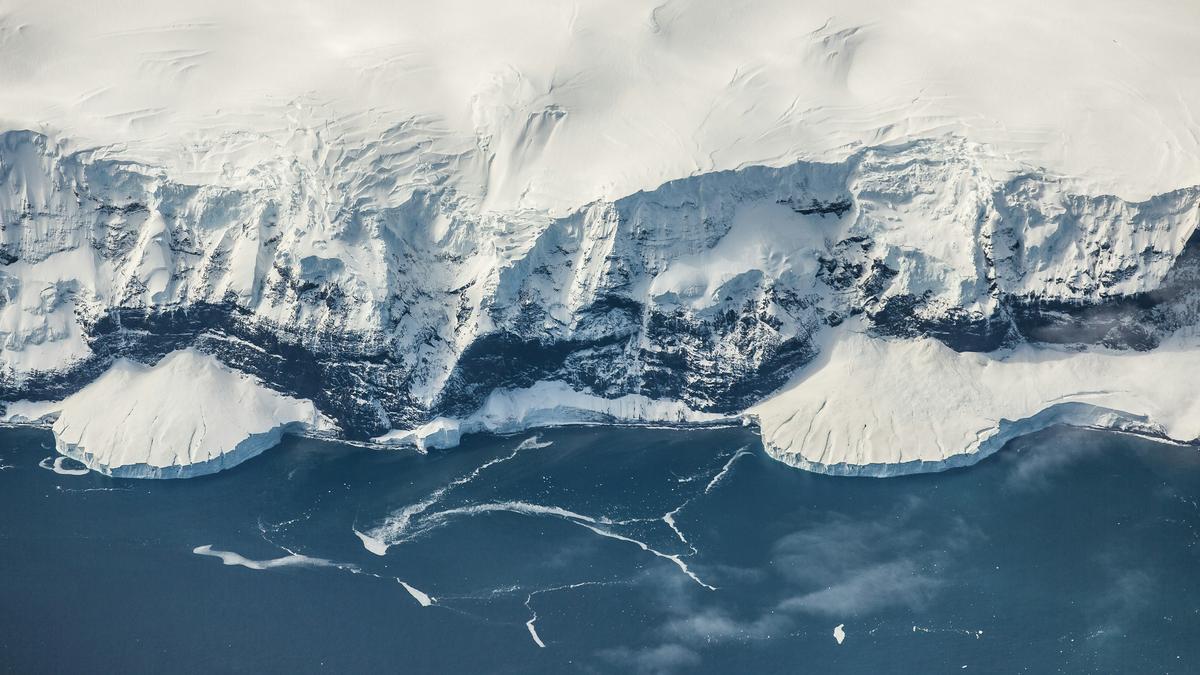
The coastline of a small island off the coast of Antarctica, seen from a window on a commercial flight, February 8, 2017. After the previous ice age, a lot of ice melted from the northernmost and the southernmost parts of the earth, causing the planet to spin faster.
| Photo Credit: Matt Palmer/Unsplash
In yet another unprecedented effect of climate change, scientists find that the melting polar ice caps have caused the earth to spin slower. This can lead to minuscule changes in the actual duration of a day — something that, ironically, does not affect our daily lives as much but could affect the technology we rely on.
As we build more connections not just among ourselves in this world but also with outer space, tools that rely on precise timekeeping, like computer networks and the ones involved in space travel, can be thrown off course.

Making the world go around…
A basic physics phenomenon called the conservation of angular momentum is key to what is happening to the earth right now. When an ice-skater rotates, if their arms are held in tightly, their moment of inertia decreases and they spin faster. If they stretched their arms out wide, their moment of inertia would increase, making them spin slower. This is because angular momentum — a product of the moment of inertia and angular velocity — is conserved no matter how the skater is spinning.
As polar ice continues to melt rapidly in a warming world, the globe isn’t affected very differently from the spinning ice-skater.
“When polar ice sheets and global glaciers melt, then this would go to the equatorial regions — we call this pole-to-equator mass flux,” Mostafa Kiani Shahvandi, a geophysicist at ETH Zurich and the lead author of the July 15 paper describing the recent results, said. “As the ice sheets melt, the earth’s oblateness increases and the region around the equator elongates slightly. The moment of inertia increases and the rotation rate gets smaller.”
Water from the melt flows towards the equator, making the earth bulge out slightly, slowing its rotation and increasing the time taken to complete one rotation, lengthening our day.
‘A pretty big thing’
Using a mix of climate models and real-world data, the scientists looked at a 200-year period, between 1900 and 2100. They found that over the last two decades, the changing climate’s effects on sea levels around the equator have slowed the rate of earth’s rotation by around 1.3 milliseconds (ms) per century.
Based on their projections, if the high emission scenarios persist, this rate will change to 2.6 ms per century. This will end up making climate change the dominant factor in slowing the earth’s rotation, surpassing other factors.
“What’s impressive about this is that it’s another indicator of just how big the effect of climate change has become,” Duncan Agnews, an emeritus professor of geophysics at the Scripps Institute of Oceanography at University of California, San Diego, said. “The fact that it can change — not by a large amount, but still, some amount — the actual rotation rate of the entire earth, it’s a pretty big thing to have been affected.”
The effect may be in the order of milliseconds but it can still affect accurate timekeeping with atomic clocks. Even though we have kept time since the 1950s with the help of these ultra-precise devices, we also track the time taken for the earth’s rotations and ensure they both match up. Just like the earth’s revolution around the sun takes just a bit longer than 365 days, requiring the addition of a leap day, its rotation is also not always exactly 24 hours. It’s a couple of milliseconds more.
When a second is a lot
A process called lunar tidal friction, or the moon pulling on the earth’s oceans, has already been slowing the planet’s rotation at about 2 ms per century. So if right now the earth takes about 2 ms longer to complete one day than the time predicted by atomic clocks, a 100 years later a day will be about 4 ms longer. As the milliseconds added up, leap seconds were added to keep pace with the earth’s rotation.
This is imperceptible to us but systems like GPS, stock trading, and space travel bank on accurate measures of time and can be thrown off.
“In the precise timekeeping world, a second is a lot,” Dr. Agnews said.
Some other processes like the slowed rotation of the earth’s core have been speeding up the earth’s rotation time. After the previous ice age, a lot of ice melted from the northernmost and the southernmost parts of the earth, causing the crust to rebound at the poles. This has also helped the earth to spin faster, so much so that scientists have mooted debates to understand if we need a negative leap second to correct for it.
The axis is shifting, too
Dr. Agnews published a paper in Nature in March showing a similar result: that climate change and the resulting melting ice are slowing the earth’s rotation and that that will actually delay the negative leap second.
Either way, both studies are proof climate change is exerting its effects over the entire planet by interfering with something as fundamental as how it spins around its axis.
Dr. Shahvandi and his collaborators published another recent paper in Nature Geophysics detailing the effects of melting polar ice on the earth’s axis of rotation. Using observed data and predictions made by physics-informed neural networks, they found the melting of polar ice and glaciers is one phenomenon driving the earth’s polar motion. The location where the earth’s axis of rotation intersects the crust is moving ever so slightly over time.
For people in low-lying coastal areas, rising sea levels because of melting ice leads to more devastating consequences than the mere wobble of the earth’s axis or a gradually lengthening day. Nevertheless, this is another example of how climate change is affecting our planet, pushing us towards a desperate need to curb emissions before the situation spins out of control.
Rohini Subrahmanyam is a freelance journalist in Bengaluru.