

Skip to content
  • Facebook
  • X
  • Linkedin
  • WhatsApp
  • YouTube
  • Associate Journalism
  • About Us
  • Privacy Policy
  • 033-46046046
  • editor@artifex.news
Artifex.News

Artifex.News

Stay Connected. Stay Informed.

  • Breaking News
  • World
  • Nation
  • Sports
  • Business
  • Science
  • Entertainment
  • Lifestyle
  • Toggle search form
  • Daily Quiz: On Sir Donald Bradman
    Daily Quiz: On Sir Donald Bradman Sports
  • Bruce Lehrmann Sex, Drugs, And Shocking Revelations In This Australian Defamation Trial
    Bruce Lehrmann Sex, Drugs, And Shocking Revelations In This Australian Defamation Trial World
  • Access Denied
    Access Denied Nation
  • Singai Ramachandran quits AIADMK; Velumani, Viswanathan absent at meeting chaired by Palaniswami
    Singai Ramachandran quits AIADMK; Velumani, Viswanathan absent at meeting chaired by Palaniswami Nation
  • Access Denied Sports
  • Should the CJP be a political party?
    Should the CJP be a political party? Nation
  • Access Denied
    Access Denied Nation
  • SpiceJet says cleared ₹160 crore worth pending employee provident fund dues
    SpiceJet says cleared ₹160 crore worth pending employee provident fund dues Business
Bird species exploded after dinos’ doom, largest yet bird genetics study says

Bird species exploded after dinos’ doom, largest yet bird genetics study says

Posted on April 2, 2024 By admin


The largest-ever study of bird genomes has produced a remarkably clear picture of the bird family tree. 
| Photo Credit: Special Arrangement

The largest-ever study of bird genomes has produced a remarkably clear picture of the bird family tree. Published in the journal Nature today, our study shows that most of the modern groups of birds first appeared within 5 million years after the extinction of the dinosaurs.

Birds are a large part of our lives, a sign of nature even in cities. They are popular among the general public and well studied by scientists. But placing all of these birds into a family tree has been frustratingly difficult.

By analysing the genomes of more than 360 bird species, our study has identified the fundamental relationships among the major groups of living birds.

The new family tree overturns some previous ideas about bird relationships, while also revealing some new groupings.

Resolving a messy relationship

Previous studies showed the bird family tree has three major branches. The first branch contains the tinamous and ratites, which include flightless birds such as the emu, kiwi and ostrich.

The second branch holds the landfowl and waterfowl – chickens, ducks and so on. All other birds sit on the third branch, known as the Neoaves, which include 95% of bird species.

The Neoaves branch includes ten groups of birds. Most of these are what biologists have named the “Magnificent Seven”: landbirds, waterbirds, tropicbirds, cuckoos, nightjars, doves and flamingos. The other three groups are known as the “orphans” and include the shorebirds, cranes and hoatzin, a species from South America.

The relationships among these ten groups, especially the orphans, have been incredibly difficult to resolve. Our genome study shows a resolution is within reach.

Meet the ‘Elementaves’

Our genome study revealed a new grouping of birds we have named “Elementaves”. With a name inspired by the four ancient elements of earth, air, water and fire, this group includes birds well adapted for success on land, in the sky and in the water. Some of the birds have names relating to the sun, representing the element of fire. The Elementaves group includes hummingbirds, shorebirds, cranes, penguins and pelicans.

Our study also confirms a close relationship between two of the most familiar groups of birds in Australia, the passerines (songbirds and relatives) and parrots. These popular birds dominate the Australian Bird of the Year polls.

Also Read | A brief guide to bird-watching spots and species in India

Songbirds make up nearly 50% of all bird species and include birds like magpies, finches, honeyeaters and fairywrens. They had their humble beginnings in Australia about 50 million years ago, then spread across the globe to become the most successful group of birds.

When did birds really emerge?

A further goal of our study was to place a timescale on the bird family tree. We did this by modelling the evolution of genomes using a tool known as the “molecular clock”. By drawing on information from nearly 200 fossils, we were able to constrain the ages of some of the branches in the bird family tree.

Our study shows all living birds share an ancestor that lived just over 90 million years ago. But most groups of modern birds emerged about 25 million years later, within a small window of just a few million years after the end of the Cretaceous period around 66 million years ago.

This coincides with the mass extinction of dinosaurs and other organisms caused by an asteroid striking Earth. So it seems birds made the most of the opportunities that became available after these other dominant life forms were wiped out.

One mystery remains

The genome study is the product of nearly a decade of research, conducted as part of the Bird 10,000 Genomes Project. The ultimate goal of this project is to sequence the genomes of all 10,000 living bird species.

The current phase of the project focused on including species from every major group, or family, of birds. The study of these 363 genomes was a truly international effort led by researchers at the University of Copenhagen, University of California San Diego and Zhejiang University in China.

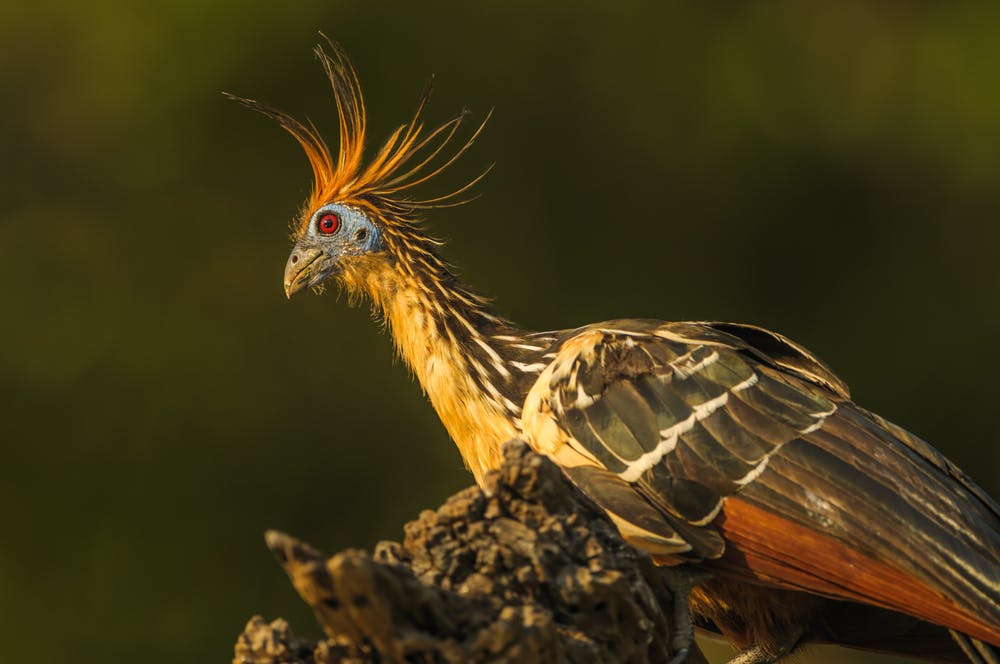
Even with such a huge amount of genome data, one branch of the bird family tree remains a mystery. Our analysis could not confidently determine the relationships of one of the orphans, the hoatzin. Found in South America, the hoatzin is a highly distinctive bird and the sole survivor of its lineage.

Our study shows that some relationships in the tree of life can only be determined using huge amounts of genome data. But our study also demonstrates the power of studying genomes and fossils together to understand the evolutionary history of life on Earth.

The Conversation

A bird with a longish neck and orange tufts on its head that looks a bit like a pigeon.
The hoatzin, one of the ‘orphan’ branches of the bird family tree, remains a mystery.Marcos Amend/Shutterstock

Jacqueline Nguyen, Scientific Officer in Ornithology, Australian Museum, and ARC DECRA Fellow, Flinders University and Simon Ho, Professor of Molecular Evolution, School of Life and Environmental Sciences, University of Sydney

This article is republished from The Conversation under a Creative Commons license. Read the original article.




Source link

Science Tags:animal news, animal science, Birds, Did birds come after dinosaurs, When did birds first appear

Post navigation

Previous Post: AAP Leader Sanjay Singh Mother Radhika Singh To NDTV After Son Gets Bail
Next Post: India, Australia and England cricket boards in talks to revive Champions League T20

Related Posts

  • Science quiz: When physics steps outside its comfort zones
    Science quiz: When physics steps outside its comfort zones Science
  • Philippines chosen to host climate ‘loss and damage’ fund board
    Philippines chosen to host climate ‘loss and damage’ fund board Science
  • Astronaut Shukla urges youths to own dreams for India’s space missions
    Astronaut Shukla urges youths to own dreams for India’s space missions Science
  • How does cutting onions make you cry?
    How does cutting onions make you cry? Science
  • Study by Indian researchers finds that body’s immune cells ‘betray’ it to help breast cancer spread
    Study by Indian researchers finds that body’s immune cells ‘betray’ it to help breast cancer spread Science
  • RRI technique yields certified randomness with one qubit
    RRI technique yields certified randomness with one qubit Science

More Related Articles

Science quiz | Isomers: same formula, different persona Science quiz | Isomers: same formula, different persona Science
Four astronomy facilities announced in Union Budget to cost ₹3,500 crore, to be completed over a period of three to 13 years Four astronomy facilities announced in Union Budget to cost ₹3,500 crore, to be completed over a period of three to 13 years Science
How ants cope with disease outbreaks How ants cope with disease outbreaks Science
Indian Institute of Astrophysics astronomers find new method to predict amplitude of upcoming solar cycle Indian Institute of Astrophysics astronomers find new method to predict amplitude of upcoming solar cycle Science
‘Amphibious mouse’ among 27 new species discovered in Peru’s Amazon ‘Amphibious mouse’ among 27 new species discovered in Peru’s Amazon Science
Kalpakkam fast breeder reactor attains criticality Kalpakkam fast breeder reactor attains criticality Science
SiteLock

Archives

  • September 2026
  • August 2026
  • July 2026
  • June 2026
  • May 2026
  • April 2026
  • March 2026
  • February 2026
  • January 2026
  • December 2025
  • November 2025
  • October 2025
  • September 2025
  • August 2025
  • July 2025
  • June 2025
  • May 2025
  • April 2025
  • March 2025
  • February 2025
  • January 2025
  • December 2024
  • November 2024
  • October 2024
  • September 2024
  • August 2024
  • July 2024
  • June 2024
  • May 2024
  • April 2024
  • March 2024
  • February 2024
  • January 2024
  • December 2023
  • November 2023
  • October 2023
  • September 2023
  • August 2023
  • July 2023
  • June 2023
  • May 2023
  • April 2023
  • March 2023
  • February 2023
  • January 2023
  • December 2022
  • November 2022
  • October 2022
  • September 2022
  • August 2022
  • July 2022
  • June 2022
  • May 2022

Categories

  • Business
  • Nation
  • Science
  • Sports
  • World

Recent Posts

  • Bihar announces OTS scheme for brick kilns, waives ₹90 crore interest on outstanding dues
  • North Korea says nuclear status ‘irreversible’ after UN atomic agency rebuke
  • Bombay High Court permits BMC to cut over 1,200 mangroves for Versova-Madh Island bridge
  • U.S. appeals court rejects Trump policy allowing swift deportations to third countries
  • Trump to meet with Venezuela’s interim President Rodriguez in New York on Sept. 22

Recent Comments

  1. Jamesslits on UP Teacher Who Asked Students To Slap Muslim Classmate
  2. MichaelClear on UP Teacher Who Asked Students To Slap Muslim Classmate
  3. Jamesslits on UP Teacher Who Asked Students To Slap Muslim Classmate
  4. Jamesslits on UP Teacher Who Asked Students To Slap Muslim Classmate
  5. MichaelClear on UP Teacher Who Asked Students To Slap Muslim Classmate
  • Gujarat MBBS Student Dies After Alleged Ragging, Probe Underway
    Gujarat MBBS Student Dies After Alleged Ragging, Probe Underway Nation
  • Access Denied World
  • South Africa vs India, T20 World Cup Final: Rohit Sharma Hailed By Virat Kohli’s Childhood Coach
    South Africa vs India, T20 World Cup Final: Rohit Sharma Hailed By Virat Kohli’s Childhood Coach Sports
  • Gaza Protesters Defy Columbia University’s Deadline To Leave Campus
    Gaza Protesters Defy Columbia University’s Deadline To Leave Campus World
  • Access Denied World
  • Access Denied
    Access Denied Nation
  • Syrian inquiry finds most allegations of kidnapped Alawite women false
    Syrian inquiry finds most allegations of kidnapped Alawite women false World
  • India, S. Korea, US, Japan, EU launch Biopharmaceutical Alliance
    India, S. Korea, US, Japan, EU launch Biopharmaceutical Alliance Business

Editor-in-Chief:
Mohammad Ariff,
MSW, MAJMC, BSW, DTL, CTS, CNM, CCR, CAL, RSL, ASOC.
editor@artifex.news

Associate Editors:
1. Zenellis R. Tuba,
zenelis@artifex.news
2. Haris Daniyel
daniyel@artifex.news

Photograher:
Rohan Das
rohan@artifex.news

Artifex.News offers Online Paid Internships to college students from India and Abroad. Interns will get a PRESS CARD and other online offers.
Send your CV (Subjectline: Paid Internship) to internship@artifex.news

Links:
Associate Journalism
About Us
Privacy Policy

News Links:
Breaking News
World
Nation
Sports
Business
Entertainment
Lifestyle

Registered Office:
72/A, Elliot Road, Kolkata - 700016
Tel: 033-22277777, 033-22172217
Email: office@artifex.news

Editorial Office / News Desk:
No. 13, Mezzanine Floor, Esplanade Metro Rail Station,
12 J. L. Nehru Road, Kolkata - 700069.
(Entry from Gate No. 5)
Tel: 033-46011099, 033-46046046
Email: editor@artifex.news

Copyright © 2023 Artifex.News Newsportal designed by Artifex Infotech.