

As dawn approached on Saturday morning of July 20, 2024 a disturbing scene unfolded in Monsur Nagar Housing Estate in Savar upazila, on the outskirts of Dhaka. Some eight to 10 plainclothes men identifying themselves as being from the detective branch (DB) of Bangladesh Police, surrounded the home of Abul Khair, a 70-year-old, who had fought in the 1971 war for freedom. The officers, armed and aggressive, began shouting and demanded that Khair open the gate, threatening to break it down if he did not. Soon, they forcefully entered, seized the family’s phones and detained Khair’s two sons, Arif Sohel, 27, and Mohammad Ali Jowel.
While Jowel was released, Sohel went missing for the next 36 hours. No police station the family approached denied his detention; nor did they show his arrest, says the family. He was allegedly beaten up and not given food. For this brief spell, the family says Sohel was another victim of ‘enforced disappearance’, a common tactic the people of Bangladesh say the former Prime Minister Sheikh Hasina’s government used, to suppress dissent. Then, he was officially shown as arrested and placed on a seven-day remand in a case his family says is fabricated. Sohel’s father says, “The behavior of the law enforcement agencies was similar to that of the Pakistani military during the Liberation War.”
Sohel is a student and convener of the Jahangir Nagar University of Students Against Discrimination movement that swept the country from July 1. The students were protesting the June 5 Dhaka Supreme Court ruling to reinstate a 30% government job quota for descendants of 1971 independence war veterans (the quota had been withdrawn in 2018).
Student unrest
Like many other movements across the world, including India’s Mandal Commission and China’s Tiananmen square, students across Bangladesh took to the streets in the thousands. They demanded the abolition of the quota and the establishment of a merit-based system instead. Underlying the anti-quota protests though, was the fear that members of the Awami League, the political party that led Bangladesh’s independence movement against Pakistan, would benefit.

The student protests were met with a brutal reaction from the government. Citizens went through raids, in which thousands of students, opposition leaders, and others were arrested for their alleged involvement in the Students Against Discrimination movement. A curfew was imposed on the midnight of July 19. Images of the army and police firing on students came out of the country, with India saying this was Bangladesh’s “internal matter”, the same way that Hasina’s government had described India’s Citizenship Amendment Act in 2022. In fact, Hasina was the first state guest to visit India after the Bharatiya Janata Party government came to power for a third term this year.
When violence broke out, about 300 Indian students who had been pursuing MBBS degrees, returned home. The internet was cut, and it was difficult to reach friends and relatives. So far, 439 people have died in the violence, as per Prothom Alo, a leading newspaper in Bangladesh.

Under pressure from students, the Supreme Court scaled back the quota on July 21 to 5%, with an additional 2% for ethnic minorities. Sifat Hasan Sakib, one of the organisers from Dhaka’s government-run Jagannath University, says, “We fought against discrimination, and students won the fight, even at the cost of lives. We want a peaceful environment on university campuses, which has been absent for a long time due to the student wing of the Awami League, Bangladesh Chhatra League. Regular students’ union elections can play a crucial role in protecting the rights of students.”
Students say the Bangladesh Chhatra League dominates student life on campus, doling out privileges only to its members, and capturing posts that no other student organisation was allowed to hold. Abdullah Al Mamun, a recent graduate from the English Department of Dhaka College, expressed his frustration, saying, “There was no alternative but to take to the streets in protest…. Sheikh Hasina would often boast about economic development, but at the same time, she allowed Chhatra League to dismantle the education system in Bangladesh.”
He says the integrity of job examinations was severely compromised. “It was common for exam paper leaks. Moreover, the viva boards were biased, often favoring candidates affiliated with Chhatra League. This left general students with little hope of securing a job. The system was rigged against us.”
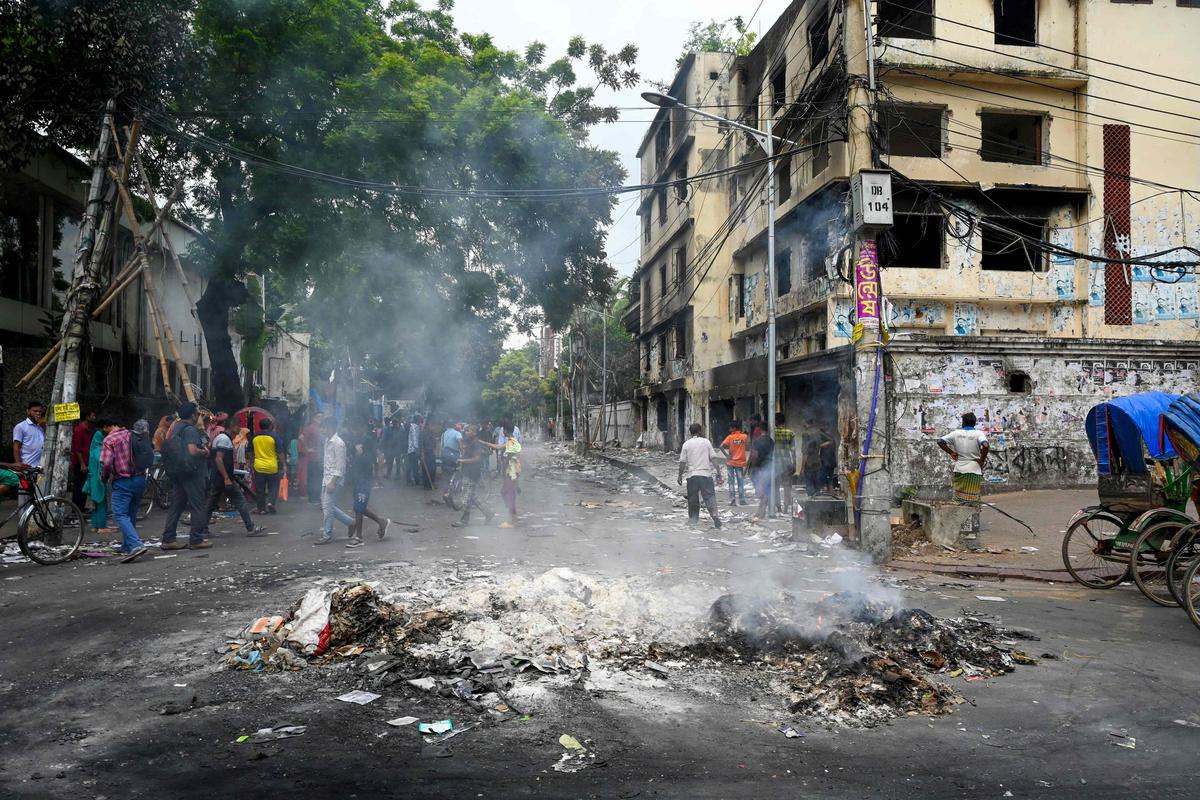
Smoke billows near a burnt Awami League party office as anti-government protestors set fire in Dhaka on August 6, 2024, after Prime Minister Sheikh Hasina fled the country.
| Photo Credit:
AFP
Bangladesh’s tipping point
Similar to how the 1857 uprising was sparked by a long history of disenchantment with British oppression, the students’ movement emerged from deep-seated political and social angst against authoritarianism and human rights violations. Thousands joined from across the country, and it was so strong it compelled Hasina to resign in the presence of the three service chiefs and flee the country, on August 5, 2024. The former Prime Minister, elected for the fifth time in January 2024, arrived in India and continues to be there, her future plans uncertain.
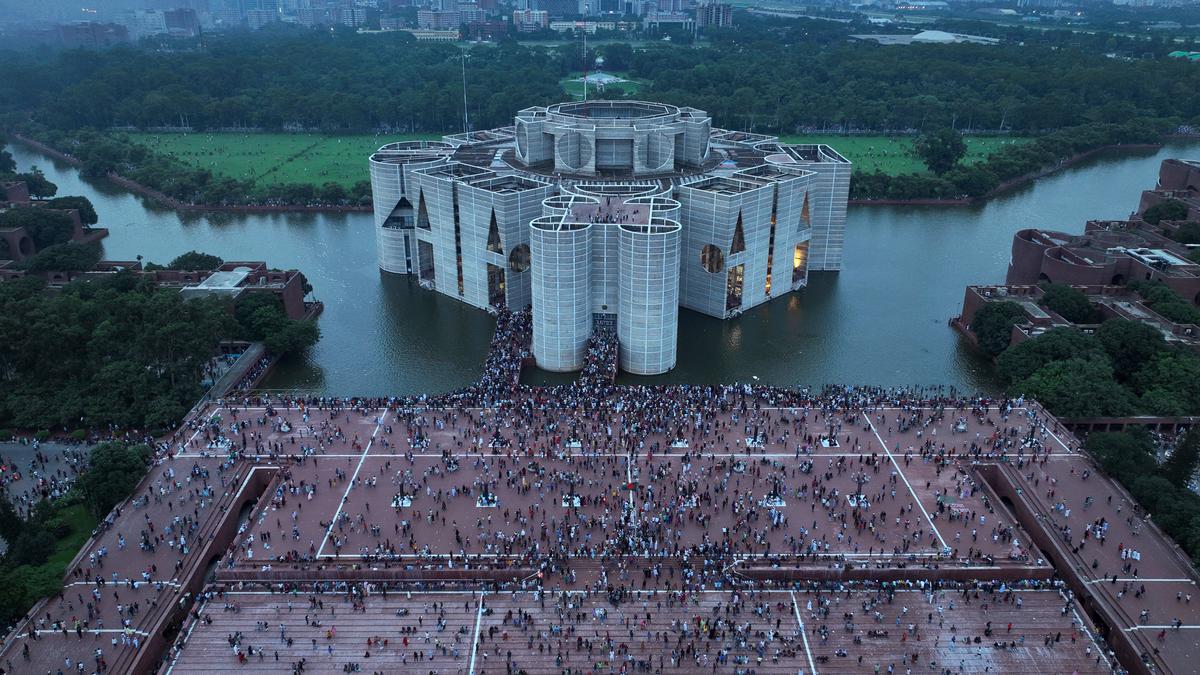
When she left her official residence, Ganabhaban, the public stormed its lavish premises. The world saw images of people making off with suitcases and deep freezers, but also goats, fish, and a German Shepherd pup. Statues of Sheikh Mujibur Rahman, Hasina’s father, considered the founding father of Bangladesh, were vandalised, the video going viral.
Watch: The story of Sheikh Hasina
The army chief, General Waker-Uz-Zaman, called for peace, and on August 6, 2024 it was announced that Muhammad Yunus, the 84-year-old pioneer of microfinance who won the Nobel prize in 2006, would lead an interim government, with 16 advisers, including two student representatives. The Hasina government had filed over 200 cases against the Grameen Bank founder, for corruption.


It wasn’t just student politics that brought the Hasina government down. According to Bangladeshi human rights organisations, security forces have committed over 600 enforced disappearances since 2009. While some people were later released, produced in court, or said to have died during an armed exchange with security forces, nearly 100 people remain missing, they say.
These actions angered people. For instance, Brigadier General (suspended) Abdullahil Amaan Azmi was released from the detention centre known as Aynaghar (House of Mirrors), after eight years of captivity in the early hours of August 6. Azmi is the son of late Ghulam Azam, the former ameer (chief) of the Jamaat-e-Islami, a religion-based political party that was started in 1941 and has its roots in present-day Pakistan. He was allegedly forcibly picked up from his residence on August 23, 2016, and had since been missing. The Hasina government had repeatedly denied the existence of Aynaghar and 23 other detention camps, where political opponents were allegedly kept.
The Hasina government had, on August 1, 2024, banned the Jamaat-e-Islami, saying it was a threat to public security. The Jamaat is a key ally of former Prime Minister Khaleda Zia’s Bangladesh Nationalist Party (BNP), who was then in jail on charges of corruption, but now released. “They (Jamaat and BNP) just used the students as their shield,” Hasina had said, when Italian Ambassador Antonio Alessandro called on her, news agency PTI reported.
The Jamaat’s central executive committee member and the party’s media and publicity secretary, Matiur Rahman Akanda, calls the 2024 election a “dummy election”.
After the fall of the Hasina regime, families of political prisoners secretly jailed under her rule have gathered in front of Director General of Forces Intelligence (DGFI) headquarters. Sanjida Islam Tulee, co-founder of Mayer Dak, an organization of the families of the victims of ‘enforced disappearances’, says, “We have learnt from recently released former army officer Brigadier General Abdullahil Aman Azmi that there are many others in that Aynaghor. We went to the DGFI office to find out who is detained there and to talk about the issue.” They demand that the prisoners be released together instead of separately.

Media strangulation
The Bangladeshi media have often accused the government of stifling freedom of speech and assembly. According to a research paper by the Centre for Governance Studies (CGS), at least 451 journalists were sued under the Digital Security Act (DSA) since its inception and 255 of them were sued for their journalistic reports. Among the accused, 209 journalists are associated with national-level Bangladesh media and 197 with regional media outlets. The CGS found that at least 4,520 people have been charged in 1,436 cases filed between October 2018 and September 2023.
Raihan Hossain, a journalist from Jago News, an online news outlet in Bangladesh, says journalists in Bangladesh have faced huge challenges, particularly when reporting on sensitive issues like the extra-judicial killings, enforced disappearances, and the corruptions.
He says, “Journalists who dared to investigate and report on these issues often faced severe threats. The powers-that-be would go to great lengths to silence us, using intimidation and fear to prevent any negative coverage. It was a constant battle, and many of us were put in positions where our safety was at risk simply for trying to do our jobs.”
He adds that the situation was further complicated by the government’s blatant ‘favouritism’ for certain media outlets. “Newspapers that aligned with the government’s agenda were granted numerous facilities and privileges, while those that attempted to maintain journalistic integrity were often deprived of essential resources. This made it increasingly difficult for independent journalism to thrive, as the government’s influence over the media landscape created an environment where only the voices that supported the official narrative could prosper.”
A rise in minority violence
After Hasina’s fall, there has also been a rise in violence against the Hindu minority. According to Bangladesh Hindu Buddhist Christian Unity Council (BHBCUC), 200-300 Hindu homes and businesses were vandalized, and 15-20 temples were damaged. Many have been injured.
Rana Dasgupta, the general secretary of the BHBCUC Oikya Parishad says, “Some of those whose homes were attacked may be directly involved in Awami League politics, but 98% are Hindus not involved in political activity.” He hopes the interim government will restore stability and protect minorities. Student and Jamaat leaders have put out statements asking supporters to guard temples and churches as diplomats and rights groups expressed concerns over reports of attacks on minority groups.
New regime in Bangladesh | Lessons for India & South Asia
Monzurul Islam, president of the Bangladesh Islami Chhatra Shibir, the student wing of Jamaat-e-Islami, says they do not consider any group a minority or majority in the country: “Everyone is equal,” he says, despite the group’s belief that the reason for Hasina’s political dominance in the country was India. Hindus, who form 8% of the population of over 17 crore, were traditionally Awami League supporters.
Photographer and human rights activist Shahidul Alam says, “India is effectively Bangladesh’s only neighbour. It is also a major trade partner. It makes no sense for Bangladesh not to have a cordial relationship with India.” He hopes though that a future relationship will be based on equality, rather than that of a ‘big brother’.