






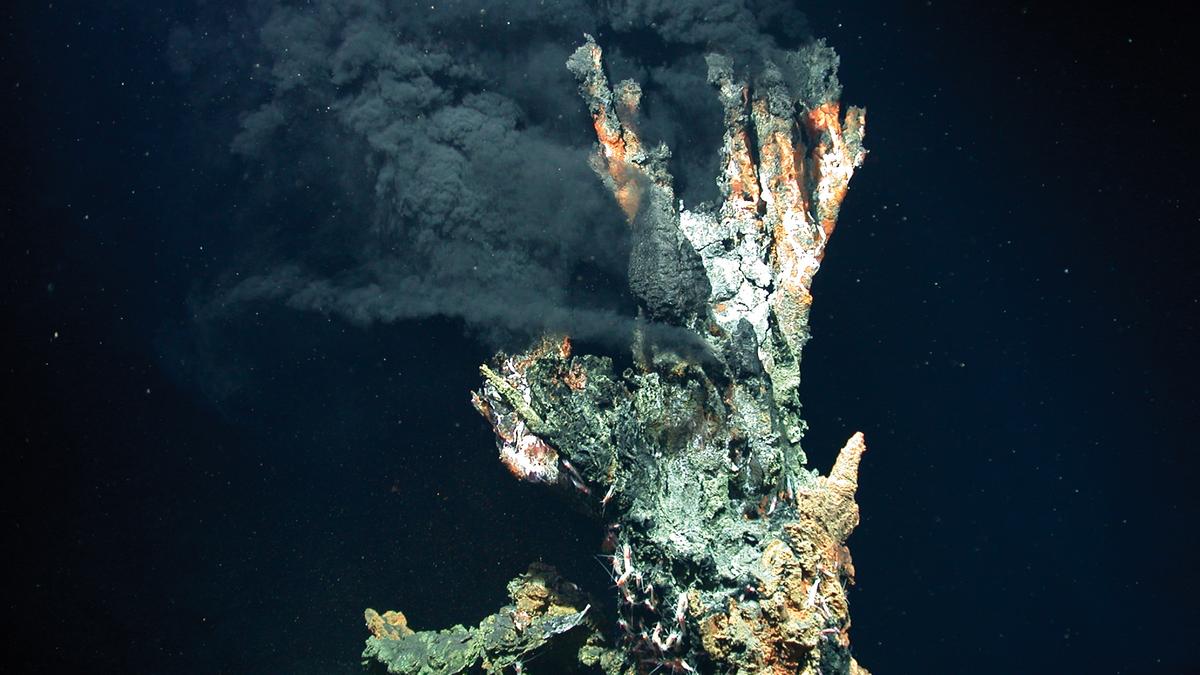
The ‘Candelabra’ hydrothermal vent on the Mid-Atlantic Ridge 3.3 km underwater, seen on June 26, 2011. In the past, scientists have found evidence of ancient life-forms in the precipitates around such vents.
| Photo Credit: MARUM (CC BY 4.0)
The origin of life on the earth is one of the world’s most enduring mysteries. There are a number of competing theories but all of them lack conclusive proof. Nonetheless, scientists widely believe a combination of geological, climatic, and chemical processes gave rise to the building blocks of life.
In the 1920s, Alexander Oparin and J.B.S. Haldane independently proposed their origin theories — the first of their kind. In 1924 and 1929, Oparin and Haldane respectively suggested the first molecules making up the earliest life forms gradually self-organised from a “primordial soup” in a young earth’s tempestuous, prebiotic environment. This idea is today called the Oparin-Haldane hypothesis.
Researchers have also conducted biochemistry experiments and found evidence to support this hypothesis. A particularly famous one was the Miller-Urey experiment in 1952, in which University of Chicago researchers Stanley Miller and Harold Urey showed that in the right conditions, inorganic compounds could give rise to complex organic compounds. Miller and Urey mixed methane, ammonia, and water, and when they applied a strong electric current — like a lightning strike might have — the mixture contained amino acids, the building blocks of proteins. They reported their discovery the very next year in the journal Science.

While we have evidence today that the earth’s environment then may not have been much like what the experiment presumed to mimic, the very fact that amino acids could be created in a broth of inorganic molecules was groundbreaking.
Other researchers have proposed other theories about the origin of life. A particularly prominent one is that meteorites from space could have brought the building blocks of life, sustained by discoveries on the earth as well as out there. In August 2019, French and Italian scientists reported discovering extra-terrestrial organic material 3.3 billion years old whereas Japan’s Hayabusa 2 mission to the asteroid Ryugu indicated the presence of more than 20 amino acids there.
LUCA and the molecular clock
As mysteries go, a close second to the origin of life is how life-forms evolved to produce the rich diversity we see around us today. Researchers believe all the three branches of life — bacteria, archaea, and eukarya — originated from a single cell, called the last universal common ancestor (LUCA).
There is no fossil evidence to support the existence of LUCA, but the fact that modern genomes share so many features provides some insights. An important concept that allows scientists to reconstruct the ‘tree of life’ is the theory of the molecular clock. Molecular biologist Emile Zuckerkandl and biochemist Linus Pauling proposed it in the 1960s and biologist Motoo Kimura subsequently improved it.
According to a simplified version of the theory, the rate at which mutations are added or removed from a population’s genome is proportional to the rate of acquiring new mutations, which is constant. Later studies also found that the mutation rate varies between species. Using these two facts, researchers developed a way to estimate how much time could have passed between two evolutionary events.
To calibrate the molecular clock to a particular rate of mutations, researchers establish links between a genome with known events, such as the ‘date’ on which the first mammal evolved or with the age of certain fossils. These links act like temporal benchmarks.
Thanks to the large number of genome sequences and fossils of various organisms as well as the computing power available today, researchers routinely use the molecular clock to understand the evolution of various life-forms on the earth through time.
Which is older: LUCA or fossils?
In a recent paper in the journal Nature Ecology and Evolution, researchers at the University of Bristol and Exeter in the U.K. constructed a phylogenetic tree of 350 bacterial and 350 archaeal genomes. Then, using a molecular clock, the team estimated when LUCA could have originated: around 4.2 billion years ago, just 300 million years after the earth itself formed.
The team also reported LUCA may have had a small genome, of some 2.5 million bases and encoding around 2,600 proteins, all just enough to help it survive in a unique environmental niche. The team also suggested the metabolites produced by LUCA — compounds produced as a result of its metabolism — could have created a ‘secondary’ ecosystem in which other microbes could have emerged.

Importantly, the origin of LUCA by 4.2 billion years significantly pre-dates previous suggestions about the origin of life on the earth. For context, researchers have found fossil records of the earliest life-forms in the Pilbara Craton in western Australia, one of the few places on the planet where archaean rocks are exposed aboveground and accessible. Studies of these fossils have suggested the life that lived on the rocks emerged around 3.4 billion years ago. The current study on the other hand pushes this date back by almost a billion years, almost on the heels of the birth of our planet itself.
The researchers also found some reasons to believe LUCA may have had genes responsible for immunity, suggesting it had to fight off viruses.
Taken together, the findings are tremendously significant not just for understanding how life emerged and evolved on the earth: they also speak to our ability to look for similar forms of life across the universe. The insights into evolution they provide will also give a significant fillip to human ambitions to engineer synthetic organisms for various industrial, chemical, and biological processes on the earth as well as to create or moderate ecosystems on other planets in future.
The authors are senior consultants at Vishwanath Cancer Care Foundation, and adjunct professors at IIT Kanpur and Dr. D.Y. Patil Vidyapeeth, and distinguished visitors at Ashoka University.