
Skip to content
  • Facebook
  • X
  • Linkedin
  • WhatsApp
  • YouTube
  • Associate Journalism
  • About Us
  • Privacy Policy
  • 033-46046046
  • editor@artifex.news
Artifex.News

Artifex.News

Stay Connected. Stay Informed.

  • Breaking News
  • World
  • Nation
  • Sports
  • Business
  • Science
  • Entertainment
  • Lifestyle
  • Toggle search form
  • Access Denied Business
  • Asia Cup | From childhood playmates to India teammates, Abhishek-Gill duo has come a long way
    Asia Cup | From childhood playmates to India teammates, Abhishek-Gill duo has come a long way Sports
  • Access Denied
    Access Denied Nation
  • Access Denied
    Access Denied Nation
  • Gautam Gambhir Receives Big Team Selection Advice For 1st Australia Test: “Even If…”
    Gautam Gambhir Receives Big Team Selection Advice For 1st Australia Test: “Even If…” Sports
  • Access Denied
    Access Denied Nation
  • Access Denied Sports
  • Zomato Rolls Back Green Uniform For Veg Fleet, All Riders To Wear Red
    Zomato Rolls Back Green Uniform For Veg Fleet, All Riders To Wear Red Nation
‘Universal’ equation predicts how often bird, bat, insect wings beat

‘Universal’ equation predicts how often bird, bat, insect wings beat

Posted on June 18, 2024 By admin


Almost all animals that fly through the air and many that swim through water have evolved to flap their wings (or fins) at a frequency given by a simple formula, three scientists at Roskilde University in Denmark have found.

The formula relates the flapping frequency at which a winged entity bats its wings to hover in the air (or stay submerged in the water) to the entity’s mass and the size of the wings.

The researchers also found the formula holds for a large variety of life-forms, including insects, birds, bats, penguins, whales, and one robotic bird called an ornithopter — the dragonfly-like aeroplanes in the new Dune films.

What is the formula?

The formula is straightforward: f ∝ √m/A. f here is the flapping frequency, m the mass of the airborne animal, and A the area of the wings (∝ stands for ‘is proportional to’).

When the researchers calculated √m/A number of various animals, birds, and insects and plotted it on the x-axis and their respective frequencies on the y-axis, they found a nearly straight line (see below). The black line is the relationship their model based on the formula predicted — an almost perfect fit.
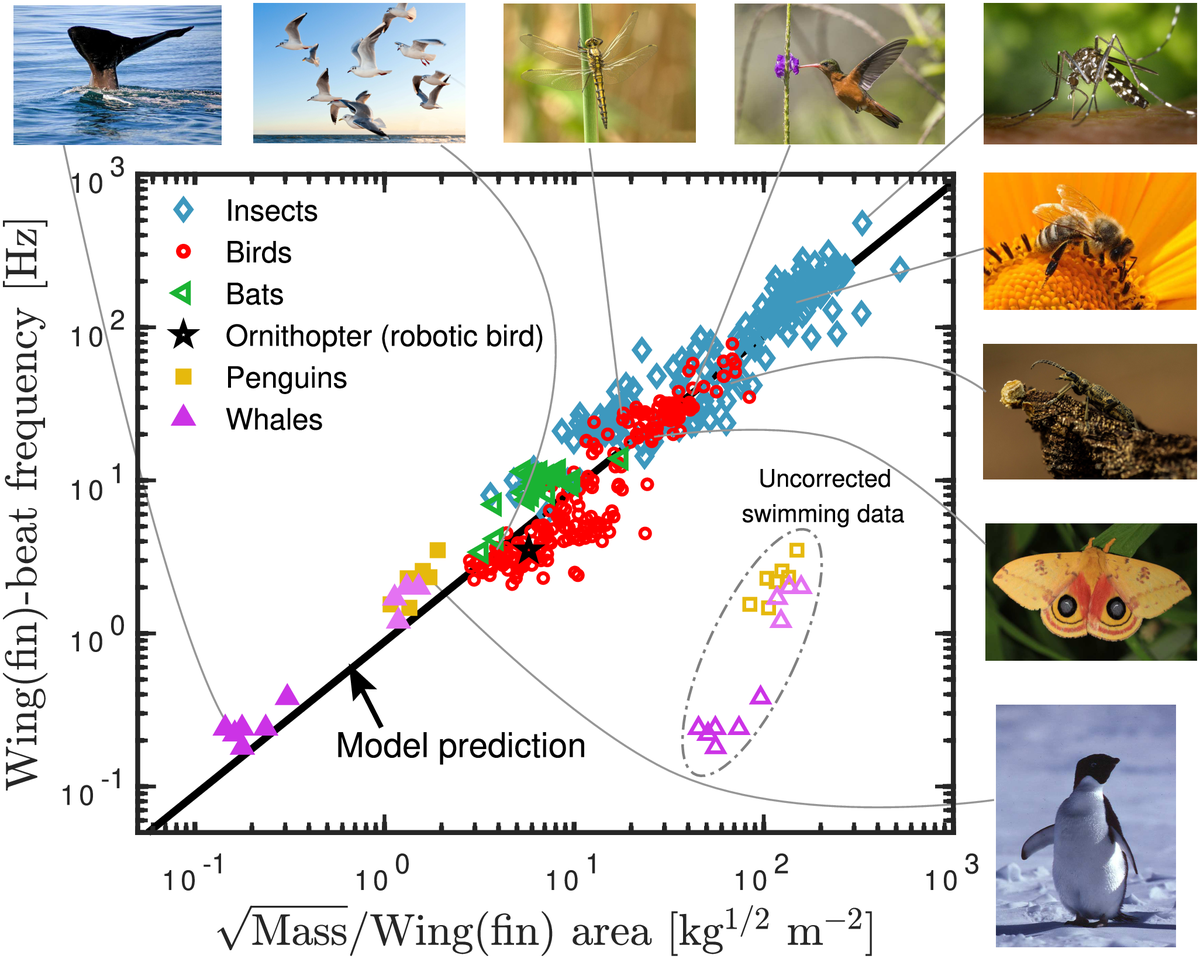
A plot showing the scaling relationship between f and √m/A.

A plot showing the scaling relationship between f and √m/A.
| Photo Credit:
PLoS ONE 19(6): e0303834.

The Roskilde team’s results were published in the journal PLoS One on June 5.

How did they find the formula?

People have attempted before to find some kind of unifying thread through the wing-beating frequencies of animals, birds, and insects that fly. In most of these efforts, scientists arrived at correlations between flapping frequency and mass and between wing area and mass based on measuring these numbers in the wild. The results were relationships like f ∝ m-0.43, which scientists haven’t been able to arrive it using only what they know about physics, without using empirical data.

In its paper, the Roskilde team wrote that its members wanted to attempt the former: derive a theoretical equation and then check if it fit what they find in the wild. As they put it: “can one arrive at a reliable prediction for the wing-beat frequency of a flying animal from physics-based arguments alone, i.e. without appealing to empirical correlations?”

They started at the equation of Newton’s second law for an animal trying to stay airborne by flapping its wings: F = ma. The a here is really g, the downward acceleration due to gravity, and m is the animal’s mass. F is the force the animal has to generate by flapping its wings. From here they worked forward to account for the momentum of the air each wing stroke pushes down, the velocity of air flow around the wings, and the density of the atmosphere.

As they did, they encountered a variety of quantities — especially the shapes of the wings and the angles at which they flap — that didn’t have units, i.e. they were dimensionless. They bundled the numbers representing these entities into a single constant called C; its precise value depends on empirical observations. Thus, they had their equation:
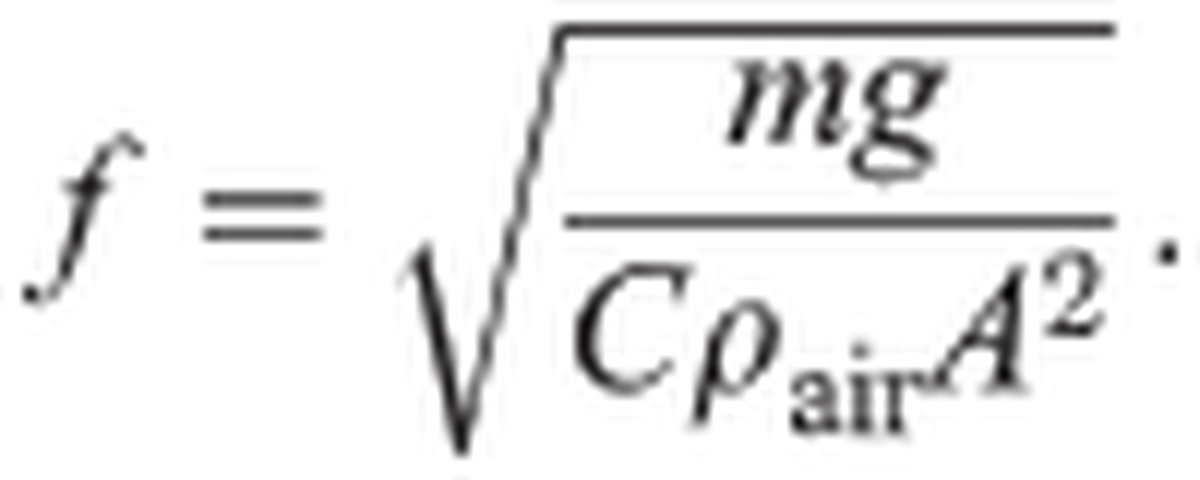
f here is the wingbeat frequency, m the mass of the animal, ⍴air the atmosphere’s density, and A the size of the wing. Et voila.

What does C hold?

Matt Wilkinson, director of studies in natural sciences at the University of Cambridge, flagged that the equation’s proportionality constant, C, could yield more insights, too.

He told Physics World a bird’s flight is most efficient when the wings beat at a bird’s specific resonant frequency, but if the bird is heavier beyond a point, this frequency won’t suffice to hold up its mass, so its flight will be necessarily less than efficient.

Given the equation’s variable components, he added, the size dependence should be hidden away in the constant C. “Unpicking that, despite the enormous differences in wing shape and flight kinematics, is where the real insights will be found,” he told the magazine.

Does the formula apply to fish?

Mathematics is a language to describe the natural universe and the equation depicts what seems to be a universal law telling us why flying birds and insects fly the way they do, what a bird or insect that evolves in the future could look like, and what winged robots need to look like if they expect to become airborne.

The proportionality relationship arises when these adjustables are taken away, leaving f ∝ √m/A.

“Interestingly,” the researchers wrote in their paper, their equation “also gives a recipe for the fin/fluke frequency of swimming animals as positively buoyant diving animals must continuously move water upwards in order to stay submerged. This, of course, holds only for animals with no means of adjusting buoyancy, which excludes fish with a swim bladder. Calculating fin/fluke frequency from [the equation] requires two modifications, replacing the density of air by the density of water and animal mass by the buoyancy-corrected mass.”

Where does the formula apply?

The researchers tested their equation with data about birds, insects, etc. presented in older published studies, where they found “176 different insect data points (including bees, moths, dragonflies, beetles, and mosquitoes), 212 different bird data points (ranging from hummingbirds to swans), and 25 bat data points”.

The equation has a regime in which its left-hand side equals its right-hand side, which presumes certain physical conditions. For example, you’ll remember reading about the Reynolds number (Re) in high school: at a low value of Re, the flow of a fluid will be streamlined; if the value is high, the flow is said to have become turbulent. The value of Re depends on the fluid’s density, speed, viscosity, and a length scale. At high Re, the fluid’s density matters more than its viscosity for an animal trying to ‘fly’ through it — and this is the case for the insects, birds, bats, etc. whose flapping frequencies the equation captures.

The authors wrote in their paper that it will need to be modified at low or very low Re, where the fluid viscosity matters more than density. For example, they were able to work out that “for flying animals at very small Reynolds numbers, f ∝ m/A replaces the above.”

They were also able to determine that as long as the density of animals didn’t vary by an order of magnitude (i.e. a factor of 10) or more, the equation couldn’t be simplified further.




Source link

Science Tags:dimensional analysis, India bird sanctuary, India birding tours, law of evolution, Roskilde University, universal law birds, wing flapping frequency

Post navigation

Previous Post: How diapers use quantum physics to attend to nature’s call | Explained
Next Post: Indian diaspora makes it big in South African Parliament and provincial legislatures

Related Posts

  • Team aims world’s smallest QR code at long-term data storage
    Team aims world’s smallest QR code at long-term data storage Science
  • Sky Teamwork: Why do birds fly in V formation?
    Sky Teamwork: Why do birds fly in V formation? Science
  • How do woodpeckers protect their brains?
    How do woodpeckers protect their brains? Science
  • IIT Mandi, DBT-inStem Bengaluru scientists find how dengue mosquito eggs are so hardy
    IIT Mandi, DBT-inStem Bengaluru scientists find how dengue mosquito eggs are so hardy Science
  • India-made app turns impaired speech into clear speech in near-realtime
    India-made app turns impaired speech into clear speech in near-realtime Science
  • How AI is helping communities restore Madagascar’s ancient baobab forests
    How AI is helping communities restore Madagascar’s ancient baobab forests Science

More Related Articles

IISc and Pratiksha Trust launch moonshot project on brain co-processors IISc and Pratiksha Trust launch moonshot project on brain co-processors Science
Scientists test menstrual products with blood for the first time, and find surprises Scientists test menstrual products with blood for the first time, and find surprises Science
Antimatter idea offers scientists clue to cracking cosmic mystery Antimatter idea offers scientists clue to cracking cosmic mystery Science
In manifesto, scientists oppose ‘militarisation’ of quantum research In manifesto, scientists oppose ‘militarisation’ of quantum research Science
Using AI to classify neem fruits based on azadirachtin content Using AI to classify neem fruits based on azadirachtin content Science
Shielding humans alone won’t prevent pandemics if animals can fall ill Shielding humans alone won’t prevent pandemics if animals can fall ill Science
SiteLock

Archives

  • May 2026
  • April 2026
  • March 2026
  • February 2026
  • January 2026
  • December 2025
  • November 2025
  • October 2025
  • September 2025
  • August 2025
  • July 2025
  • June 2025
  • May 2025
  • April 2025
  • March 2025
  • February 2025
  • January 2025
  • December 2024
  • November 2024
  • October 2024
  • September 2024
  • August 2024
  • July 2024
  • June 2024
  • May 2024
  • April 2024
  • March 2024
  • February 2024
  • January 2024
  • December 2023
  • November 2023
  • October 2023
  • September 2023
  • August 2023
  • July 2023
  • June 2023
  • May 2023
  • April 2023
  • March 2023
  • February 2023
  • January 2023
  • December 2022
  • November 2022
  • October 2022
  • September 2022
  • August 2022
  • July 2022
  • June 2022
  • May 2022

Categories

  • Business
  • Nation
  • Science
  • Sports
  • World

Recent Posts

  • Nicobarese oppose proposal for three wildlife sanctuaries
  • Visakhapatnam Collector calls for inter-departmental synergy to boost investments
  • Kohli’s masterful knock powers Royal Challengers to the top
  • Senior IPS officer Asra Garg posted IGP Intelligence
  • Vijay Narayan earns rare distinction of being Advocate General under two different governments

Recent Comments

  1. StevenLek on UP Teacher Who Asked Students To Slap Muslim Classmate
  2. Leonardren on UP Teacher Who Asked Students To Slap Muslim Classmate
  3. NathanQuins on UP Teacher Who Asked Students To Slap Muslim Classmate
  4. Davidgof on UP Teacher Who Asked Students To Slap Muslim Classmate
  5. NathanJobre on UP Teacher Who Asked Students To Slap Muslim Classmate
  • As Google Faces A Grave And Uncertain Future, Apple Steps In. Here’s Why
    As Google Faces A Grave And Uncertain Future, Apple Steps In. Here’s Why World
  • South African Rassie Van Der Dussen Opens Up On Scoring Consecutive 50 vs Bulawayo Brave Jaguars And JoBurg Bangla Tigers
    South African Rassie Van Der Dussen Opens Up On Scoring Consecutive 50 vs Bulawayo Brave Jaguars And JoBurg Bangla Tigers Sports
  • Trump sues JPMorgan for  billion, alleges the bank closed his accounts for political reasons
    Trump sues JPMorgan for $5 billion, alleges the bank closed his accounts for political reasons World
  • Access Denied
    Access Denied Nation
  • “I Don’t Know”: Mitchell Starc Unsure About Australia’s Bowling Due To The Absence Of This Star For India Series
    “I Don’t Know”: Mitchell Starc Unsure About Australia’s Bowling Due To The Absence Of This Star For India Series Sports
  • Access Denied Sports
  • 2 Students Fall To Death From 4th Floor Of Their Rented Home In Delhi: Cops
    2 Students Fall To Death From 4th Floor Of Their Rented Home In Delhi: Cops Nation
  • Russian Foreign Minister Lavrov backs UNSC bid by India, Brazil at U.N. General Assembly
    Russian Foreign Minister Lavrov backs UNSC bid by India, Brazil at U.N. General Assembly World

Editor-in-Chief:
Mohammad Ariff,
MSW, MAJMC, BSW, DTL, CTS, CNM, CCR, CAL, RSL, ASOC.
editor@artifex.news

Associate Editors:
1. Zenellis R. Tuba,
zenelis@artifex.news
2. Haris Daniyel
daniyel@artifex.news

Photograher:
Rohan Das
rohan@artifex.news

Artifex.News offers Online Paid Internships to college students from India and Abroad. Interns will get a PRESS CARD and other online offers.
Send your CV (Subjectline: Paid Internship) to internship@artifex.news

Links:
Associate Journalism
About Us
Privacy Policy

News Links:
Breaking News
World
Nation
Sports
Business
Entertainment
Lifestyle

Registered Office:
72/A, Elliot Road, Kolkata - 700016
Tel: 033-22277777, 033-22172217
Email: office@artifex.news

Editorial Office / News Desk:
No. 13, Mezzanine Floor, Esplanade Metro Rail Station,
12 J. L. Nehru Road, Kolkata - 700069.
(Entry from Gate No. 5)
Tel: 033-46011099, 033-46046046
Email: editor@artifex.news

Copyright © 2023 Artifex.News Newsportal designed by Artifex Infotech.