


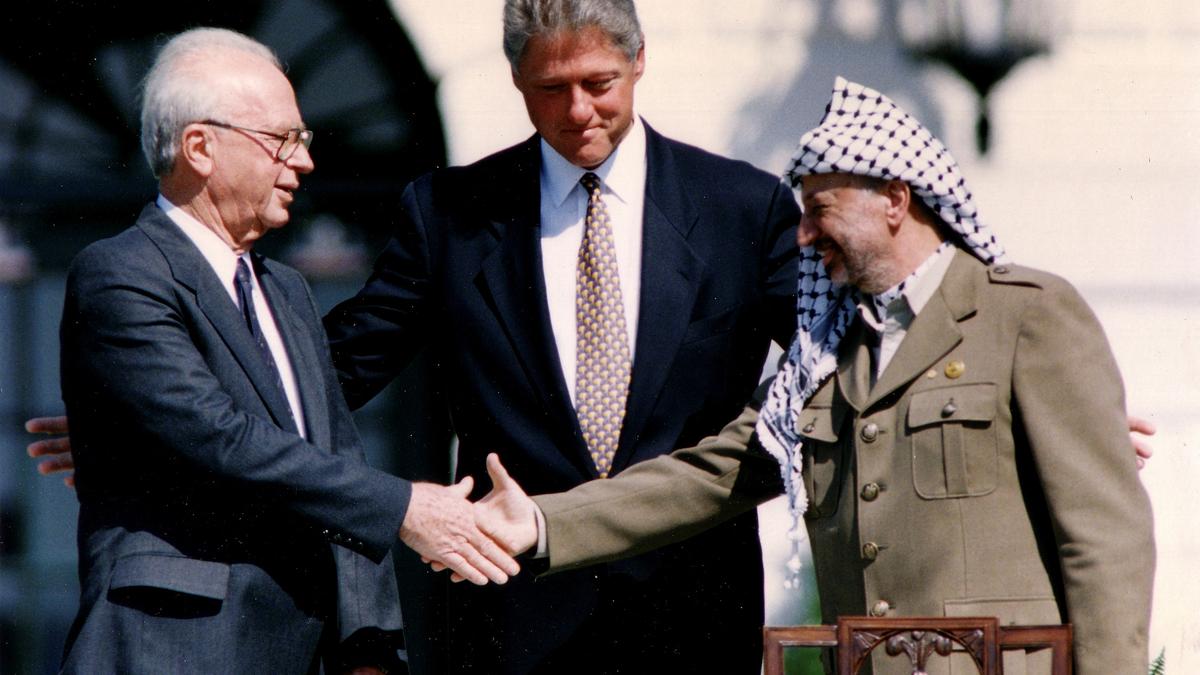
PLO chairman Yasser Arafat shakes hands with Israeli Prime Minister Yitzhak Rabin as U.S. President Bill Clinton stands between them after the signing of the Israel-PLO peace accord at the White House in Washington on September 13, 1993.
| Photo Credit: Reuters
The story so far: Hamas’s October 7, 2023 attack in Israel and the latter’s continuing war on Gaza have brought the Palestine question back to the fore of West Asia. As the war has destroyed much of Gaza and killed 36,000 of its people, the world has also seen more countries voicing strong support for a future Palestine state. Recently, three European countries, Spain, Ireland and Norway, recognised the Palestine state. Arab countries, including Saudi Arabia and Jordan, say there wouldn’t be lasting peace in the region unless the Palestine question is resolved. An internationally recognised solution to the crisis is what’s called the two-state solution.

What’s the two-state solution?
The short answer is simple: divide historical Palestine, the land between the Jordan River on the east and the Mediterranean Sea in the west, into an Arab state and a Jewish state. But the long answer is complicated. Israel, a Jewish state, was created in Palestine in 1948. But a Palestine state is not yet a reality. Palestinian territories have been under Israeli occupation since 1967. So, a two-state solution today means the creation of a legitimate, sovereign Palestine state, which enjoys the full rights like any other nation state under the UN Charter.
What are the origins?
The roots of the two-state solution go back to the 1930s when the British ruled over Palestine. In 1936, the British government appointed a commission headed by Lord William Robert Peel (known as the Peel Commission) to investigate the causes of Arab-Jewish clashes in Palestine. A year later, the commission proposed a partition of Palestine into a Jewish and an Arab state. At that time, Jews accounted for some 28% of Palestine’s population. According to the Peel Commission proposal, the West Bank, Gaza and Negev desert would make up the Arab state, while much of Palestine’s coast and the fertile Galilee region would be part of the Jewish state. Arabs rejected the proposal.
After the Second World War, the U.N. Special Commission on Palestine (UNSCOP) put forward another partition plan. It proposed that Palestine be divided into three territories — a Jewish state, an Arab state and an international territory (Jerusalem). Jews, who made up roughly 32% of Palestine’s population, were to have 56% of the Palestine land as per the UNSCOP plan. The partition plan was adopted in the U.N. General Assembly (Resolution 181). Arabs rejected the plan (India voted against it), while the Zionist leadership of Israeli settlers in Palestine accepted it. And on May 14, 1948, Zionists unilaterally declared the state of Israel. This triggered the first Arab-Israeli war. And by the time an armistice agreement was achieved in 1949, Israel had captured some 22% more territories than what the U.N. had proposed.
How did it get international legitimacy?
In the 1967 Six-Day War, Israel captured the West Bank and East Jerusalem from Jordan, the Gaza Strip and the Sinai Peninsula from Egypt and the Golan Heights from Syria (Israel continues to control all territories except the Sinai which it returned to Egypt after the 1978 Camp David Accords). Palestine nationalism emerged stronger in the 1960s, under the leadership of the Palestine Liberation Organization (PLO).
The PLO initially demanded the “liberation” of the whole of Palestine, but later recognised the two-state solution based on the 1967 border. Israel initially rejected any Palestinian claim to the land and continued to term the PLO as a “terrorist” organisation. But in the Camp David Accords, which followed the 1973 Yom Kippur War in which Egypt and Syria surprised Israel with an attack, it agreed to the Framework for Peace in the Middle East agreement. As part of the Framework, Israel agreed to establish an autonomous self-governing Palestinian authority in the West Bank and Gaza Strip and implement the U.N. Resolution 242, which has demanded Israel pull back from all the territories it captured in 1967. The Framework laid the foundation for the Oslo Accords, which, signed in 1993 and 1995, formalised the two-state solution. As part of the Oslo process, a Palestinian National Authority, a self-governing body, was formed in the West Bank and Gaza and the PLO was internationally recognised as a representative body of the Palestinians. The promise of Oslo was the creation of a sovereign Palestinian state which would live next to the Israeli state in peace. However, this promise has never been materialised.
A video on the Yom Kippur war that happened 50 years ago
What are the hurdles to achieving the two-state solution?
The first setback for the Oslo process was the assassination of Yitzhak Rabin, the Israeli Prime Minister who signed the accords, in November 1995 by a Jewish extremist. Rabin’s Labour party was defeated in the subsequent elections and the right-wing Likud, under Benjamin Netanyahu’s leadership, came to power. The rise of Hamas, the Islamist militant group that opposed the Oslo Accords saying the PLO made huge concessions to the Israelis, also contributed to the derailment of the peace process. After the collapse of the Oslo process in the 1990s, there were multiple diplomatic efforts to revive the two-state plan, but none of these made progress towards achieving the goal.

Multiple reasons could be identified for this failure. But there are specific structural factors that make the two-state solution unachievable, at least for now. One is the boundary. Israel doesn’t have a clearly demarcated border. It is essentially an expansionist state. In 1948, it captured more territories than it was promised by the UN. In 1967, it expanded further by taking the whole of historical Palestine under its control. From the 1970s, Israel has been building illegal Jewish settlements in Palestinian territories. While Palestinians say their future state should be based on the 1967 border, Israel is not willing to make any commitments.
Two, the status of settlers. Roughly 7,00,000 Jewish settlers are now living in the West Bank and East Jerusalem. If Israel is to withdraw to the 1967 border, they will have to pull back the settlers. The settlers are now a powerful political class in Israeli society and no Prime Minister can pull them back without facing political consequences. Three, the status of Jerusalem. Palestinians say East Jerusalem, which hosts Al Aqsa, Islam’s third holiest mosque, should be the capital of their future Palestinian state, while Israel says the whole of Jerusalem, which hosts the Western Wall, the holiest place in Judaism, is Israel’s “eternal capital”. Four, the right of refugees to return to their homes. Some 7,00,000 Palestinians were displaced from their homes in 1948 when the state of Israel was declared. According to international law, they have a right to return to their homes. Israel says it won’t allow the Palestinian refugees to return.

While these are the structural factors that make the two-state solution complicated, on the ground, Israel’s rightwing leadership shows no willingness to make any concessions. Israel wants to continue the status quo — the status quo of occupation. The Palestinians want to break that status quo.