



Taking forward the research to potentially establish a relationship between the Harappan civilisation and the people of the Vedic age, a group of archeologists are now collaborating with Sanskrit scholars to decipher the text of the Rigveda.
In an exclusive interview with The Hindu, Vasant Shinde, archaeologist and former Vice Chancellor of Deccan College, Pune, said that a clear understanding of what is mentioned in the Rigveda text is important in order to co-relate archaeological evidence unearthed by his team in excavations of Harappan settlements at Haryana’s Rakhigarhi and Banawali, at Kalibanga on the Haryana-Rajasthan border, and at Dholavira in Gujarat.
Seeking evidence
The National Council of Educational Research and Training (NCERT) recently made a major addition to the Class 12 History textbook, Themes in Indian History Part 1, under a chapter titled, ‘Bricks, Beads and Bones – The Harappan Civilisation’, based on DNA evidence from the 4,600-year old remains of a woman, indicating that the Harappans were an indigenous people. Mr. Shinde’s work is now focussed on testing the hypothesis that the Harappans and the Vedic people were the same. The NCERT has added a disclaimer in the textbook that more research is required to establish this relationship.
Also read | ‘Harappans were best civil engineers’
“While excavating the site of Rakhigarhi, we found evidence of ritual platforms and fire altars. Parallely, fire worship is mentioned in Rigvedic texts. We now need to get more understanding about what is mentioned in Rigvedic text, and how much of that can be co-related with archaeological evidence. We have not done this in great detail, but now we want to do it,” Mr. Shinde said.
Currently, there is a debate about the period of origin of the Vedas, with one set of historians holding that the Vedas originated between 1,500 BC and 2,000 BC. However, another set of historians, including Mr. Shinde, believe that the Vedas date farther back to 2,500 BC — or 4,500 years ago. This would coincide with the age of the genetic evidence from the erstwhile Harappan woman’s bone samples tested at the Rakhigarhi site.

Mr. Shinde argues that nobody knows when the Vedic texts were written, adding that people will only believe hypotheses if one has the archaeological evidence to prove or disprove them.
Saraswati: a common thread
“If you see description in Rigvedic text of the area where people lived, there is frequent description of the river Saraswati. The mention of the river is recorded at least 71 times in the Rigvedic text. During archaeological excavations, we discovered a majority of Harappan settlements along the banks of river Saraswati. Of the nearly 2,000 known Harappan settlements spread over the Indus basin, Saraswati, and in Gujarat, of which almost two-thirds, at least 1,200 are located along the basin of the river Saraswati,” Mr. Shinde says.
DNA evidence now suggests that cities and towns first came into existence during the Harappan times, dating 4,500 to 4,600 years ago, he says. “They again later came into existence 2,400 years ago, by which time proofs of use of iron also emerged. In the middle, there seems to be a decline, where humankind reverted back to rural life. However, the later settlements were not along the banks of river Saraswati. The Rigveda talks about river Saraswati, and we only have proof of dense Harappan settlements there, dating back to 4,600 years ago. Also, Rigvedic texts do not mention the use of iron, so co-relation with early historic settlements which came much later and are 2,400 year old ones (near the Ganga Basin and the Deccan region) is not possible,” argues Mr. Shinde.
In modern times, the Saraswati is called the Ghagghar-Hakra river and flows only during the monsoon season. It originates from the Shivaliks, the foothills of the Himalayas, then flows through Punjab, Haryana, and a part of Rajasthan before entering what is now Pakistan. The Indian part of the river is named the Ghagghar, while the one in Pakistan is the Hakra, Mr. Shinde says.
A debate on animal bones
Another point of reference which may link the Harappans with Vedic times is a set of animal bones found and studied by two archaeo-zoologists in the Surkotada region of Kutch, Gujarat. While a group of researchers from Hungary stated that these bones belonged to a proper domesticated horse, another group from Harvard University headed by Richard Meadow concluded that these were the bones of a wild ass.
Mr. Shinde says that this opens up a point of debate. “Those who believe that the Harappans and Rigvedic people are the same cite the Hungarian reference of the animal bones being that of a horse, as horses find mention in Rigvedic texts. However, those historians who date the Rigveda to after 2,000 BC, believe Richard Meadow’s theory that the animal bones were that of a wild ass as some scholars say domesticated horses only came to India after 1,800 BC from central Asia,” he says.
He further points out that some terracotta figurines of horselike animals have been excavated from the Harappan sites of Lothal and Mohenjadaro. “Both sites have mentioned evidence of terracotta horse, there is a possibility that the animal existed but this is very slender evidence, we don’t have strong evidence to prove that the domesticated horse was present during Harappan times,” he says.
South Asian ancestor theory
Contrary to the theory that there was a large scale immigration of ‘Aryans’ from Europe to central Asia and then to south Asia, the NCERT textbook revisions mention that the Harappans were indigenous to India, dating back to 10,000 BC.
“Most scholars are of the opinion that Sanskrit is the base of Indo-European languages, so why could these languages have not originated from Sanskrit? Nobody knows where Indo-European languages originated. If we have adopted and carried forward most of the Harappan traditions, then I am of the opinion that language must have also continued. But currently this is just a hypotheses,” says Mr. Shinde, on being asked about the dating and origin of the Sanskrit language.
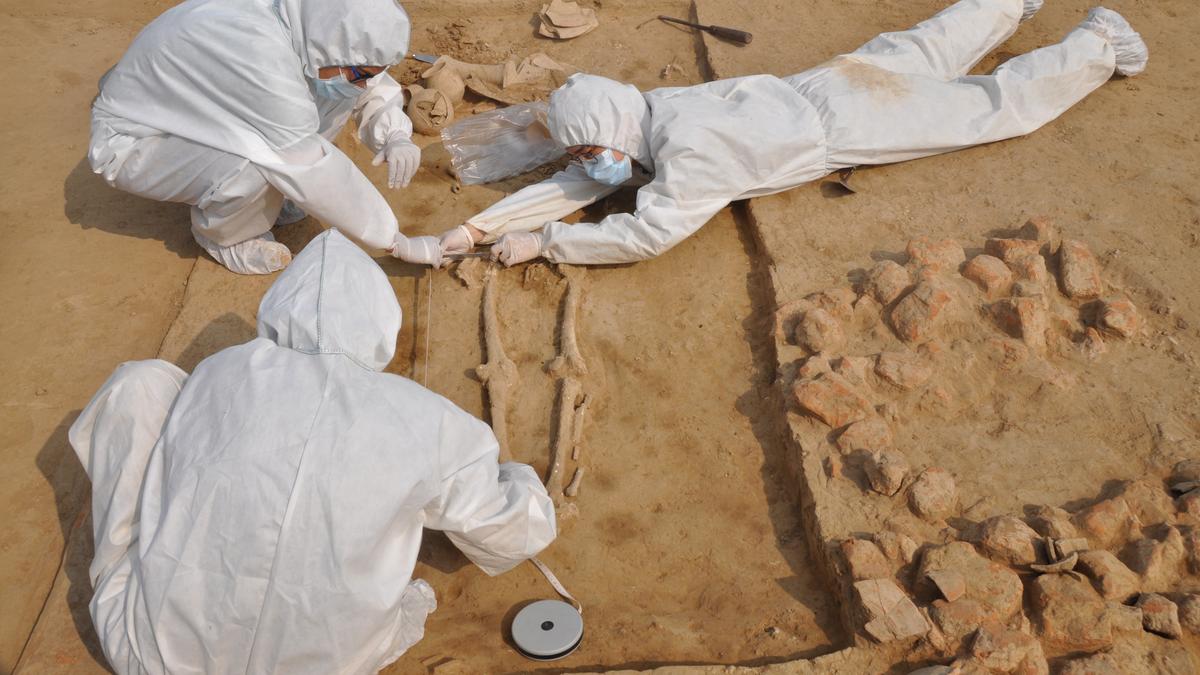
Mr. Shinde and his team had extracted DNA from the well-preserved petrous bone remains of a female skeleton which was dated to 4,600 years ago, and was not found comparable to the Steppe or Iranian population. Their findings were published in the international journal Cell in 2019.
“We applied genetic chronology to find out the root of her genes. That took us back to 10,000 BC. There were hunter gatherers at the Iran-Afghanistan border which may have split into two groups — one came to south Asia, one went to Iran. The ones who came to south Asia formed distinct genes and were Harappans,” Mr. Shinde says.
Testing modern Indians
Mr. Shinde’s group carried out DNA analysis from the blood samples of 3,000 modern south Asians from different linguistic and religious groups, and found that most of them — from the Andaman and Nicobar islands to Ladakh and Kashmir, and from Afghanistan to Bengal —. carried genetic similarities to the Harappan woman’s skeleton.
When we say one is a descendant of a particular family, the descendant should contain 25% to 30% genes of that family, while the rest can be mixed as a result of some intermixing of populations. Earlier, it was thought that the genes of people living in northern India had more Steppe genes, and they were said to have descended from ‘ancient ancestor north Indian’, while those Indians who settled down in the south were descended from ‘ancient ancestor south Indian’.
But now, Mr. Shinde says that most scholars are of the opinion that most people in India have Harappan genes, and should be called the descendants of a common ‘ancient ancestor south Asian’, as this kind of genes are found in people all over India, and are not only confined to south India, based on his team’s comparisons of ancient DNA genetic evidence with the 3,000 blood samples from across India.