



Skip to content
  • Facebook
  • X
  • Linkedin
  • WhatsApp
  • Associate Journalism
  • About Us
  • Privacy Policy
  • 033-46046046
  • editor@artifex.news
Artifex.News

Artifex.News

Stay Connected. Stay Informed.

  • Breaking News
  • World
  • Nation
  • Sports
  • Business
  • Science
  • Entertainment
  • Lifestyle
  • Toggle search form
  • India’s GDP grows at 8.4% in October-December quarter; 2023-24 growth scaled up to 7.6% from 7.3% Business
  • AAP To Make Electoral Debut In Northeast By Contesting Mizoram Polls Nation
  • “Unprofessional”: Franchises Fuming Over Foreign Stars Pulling Out Of IPL – Report Sports
  • IPL-17, LSG vs CSK | Simply owning that space, says Fleming of Dhoni Sports
  • Over 30 Lakh Audit Reports Filed On Income Tax Department Website Business
  • Suspended Congress MP Preneet Kaur, Wife Of Amarinder Singh, Joins BJP Nation
  • Seeing the magic of artificial intelligence applications in ophthalmology Science
  • “Justice For Sanju”: Shashi Tharoor Bats For “Best IPL Keeper” Samson Ahead India’s T20 World Cup Selection Sports

What causes landslides? Can we predict them to save lives?

Posted on May 28, 2024 By admin


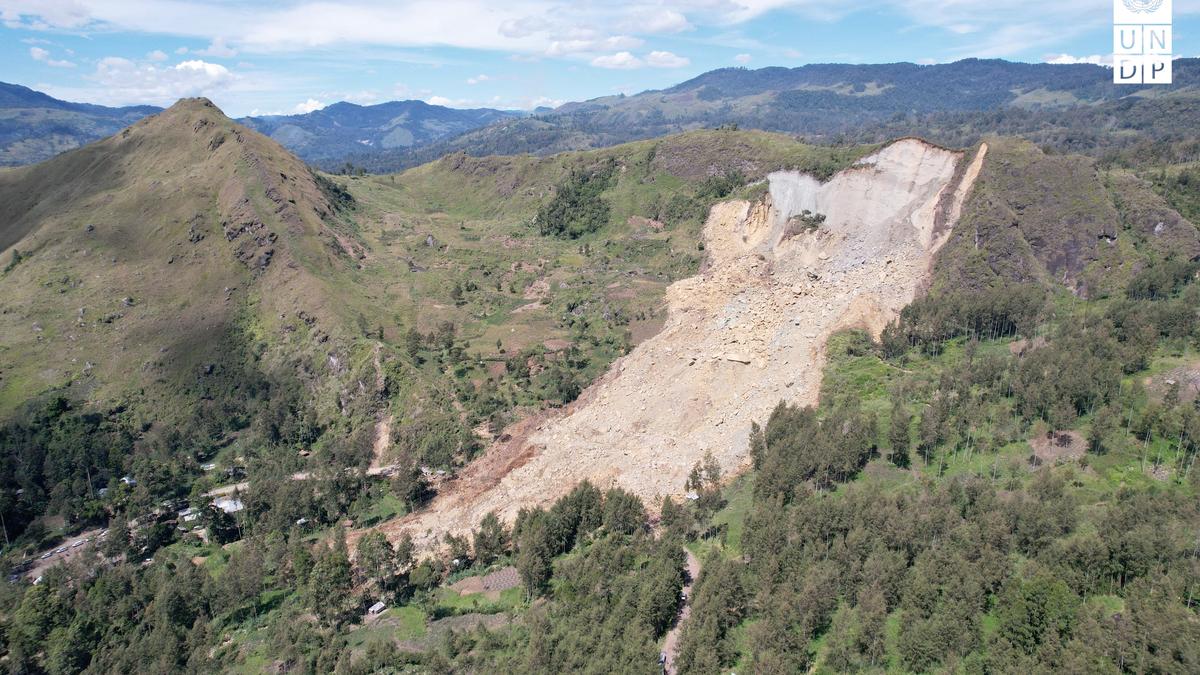
A view of the site of a landslide in Yambali village, Enga Province, Papua New Guinea, May 27, 2024.
| Photo Credit: Reuters

A devastating landslide struck several remote villages in the mountainous Enga province in Papua New Guinea late last week.

While it is too early for official confirmation, estimates place the death toll between 690 and 2,000 people, with thousands more missing. That only a few bodies have been recovered serves as a tragic reminder of the destructive power of these events.

The ongoing search and rescue operations have proven challenging. As often with landslides, secondary slides and rock falls are hampering efforts in the search zone. There’s also a lack of access to heavy digging machinery, and roads need to be cleared or repaired for assistance and equipment to arrive.

Even more critically, it is difficult to locate potential survivors, as landslides carry away buildings and their occupants in an unpredictable manner. What causes these devastating events and why are they so sudden and unpredictable?

What causes landslides?

Landslides happen when the pull from gravity exceeds the strength of the geomaterial forming the slope of a hill or mountain. Geomaterials can be as varied as rocks, sand, silt and clays.

Then, part of this slope starts sliding downhill. Depending on where the slope fails, the material sliding down can be just a few cubic metres or a few million cubic metres in volume.

Why do slopes fail? Most natural landslides are triggered by earthquakes or rainfall, or a combination of both.

Earthquakes shake the ground, stress it and weaken it over time. Rainwater can seep through the ground and soak it – the ground is often porous like a sponge – and add weight to the slope. This is why PNG is so prone to landslides, as it sits on an active fault and is subjected to heavy rainfalls.

Another adverse effect of water is erosion: the constant action of waves undercuts coastal slopes, causing them to fail. Groundwater can also dissolve rocks within slopes.

Humans can (and do) cause landslides in several ways, too. For example, deforestation has a negative impact on slope stability, as tree roots naturally reinforce the ground and drain water out. Also, mine blasts produce small earthquake-like ground vibrations that shake slopes nearby.

Why can’t we predict landslides?

It’s very difficult to predict and mitigate landslide risk effectively. The Enga landslide and the thousands of deadly and costly landslides occurring every year worldwide suggest so. Even in Australia – the flattest continent in the world – home insurance policies don’t tend to cover landslide risk for a simple reason: this risk is difficult to estimate.

So what would it take to warn people of a coming landslide? You would need a prediction for earthquakes and rainfall, in addition to a perfect knowledge of the slope-forming geomaterial.

Under our feet, geomaterials may include multiple, entangled layers of various kinds of rocks and particulate materials, such as sand, silt and clays. Their strength varies from a factor of one to 1,000, and their spatial distribution dictates where the slope is likely to fail.

To accurately assess the stability of the slope, a three-dimensional mapping of these materials and their strengths is needed. No sensor can provide this information, so geologists and geotechnical engineers must deal with partial information obtained at a few selected locations and extrapolate this data to the rest of the slope.

The weakest link of the chain – such as an existing fracture in a rock mass – is easily missed. This is an inevitable source of uncertainty when trying to predict how much material might slip.

We do know that the larger the volume of a landslide, the farther its runout distance. But it’s hard to gauge the exact size of a landslide, making predictions of runout distances and safe zones uncertain.

The question of “when will a landslide will occur” is also uncertain. Mechanical analysis enables us to estimate the vulnerability of a slope in a particular scenario, including earthquake magnitude and distribution of groundwater. But predicting if and when these triggers will happen is as “easy” as predicting the weather and seismic activity – a difficult task.

Unfortunately, all the money in the world can’t buy accurate landslide predictions – especially in remote parts of the world.

This article is republished from The Conversation under a Creative Commons license. Read the original article.



Source link

Science Tags:Environment news, environmental disasters, landslides, landslides enga province, landslides in papua new guinea, science news

Post navigation

Previous Post: “Please Stop It”: Kevin Pietersen Reacts As ‘Joker’ Dig At Ambati Rayudu Intensifies Abuse
Next Post: Mosquito species from Asia pose growing risk to Africa’s anti-malaria efforts

Related Posts

  • Rocks with the oldest evidence of Earth’s magnetic field discovered Science
  • Russia’s war is weakening scientists’ ability to track the climate Science
  • What helped Vikram lander to soft-land on the moon Science
  • Estivation: The summer’s urge to nap Science
  • Russia’s Luna-25 spacecraft crashes into the Moon Science
  • Watch | Data Point: How tough is it to land Chandrayaan-3’s Vikram lander on the moon? Science

More Related Articles

Is there new evidence that Mars once had lakes, rivers? Science
Scientists grow a model of human embryo in the lab Science
AI can help shipping industry cut down emissions, report says Science
China offers to collaborate on lunar mission as deadlines loom Science
Could the key to how good we are at maths be hidden in our brains? Science
Sci-Five | The Hindu Science Quiz: On Printing Science
SiteLock

Archives

  • July 2024
  • June 2024
  • May 2024
  • April 2024
  • March 2024
  • February 2024
  • January 2024
  • December 2023
  • November 2023
  • October 2023
  • September 2023
  • August 2023
  • July 2023
  • June 2023
  • May 2023
  • April 2023
  • March 2023
  • February 2023
  • January 2023
  • December 2022
  • November 2022
  • October 2022
  • September 2022
  • August 2022
  • July 2022
  • June 2022
  • May 2022

Categories

  • Business
  • Nation
  • Science
  • Sports
  • World

Recent Posts

  • Myanmar’s ethnic rebels say they captured an airport in a new setback for the military government
  • Storm Beryl Kills 2, Knocks Out Power As It Churns Across Texas
  • Employment Growth Rate In India Was 6% Last Year, Says Reserve Bank Of India
  • Govt. reopens PLI scheme for white goods till October 12
  • Taylor Fritz Beats Alexander Zverev To Reach Wimbledon 2024 Last Eight

Recent Comments

  1. ywdVpqHiNZCtUDcl on UP Teacher Who Asked Students To Slap Muslim Classmate
  2. bRstIalYyjkCUJqm on UP Teacher Who Asked Students To Slap Muslim Classmate
  3. GkJwRWEAbS on UP Teacher Who Asked Students To Slap Muslim Classmate
  4. xreDavBVnbGqQA on UP Teacher Who Asked Students To Slap Muslim Classmate
  5. aANVRzfUdmyb on UP Teacher Who Asked Students To Slap Muslim Classmate
  • Rupee falls 35 paise to close at 83.06 against U.S. dollar Business
  • India To Again Delay Caps On UPI Payments Market Share, Will Help PhonePe, Google Pay: Report Nation
  • Commander Of Russia’s Black Sea Fleet Killed In Missile Strike, Says Kyiv World
  • Navalny’s widow says Putin blocking body handover World
  • Glenmark Prescription drugs Remembers 1,200 Bottles Of “Subpotent” High blood pressure Drug In US Nation
  • Two Minutes Of Extreme Violence In French Prison Van Escape World
  • The Science Quiz | Security features of rupee notes Science
  • Asia Cup 2023 | India’s top-order keen to decode the Shaheen Afridi riddle Sports

Editor-in-Chief:
Mohammad Ariff,
MSW, MAJMC, BSW, DTL, CTS, CNM, CCR, CAL, RSL, ASOC.
editor@artifex.news

Associate Editors:
1. Zenellis R. Tuba,
zenelis@artifex.news
2. Haris Daniyel
daniyel@artifex.news

Photograher:
Rohan Das
rohan@artifex.news

Artifex.News offers Online Paid Internships to college students from India and Abroad. Interns will get a PRESS CARD and other online offers.
Send your CV (Subjectline: Paid Internship) to internship@artifex.news

Links:
Associate Journalism
About Us
Privacy Policy

News Links:
Breaking News
World
Nation
Sports
Business
Entertainment
Lifestyle

Registered Office:
72/A, Elliot Road, Kolkata - 700016
Tel: 033-22277777, 033-22172217
Email: office@artifex.news

Editorial Office / News Desk:
No. 13, Mezzanine Floor, Esplanade Metro Rail Station,
12 J. L. Nehru Road, Kolkata - 700069.
(Entry from Gate No. 5)
Tel: 033-46011099, 033-46046046
Email: editor@artifex.news

Copyright © 2023 Artifex.News Newsportal designed by Artifex Infotech.