




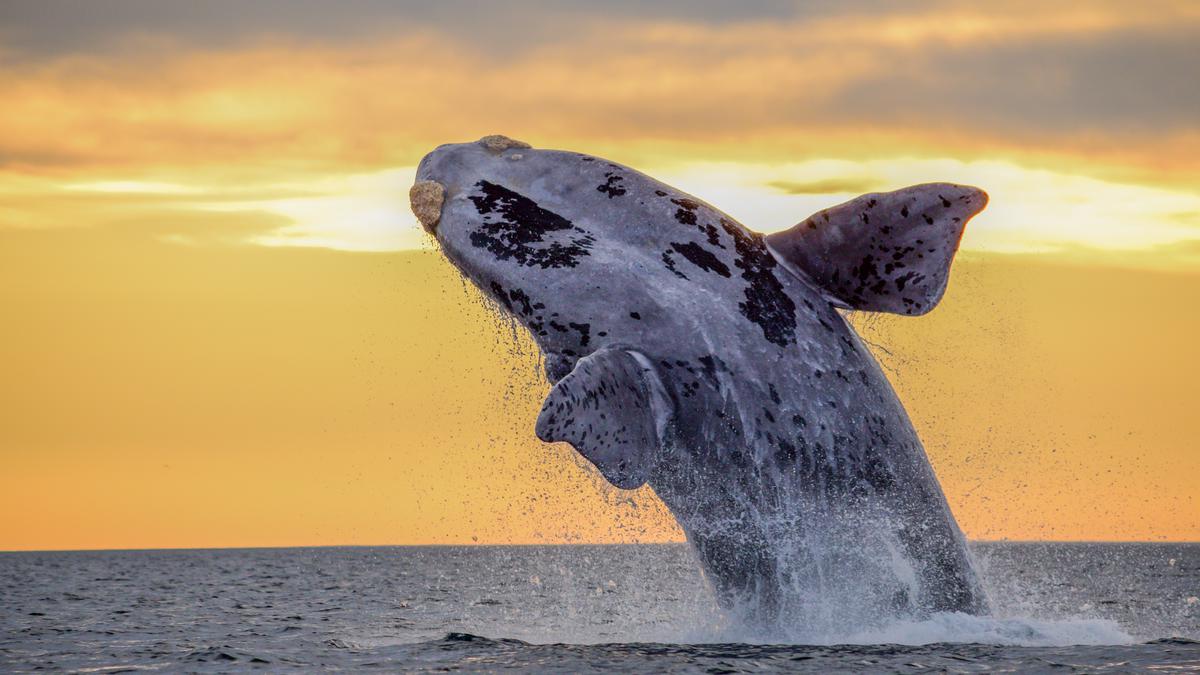
It sounds like a crime show episode at sea: In late January 2024, federal regulators learned that a dead female North Atlantic right whale had been sighted near Martha’s Vineyard, Massachusetts. The whale was towed to shore, where more than 20 U.S. and Canadian scientists converged to perform a necropsy, or animal autopsy.
On February 14, the U.S. National Oceanic and Atmospheric Administration announced that the whale was #5120 in a catalogue that tracks individual right whales. Further, the agency said, rope that had been deeply embedded in the whale’s tail had likely come from lobster fishing gear in Maine.
Entanglement in fishing gear is a deadly threat to these critically endangered animals. Scientists estimate that before commercial whaling scaled up in the 18th and 19th centuries, there may have been as many as 10,000 North Atlantic right whales. Today, fewer than 360 individuals remain. Almost 90% of them have been entangled at least once.
When whales become entangled in fishing gear, they use extra energy dragging it as they swim. If the rope is caught around their mouths, they may struggle to feed and slowly starve. Ropes wrapped around whales’ bodies, flippers or tails can cut into the animals’ skin and become deeply embedded in their flesh, as happened to whale #5120. This can cause infections, chronic emaciation and damage to whales’ blubber, muscle, bone and baleen – the bristly structures in their mouths that they use to filter prey from the water.
North Atlantic right whales are legally protected, both internationally and in U.S. waters, including policies that seek to reduce deaths or serious injuries resulting from entanglements. However, even when entanglement does not kill a whale, it can affect individuals’ ability to reproduce, which is critically important for a species with such low numbers.
In a newly published study, we show that even entanglements scientists classify as “minor” have devastating impacts on female right whales and that, surprisingly, potential mothers who suffer “minor” entanglements have the lowest chance of starting to breed. As researchers with expertise in marine biology, ecology and statistics, we believe our findings underline the urgent need for ropeless fishing gear that can reduce threats to the survival of this species.
Smaller females having fewer young
Understanding reproductive patterns is essential for supporting species that are critically endangered. North Atlantic right whales historically started breeding by around 9 years of age and gave birth to a single calf every three to four years thereafter for several decades.
Today, however, many females have yet to reproduce at all. Moreover, those that have successfully produced calves now don’t produce another calf for more than seven years on average.
As we showed in a 2022 study, after an encouraging North Atlantic right whale population recovery from the 1970s through the early 2000s, the number of reproductively mature female right whales declined from 2014 onward. By 2018 there were only about 73 breeding females left, representing roughly half of all females and a sixth of the entire species.
Other research has shown that poor health and physical condition are making it harder for these females to even start breeding. Since the early 1980s, North Atlantic right whales have literally shrunk: Adults have shorter bodies than they did several decades ago. This trend is associated with entanglements in fishing gear. As is true for all mammals, decreasing female body size reduces the likelihood of reproducing. Smaller whales have fewer calves.
Low calving rates are a significant factor in North Atlantic right whales’ decline, so it is important to understand what causes them. Many organisations are involved in tracking North Atlantic right whales, including government agencies, aquariums and conservation groups. Photos taken from the air enable researchers to identify individuals and so monitor whale population trends, births and deaths, ocean habitat use patterns, health, and rates of scarring from entanglements and collisions with ships.
Our new study found that female right whales who have experienced even a minor entanglement before reaching sexual maturity may not ever start to breed. Even females who have previously reproduced are less likely to breed again following an entanglement event.
We determined this by using a mathematical model to incorporate information on the identity of individual whales, derived from photographs of natural markings known as callosities on the whales’ heads. By identifying and photographing whales repeatedly over time, scientists can estimate different stages of their life, such as when females give birth.
Weakness of current regulations
Researchers categorise the severity of injuries that result from entanglements as minor, moderate or severe. The scientists who manage the right whale catalogue classify scars or injuries on the skin as minor if they are smaller than 2 cm without entering the blubber. If they are larger and enter the blubber, they are classified as moderate. Injuries that extend deep into the muscle or bone are categorised as severe.
Our research makes it clear that such value-laden terms are potentially misleading because even minor entanglements can threaten whales’ successful reproduction.
Multiple laws ostensibly protect North Atlantic right whales, including the U.S. Endangered Species Act and Marine Mammal Protection Act, and Canada’s Species at Risk Act. In our view, these measures do not give enough weight to preventing all types of entanglements, regardless of severity.
Under the Marine Mammal Protection Act, the NOAA develops and implements conservation plans and so-called Take Reduction Plans, which are designed to minimise wildlife deaths and serious injury resulting from commercial fishing gear.
The Atlantic Large Whale Take Reduction Plan, developed in 1997, requires fishers to use weak links, with a maximum breaking strength of 771 kg, to connect lobster and crab pots to buoys on the surface. These links are intended to break when whales swim into them, so that the whales do not become entangled and weighed down by ropes and traps.
The plan also requires fishers to use heavy ground lines to connect multiple traps or pots. These lines are designed to sink to the bottom rather than floating in the water column. And the plan closes trap fishing areas seasonally when whales are known to be present in those zones.
Coming back from the brink
Current population estimates suggest that the numbers of North Atlantic right whales could be stabilising, meaning that the number of deaths is approximately equal to the number being born. While these estimates seem promising, females need to start and continue producing calves to increase whales’ numbers.
From our work, it is very clear that both lethal and sublethal impacts of entanglements are of grave concern for these whales. As we see it, eliminating entanglement, not mitigating it, is the only way to avoid the extinction of this species. Every entanglement, whatever its severity, is bad news for the whales.
(Joshua Reed is a research associate in biology, Macquarie University; Leslie New is an assistant professor of statistics, Ursinus College; Peter Corkeron is an adjunct senior research fellow, Centre for Planetary Health and Food Security, Griffith University; and Rob Harcourt is a professor of marine ecology, Macquarie University. This article is republished from The Conversation.)