
Skip to content
  • Facebook
  • X
  • Linkedin
  • WhatsApp
  • YouTube
  • Associate Journalism
  • About Us
  • Privacy Policy
  • 033-46046046
  • editor@artifex.news
Artifex.News

Artifex.News

Stay Connected. Stay Informed.

  • Breaking News
  • World
  • Nation
  • Sports
  • Business
  • Science
  • Entertainment
  • Lifestyle
  • Toggle search form
  • Access Denied
    Access Denied Nation
  • Access Denied Sports
  • Fresh Lookout Notice For Deve Gowda’s Grandson As Sex Scandal Row Deepens
    Fresh Lookout Notice For Deve Gowda’s Grandson As Sex Scandal Row Deepens Nation
  • Access Denied Business
  • How ISRO Will Dock Two Satellites In Space
    How ISRO Will Dock Two Satellites In Space Nation
  • House passes immigrant detention bill that would be Trump’s first law to sign
    House passes immigrant detention bill that would be Trump’s first law to sign World
  • Alexis Carrel’s Nobel-winning work in vascular repair and transplantation
    Alexis Carrel’s Nobel-winning work in vascular repair and transplantation Science
  • Donald Trump’s 4 million civil fraud judgment fine slashed to 5M by New York appeals court
    Donald Trump’s $454 million civil fraud judgment fine slashed to $175M by New York appeals court World
How can India benefit from neurotechnology? | Explained

How can India benefit from neurotechnology? | Explained

Posted on December 9, 2025 By admin


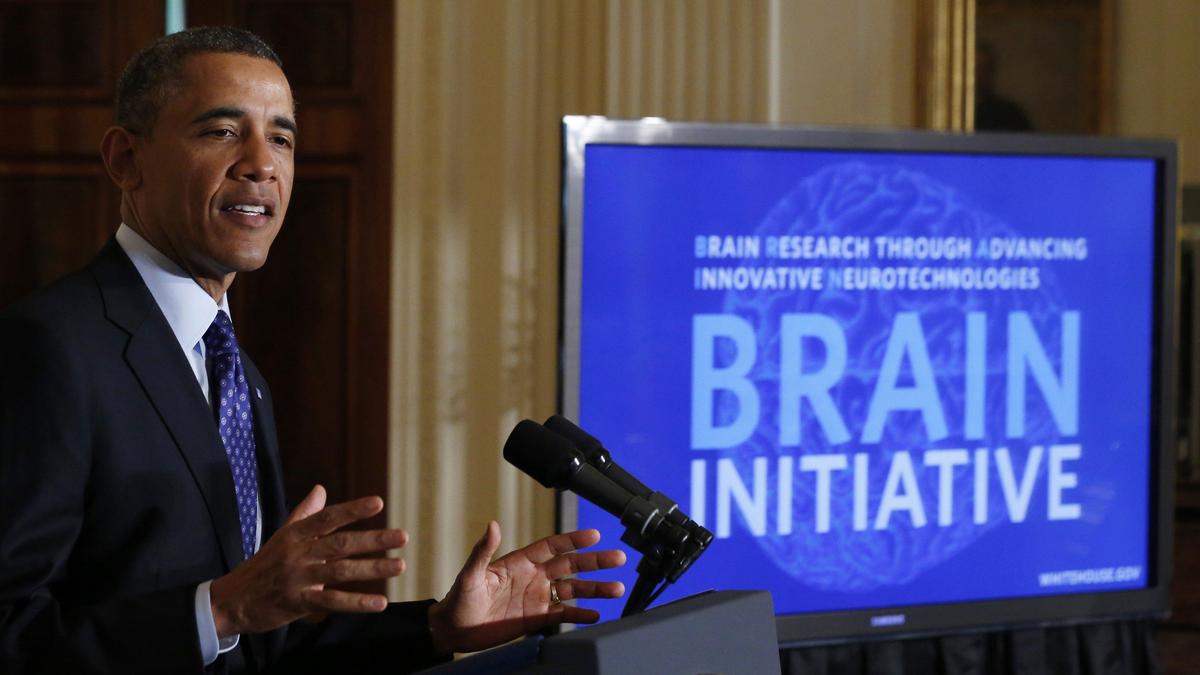
Former U.S. President Barack Obama announces the Brain Research through Advancing Innovative Neurotechnologies (BRAIN) Initiative at the White House in Washington on April 2, 2013.
| Photo Credit: REUTERS

The story so far:

The brain remains humanity’s final frontier. In the decades ahead, neurotechnology will stretch the boundaries of what it means to understand, and even shape, the functioning of the human brain. 

What is neurotechnology?

Neurotechnology is the use of mechanical tools to talk directly to the brain. It includes systems that can record, monitor, or even influence neural activity, opening up new ways to understand how the mind works and, consequently, how it might be repaired or enhanced. Drawing on advances in neuroscience, AI, engineering, and computing, these devices can now sense or stimulate brain signals in real time. At the heart of this revolution is the Brain-Computer Interface (BCI), a technology that blends neuroscience and computing to translate thoughts into action. BCIs can turn brain signals into digital commands that control a computer cursor, a wheelchair, or even a robotic arm. Some systems rely on non-invasive sensors, such as EEG headsets; others use implanted electrodes for more precise control.

A BCI essentially listens to the brain, decodes its signals, and can turn them into instructions for a prosthetic to follow. Some devices are purely diagnostic, helping scientists study brain disorders or cognitive function. Others go further, allowing paralysed patients to move prosthetic limbs, or stimulating certain brain regions to treat depression or Parkinson’s disease.

In labs, researchers have even managed to connect the brains of two mice, transmitting simple information from one to the other. But human applications remain mostly therapeutic for now, focused on rehabilitation, neuroprosthetics, and mental health. The idea of using such interfaces for human enhancement or military advantage is technically likely but will need fierce ethical debate before its use.

Why does India need it?

India carries a significant neurological disease burden, from strokes and spinal cord injuries to Parkinson’s disease and depression. Between 1990 and 2019, the share of non-communicable and injury-related neurological disorders in India’s overall disease load rose steadily, with stroke emerging as the largest contributor. For those living with paralysis, neuroprosthetics could restore mobility and communication. For mental health patients, targeted neural stimulation offers the possibility of reducing long-term dependence on medication. But the opportunity extends far beyond healthcare. Neurotechnology sits at the intersection of biotechnology, engineering, and AI, sectors where India is rapidly developing global competence. 

Where does India stand today?

India is creating academic and private sector strengths in neurotechnologies. IIT Kanpur researchers recently unveiled a BCI-based robotic hand that could be useful for stroke patients. The National Brain Research Centre in Manesar, and the Brain Research Centre at IISc, Bangalore are leading research centres for neuroscience. Dognosis, a startup, is using neurotechnology to study brain signals in dogs, aiming to detect the neural patterns that occur when they recognise the scent of cancer in human breath samples. This is an application of neurotechnology used in animals but with the potential to revolutionise cancer screening in humans.

What are other countries doing?

The U.S. is the global leader in neurotechnologies. The NIH’s Brain Research Through Advancing Innovative Neurotechnologies® Initiative, or The BRAIN Initiative®, is a partnership between federal and non-federal partners to accelerate the development of innovative neurotechnologies. In May 2024, Neuralink received approval from the Food and Drug Administration for in-human trials of its BCI and has already demonstrated the ability of its BCIs to restore some prosthetic-enabled motor function in paralytic patients. The China Brain Project (2016-2030) focuses on understanding cognition, developing brain-inspired AI, and treating neurological disorders. EU and Chile are pioneering laws for BCIs and neurorights.

Neurotechnologies are a set of emerging technologies with a wide set of applications in healthcare to gaming to recreation. These are important for India not only from a mental health perspective but also as an economic opportunity. Given the nascency of the field, there is much progress to be made and India’s genomic diversity, available expertise and increasing awareness about brain research positions India as a potential hub for its development.

However, if there is inadequate regulatory support, BCI development and adoption will be thwarted. A public engagement strategy to discuss the benefits and risks of BCIs would help in understanding public perception of these technologies. Instead of a singular policy for all BCIs, tailored regulatory pathways for the different types of BCIs based on their benefits and risks would help development of beneficial BCIs in the Indian context. A regulatory pathway that assesses BCI on technical and ethical aspects, including ensuring data privacy and user autonomy is of utmost need.

The author is chairperson, Takshashila Institution’s Health & Life Sciences Policy. 

Published – December 09, 2025 08:30 am IST


Source link

Science

Post navigation

Previous Post: Govt to curtail IndiGo’s winter flight schedule, slots to be reallocated to other carriers: Aviation Minister
Next Post: On zoos and magnets: the physics behind sounds

Related Posts

  • Antibiotics can leave a long-term footprint on our gut microbiome: study
    Antibiotics can leave a long-term footprint on our gut microbiome: study Science
  • UTIs, tooth decay: how common infections may be fast-tracking dementia
    UTIs, tooth decay: how common infections may be fast-tracking dementia Science
  • Are antibiotics responsible for inflammatory bowel diseases?
    Are antibiotics responsible for inflammatory bowel diseases? Science
  • Fossils suggest even smaller ‘hobbits’ roamed an Indonesian island 700,000 years ago
    Fossils suggest even smaller ‘hobbits’ roamed an Indonesian island 700,000 years ago Science
  • The Science Quiz: The evolutionary edge to human survival
    The Science Quiz: The evolutionary edge to human survival Science
  • When for-profit companies fund research, how is science affected?
    When for-profit companies fund research, how is science affected? Science

More Related Articles

How will Gaganyaan astronauts return safely to earth? | Explained How will Gaganyaan astronauts return safely to earth? | Explained Science
Need to tell AI-made deepfakes from real pics? Call astronomers Need to tell AI-made deepfakes from real pics? Call astronomers Science
Parched Philippine dam reveals centuries-old town, luring tourists Parched Philippine dam reveals centuries-old town, luring tourists Science
India’s mission to drill a 6-km deep hole in Koyna, Maharashtra | Explained India’s mission to drill a 6-km deep hole in Koyna, Maharashtra | Explained Science
Bird flu strain raises alarm as virus kills South American wildlife Bird flu strain raises alarm as virus kills South American wildlife Science
Sci-Five | The Hindu Science Quiz: On Frogs Sci-Five | The Hindu Science Quiz: On Frogs Science
SiteLock

Archives

  • May 2026
  • April 2026
  • March 2026
  • February 2026
  • January 2026
  • December 2025
  • November 2025
  • October 2025
  • September 2025
  • August 2025
  • July 2025
  • June 2025
  • May 2025
  • April 2025
  • March 2025
  • February 2025
  • January 2025
  • December 2024
  • November 2024
  • October 2024
  • September 2024
  • August 2024
  • July 2024
  • June 2024
  • May 2024
  • April 2024
  • March 2024
  • February 2024
  • January 2024
  • December 2023
  • November 2023
  • October 2023
  • September 2023
  • August 2023
  • July 2023
  • June 2023
  • May 2023
  • April 2023
  • March 2023
  • February 2023
  • January 2023
  • December 2022
  • November 2022
  • October 2022
  • September 2022
  • August 2022
  • July 2022
  • June 2022
  • May 2022

Categories

  • Business
  • Nation
  • Science
  • Sports
  • World

Recent Posts

  • France allows asymptomatic passengers off new cruise ship struck by stomach bug outbreak
  • Sensex jumps nearly 790 points on buying in telecom, banking shares
  • V.D. Satheesan calls on A.K. Antony
  • BEST conductor dies in accident involving four buses in Mumbai
  • U.K. Health Minister Wes Streeting resigns

Recent Comments

  1. JamesHeR on UP Teacher Who Asked Students To Slap Muslim Classmate
  2. RafaelNar on UP Teacher Who Asked Students To Slap Muslim Classmate
  3. CarlosExorb on UP Teacher Who Asked Students To Slap Muslim Classmate
  4. Robertfloup on UP Teacher Who Asked Students To Slap Muslim Classmate
  5. Davidcag on UP Teacher Who Asked Students To Slap Muslim Classmate
  • Access Denied
    Access Denied Nation
  • Botswana votes with ruling party aiming to extend six decades of power
    Botswana votes with ruling party aiming to extend six decades of power World
  • Rupee falls 9 paise to 88.77 against U.S. dollar in early trade
    Rupee falls 9 paise to 88.77 against U.S. dollar in early trade Business
  • India’s aviation market growth needs to be matched with capacity; open for partnerships: Emirates CCO
    India’s aviation market growth needs to be matched with capacity; open for partnerships: Emirates CCO Business
  • Access Denied
    Access Denied Nation
  • Rajya Sabha And Lok Sabha Members Gather Outside Old Parliament Building For Group Photograph
    Rajya Sabha And Lok Sabha Members Gather Outside Old Parliament Building For Group Photograph Nation
  • Israel-Iran war LIVE: Trump says King Charles does not want Iran to have nuclear weapon
    Israel-Iran war LIVE: Trump says King Charles does not want Iran to have nuclear weapon World
  • Access Denied
    Access Denied Nation

Editor-in-Chief:
Mohammad Ariff,
MSW, MAJMC, BSW, DTL, CTS, CNM, CCR, CAL, RSL, ASOC.
editor@artifex.news

Associate Editors:
1. Zenellis R. Tuba,
zenelis@artifex.news
2. Haris Daniyel
daniyel@artifex.news

Photograher:
Rohan Das
rohan@artifex.news

Artifex.News offers Online Paid Internships to college students from India and Abroad. Interns will get a PRESS CARD and other online offers.
Send your CV (Subjectline: Paid Internship) to internship@artifex.news

Links:
Associate Journalism
About Us
Privacy Policy

News Links:
Breaking News
World
Nation
Sports
Business
Entertainment
Lifestyle

Registered Office:
72/A, Elliot Road, Kolkata - 700016
Tel: 033-22277777, 033-22172217
Email: office@artifex.news

Editorial Office / News Desk:
No. 13, Mezzanine Floor, Esplanade Metro Rail Station,
12 J. L. Nehru Road, Kolkata - 700069.
(Entry from Gate No. 5)
Tel: 033-46011099, 033-46046046
Email: editor@artifex.news

Copyright © 2023 Artifex.News Newsportal designed by Artifex Infotech.