





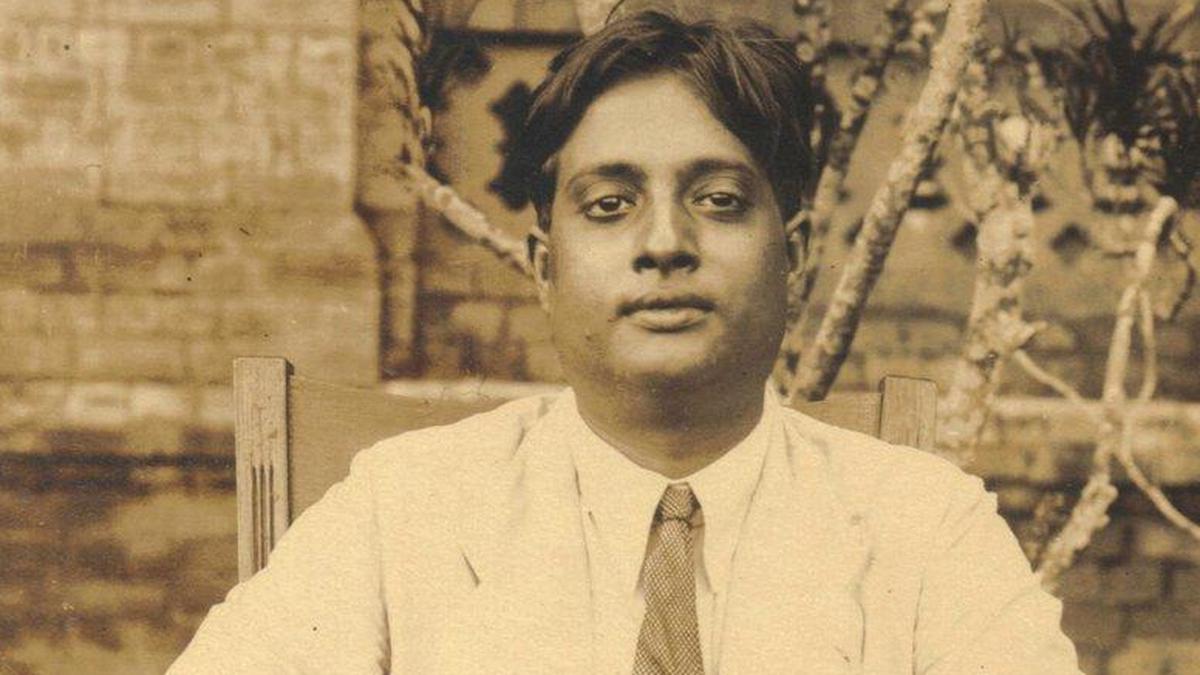
Satyendra Nath Bose appeared on the physics scene like a comet.
The year was 1924. Physics was in the middle of the biggest upheaval in its history. The old foundations had crumbled in the face of new data. The picture of a new ‘quantum theory’ was emerging. But it was a fractured, disjointed picture with major pieces missing.
The search was on among physicists to find the pieces and complete the jigsaw. In the best universities of Europe, new ideas were being proposed, debated, and discarded every week. Then a lecturer of physics from Dhaka University — located then in the backwater of backwaters — appeared out of nowhere with a major missing piece of the puzzle.
The lecturer, Satyendra Nath Bose, had discovered the correct set of equations to use to work out the behaviour of collections of photons (particles of light). As physics work goes, Bose’s was as fundamental as it got. The physicist and writer Abraham Pais listed it as one of the six foundational papers of quantum theory. Few would disagree.
Even so, a paper from an unknown Indian scientist was initially rejected by a journal. Bose then mailed the paper to his favourite physicist, Albert Einstein, hoping to secure the giant’s support. Einstein loved the paper, translated it to German, and sent it to a journal himself.
This year marks 100 years of Bose’s discovery.
Bose and Saha
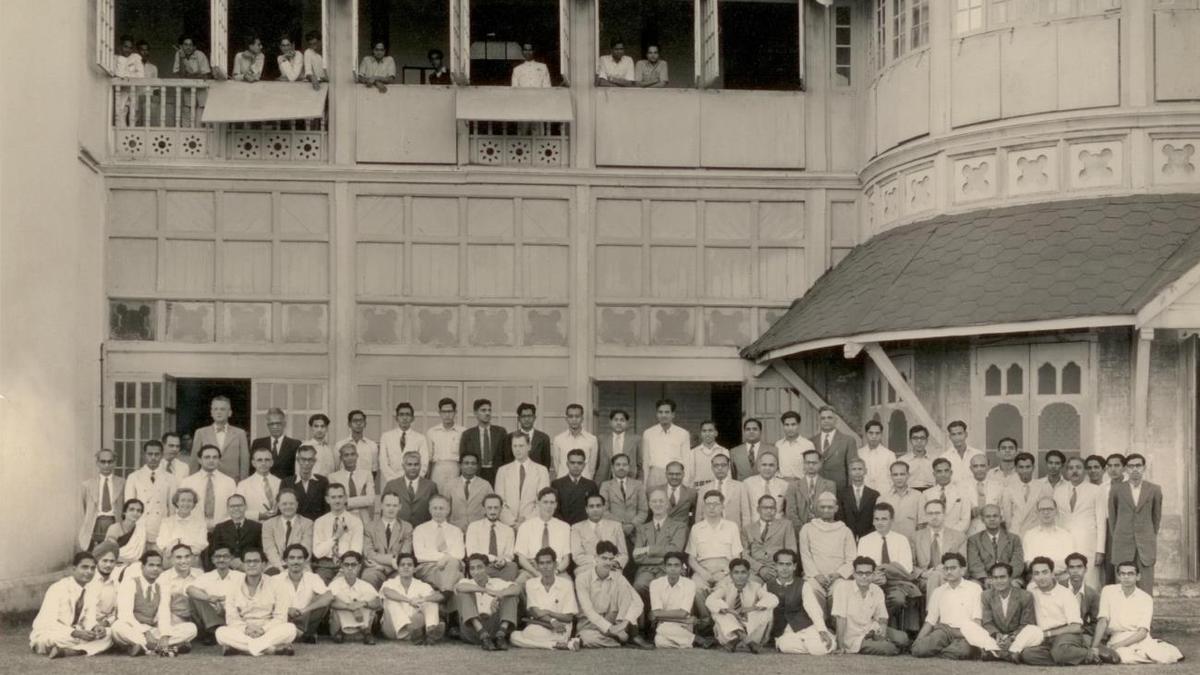
Bose was born in Calcutta (now Kolkata) in 1894. His mathematical prowess had been noted by his teachers early on. After completing his schooling, he joined Presidency College to study physics. This is where he met and befriended another brilliant young man, Meghnad Saha. The two would remain lifelong friends.
A few years on, both were appointed faculty members in the newly founded Rajabazar Science College.
Physics was changing rapidly at the time. Einstein had reset the understanding of space and time with his theory of relativity. The work of Max Planck, Niels Bohr and, again, Einstein had shown that the old physics was incapable of dealing with the microscopic world — the world inside atoms.
Bose and Saha were tasked with teaching the new physics to their students. The job was made more challenging by the fact that all the important papers at the time were in German. But neither the challenge of learning a new language nor the conceptual novelty of the emerging concepts proved a roadblock for the two young physicists.
While physicists around the world were grappling with the new concepts, Saha and Bose became early adapters. Together they published the first English translation of Einstein’s papers on general relativity. Saha was one of the first people to start finding applications of the developing quantum theory to molecular physics. Bose was less prolific, but he immersed himself in the study of the fundamental papers in quantum theory.
Bose’s next job was as a lecturer in the recently established Dhaka University. Among the topics he had to teach was Planck’s law of black-body radiation. Bose found he could not explain it to his students to his satisfaction.
Planck’s law was the first discovered piece of the quantum puzzle. It agreed perfectly with experiments, but no one could fully explain where it came from. Saha, visiting his friend in Dhaka, introduced Bose to the latest attempts at deriving Planck’s law. Bose found none of them fully satisfactory and decided to have a go himself.
Planck’s law
Planck’s law, named for its discoverer Max Planck, who found it in 1900, describes the pattern that told physicists physics worked differently in the microscopic. It is also probably the most successful guess in the history of physics.
Planck’s law is about radiation. All hot objects — from a bowl of hot soup to the Sun — emit radiation in a range of frequencies. Physicists typically simplify them to an ideal: as objects that can emit light but not reflect it, a.k.a. black bodies.
The study of black-body radiation was a hot topic of 19th century physics. The key question was how the radiated energy is distributed among the different frequencies. Theoretical predictions on this matched experimental results only for a certain range of frequencies.
Planck looked closely at the data and simply guessed the right formula. It worked like magic. The only problem: it violated the rules of physics.
Planck’s formula was incompatible with the known laws of physics. Specifically, it required energy to be fundamentally discrete. Just like matter is a collection of discrete atoms, energy too had to be a collection of discrete packets or ‘quanta’. This idea was the birthplace of quantum mechanics.
But even physicists who accepted Planck’s radical hypothesis about quantised energy pointed out that his derivation was incorrect. Planck’s use of statistical methods did not stand up to scrutiny.
Planck’s law was correct, but its derivation was not. It had to wait until Bose.
Bose’s derivation
By the time Bose took up the problem, more results on quantum theory had appeared even as the rules remained unclear. Einstein had explained the photoelectric effect using the hypothesis that light carries energies in packets. The American physicist Arthur Compton had demonstrated that light carries discrete units of momentum, too.
There had also been several attempts at deriving Planck’s law in the interim. To Bose, all of them suffered from the same conceptual issue. They used results from both quantum physics and pre-quantum (or classical) physics. This was not logically consistent.
Planck’s own original derivation, for example, was based on a model of the black body, specifically of the mechanism by which it produces radiation. It was through this model that classical physics had entered the story.
Bose showed all of this was unnecessary. Planck’s law was independent of the mechanism that produced it. By making clever use of the results of Einstein and Compton, Bose eliminated classical physics from the picture, and stripped the problem to its essence: finding the most probable way of distributing energy among quanta of radiation. Bose showed that the most probable way translated to Planck’s formula.
Planck’s law was therefore simply a statistical property of the quanta of radiation, a.k.a. photons.
This was Bose’s major result. But there were crucial results implicit in his methods, some of which might not have been apparent to Bose himself. The most important is that the total number of photons is not conserved — photons could appear out of thin air and disappear into nothingness.
Bose’s paper pioneered the field of quantum statistics.
A few years later, when the rules of quantum theory were finally clear, the British physicist Paul Dirac obtained Bose’s statistics from them. That is, he showed that fundamental particles can be in one of two categories depending on their statistics (i.e. the set of rules to describe them properly): bosons or fermions.
Despite a long career in physics, Bose published sparsely and never produced another work of similar value. He once described himself as a comet that only came once and never returned.
For a comet as bright, though, once can be quite enough.
Nirmalya Kajuri is an assistant professor of physics in IIT Mandi.