




Skip to content
  • Facebook
  • X
  • Linkedin
  • WhatsApp
  • YouTube
  • Associate Journalism
  • About Us
  • Privacy Policy
  • 033-46046046
  • editor@artifex.news
Artifex.News

Artifex.News

Stay Connected. Stay Informed.

  • Breaking News
  • World
  • Nation
  • Sports
  • Business
  • Science
  • Entertainment
  • Lifestyle
  • Toggle search form
  • Access Denied
    Access Denied Nation
  • Ajit Pawar’s Wife Sunetra Takes Oath As Maharashtra’s First Woman Deputy Chief Minister Business
  • Tamil Nadu Forest Department Uses AI To Track Elephant Movements
    Tamil Nadu Forest Department Uses AI To Track Elephant Movements Nation
  • “Gautam Gambhir Should Be Saying…”: Sunil Gavaskar Drops ‘Domestic Cricket’ Bombshell
    “Gautam Gambhir Should Be Saying…”: Sunil Gavaskar Drops ‘Domestic Cricket’ Bombshell Sports
  • Injured Lionel Messi Ruled Out Of Argentina World Cup Qualifiers
    Injured Lionel Messi Ruled Out Of Argentina World Cup Qualifiers Sports
  • Coffee prices soar, but 15% loss in yield expected due to vagaries of weather
    Coffee prices soar, but 15% loss in yield expected due to vagaries of weather Business
  • ISRO will take all precautions before manned Gaganyaan mission: Somanath
    ISRO will take all precautions before manned Gaganyaan mission: Somanath Science
  • Access Denied Sports
Attophysics — new tools to fathom the world of electrons | Explained

Attophysics — new tools to fathom the world of electrons | Explained

Posted on October 7, 2023 By admin


The story so far: On October 3, the 2023 Nobel Prize for physics was awarded to Anne L’Huillier, Pierre Agostini, and Ferenc Krausz “for experimental methods that generate attosecond pulses of light for the study of electron dynamics in matter”.

What is an attosecond?

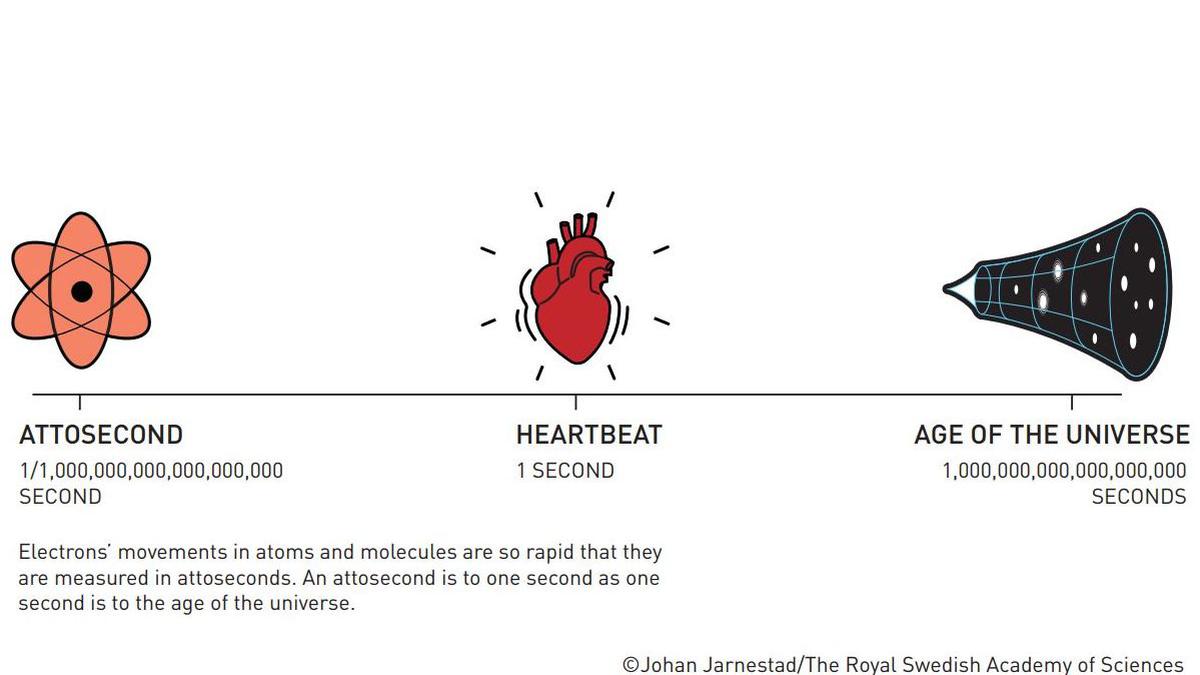
An attosecond is one quintillionth of a second, or 10^-18 seconds. This is the timescale at which the properties of an electron change. So, to truly understand electrons, it should be possible to study them at these timescales. This is what the work of the Nobel laureates made possible.

What is attosecond science?

Attosecond science, including attosecond physics, or attophysics, deals with the production of extremely short light pulses and using them to study superfast processes. A hummingbird’s wings beat 80 times a second, so a single beat would last 1/80th of a second. At its best, the human eye can see up to 60 frames per second, which is not good enough to see a single wingbeat as it happens. Instead, the wings’ motion would appear as a blur.


Editorial | Let there be light: On the 2023 physics Nobel

One solution is to use a digital camera that creates photographs by capturing light coming from a source using a sensor. To capture a single wingbeat, the camera needs to capture only just as much light — which it can do if its aperture is open for exactly 1/80th of a second. An alternative is to keep the aperture open at all times and release a light pulse whose duration is 1/80th of a second towards the wing and capture the reflection. The former is much easier to do with a digital camera, but when you’re studying electrons, the latter is a better option. In attosecond science, the light pulse’s duration is a few hundred attoseconds because the electrons’ ‘wingbeats’ happen that rapidly.

What is the physics of producing an attosecond pulse? 

The concepts underlying the production of attosecond pulses come from wave mechanics. In 1988, Anne L’Huillier and her colleagues in Paris passed a beam of infrared light through a noble gas. They found that the gas emitted light whose frequency was a high multiple of the beam’s frequency — for example, if the beam frequency was 10 arbitrary units, the emitted light had frequencies of 50 units, 60 units, 70 units, etc. This phenomenon is called high-harmonic generation, and the emitted waves are said to be overtones of the original. The researchers also found that as they increased the frequency of the original beam, the intensity of the emitted light dropped sharply, then stayed constant for a range, and then dropped again.

By 1994, researchers had worked out why passing the infrared beam through the noble gas was having these effects. A beam of light consists of oscillating electric and magnetic fields. ‘Oscillating’ means that at a given point, the field’s strength alternately increases and decreases. So an electron at this point would be imparted some energy and then have it taken away; when energy is imparted, the electron would come loose from an atom, and when it is taken away, the electron and the atom would recombine, releasing some excess energy. This energy is the light re-emitted by the gas.

The researchers also found a way to describe this process using the equations of quantum mechanics. These equations also explained why the intensity of the re-emitted light plateaued as the beam frequency was increased.

How is an attosecond pulse produced?

When the infrared beam strikes the noble gas atoms, it produces multiple overtones. If the peak of one overtone merges with the peak of another, they undergo constructive interference (like in the double-slit experiment) and produce a larger peak. When the peak of one overtone merges with the trough of another, however, they undergo destructive interference, ‘cancelling’ themselves out.

By combining a large number of overtones in this way, physicists could fine-tune a setup to produce light pulses for a few hundred attoseconds — due to constructive interference — and then stop, due to destructive interference. These pulses are produced only when the beam’s frequency is within the plateau range.

How do we know a pulse lasts for an attosecond?

A major technique to measure the duration of a short light pulse is called RABBIT — and Pierre Agostini and his colleagues at a facility in Paris developed it in 1994. Here, the attosecond pulse and another pulse of a longer duration are shined on atoms of a noble gas. Due to the photoelectric effect, the photons in the two pulses kick out electrons from the atoms. Physicists harvest data about these electrons and the atoms. Information about the pulse’s properties — including its duration — can be mathematically extracted by analysing this data. The principles of producing and then measuring attosecond pulses were finally in place.

It was only in 2001 that Agostini et al., in Paris, and Ferenc Krausz et al. in Vienna were able to produce verified attosecond pulses in a ‘train’: a pulse followed by a gap, followed by a pulse, and so forth. The pulse duration in the former case was 250 as. In the latter, the Krausz group produced a pulse train with a pulse duration of 650 as, and using a filtering technique was also able to isolate a single pulse, a bullet of light.

After these achievements, all three groups, and other physicists, kept refining these techniques so that, by 2017, experts were able to produce a pulse as short as 43 attoseconds.

What are the applications of attophysics?

The devices used to produce attosecond pulses cost crores of rupees, great skill to operate, and are bulky. But miniaturisation has been an important form of technological progress in the last century and, someday, we may have pocket-sized gizmos to study electrons. The important thing is we know how to achieve it. Science has had its own variety of miniaturisation — microbiology, femtochemistry, attophysics — facilitated by devices that could see smaller and smaller things.

Microbiology alerted us to bacteria and femtochemistry allowed us to finely manipulate chemical reactions. In 2010, a team led by Dr. Krausz used attophysics to find that electrons leaving two slightly different energy levels in a neon atom, due to the photoelectric effect, don’t do so simultaneously, as was once thought. Instead, there is a 21-attosecond delay. The photoelectric effect is at the heart of solar power, and by refining our theoretical understanding of it based on studies like this, we could gain big. This motif extends to most parts of physics, chemistry, and biology — everywhere the properties of electrons matter.




Source link

Science Tags:2023 Physics Nobel, Attophysics, Attoseconds, Electrons movement, The Hindu explains

Post navigation

Previous Post: Significance of quantum dots in nanotechnology | Explained
Next Post: Magnitude 4.3 Earthquake Hits Andaman Sea

Related Posts

  • Cyclone Fengal: What is landfall?
    Cyclone Fengal: What is landfall? Science
  • SpaceX loses contact with Starlink satellite after mishap
    SpaceX loses contact with Starlink satellite after mishap Science
  • Panic in the time of cholera: addressing issues critical to managing a resurgence 
    Panic in the time of cholera: addressing issues critical to managing a resurgence  Science
  • Indian Immunologicals rolls out India’s first gE deleted DIVA marker vaccine against IBR
    Indian Immunologicals rolls out India’s first gE deleted DIVA marker vaccine against IBR Science
  • The biological magic of shared laughter
    The biological magic of shared laughter Science
  • Earth Observation Satellite EOS-08 slated for launch: ISRO
    Earth Observation Satellite EOS-08 slated for launch: ISRO Science

More Related Articles

Hidden craters suggest earth once had a Saturn-like ring Hidden craters suggest earth once had a Saturn-like ring Science
The eyes and ears of Pragyan that help rover find its way on moon The eyes and ears of Pragyan that help rover find its way on moon Science
Satellite data show India’s major deltas sinking due to human activity Satellite data show India’s major deltas sinking due to human activity Science
Hotter Kalahari desert may stop hornbills breeding by 2027 Hotter Kalahari desert may stop hornbills breeding by 2027 Science
Plankton balloon to six times their size to reach ocean surface Plankton balloon to six times their size to reach ocean surface Science
Sci-Five | The Hindu Science Quiz: On Autism Sci-Five | The Hindu Science Quiz: On Autism Science
SiteLock

Archives

  • May 2026
  • April 2026
  • March 2026
  • February 2026
  • January 2026
  • December 2025
  • November 2025
  • October 2025
  • September 2025
  • August 2025
  • July 2025
  • June 2025
  • May 2025
  • April 2025
  • March 2025
  • February 2025
  • January 2025
  • December 2024
  • November 2024
  • October 2024
  • September 2024
  • August 2024
  • July 2024
  • June 2024
  • May 2024
  • April 2024
  • March 2024
  • February 2024
  • January 2024
  • December 2023
  • November 2023
  • October 2023
  • September 2023
  • August 2023
  • July 2023
  • June 2023
  • May 2023
  • April 2023
  • March 2023
  • February 2023
  • January 2023
  • December 2022
  • November 2022
  • October 2022
  • September 2022
  • August 2022
  • July 2022
  • June 2022
  • May 2022

Categories

  • Business
  • Nation
  • Science
  • Sports
  • World

Recent Posts

  • Trump’s proposed ‘Golden Dome’ estimated to cost $1.2 trillion, far more than he initially said
  • Iran-Israel war LIVE: Trump says stopping Iran's nuclear program outweighs Americans' economic pain
  • 10 rescued after a small plane crashes off the Florida coast
  • Rangasamy to be sworn-in as CM today
  • Diplomacy and sustainability- dialogues for the future

Recent Comments

  1. JeffryFok on UP Teacher Who Asked Students To Slap Muslim Classmate
  2. StanleyPeapy on UP Teacher Who Asked Students To Slap Muslim Classmate
  3. RonaldLam on UP Teacher Who Asked Students To Slap Muslim Classmate
  4. RaymondKiree on UP Teacher Who Asked Students To Slap Muslim Classmate
  5. Lavernedrums on UP Teacher Who Asked Students To Slap Muslim Classmate
  • 48% of NSE firms have no women as key managers; women losing out on higher paid jobs: study
    48% of NSE firms have no women as key managers; women losing out on higher paid jobs: study Business
  • Access Denied Business
  • Access Denied Sports
  • Spain’s 16-year-old Lamine Yamal becomes youngest-ever scorer at Euros with stunner against France in semifinal
    Spain’s 16-year-old Lamine Yamal becomes youngest-ever scorer at Euros with stunner against France in semifinal Sports
  • Himachal Pradesh Announces 180-Day Maternity Leave For Home Guards
    Himachal Pradesh Announces 180-Day Maternity Leave For Home Guards Nation
  • Access Denied Sports
  • Access Denied
    Access Denied Nation
  • Lok Sabha Elections 2024: Encourage People From Manipur Living Outside To Vote In State: Delhi Meitei Forum
    Lok Sabha Elections 2024: Encourage People From Manipur Living Outside To Vote In State: Delhi Meitei Forum Nation

Editor-in-Chief:
Mohammad Ariff,
MSW, MAJMC, BSW, DTL, CTS, CNM, CCR, CAL, RSL, ASOC.
editor@artifex.news

Associate Editors:
1. Zenellis R. Tuba,
zenelis@artifex.news
2. Haris Daniyel
daniyel@artifex.news

Photograher:
Rohan Das
rohan@artifex.news

Artifex.News offers Online Paid Internships to college students from India and Abroad. Interns will get a PRESS CARD and other online offers.
Send your CV (Subjectline: Paid Internship) to internship@artifex.news

Links:
Associate Journalism
About Us
Privacy Policy

News Links:
Breaking News
World
Nation
Sports
Business
Entertainment
Lifestyle

Registered Office:
72/A, Elliot Road, Kolkata - 700016
Tel: 033-22277777, 033-22172217
Email: office@artifex.news

Editorial Office / News Desk:
No. 13, Mezzanine Floor, Esplanade Metro Rail Station,
12 J. L. Nehru Road, Kolkata - 700069.
(Entry from Gate No. 5)
Tel: 033-46011099, 033-46046046
Email: editor@artifex.news

Copyright © 2023 Artifex.News Newsportal designed by Artifex Infotech.