




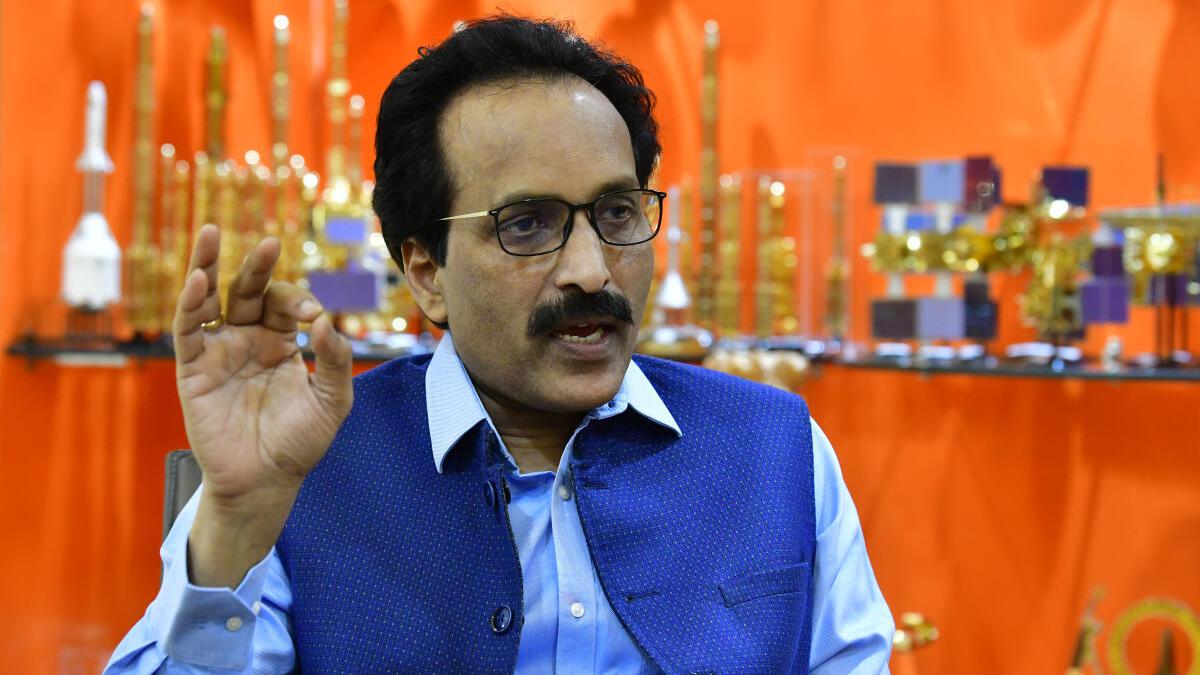
S. Somanath, Chairman of the Indian Space Research Organisation (ISRO), attributes the success of the Chandrayaan-3 mission to the moon to “the result of the hard work of thousands of people in ISRO”, the “rigour of the reviews”, and “corrective action taken meticulously.”
In an interview with T.S. Subramanian in Bengaluru, Dr. Somanath asserted that the launch of the LVM-3 rocket on July 14 from Sriharikota and its placing the Chandrayaan-3 spacecraft into its earth-bound orbit was the “most critical event” of the mission. He also spoke about the significance of the hop test conducted with the Vikram lander on the moon, said that “we are in the process of thinking about” a sample return mission from the moon, and shared his thoughts on the Aditya-L1 mission.
Question: How confident were you about the Chandrayaan-3 mission’s success? What were the contributing factors that led to the success – to the lander Vikram soft-landing on the moon and the rover Pragyan sliding down from Vikram?
Answer: There were many. The first and foremost is Chandrayaan-2’s unsuccessful attempt itself. When there is an unsuccessful attempt, it gives a lot of information. The analysis of that event gave us so [many] additional insights which were not available in the Chandrayaan-2 time frame itself. We understood the deficiencies very well. There were multiple deficiencies. It was a chain of events that caused the failure. In any rocket mission, we make sure that one event does not propagate. If one event propagates and results ultimately in failure, it means the protection mechanisms you had planned are not functioning.
There were at least five different events that culminated in the failure. There were windows left for the failure to propagate. Once we understood them, we looked at what more could happen in similar lines. Once they were understood, we devised a set of tests that were much more rigorous and involved than what we did earlier. All these tests were done without a single item being dropped. All the tests’ results were reviewed and analysed, and corrective action taken meticulously. It took almost four years of work to be done. That is why there was such a long gap between Chandrayaan-2 and Chandrayaan-3.
You know every success comes not (repeat not) out of review or checks but it is the work of the people… So you have to challenge them. Unless you challenge them, unless they feel insecure, they will not do a great job. Complacency is dangerous. My job was to create an awareness about themselves… You have to stir them, challenge them. This is what we did.
Last time [during the Chandrayaan-2 mission], we had a problem with the software; we had problems with algorithms; we had problems with hardware; and we had problems with implementation. There was inadequacy of thrust.
Was the removal of the central, fifth engine in the lander a contributing factor to Chandrayaan-3’s success? Originally, there were only four engines in Chandrayaan-2 but a fifth engine was added. This additional fifth, middle engine in Chandrayaan-2 did not perform well. Time was running out. Fuel was running out.
No, no. I will explain. It had nothing to do with the failure or success of the fifth engine. The fifth engine was necessary in [the lander of] Chandrayaan-2 because only that much thrust was necessary. Only the central engine was used for the final landing. If you have four engines, a fifth engine is a possibility. A central engine was necessary in Chandrayaan-2 because the thrust of that engine matched with the thrust of the mass of the craft. But when it came to Chandrayaan-3, the mass of the craft was 250 kg more. A single engine would be unable to sustain such a mass. So you have to fire two engines. When you have to fire two engines, four is a better configuration. The fifth engine was deleted in Chandrayaan-3 because the mass of the landing craft increased [and you needed two engines to fire]. The fifth engine in Chandrayaan-2 had nothing to do with the mission’s failure or success.
You had chosen a bigger area on the lunar surface to land now. Was it another contributing factor to Vikram’s successful landing?
Last time, we had an area of half a km by half a km to land. One of the biggest flaws last time was that we were trying to land exactly at a [particular] location. So the programme was trying to move the lander to that point and then land. Although it could have landed safely, it was not allowing. The software was trying to push it to that point. This was not really necessary. We could have landed in a place away. We could have been left with no time to land.
We had a wider area this time. But a wider area was not possible last time because we did not have good images of the [lunar surface then]. We were actually imaging prior to the orbit and identifying the landing location from the previous orbit, sending it to the earth, and saying, “This is the location.”
This time, we already had the pictures from Chandrayaan-2. Using those pictures, we could choose a wider area. It was pre-planned. This time, there was no taking pictures from the previous orbit and analysing them. So Chandrayaan-2 helped Chandrayaan-3 to land safely. A wider area of 4.5 km by 2.5 km was selected this time. We were supposed to land in the middle of it. We landed within 300 metres of it.
You listed five “critical events” during the entire Chandrayaan-3 mission. They were the launch of the LVM3 (Launch Vehicle Mark 3) rocket and its putting Chandrayaan-3 first into earth-bound orbit; the propulsion module with the lander being put into trans-lunar orbit; the propulsion module being captured by the moon’s gravity; the separation of the lander from the propulsion module; and the lander Vikram soft-landing on the moon. In your estimate, which was the most critical of these five events?
Undoubtedly, it was the launch.
But the LVM-3 (Launch Vehicle Mark 3) rocket had had six successful flights in a row already.
People take it for granted that the launch is just a routine affair. But the launch is much more complex than even the Chandrayaan-3 satellite which is such a simple, upper stage of the PSLV only. But it has a little more sensors and software. That is all. But a rocket is much more complex. It has to go through the atmosphere, do the turning, do the work under severe conditions, experience stress and strain, and reach the correct orbit. The number of systems [working in a rocket] is ten times more than that of Chandrayaan-3 craft. The propulsion, algorithms, gyros, mechanisms, sensors and so many complex events are taking place. Yet the rocket has to be successful. But people take it for granted. “It is all child’s play” [people think]. The good part is that we are doing the launch multiple times. If we do it again and again, we have the confidence. That is all the result of the work of thousands of people. Chandrayaan-3 is also such a result.
I consider the launch [to have been] the most critical event because there is no intervention in that. It is fully autonomous. There is no human intervention.
It is totally autonomous…
From lift off, you give the command, up to the injection of the satellite into orbit, there is no human intervention. But manoeuvres of Chandrayaan-3 spacecraft such as its trans-lunar injection, its being captured by the moon, Vikram landing on the moon, everything is with our intervention. All of these, we can intervene at any point. We can change the software. We can change the parameters. We can land appropriately. All these are possible except in the launch. That is why the launch is more critical.
Can you explain the expected behaviour and the actual behaviour of Vikram during the landing process?
Actually, the landing process is a very complex process. It is the reverse of the rocket taking off. The rocket takes off vertically and finally becomes horizontal.
It will become tangential to the earth. It will continuously take an arc from the lift-off to the injection of the satellite into orbit.
During the landing process, the lander has to come down from a high velocity to low velocity. In this case, the lander could have come down straight away. But we did not plan it like that. In this mission, in-between, we introduced a lot of check-points. From 30 km, it will come down to 7.80 km, then it will come down to 150 metres. It will then do certain checks. The lander will hover at these points. This hovering was necessary to do certain instruments’ verification. [For instance) Altimeter. In the general soft-landing, all these are not necessary. It made the whole landing process a little more complex. It is longer than needed. It will consume more fuel.
After the confidence building resulting from Chandrayaan-3, the landing process in the future missions will be smoother and without break. It will be continuously coming down from one point to another. It will be more fuel-efficient and faster.
One of the problems during the Chandrayaan-2 landing was the way of landing. We had one section called the rough braking phase, then the camera coasting phase, the fine braking phase and the terminal descent phase. Conversion into four different phases is not really necessary. It can seamlessly continue.
We did a scenario of continuous landing in case of some emergency where the sensors need not come into picture. In future missions, we will do [it] like that. This landing in Chandrayaan-3 followed exactly what we had planned. The velocity reduction, orientation changes etc. happened perfectly. It did the hovering exactly. In the last 150 metres, we had some time to study the lunar surface and see whether there were any boulders. The lander moved a little bit. We identified that it moved a little bit to see whether it was clear of rocks. It landed very safely. Almost all the sensors worked… So I must say it was a perfect landing.
What is the significance of the hop test done by the Vikram lander? It hopped 50 cm and it rose a little bit in the air.
In any mission, the craft which goes to the moon or Mars should come back. Otherwise, it will be a one-way mission. The vehicle is supposed to do a two-way mission. If you do a two-way mission, the vehicle will take off from the moon’s surface and come back to the earth. When you take off from the moon’s surface, it is a different algorithm. It is not a landing algorithm. It is a rocket algorithm. It has to go into orbit. From the orbit, it has to restart and come back to the earth. If you do it, the cycle is complete
When human beings go to the moon, all these have to be achieved. We have to learn all these in steps. I thought that after this primary mission goes off well, why don’t we start trying it out [the hop test]. It is new thinking. A week after the landing, we mooted this idea. Once all the mission’s objectives were met, why can’t we do some trials … to see whether it is possible. But we could not do it fully. If you take off, it can actually take off. There was no issue. But people were scared. The lander can fail. It can topple. It should not jeopardise the mission. After a week, the daylight will come. So we decided that we will do a short pulse.
A short jump?
Yes, a short jump. If you don’t stop, it will continue. The hopping is to show it rises to a certain height, it can land and to see whether our control systems, propulsion systems and sensors have worked well. This is the trial here. It worked reasonably well.
Is it a trial for the sample-return mission?
Chandrayaan-3 configuration cannot work for a sample return mission. You have to design a new craft, a new approach. It requires more mass, a higher payload. Then a sample return mission is possible. The travel for coming back from the moon to the earth requires energy. We have to plan for that. We are in the process of thinking about it.
You have sent Aditya-L1 to study the sun’s corona, the solar flares, the solar winds etc. What made you choose the sun for study? Is it because “Without the sun, you cannot study the earth”?
The study of the sun is not a new thing. We have the Physical Research Laboratory (PRL) in Ahmedabad. It has a research group which is focused on the study of the sun. We have a solar observatory at Udaipur. It is under the PRL. There are ground-based observations of the sun happening regularly. There are multiple institutions such as the Indian Institute of Astrophysics (IIA), the Inter-University Centre for Astronomy and Astrophysics (IUCAA) and others concentrating on sun-related studies.
Once a small team of scientists is there, it is good to look at the sun. Then the question of developing the instruments to study the sun came up. Three years ago, a discussion on how to develop these instruments began… From the time of U R Rao [former ISRO Chairman], discussions have been taking place. The idea is good but somebody has to develop the instruments.
Vikram Sarabhai was interested in the study of the sun.
Many missions to study the sun had already taken place. They were done the world-over by the Americans, the Europeans and others. We now have a little more understanding of the type of instruments needed to be built. We decided that our instruments must be unique in their ability to observe the sun. That is how the seven instruments were identified for Aditya L1. Solar coronagraph was developed by ISRO and the IIA. It looks at the solar corona, solar mass ejection etc. They help us in modelling the corona.
IUCAA’s instrument is for ultraviolet radiation. They have reasonable expertise in it. The VSSC, the PRL and others built the remaining instruments. The Space Physics Laboratory (SPL), Thiruvananthapuram, looks at the sun’s particles, its low-energy and high-energy X-rays, particle emissions, its magnetic influence and so on.
The importance of Aditya L1 is that it actually connects the solar emissions to particle emissions to X-ray emissions to magnetic influence. So there is a chain of connected events. In other missions, these types of [connected] measurements are not done. You measure coronal mass ejections and no other correlated measurements. If you do correlated measurements and there is a magnetic influence happening, I can relate to coronal mass ejections. This means these measurements are inter-related. They help in long-term predictions of the impact of such emissions on our sun.
What is the current status of the propulsion module of the Chandrayaan-3 mission? And what is its SHAPE (Spectro-polarimetry of Habitable Planet Earth) payload doing?
The propulsion module is going around the moon in a 100-km orbit. Its SHAPE payload is observing the earth… That data is being continuously collected.
With the success of the Mars orbiter, Chandrayaan-3, and Aditya L1 missions, will ISRO be concentrating more on interplanetary missions? Will you ask the private companies to build and launch application satellites?
Nothing like that. Scientific missions have been done by ISRO only. It may not have commercial value. If commercial values are there, industries will be interested. Otherwise, going to the moon and doing the sun mission, who will be interested? They are national missions with a certain objective of growing a scientific pool within the country and creating a certain capability. It has to be publicly funded. It cannot be private.
Of course, tomorrow, there is asteroid-mining and commercial opportunities are there, private companies will be interested. Private companies cannot work without profitability.
Another point you mentioned is whether all application-oriented satellites will be launched by private companies. That may not be possible because it goes with commercial viability. If they are not commercially viable, they will not implement some of the technologies. We have to build advanced communication satellites, with R&D components. We will be building hundreds of satellites. We will look at [satellites with] synthetic aperture radars, which are scientific in nature than observation. Such things as strategic satellites, we will continue to build.
How do you view in totality the three Chandrayaan, the Mars Orbiter, and the Aditya-L1 missions?
Space has always been an inspirational domain for scientists who want to pursue a career in science, engineering and technology. Every young boy and girl will say that he or she wants to become an astronomer, astrophysicist, and so on. Their career will take them to many places. They are fascinated by celestial bodies… Space technology is such an inspirational domain. We also know it is a complex domain. For countries like India, there are questions being asked even today about its relevance. During Sarabhai’s time, there were a lot of such questions. These types of missions [to the moon, Mars and so on] will reduce the number of such questions.